Jump to Section:
If you’re comparing Sendoso alternatives, the choice really comes down to four platform types: catalogue marketplaces, branded swag platforms, digital reward cards, and experiential or voucher platforms. Each solves a different problem. Marketplaces win on recipient choice and scale. Swag platforms win on brand presence at onboarding and events. Digital reward cards win on speed for remote, frequent recognition. Experiential platforms, including travel certificates, win when the goal is a gift people actually remember.
Before you commit to any of them for a full rollout, run a small pilot first. A 50-person test tells you more about redemption rates and recipient friction than any sales deck.
- Marketplace/catalogue: best when recipients need choice and you’re sending at volume.
- Swag/merch: best for onboarding kits, HQ events, and brand-forward moments.
- Digital reward cards: best for fast, frequent recognition across distributed teams.
- Experiential/vouchers (including travel certificates from a platform like Gift A Trip): best for milestone recognition, executive gifting, and auction items where impact matters more than frequency.
Key Takeaways
The most effective approach to finding a Sendoso replacement is matching platform type to the specific gifting occasion rather than picking one vendor for everything.
| Point | Details |
|---|---|
| Four core categories | Marketplace, swag, digital reward cards, and experiential/vouchers each solve a different gifting job. |
| Match format to occasion | Use digital cards for frequent recognition and physical or experiential gifts for milestone moments. |
| Pilot before scaling | Test a cohort of 50 to 100 recipients over 4 to 6 weeks before committing to a full rollout. |
| Ask about real fulfillment | Confirm warehouse locations and integrations, since “ships internationally” isn’t the same as global fulfillment infrastructure. |
| Reserve experiential gifts for high-impact moments | Gift A Trip’s travel certificates fit executive gifting, sales incentives, and auction items where memorability matters most. |
Table of Contents
- What Are the Main Sendoso Alternatives?
- How Do You Evaluate a Sendoso Replacement?
- What Does Implementation Actually Look Like by Category?
- How Do You Pilot an Alternative to Sendoso?
- Why Do Travel Certificates Outperform Standard Swag for High-Value Recognition?
- What Gifting Managers Get Wrong About Choosing a Platform
- How Gift A Trip Fits Into Your Gifting Program
- Sources
- FAQ
What Are the Main Sendoso Alternatives?
Sendoso built its business on a single idea: a catalogue of gift options tied to a sending platform with tracking and reporting. That model works, but it’s not the only one, and it’s often not the cheapest or most flexible one for a given use case. The four categories below cover most of what corporate gifting managers actually need.
- Marketplace/catalogue platforms offer a wide product library and let recipients pick their own item. They’re strong when you’re managing high send volumes and don’t want to guess at individual preferences, but breadth can dilute the sense of a curated moment.
- Swag/merch platforms focus on branded physical goods, apparel, and desk items, produced and warehoused for you. They’re the right call for onboarding kits and in-person events, where a physical, branded object reinforces identity.
- Digital reward-card platforms distribute codes or points instantly through a redemption portal. According to RibiRewards, digital rewards scale well and deliver immediately, making them the default for frequent or remote recognition.
- Experiential/voucher platforms issue certificates redeemable for travel, dining, or other experiences. They’re built for the moments that need to feel significant rather than routine, such as anniversaries, top-performer recognition, or vacation package certificates tied to a big win.
Map the category to the job. Retention and onboarding programs usually lean swag or experiential. Acquisition and event follow-up often lean marketplace or digital cards, where speed and volume matter more than ceremony.
How Do You Evaluate a Sendoso Replacement?
Picking among Sendoso competitors without a framework leads to decision paralysis or, worse, a contract you regret in six months. Forest Nation’s guide to choosing corporate gifting platforms frames this as five questions worth asking before you sign anything, and they hold up well in practice.
- Gift fit: Does the item align with your company’s values and the occasion, or does it feel generic and interchangeable with a dozen other vendors’ catalogues?
- Personalization and branding: Can you customize packaging, messaging, and landing pages, or are you stuck with the vendor’s template?
- Fulfillment and logistics: What are the lead times, how is address data handled, and what happens when a delivery fails?
- Reporting and analytics: Can you track redemption rates, engagement, and a real ROI signal, not just “gifts sent”?
- Pricing and scale: Are you paying per send, per seat, or a flat subscription, and do volume discounts kick in at a threshold you’ll actually hit?
Don’t skip finance on this one. Ask early whether gifts count as taxable income for recipients above certain thresholds, since that affects both budget and how HR frames the program. Gift A Trip’s guide to gifting employee travel walks through the tax-smart side of this for travel-based rewards specifically.
Pro Tip: Ask any vendor for their actual warehouse locations and integration list, not just a claim that they “ship internationally.” Imprint Engine’s enterprise gifting guide points out that “can ship internationally” and “having global fulfillment infrastructure” are two very different capabilities, and only one of them will hold up under a real rollout.

What Does Implementation Actually Look Like by Category?
Knowing the category is one thing. Knowing what a Tuesday afternoon rollout actually looks like is another, and this is where a lot of gifting managers get surprised.
Marketplace workflow: You send a redemption link, the recipient browses a catalogue and picks an item, and the platform handles shipping. This is low friction on your end but puts the “moment” of the gift entirely in the recipient’s hands. It’s the right call for large distributed sends where personal touch matters less than reach.
Swag workflow: You design or select branded items, the vendor warehouses and fulfills them, and kits typically ship out ahead of a known event date like a new-hire start day. This requires more lead time up front. Building or restocking a branded inventory can take weeks, so this category punishes last-minute planning the hardest.
Digital reward-card workflow: A code or point balance gets issued and the recipient redeems it through a portal, often within seconds of the send. The Reward Store notes that physical fulfillment, by contrast, typically runs several business days once you factor in address collection and shipping. That gap alone is often the deciding factor for time-sensitive recognition programs.
Experiential/voucher workflow: A certificate gets issued, often digitally, and the recipient later books their redemption experience directly with the travel brand or resort. This format asks more of the recipient at the front end (they have to plan a trip) but delivers a payoff that a $50 gift card simply can’t match for a milestone anniversary or a top-of-leaderboard sales incentive.
- Marketplace sends: fastest to launch, lowest personalization ceiling.
- Swag kits: longest lead time, highest brand visibility.
- Digital cards: near-instant delivery, best cost efficiency at scale.
- Experiential vouchers: highest perceived value per gift, best reserved for smaller, high-impact cohorts.
The common failure point across every category isn’t the gift itself. It’s what happens when a delivery bounces or a recipient never redeems. Build a fallback process before you launch, not after the first support ticket.
How Do You Pilot an Alternative to Sendoso?
Running a full-scale switch away from an existing platform without testing first is how gifting budgets get wasted. A 4 to 6 week pilot gives you real data without real risk.
- Set your objective and pick two or three metrics to track: delivery rate, redemption rate, any measurable NPS lift, and cost per engaged recipient.
- Choose a cohort that matches a real use case, such as 50 new hires going through onboarding or 100 attendees at an upcoming event, rather than a random sample.
- Build a timeline with contingency built in, including a named support contact on both your side and the vendor’s, in case fulfillment issues pop up mid-pilot.
- Collect both hard numbers and qualitative feedback, then compare results against go/no-go criteria you set before the pilot started, not after.
- If it works, model the budget at scale before you commit, since per-unit costs and volume discounts often shift once you move from 50 sends to 5,000.
Pro Tip: Run your pilot cohort through two different categories at once, say digital cards for half and an experiential voucher for the other half, and compare redemption and feedback side by side. You’ll learn more from that split test in six weeks than from a year of anecdotal feedback on a single format.
Why Do Travel Certificates Outperform Standard Swag for High-Value Recognition?
Not every gift needs to be a memorable event. But when the occasion calls for something bigger, a travel certificate does something a branded tumbler never will.
Gift A Trip issues digital and physical travel certificates redeemable at resorts, hotels, cruise lines, and vacation packages from major travel brands, with secure digital delivery and support for customizable bulk orders for corporate programs. Certificates come with taxes and resort fees included and minimal blackout dates, which removes two of the biggest friction points recipients run into when they try to actually use a travel gift.
- Strong fit for executive gifting, top-performer sales incentives, and charitable auction items.
- Recipients get a real vacation, not a gift card balance they forget about.
- Bulk orders and custom messaging make it workable for HR and event teams managing dozens or hundreds of sends at once.
For teams planning a rollout, the Travel Certificate Distribution Guide for HR and Events covers the operational side of sending certificates at scale.
What Gifting Managers Get Wrong About Choosing a Platform
Most guides to Sendoso alternatives treat the decision as a feature checklist: reporting dashboards, catalogue size, integrations. That’s not wrong, but it misses the actual failure mode I keep seeing, which is picking one platform type to cover every occasion.
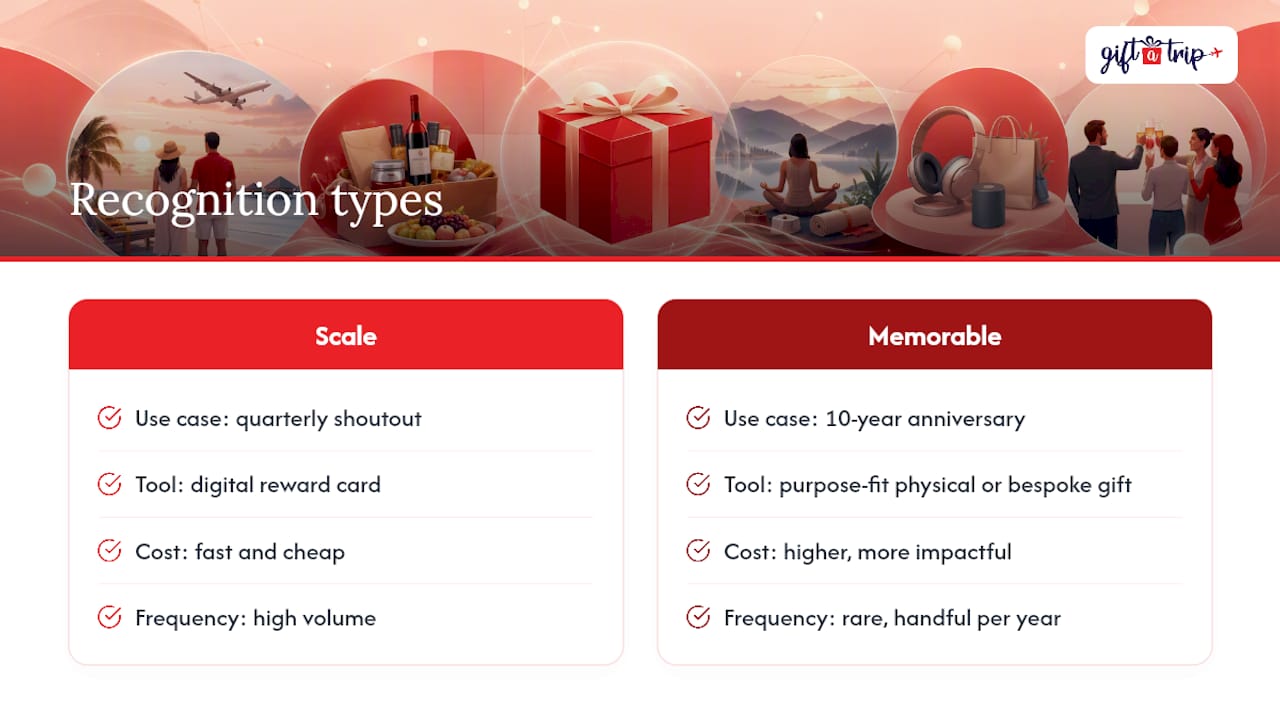
A digital reward card is the right tool for a quarterly shoutout. It is the wrong tool for a 10-year anniversary or a top sales performer who just hit a stretch goal most of the team assumed was impossible. Conventional advice tends to treat “gifting platform” as a single decision, when it’s really a portfolio decision. You need something fast and cheap for volume, and something that actually lands emotionally for the handful of moments each year that matter more.
The mistake I’d prioritize fixing first isn’t vendor selection. It’s the failure to separate “recognition at scale” from “recognition that needs to be remembered.” Once you draw that line, the platform choice for each side gets a lot easier, and a lot less expensive.
— Donovan
How Gift A Trip Fits Into Your Gifting Program
If you’ve been leaning on catalogue platforms or swag vendors for every occasion, you already know the gap: a $75 gift card doesn’t feel special after the third quarter running, and warehousing branded merchandise for a one-time executive award is overkill. Gift A Trip fills that specific gap. It sells digital and physical travel certificates redeemable at resorts, cruise lines, and vacation packages from major travel brands, built specifically for the moments where a bigger gesture actually matters.
Use it for the recognition tier your current platform wasn’t built for: a top sales performer’s annual trip, a retirement gift, an auction item for a charity gala, or a milestone anniversary award. Certificates ship with taxes and resort fees included and minimal blackout dates, and bulk orders can be customized with branded messaging for HR or event teams sending dozens at once. Browse available certificates or check the distribution guide to see how a pilot batch would work for your next incentive cycle, and request program pricing before your next planning meeting.
Sources
- Corporate Gifting Platforms: How to Choose (2026)
- Digital vs Physical Reward Cards: Which Should You Send? | RibiRewards Blog
- Global Gifting Platform Guide for Enterprise Teams 2026 | Imprint Engine
- The Reward Store
FAQ
What Are the Best Sendoso Alternatives for Small Teams?
Digital reward-card platforms tend to fit small teams best because they require no minimum warehousing commitment and scale down easily for occasional sends.
Is Sendoso More Expensive Than Its Competitors?
Pricing varies by contract structure, but marketplace and digital card platforms often have lower per-send costs than full-service catalogue platforms, especially at low volume.
How Long Does It Take to Set Up a Sendoso Alternative?
A basic digital reward-card program can launch within days, while swag or experiential programs, including bulk travel certificate orders through Gift A Trip, typically need a few weeks for design, branding, and fulfillment setup.
Are Travel Certificates a Good Substitute for Sendoso Gift Boxes?
For milestone recognition, executive gifts, and auction prizes, travel certificates often deliver more perceived value than a physical gift box, since the reward is an experience rather than an object.
What Should I Check Before Switching Gifting Platforms?
Confirm fulfillment lead times, reporting capabilities, and tax treatment for recipients before switching, and run a small pilot before moving your full program over.