Jump to Section:
Flexible travel gift certificates from a specialist provider like Gift A Trip are the fastest, lowest-risk way to build referral program travel rewards that people actually want to earn. A certificate beats cash or a standard gift card because it carries higher perceived value, gives recipients full control over when and where they travel, and takes far less internal coordination than booking bespoke trips one by one.
Before you buy, confirm three things with any vendor: delivery method (digital, physical, or both), what’s included (taxes, resort fees, blackout date policy), and who supports the recipient when they redeem.
A referral reward only works if the person earning it can picture themselves using it. A locked-down group trip is hard to picture. An open certificate to a resort, cruise, or hotel brand they already recognize is not.
Key Takeaways
Flexible travel gift certificates outperform cash and standard gift cards for referral rewards because they combine higher perceived value with lower fulfillment overhead for program administrators.
| Point | Details |
|---|---|
| Choose flexibility over fixed trips | Certificates with minimal blackout dates and long redemption windows drive higher completion. |
| Confirm inclusions before buying | Taxes and resort fees should be built into face value, not billed separately at redemption. |
| Involve finance early | Certificate value counts as taxable income; confirm valuation and reporting with a tax advisor before launch. |
| Track redemption, not just delivery | A delivered certificate that goes unredeemed signals a vendor or communication issue worth fixing. |
| Gift A Trip handles bulk execution | Inclusive pricing, digital delivery, and branded bulk ordering reduce the operational load of running a certificate-based referral program. |
This article is general information, not a substitute for advice from a qualified financial advisor. Consult a qualified financial professional about your own circumstances before acting on anything here.
Table of Contents
- Why Travel-Based Rewards Outperform Cash and Gift Cards
- What to Require From a Travel-Certificate Vendor
- How to Procure Travel Certificates in Bulk
- Fulfillment Options for Delivering Certificates to Referrers
- Budgeting, Valuation, and Tax Considerations
- How to Measure Success and Improve the Program Over Time
- Why Flexible Certificates Are the Practical Choice
- How Gift A Trip Supports Referral-Program Travel Rewards
- Sources
- FAQ
Why Travel-Based Rewards Outperform Cash and Gift Cards
Cash gets spent on groceries. A travel reward gets remembered. That distinction shows up clearly in incentive-industry research: individual travel rewards were rated “extremely motivating” by 61% of respondents in SITE and Maritz’s incentive travel study, well above cash or merchandise.
Anticipation is doing a lot of the psychological work here. A cash bonus is spent and forgotten within a week. A travel certificate sits in someone’s inbox as a plan they’re excited to make.
That anticipation effect matters more for referral programs than for annual bonuses, because referrals are ongoing behavior you’re trying to reinforce repeatedly, not a once-a-year event. Practitioner data cited by Covington Travel backs this up at scale: companies running travel gift-certificate incentive programs report notable performance gains shortly after launch, with increasing improvement over time, alongside meaningful reductions in voluntary turnover.
What to Require From a Travel-Certificate Vendor
Not all certificates are created equal, and the fine print determines whether your referral program feels generous or feels like a trap. Run every vendor through this checklist before signing a contract.
Core certificate terms:
- Flexible redemption windows (18 to 24 months is typical for quality providers)
- Minimal blackout dates, especially around holidays and peak season
- Taxes and resort fees included in face value, not billed separately at checkout
- Digital delivery as standard, with multi-currency support if you have international referrers
Operational features:
- Bulk ordering with a single invoice, not per-unit checkout
- Company branding on the certificate or delivery email
- Clear choice between single-use redemption codes and account-based fulfillment
- A defined support channel for recipients who hit redemption problems
Redemption flexibility is one of the top criteria U.S. News uses when ranking travel rewards programs generally, and it applies just as directly here: a certificate that’s hard to book against is a certificate nobody refers a friend for.
Pro Tip: Ask every vendor how many resort and cruise brands the certificate can redeem against before you ask about price. A cheaper certificate locked to three properties is worth less than a slightly pricier one that opens up dozens of options, even if the sticker price looks better on a budget spreadsheet.
How to Procure Travel Certificates in Bulk
Buying 50 or 500 certificates for a referral program isn’t like buying 500 coffee mugs. Here’s the sequence that keeps procurement clean.
- Define quantity and tiering. Decide if every referral gets the same certificate value or if you’re tiering rewards by referral quality or number closed.
- Lock customization scope. Confirm branding, personalized messaging, and any bundled extras (upgrades, add-on experiences) before the vendor builds your order.
- Review terms. Check redemption windows, cancellation and refund policy, transferability rules, and liability limits in the contract.
- Confirm payment and invoicing. Bulk buyers typically get net terms and a single consolidated invoice rather than per-certificate charges.
- Get receipt confirmation. Make sure delivery, whether digital batch or physical shipment, comes with tracking so nothing goes missing before it reaches a referrer.
The Incentive Research Foundation’s Toolkit makes a point worth repeating here: operations staff need to be part of budget development from the start, not brought in after the numbers have been set. That prevents the common failure mode where marketing promises a reward tier finance never approved.
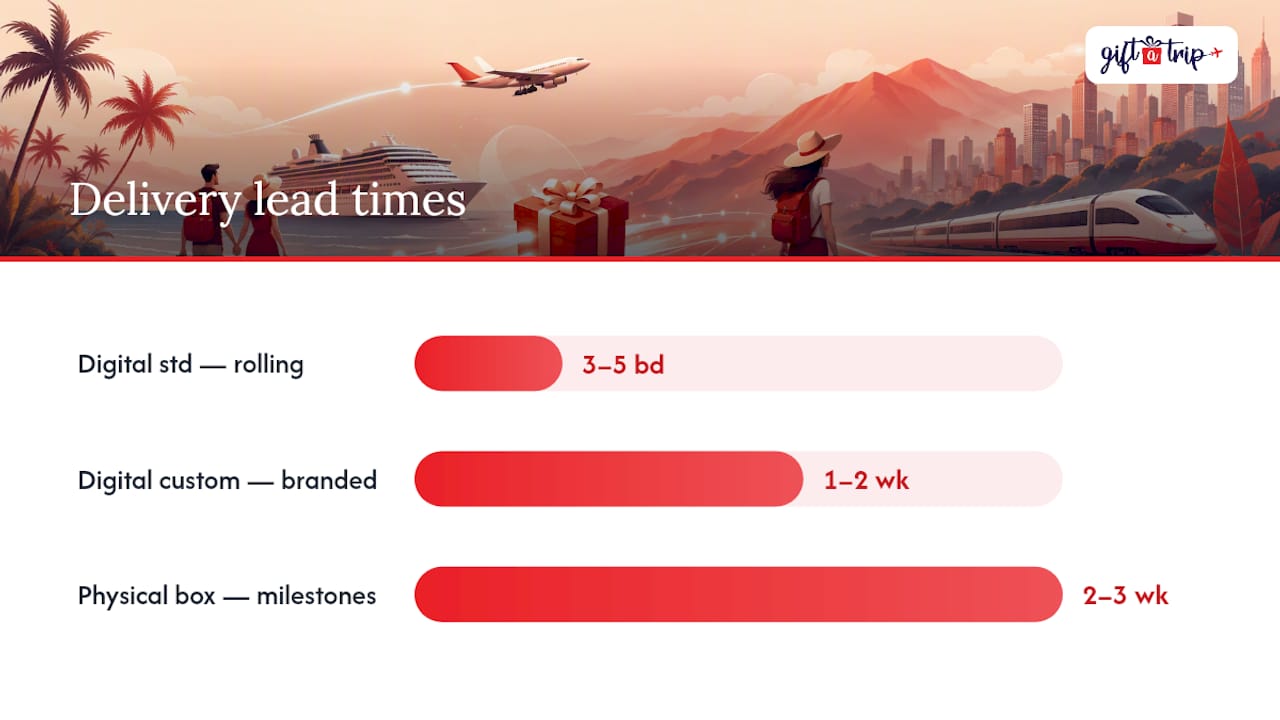
| Delivery Method | Typical Lead Time | Best For |
|---|---|---|
| Digital certificate, standard order | 3–5 business days | Ongoing referral programs with rolling payouts |
| Digital certificate, custom-branded | 1–2 weeks | Launch campaigns needing company branding |
| Physical gift box | 2–3 weeks | Milestone awards, executive-level referrals |
Fulfillment Options for Delivering Certificates to Referrers
How a certificate arrives shapes how it’s received. Instant digital codes work well for high-volume, lower-value referral tiers where speed matters more than ceremony. Scheduled email delivery suits programs where you want the reward to land on a specific date, like a program anniversary. Physical gift boxes cost more and take longer to arrive, but they’re worth it for milestone rewards where the unboxing itself is part of the experience.
Whichever method you choose, build in tracking from day one:
- Confirm delivery receipt (opened email, scanned physical package) so you know a reward actually reached its recipient; for detailed guidance on issuance and redemption, see our How to Book a Weekend Stay and Get the Best Deal – Wild Foodz by Hotel Entree Brugge resource.
- Log redemption status separately from delivery status. A delivered certificate that never gets redeemed is a signal worth investigating
- Set an automated reminder before expiration, since unredeemed certificates near the deadline are your biggest source of support tickets
- Route lost-certificate and misredemption issues to a dedicated support contact rather than your own HR inbox
Gift A Trip’s distribution guide for HR and events walks through fulfillment sequencing in more detail if you’re setting this up for the first time.
Pro Tip: If your referral base skews toward remote or distributed teams, skip the physical box entirely and add a short personalized video message to the digital delivery instead. It closes most of the emotional gap without the shipping delay.
Budgeting, Valuation, and Tax Considerations
Certificate face value is only one line in the budget. Factor in inclusions (taxes and resort fees baked into the price versus billed separately), fulfillment and shipping if you’re sending physical boxes, and any custom branding fees. Full incentive-travel budgeting guides recommend accounting for the entire participant journey, including contingency and administration costs, not just the sticker price of the reward itself. Certificates simplify most of that list, but fulfillment and support still cost something.
On valuation: travel rewards generally count as taxable income to the recipient in the United States, and the value used for payroll or 1099 reporting purposes should reflect the certificate’s fair market value, not a discounted purchase price. This gets complicated fast depending on award size and recipient classification, so loop in your finance team or a tax advisor before finalizing program terms rather than after certificates go out.
| Budget Line Item | What It Covers |
|---|---|
| Certificate face value | Base redeemable amount toward stay/cruise/package |
| Inclusions | Taxes and resort fees bundled into face value |
| Fulfillment | Digital delivery platform fees or physical packaging/shipping |
| Customization | Company branding, personalized messaging |
| Administration | Staff time for tracking, support, and expiration follow-up |
How to Measure Success and Improve the Program Over Time
A referral program without KPIs is just a hope. Track these from launch:
- Referral conversion rate. How many referrals actually close versus how many are submitted.
- Redemptions per certificate issued. Low redemption rates usually point to a vendor or communication problem, not a bad reward.
- Cost per successful referral. Certificate cost plus fulfillment, divided by closed referrals.
- Retention lift. Compare retention among referrers and referred hires against your baseline.
- Participant satisfaction (NPS-style). A short post-redemption survey tells you if the reward matched expectations.
Once baseline numbers exist, test variables one at a time:
- Certificate value tiers (does a higher-value reward meaningfully lift referral volume, or just cost more?)
- Delivery method (digital versus physical, matched against redemption speed)
- Messaging tone in the referral invitation itself
- Qualification threshold (does requiring a completed 90-day hire change referral quality?)
Start with a pilot group before rolling company-wide, keep a short internal comms checklist so managers know what to tell their teams, and report results to leadership on a fixed cadence, monthly is typical, so the program doesn’t quietly stall after launch enthusiasm fades.
Why Flexible Certificates Are the Practical Choice

Flexible certificates win on manageability. You’re not chasing group availability, coordinating dates across a dozen calendars, or absorbing the cost of no-shows. A certificate scales the same way whether you’re rewarding 5 referrals a quarter or 500.
That said, a bespoke group trip still earns its place for top-tier, long-term recognition, think annual President’s Club winners or a decade-of-service milestone, where the shared experience itself is the point, not just the travel. For the day-to-day mechanics of a referral program, though, certificates do the job with a fraction of the overhead, and providers like Gift A Trip have built turnkey execution paths that make bulk ordering close to as simple as it should be.
How Gift A Trip Supports Referral-Program Travel Rewards
Compared to sourcing individual group trips through a travel agency, or trying to negotiate blackout-free hotel stays one property at a time, Gift A Trip removes the negotiation entirely. Every certificate ships with taxes and resort fees already included, minimal blackout dates, and digital delivery that lands in a recipient’s inbox within days, not weeks.
For program administrators, the operational win is bulk ordering with a single invoice, company branding on the certificate itself, and dedicated support if a recipient runs into trouble redeeming their reward. A typical flow looks like this: you define quantity and value tier, Gift A Trip customizes branding and messaging, certificates deliver digitally in batches, and your team tracks redemption through completion, no chasing individual bookings or managing separate vendor relationships for hotels, cruises, and resorts. Explore the current lineup, including Virgin Voyages cruise certificates, or request a bulk quote to see per-unit pricing for your referral program’s expected volume.
Sources
- Incentive Travel Toolkit, Section 4: Program Operations Best Practices – Incentive Research Foundation
- Travel Gift Certificates: Excellent Employee Incentives | Covington Travel
FAQ
What Are Travel Gift Certificates Used for in Referral Programs?
They’re issued as the reward when someone successfully refers a candidate, customer, or sale, redeemable toward hotels, resorts, cruises, or vacation packages instead of cash.
How Much Should a Referral Travel Reward Be Worth?
There’s no fixed rule, but the certificate value should feel meaningful relative to the effort of referring, and inclusions like taxes and resort fees should count toward that perceived value, not eat into it.
Are Travel Certificates Taxable Income for Recipients?
Generally yes in the United States; treat certificate value as reportable income and confirm exact treatment with your finance team or a tax advisor before distributing rewards.
How Long Should Redemption Windows Be?
Look for 18 to 24 months from providers like Gift A Trip, which gives recipients enough runway to plan travel without the reward feeling rushed or disposable.
What Happens if a Recipient Loses Their Certificate Code?
A quality vendor provides dedicated redemption support that can verify and reissue access, which is why support responsiveness should be part of your vendor evaluation checklist.