Jump to Section:
TL;DR:
- Travel gift certificates offer flexibility and tangible value across multiple brands.
- Proper eligibility and account activity are essential before transferring miles or points.
- Flexible certificates are ideal for individuals and corporations, reducing friction and administrative costs.
Picking the perfect gift for a traveler sounds easy until you realize just how quickly it falls apart. Airline miles expire, hotel points come with blackout dates, and nobody wants to hand over a gift that’s hard to redeem. Whether you’re celebrating a milestone birthday, rewarding a top-performing employee, or building a corporate incentive program, the gap between “I want to give travel” and “I actually gave someone a great experience” is wider than most people expect. Travel gift certificates tied to loyalty programs bridge that gap in ways that generic gifts simply cannot.
Table of Contents
- What are travel gift certificates for loyalty programs?
- What you need to gift travel rewards: Requirements and prerequisites
- Step-by-step: How to send travel gift certificates through loyalty programs
- Troubleshooting, common mistakes, and maximizing your gifting impact
- Why flexibility beats rigid gifting: A fresh perspective
- Discover easy travel gifting solutions and maximize your rewards
- Frequently asked questions
Key Takeaways
| Point | Details |
|---|---|
| Gift certificates save hassle | Travel gift certificates are easier to redeem and more flexible for recipients than miles or points. |
| Know gifting limits and fees | Each loyalty program sets annual limits and fees for gifting rewards—review these before sending. |
| Flexible cards beat rigid rewards | Gift cards and certificates often provide better recipient satisfaction and corporate ROI than traditional points. |
| Pro tips enhance value | Booking awards directly or gifting during promo periods can minimize fees and maximize impact. |
What are travel gift certificates for loyalty programs?
Travel gift certificates are prepaid travel credits that recipients can redeem for bookings, upgrades, or experiences, often through a loyalty program or dedicated travel platform. Unlike physical gifts, these certificates carry real, tangible value: a night at a resort, a cruise upgrade, or a fixed-dollar credit toward any qualifying booking. They are designed to remove the friction that comes with traditional gifting.
There are four main types worth knowing:
- Airline mile gifts: You purchase or transfer miles into someone else’s frequent flyer account.
- Hotel points gifts: Points are added to a recipient’s loyalty account for future stays.
- Status gifts: Elite members gift their status tier to family, friends, or colleagues.
- Flexible travel gift cards or certificates: Prepaid travel credits redeemable across multiple brands or platforms.
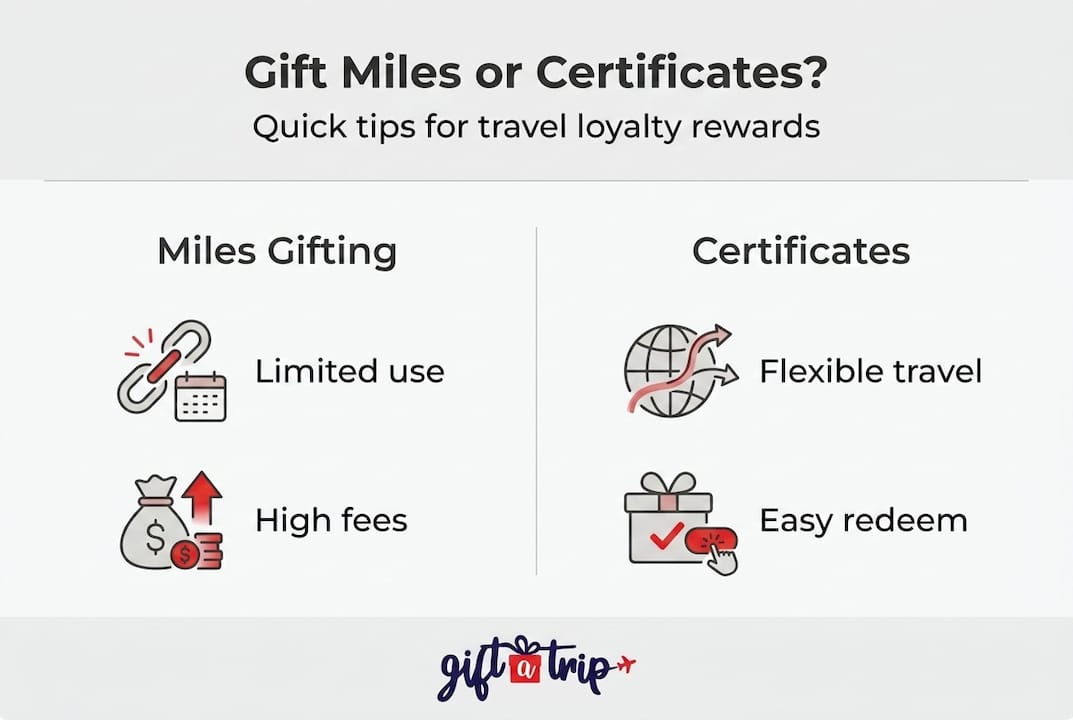
The difference between gifting miles or points versus gifting a flexible certificate matters a lot in practice. Miles and points lock recipients into a specific airline or hotel chain, which is limiting if they don’t already fly that carrier or stay at that brand’s properties. Flexible travel certificates work across a broader ecosystem, giving recipients real choice. Travel certificate solutions from platforms like Gift A Trip take this a step further by covering taxes and resort fees and minimizing blackout dates.
One expert insight worth noting: gifting miles is costly unless you catch a promotional window, and gift cards from travel-focused platforms tend to deliver more flexibility and real-world value. For corporate programs that need to operate at scale and stay compliant, dedicated platforms like Gift A Trip are often a smarter operational choice than juggling multiple airline and hotel loyalty portals.
| Feature | Miles/Points gifting | Flexible travel certificates |
|---|---|---|
| Recipient flexibility | Low (brand-locked) | High (multi-brand) |
| Fee structure | $30+ per transaction | Often included |
| Expiration risk | High | Low to none |
| Corporate scalability | Moderate | High |
| Redemption complexity | High | Low |
For individual gifters, flexible certificates eliminate the guesswork. For corporate programs, they reduce administrative overhead and deliver measurable results.
What you need to gift travel rewards: Requirements and prerequisites
Before you transfer a single mile or send a certificate, there are specific requirements each program imposes. Getting these wrong can result in failed transfers, wasted fees, or a gift that sits unused.
Here’s what most programs require:
- Active loyalty account: The recipient must have an account with the relevant airline or hotel program. Many programs require recent account activity within the past 12 to 18 months.
- Account age: Some programs don’t allow gifting to accounts opened fewer than 30 to 90 days prior.
- Personal details: You typically need the recipient’s full name, account number, and sometimes their email address.
- Payment method: Credit or debit card for purchasing miles or certificates.
The fees and limits vary significantly by program. Here’s a practical breakdown:
| Program | Min gift | Max per year | Cost per unit | Transaction fee |
|---|---|---|---|---|
| Delta SkyMiles | 2,000 miles | 60,000 miles | 3.5¢/mile | $30 |
| United MileagePlus | 500 miles | 200,000 miles | ~3.8¢/mile (promo: ~2¢) | $7.50/500 + $30 |
| Southwest Rapid Rewards | 2,000 points | No annual cap | 3¢/point | Varies |
Hotel loyalty programs go even further with elite status gifting. Hilton Diamond members can gift Gold or Diamond status to a companion. Marriott Bonvoy members who hit 50, 75, or 100 nights per year unlock choice benefits that include gifting status. IHG Diamond members can gift Platinum status, and Wyndham Diamond members can gift Gold status to a companion of their choosing.

Pro Tip: Instead of paying fees to transfer miles, log into the airline’s website and book the award flight directly on behalf of your recipient. You use your own miles, they get the seat, and you avoid the $30 transfer fee entirely. This works best when you know the recipient’s travel dates in advance.
For hotel stays and resort experiences, a hotel stay certificate guide can help you navigate which certificate types align best with your recipient’s preferences. Businesses building employee recognition programs should also review a hotel certificate recognition resource to ensure the certificates they select will land well with staff.
Step-by-step: How to send travel gift certificates through loyalty programs
With your prerequisites sorted, here’s exactly how to execute the gift, whether you’re sending it to a friend or rolling it out to an entire sales team.
For gifting airline miles or hotel points:
- Log into your loyalty program account online.
- Navigate to the “Gift Miles” or “Transfer Points” section (usually found under “My Account” or “Manage Miles”).
- Enter the recipient’s account number, full name, and the number of miles or points you want to gift.
- Review the fee breakdown before confirming. Total cost for 10,000 Delta miles, for example, would be $350 + $30 = $380.
- Complete payment and save your confirmation number.
- Note that transfers typically post within 24 to 72 hours, though some programs take up to five business days.
For gifting flexible travel certificates:
- Choose a platform that offers the type of certificate that fits your need: resort stays, cruises, hotel nights, or full vacation packages.
- Select the certificate value and any personalization options such as a custom message or digital gift box.
- Complete checkout and receive a digital certificate via email.
- Forward or present the certificate to your recipient. They redeem it directly through the platform.
For corporate gifting programs:
- Identify your program goals: Is this for performance recognition, milestone rewards, or sales incentives?
- Select a platform designed for corporate travel rewards that can handle bulk orders, customization, and compliance documentation.
- Define your budget per recipient and choose certificate tiers accordingly.
- Work with your provider to brand the certificates and create a streamlined redemption experience.
- Track redemption rates and gather feedback to refine future program cycles.
The corporate travel incentive guide offers detailed frameworks for structuring these programs. And if your company wants to move fast without building a program from scratch, a turnkey travel reward guide can help you launch in days, not months.
Important note: Corporate gifting programs that include travel certificates may have tax implications depending on the value of the gift and your jurisdiction. In the U.S., gifts to employees over $25 may be considered taxable compensation. Consult your tax or HR advisor before scaling a program. Breakage, the percentage of certificates that go unredeemed, can also affect your program’s true cost and should be factored into budget planning.
Pro Tip: Watch for airline mile promotion windows, which typically reduce purchase costs by 25 to 50 percent. Signing up for program emails and deal alerts from travel rewards newsletters can help you time a purchase perfectly and cut your gifting cost nearly in half.
Troubleshooting, common mistakes, and maximizing your gifting impact
Even well-intentioned gifters run into problems. Here are the most common mistakes and exactly how to avoid them.
Mistake 1: Gifting miles or points without checking the recipient’s account status.
If the account is too new or inactive, the transfer may fail or the miles may expire before they’re used. Always confirm the recipient has an active account before initiating any transfer.
Mistake 2: Ignoring the per-unit cost of gifting miles.
At 3.5 to 3.8 cents per mile plus a flat fee, buying miles for someone can cost far more than the flight would if purchased outright. Unless a promo drops the cost significantly, the math often doesn’t favor direct mile purchases.
Mistake 3: Choosing brand-locked certificates for recipients with no loyalty to that brand.
Gifting Marriott points to someone who exclusively stays at Hilton properties wastes both your money and their goodwill. Flexible certificates solve this entirely.
Mistake 4: Overlooking redemption windows and blackout dates.
Some hotel or airline certificates come with significant restrictions. Always read the fine print and, when possible, choose certificates from platforms that explicitly minimize restrictions.
Mistake 5: Underestimating corporate program design.
A certificate handed to an employee with no context or fanfare delivers far less impact than one presented as part of a structured recognition moment. The presentation matters as much as the gift itself.
The data on travel rewards is compelling: 54 to 66 percent of employees prefer travel rewards over cash, especially among Gen Z workers. Corporate programs using travel incentives see performance improvements of up to 22 percent and meaningful gains in employee retention. However, taxes and breakage can erode value if the program isn’t carefully designed.
- Opt for certificates over miles whenever flexibility matters more than brand loyalty.
- Time mile purchases during promotional windows to reduce cost by 25 to 50 percent.
- Present corporate certificates as part of a formal recognition moment for maximum impact.
- For personal gifting, a flexible certificate is almost always a safer bet than a brand-specific gift.
Pro Tip: If you manage a corporate rewards program, track redemption rates quarterly. A redemption rate below 70 percent usually signals that recipients don’t find the certificates appealing or easy to use. Switching to broader, flexible travel certificates almost always improves that number quickly.
For businesses looking to build their approach, a recognition guide can help you design a program that people actually want to participate in. And if you’re thinking about how to roll out individual incentive travel options as part of a broader strategy, there are scalable models that work for companies of all sizes.
Why flexibility beats rigid gifting: A fresh perspective
Here’s a perspective that often gets overlooked in the miles-and-points community: the obsession with accumulating and transferring loyalty currency often creates more friction than value in the gifting context. It makes perfect sense to use your own miles to book a flight for yourself. It rarely makes sense to pay 3.5 cents per mile plus a $30 fee so someone else can sit on miles they may never redeem.
We’ve worked with both individual gifters and corporate clients, and the pattern is consistent. The recipients who feel most genuinely rewarded are not the ones who got 10,000 airline miles added to a dusty loyalty account. They are the ones who received a certificate they could actually use, for a trip they actually wanted, with minimal hoops to jump through. That’s not a small distinction. It’s the entire point of gifting.
For corporate programs, the lesson is even sharper. Miles and points tie your recognition program to the quirks of third-party loyalty systems. Expiration policies change, redemption values fluctuate, and your employees end up confused or disappointed. Flexible travel certificates, by contrast, give you control. You define the value, the recipient chooses the experience, and your program delivers on its promise every time.
The corporate recognition gifting landscape in 2026 is moving decisively toward this model. Organizations that cling to miles-based reward structures will find it increasingly hard to compete for employee attention and satisfaction against programs that offer genuine, flexible travel experiences.
The most underrated move in travel gifting? Stop trying to outsmart loyalty programs and start giving people the freedom to choose their own adventure.
Discover easy travel gifting solutions and maximize your rewards
Ready to put everything you’ve learned into action? Gift A Trip makes it simple to find, customize, and deliver travel certificates that actually resonate, whether you’re gifting for a birthday, a honeymoon, or a company-wide incentive program.

Browse a wide range of digital travel gift examples to see exactly what recipients experience when they open their gift. From resort stays to cruise packages, every certificate is designed for easy redemption and maximum enjoyment. If you want to understand the full range of what’s possible, start with the overview of travel certificate flexibility to match the right certificate to your gifting goal. For corporate teams, the corporate gifting guide walks you through how to scale, customize, and measure a travel-based rewards program from the ground up.
Frequently asked questions
Can I buy airline miles as a gift for someone else?
Yes, most major programs let you buy or transfer miles to another account, but fees and annual limits apply. Booking an award ticket directly for your recipient is often the smarter move since it sidesteps transfer fees entirely.
Are travel gift cards better than gifting points or miles?
Travel gift cards typically offer greater flexibility and fewer restrictions than airline miles or hotel points, especially for recipients who don’t have strong brand loyalty to a single carrier or hotel chain.
How do hotel loyalty programs handle status gifting?
Elite members can gift status to companions, with options like Hilton Diamond gifting Gold or Diamond and Marriott offering choice benefits at 50, 75, and 100 night thresholds. IHG and Wyndham offer similar companion status options for their top-tier members.
What are the fees for gifting points or miles?
Fees vary by program, but United MileagePlus charges roughly 3.8 cents per mile plus $7.50 per 500 miles and a $30 flat fee. Promotional periods can reduce costs significantly, sometimes to as low as 2 cents per mile.
Do travel gift certificates work for business or corporate rewards?
Absolutely. Travel rewards outperform cash for 54 to 66 percent of employees, and corporate programs using travel certificates see meaningful performance and retention gains. Certificates are especially effective when presented as part of a structured recognition program.