
An employee travel incentive policy is a short written document that says who can earn a company-paid trip, how they earn it, what the trip includes, what it costs, and how the company handles taxes and accessibility. Write it before you announce the program. Employees trust a reward more when the rules are simple, public and the same for everyone. This guide gives you the ten parts to include, a worked structure and the U.S. tax and legal points to settle before launch.
TL;DR
- A good policy covers objectives, audience, qualification rules, the award, tracking, budget, communications, tax treatment, accessibility and evaluation.
- Write rules that are simple, achievable and trackable, with clear thresholds or tiers, as the Incentive Research Foundation (IRF) recommends.
- In the U.S., the IRS treats a vacation award as a taxable fringe benefit. The achievement-award exclusion does not cover vacations, meals or lodging.
- Offer an alternative for people who cannot or do not want to travel, and review accessibility needs before you publish.
- Set success measures before launch and report against them when the program ends.
Table of Contents
- What an employee travel incentive policy does
- The ten parts of the policy
- A sample policy outline you can adapt
- Common gaps to close before you launch
- Perspective
- Make the reward match the policy
- FAQ
- Sources
What an employee travel incentive policy does
Incentive travel is a motivational tool: participants earn a company-sponsored trip by reaching performance levels set by management. IRF-backed academic research describes companies using these programs to recognize achievement, motivate continued performance, build relationships and share best practices.
The policy is what turns that idea into something HR, finance, managers and employees can all act on. Without it, the same questions come up every quarter. Does a new hire qualify? What happens if two people tie? Who pays the taxes? Who decides when a sales number is disputed?
A policy also protects the program. When a reward is defined in writing, the company can apply it consistently, and employees can see that it was.
The ten parts of the policy
The IRF’s program design guidance recommends starting with measurable objectives, identifying the people who can influence them, setting clear rules and tiers, building tracking, budgeting for administration, communications, awards and measurement, and keeping rules simple, achievable and trackable. Here is how that translates into policy sections.
| # | Section | What it should state |
|---|---|---|
| 1 | Purpose and objectives | The measurable business result the trip is meant to drive |
| 2 | Audience | Which teams, roles or divisions can earn it |
| 3 | Eligibility | Tenure, employment status, good standing |
| 4 | Qualification rules | Metric, thresholds or tiers, qualification period |
| 5 | The award | What the trip includes, who may join, how the destination is chosen |
| 6 | Tracking and disputes | Who owns the numbers, how often they are published, how to appeal |
| 7 | Budget | Total, cost per winner, what is included |
| 8 | Taxes and compliance | How the benefit is reported and who bears the tax |
| 9 | Accessibility and alternatives | Accommodations, non-travel option |
| 10 | Communication and evaluation | Cadence of updates, success measures, review date |
1. Purpose and objectives
Open with one or two sentences naming the result you want: for example, higher new-account revenue, better retention in a support team or safer operations across a plant. Make it measurable. A policy that says “reward great work” cannot be judged later. A policy that says “increase renewals in the mid-market team over the next 12 months” can.
If you want help framing goals for a leadership audience, our HR guide to travel rewards walks through the business case.
2. Audience
Name the teams or divisions that can influence the objective. A sales-revenue goal belongs with sales and the people who support the sale, not the whole company by default. If several groups qualify, say whether they compete against each other or against their own targets. Targets set against each person’s own baseline feel fairer when territories differ.
3. Eligibility
The IRF and University of Central Florida case study says eligibility policies should state how employees earn the award, the general qualification rules, the award itself and any category-specific criteria. The company in that study also used tenure requirements and ranking limits, with roughly 10% of eligible employees in each division earning a place.
You do not have to copy that ratio. The lesson is to decide your approach in advance. Typical eligibility lines cover:
- Minimum time with the company at the start of the qualification period
- Full-time, part-time and contractor status
- Good standing at the time of travel, defined in terms HR already uses
- What happens if someone leaves, transfers or goes on leave mid-period
4. Qualification rules and period
Companies typically define a qualification period, set clear business objectives and publish transparent criteria for how employees can earn the trip, according to Perk’s guide to incentive trips. Put three things in writing:
- The metric. Revenue, units, margin, customer satisfaction, safety record or another number you can track without argument.
- The threshold. A fixed target (“reach 110% of quota”), a tier structure (silver, gold, platinum) or a ranking cut (top performers per division).
- The window. Start and end dates, and the date results are final.
Tiers let more people feel in reach of something. A common design is a base trip for everyone who hits target and an upgraded experience for the top tier. Whichever you choose, run a few sample scenarios before publishing. If the target looks impossible to most people, they will not try.
5. The award
Describe what the winner receives, in plain terms: the trip type, length, travel class or booking method, whether a guest may come, and whether spending money is included. If your workforce is spread across the country, a fixed itinerary can be hard to schedule. Certificate-based rewards solve part of this because winners can choose when and where to travel within the terms. We cover how that works in our guide to travel certificates for corporate rewards.
The IRF’s 2024 attendee preferences study found destination appeal is highly motivating, attendees favor unique and varied experiences and sufficient spending support, and 57% of respondents continued to extend incentive trips in 2024, split evenly between pre-trip and post-trip extensions. Your policy can reflect this by saying whether winners may add personal days at their own cost.
6. Tracking and disputes
Name who owns the data (finance, sales operations or HR), where employees can see their standing and how often it updates. Add a short appeal path: who to contact, within how many days, and who makes the final call. One page of process here prevents most morale problems later.
7. Budget
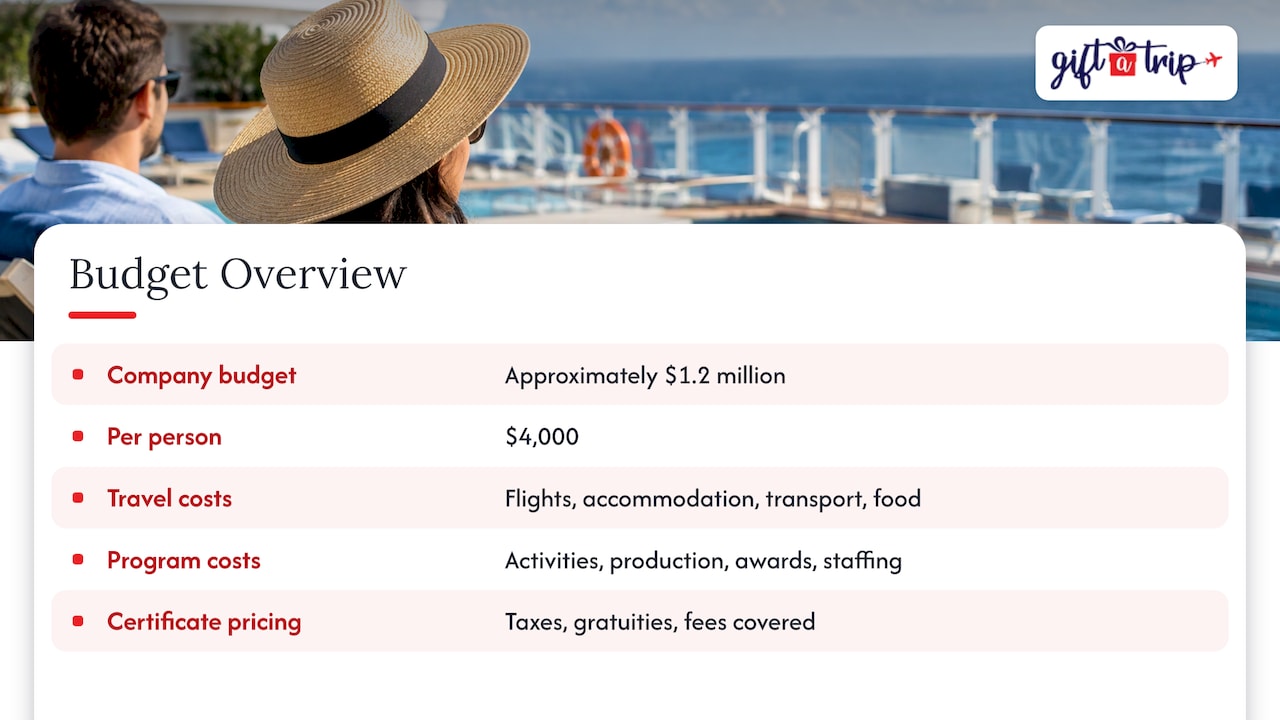
Budget for administration, communications, awards and measurement, not just the trips. The IRF/UCF case study reports a company budget of approximately $1.2 million, or $4,000 per person, covering flights, accommodation, transportation, food and beverage, activities, production, communications and web services, awards, staffing, gratuities and related event expenses. That was a large group program from an earlier period, so treat it as a map of cost categories rather than a benchmark for your own spend.
When you set a per-winner amount, decide what sits inside it. A clear all-in figure is easier to communicate than a list of extras. With our certificates, taxes, gratuities and fees are covered in the certificate pricing, which keeps the stated value closer to what the recipient actually gets. See the exact terms on the item page before you set a budget.
8. Taxes and compliance
This is the part most policies skip, and the one that causes surprises. The IRS says in Publication 15-B (2026) that any fringe benefit is taxable and must be included in the recipient’s pay unless the law excludes it. The employee achievement award exclusion applies only to tangible personal property, such as items given for length of service or safety, and the publication states that vacations, meals and lodging are not covered.
IRS Publication 5137 adds that taxable fringe benefits are generally reported on Form W-2 and are generally subject to withholding and payroll taxes. It also says a benefit provided for an employee remains taxable when a spouse or child receives it. And it separates ordinary business travel, which can be excludable under an accountable plan, from an incentive vacation, which should be reviewed for taxable-fringe-benefit treatment.
What this means for your policy:
- State that the trip is treated as taxable compensation, and say whether the company or the employee bears the resulting tax cost.
- Say the value will be reported on the employee’s W-2.
- Have your payroll provider or a CPA review the wording. State and local rules may add requirements, so this is a question for your tax professional, not a template.
9. Accessibility and alternatives
The Americans with Disabilities Act covers employers with 15 or more employees and prohibits discrimination against qualified individuals with disabilities in the terms, conditions and privileges of employment, according to the EEOC’s ADA fact sheet. A travel reward is one of those privileges. Include a line inviting winners to request accommodations, name a confidential HR contact, and plan for accessible lodging and transport when you book.
Also give people a choice when travel is not realistic. Holafly suggests building in a non-travel option, such as extra paid time off plus cash. Caregivers, people with health limits and employees without a passport are common reasons someone might prefer it. If you offer this, say so in the policy and confirm the tax treatment with your advisor.
10. Communication and evaluation
The IRF/UCF case study describes monthly website rankings and email updates during the earning period, plus an announcement of the next year’s destination, as ways to build anticipation and let employees benchmark progress. Perk’s guide likewise notes that successful programs often use internal marketing, leaderboards and consistent communication.
Your policy should list the launch announcement, the update cadence, the winners’ announcement and the trip itself. Between milestones, small touches keep attention up. Ideas for engaging an audience at company events can help at the kickoff and the awards night, and a modest gift tied to a mid-period milestone, such as corporate coffee gifts, reminds people the finish line is real.
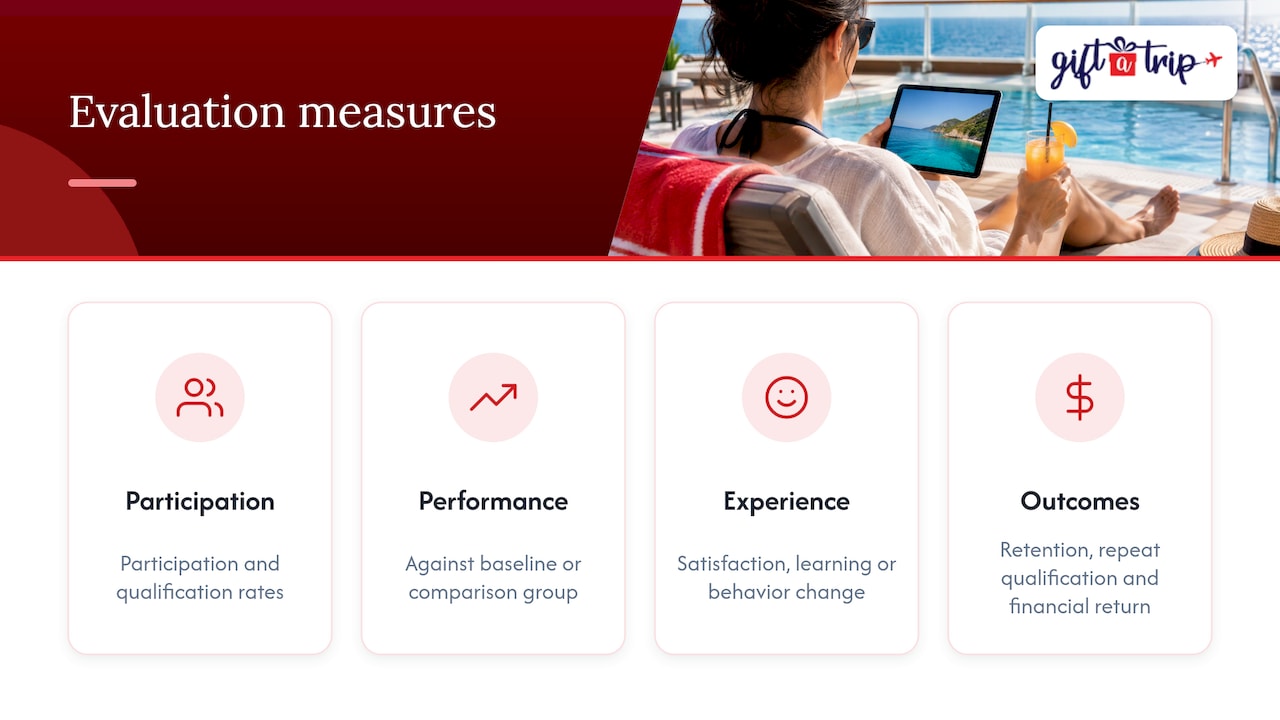
For evaluation, set the measures before launch and compare actual results with them. The IRF/UCF framework lists participation and qualification rates, performance against a baseline or comparison group, budget variance, attendee satisfaction, learning or behavior change, retention and repeat qualification, and financial return. It recommends measuring both tangible and intangible outcomes, and using ROI or return-on-objectives analysis where it fits.
A sample policy outline you can adapt
Use this as a skeleton. Replace the bracketed items with your own numbers and have HR, finance and legal review it.
- Purpose. This program rewards [team] for [measurable result] between [start] and [end].
- Who can qualify. Active [full-time] employees in [teams] with at least [X] months of service on the start date.
- How to qualify. Reach [threshold] on [metric]. Tier 1 earns [award]. Tier 2 earns [upgraded award].
- The award. [Trip type or certificate], with [guest policy], valid for travel within [window defined by the certificate terms].
- Tracking. [Owner] publishes standings [weekly or monthly] at [location]. Questions go to [contact] within [X] days of each update.
- Taxes. The award is taxable compensation, reported on Form W-2. The company [will or will not] cover the resulting tax.
- Accessibility. Winners may request accommodations from [contact]. A non-travel alternative of [description] is available.
- Changes. The company may amend the program with written notice before the qualification period begins.
- Review. Results are compared with the objectives above within [X] days of the program’s close.
Keep the final document to one or two pages. The longer it gets, the less likely people are to read it.
Common gaps to close before you launch
- Vague metrics. If two managers could read the rule differently, rewrite it.
- Moving targets. Changing thresholds mid-period damages trust faster than any missed reward.
- No plan for edge cases. Parental leave, transfers and resignations should have a stated rule.
- Hidden costs. Add up gratuities, resort fees, airfare and the tax cost, or choose a reward whose price already includes them.
- One-size destination. The IRF’s 2024 research suggests preferences strongly influence motivation, but planners must balance them against operational and budget limits. A short survey before choosing a destination helps, and a flexible certificate lets individuals choose.
Perspective
We see the same pattern with HR and sales leaders. The reward is rarely the problem. The policy is. A team that knows exactly what it is chasing, what it wins and when it can use it will work toward it, and a trip is one of the few rewards people still talk about years later.
That is why we built our certificates around simplicity for the administrator. There is no minimum order, delivery is digital and secure, taxes and fees are part of the all-inclusive pricing we describe, and blackout dates are kept minimal. A winner chooses from resorts, hotels, cruises and vacation packages from major brands rather than being handed one itinerary, and you can add a personal message so the reward feels like recognition, not a transaction.
If your policy says the award is a travel certificate, you can keep the rules short and the experience personal. Flexibility is not a compromise here. It is how a nationwide team all gets something they actually want.
Donovan
Make the reward match the policy
Once the rules are written, the award itself should be easy to deliver. We sell digital and physical travel certificates redeemable for resort, hotel, cruise and vacation packages, with options for bulk orders, custom-branded gift boxes and personalized messaging.
If you manage a team or a program, explore our corporate gifting solutions for custom trip selection sites, airfare vouchers and custom flex collections, or browse Flex Trip Collections to see how winners can choose their own trip. For a polished presentation at the awards moment, Red Box Delivery is available at $69 one-off. For deeper reading on structure and engagement, see our guide to incentive trips for employees.
FAQ
Is an employee travel incentive taxable in the U.S.?
Generally yes. The IRS says any fringe benefit is taxable unless the law excludes it, and the achievement-award exclusion does not cover vacations, meals or lodging. Taxable benefits are generally reported on Form W-2 and are subject to withholding and payroll taxes. Ask your payroll provider or CPA how to apply this to your program.
How long should the qualification period be?
There is no single required length. Companies typically define a qualification period with clear objectives and transparent criteria, as Perk’s guide describes. Match the window to your business cycle, such as a fiscal year or a sales quarter, and publish the start and end dates in the policy.
Who should be eligible for the trip?
Start with the teams that can actually influence your measurable objective. Then state tenure, employment status and good-standing rules, and decide whether you reward everyone who hits target or only the top share of each division. The IRF/UCF case study, for example, used tenure requirements and ranking limits.
What if an employee cannot or does not want to travel?
Include an alternative in the policy, such as extra paid time off plus cash, and a way to request accommodations. The ADA prohibits discrimination in the privileges of employment for covered employers, so involve HR early. Confirm the tax treatment of any alternative with your advisor.
How do we know if the program worked?
Decide your measures before launch: qualification rates, performance against a baseline, budget variance, satisfaction, retention and return on the investment. Compare results with those targets when the program ends, and note intangible outcomes such as morale alongside the numbers.
Sources
- Anatomy of a Successful Incentive Travel Program (IRF and University of Central Florida)
- IRF Incentive Travel Toolkit, Section 3: Program Design Best Practices
- IRF 2024 Attendee Preferences for Incentive Travel
- IRS Publication 15-B (2026), Employer’s Tax Guide to Fringe Benefits
- IRS Publication 5137, Fringe Benefit Guide for Federal, State and Local Governments
- EEOC: Facts About the Americans with Disabilities Act
- Perk: The complete guide for incentive trips for employees
- Holafly: Travel incentive programs and how to plan one
- Audience engagement at corporate parties: your 2026 guide
- Why coffee gifts suit corporate gifting: a buyer’s guide