
The simplest way to send one gift to many people is to pick a gift that travels by email, collect clean recipient data once, and send everything in a single order. Digital travel certificates fit this well. There are no street addresses to chase, no carriers to track, and each person gets a personal message and a choice of where to go. This guide covers seven ways to handle multi-recipient delivery, what to collect before you order, how scheduling works, and which gift card rules matter when your list spans several states.
TL;DR
- Digital gifts remove most multi-address headaches: you need a name and an email per person, not a validated shipping address.
- Collect the data in one spreadsheet before ordering: name, email, personal note, occasion date and any special handling.
- Retailers that offer scheduled delivery usually set a fixed window, so check how far ahead and at what time of day a card will go out.
- Federal rules set a floor of five years before a gift card can expire, and some states go further, so keep your list’s states in mind.
- For physical touches, a branded box can sit alongside the digital certificate for the people you most want to impress.
Table of Contents
- What multi-recipient gift delivery really involves
- 7 ways to handle multi-recipient gift delivery
- Quick comparison
- What to collect before you send
- How to schedule digital gift delivery
- What to check when a gift does not arrive
- Gift card rules that apply across a multi-state list
- Our perspective
- Send your group gift with Gift A Trip
- A simple 5-step plan for your next group send
- FAQ
- Sources
What multi-recipient gift delivery really involves
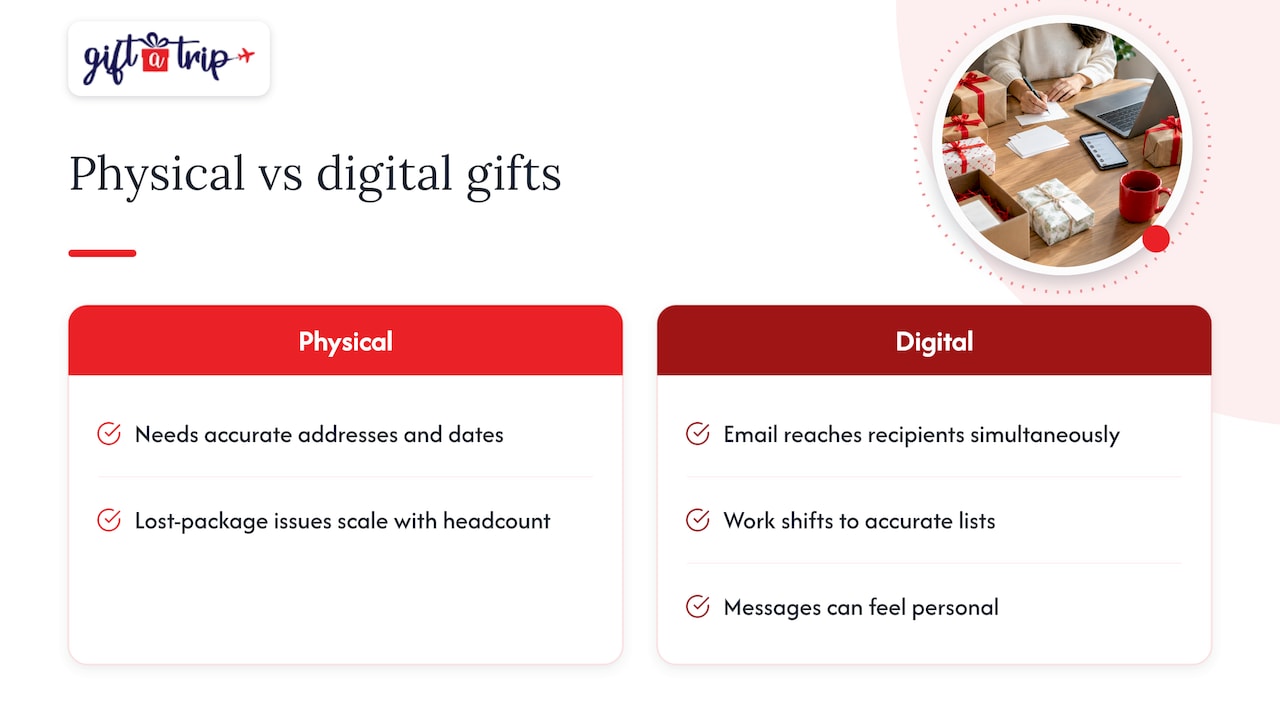
Sending gifts to a group sounds like one task, but it is three: choosing the gift, getting it to each person, and handling what goes wrong afterward. Physical gifts make the second step hard. You need accurate addresses, you need to hit a delivery date, and you inherit every lost-package problem multiplied by your headcount.
Digital gifts shrink the problem. A certificate delivered by email reaches a remote employee in Denver and a client in Miami at the same moment. The work shifts to getting the list right and deciding how personal each message should feel.
That is why HR teams, sales managers, event planners and charity organizers often use travel certificates for group gifting. Our travel certificate distribution guide for HR and events walks through the logistics in more detail. Below are the seven approaches we see work best.
7 ways to handle multi-recipient gift delivery
1. Send the same digital certificate to everyone
This is the baseline: one certificate type, one order, many recipients. It suits holiday thank-yous, anniversary recognition across a team, or a thank-you to every attendee of an event.
Why it works: everyone receives the same value, so there are no fairness questions. Administration is light, because you manage one product and one budget line. Our platform has no minimum order, so a team of six and a team of six hundred use the same process. You can browse the resort and hotel, cruise, and golf and spa certificates to pick a single option for the whole group.
Best for: small to mid-size teams, event goodie bags, and quick recognition.
2. Let recipients choose with a flex collection
A group rarely shares one taste. Some people want a beach, some want a cruise, others want a golf weekend. A flex collection gives each person a set of options under one gift, so you buy once and they decide.
Our Flex Trip Collections are built for this situation. For larger programs, we also offer Custom Flex Trip Collections, where the selection is shaped around your group. See the corporate gifting page for how that works.
Best for: diverse teams, customer appreciation lists, and anyone who dislikes guessing.
3. Personalize the message for each person
The fastest way to make a bulk gift feel like a bulk gift is to send the same generic note to everyone. A short, individual line costs a few minutes per person and changes how the gift lands: a project they finished, a year of service, a birthday.
Our certificates support personalized messaging. Write the notes in your spreadsheet next to each email address so the message travels with the right recipient. Keep them to one or two sentences and avoid names or details you are not sure of.
Best for: employee milestones, sales awards, and client thank-yous.
4. Add a branded gift box for key recipients
Digital delivery is efficient, but a physical item has a different impact. Many organizations send the certificate digitally to the full list and add a box for a smaller group: top performers, executives, VIP clients or auction winners.
Our Red Box Delivery is a one-off $69 fee, and the details are on the gift delivery page. For bigger programs, custom, branded gift box delivery is part of our corporate gifting options. If you need physical delivery to several addresses, plan that part earlier than the digital part and confirm addresses with each person.
Best for: tiered recognition, galas, and high-value client relationships.
5. Use airfare vouchers for a flexible, universal gift
Some groups are spread across the country, and a resort in one region is a long trip for half of them. Airfare vouchers in all denominations let you match the value to the person: a larger voucher for a senior performer, a smaller one for a new hire. They are listed among our corporate services on the corporate gifting page.
Best for: geographically dispersed teams and tiered reward levels.
6. Build a custom trip selection site
When a program runs all year, with new winners every quarter, one-off orders become tedious. A custom trip selection site gives recipients a branded place to choose their trip. You issue the access, and they handle the rest. Details are on our corporate gifting page.
Best for: ongoing incentive programs, loyalty rewards and sales contests.
7. Stagger delivery around personal dates
Not every gift needs to arrive on one day. Birthdays, work anniversaries and closed deals each have their own date. If you are managing 40 work anniversaries across a year, you do not want to press send 40 times on the day itself.
This is where scheduled delivery matters. Many retailers let you pick a send date when you buy. We cover timing in its own section below. For ideas on how recipients experience the gift once it arrives, see our piece on how to send digital travel gifts.
Best for: anniversaries, birthdays, and rolling recognition programs.
Quick comparison
| Approach | Best for | Effort for you | Personal feel |
|---|---|---|---|
| Same certificate for all | Small teams, events | Low | Medium |
| Flex collection | Mixed tastes | Low | High |
| Individual messages | Milestones | Medium | High |
| Branded gift box | VIPs, top performers | Medium to high | Very high |
| Airfare vouchers | Dispersed teams | Low | Medium |
| Custom selection site | Ongoing programs | Setup once | High |
| Staggered delivery | Anniversaries, birthdays | Medium | High |
What to collect before you send
Most multi-recipient problems start with the list, not the gift. A bounced email or a typo in a name creates a gap that you only find after the date has passed.
Build one spreadsheet with these columns:
- Full name as the person uses it, not as it appears in an old system.
- Email address the recipient actually checks. For employees, consider whether a personal email is better for a gift redeemed on their own time.
- Personal message, written ahead of time, one or two sentences.
- Occasion and target date, so you can group sends.
- Gift level or type, if you use tiers.
- Shipping address, only for those receiving a physical box, with a phone number for the carrier.
- Notes, such as a recipient on leave, or someone who should receive the gift from a specific manager.
Before ordering, sort by email domain and look for obvious errors: missing at-signs, doubled letters, old company domains. Have a second person scan the list. It takes ten minutes and prevents the most common failure.
If you collect data from recipients themselves, keep it to what you need and tell them how it will be used. Our distribution guide for HR and events includes more on organizing lists for large programs.
How to schedule digital gift delivery
Scheduling rules differ from seller to seller, so check the specifics before you plan around them. Two examples show the range. One large retailer lets you schedule its digital gift cards up to 12 months ahead, sends them at 7 am on the chosen date, and says instant delivery typically arrives within 5 to 10 minutes. A restaurant chain’s eGift cards, by contrast, can be sent immediately or up to one month ahead.
Those are examples of two different policies, and neither describes how another seller works. The takeaways for your own planning:
- Ask how far ahead you can schedule. A window of one month and a window of a year lead to different workflows.
- Ask what time of day the message goes out. A 7 am send reaches most inboxes before work. A midnight send may be buried by morning.
- Think about time zones. A team across four zones will not all receive a message at the same local hour unless the seller handles it.
- Do not schedule at the last minute. Allow a day or two of margin before a birthday or award ceremony, so you can fix errors.
For holiday gifting, lead times get tighter because everyone is ordering at once. Our holiday gift card lead times guide covers how to plan corporate holiday orders. If you add physical items, remember that carriers publish recommended last-ship dates each year. Check the carrier’s own current schedule rather than relying on a date you saw last season.
What to check when a gift does not arrive
With a big list, a few messages will go astray. Plan for it rather than being surprised.
- Spam and promotions folders. Ask recipients to check there first, and send a short heads-up message before the gift arrives so they expect it.
- Typos in the email address. Compare the address to your source list.
- Corporate filters. Some company mail systems block unfamiliar senders. Ask the recipient’s IT team to allow the sender, or use a personal address.
- Order status and resend. Some sellers let the buyer track an order and resend the card themselves using the email address and confirmation number, as one restaurant chain’s eGift FAQ describes. Keep your confirmation numbers in the spreadsheet.
- Not redeemed. If someone has not used a gift after a few weeks, a friendly reminder works better than silence. Tell them where the redemption instructions are.
Keep a short log: who was sent what, on which date, and who confirmed receipt. For charity auctions and sales contests, that log also helps with reporting.
Gift card rules that apply across a multi-state list
If your recipients live in several states, one set of rules does not cover them all. Two points are worth knowing.
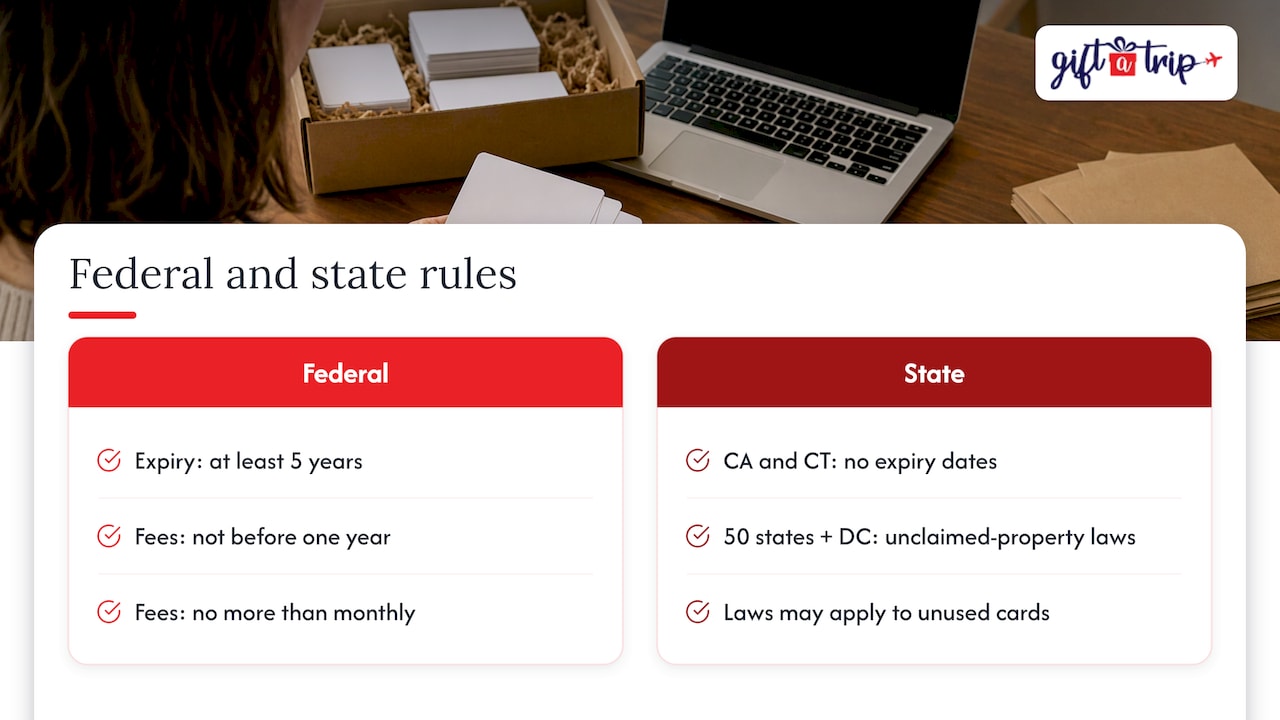
First, federal law sets a floor. According to Wolters Kluwer’s summary of gift card rules, a gift card cannot expire for at least five years from the purchase date or from the date money was last added, and in most cases inactivity fees cannot be charged until a year after issue or more often than monthly.
Second, states can go further. The same source notes that California and Connecticut prohibit expiration dates entirely, and that all 50 states and the District of Columbia have unclaimed property laws that may apply to unused cards. If any of your recipients are in California, it is worth reading about California gift certificate requirements and small-balance refunds before you finalize a program.
For a fuller look at how federal and state rules compare, see our guide to U.S. gift card expiration laws. Travel certificates have their own terms, including redemption windows, so read our explainer on open date travel vouchers too. On cost, our article on taxes and fees in travel gift cards explains what to look for so recipients do not face surprise charges.
Our perspective
Group gifting fails in a predictable way: the gift is fine, but the process around it is messy. People send a generic note, miss a few addresses, and then spend the next week answering “did mine arrive?”
We built Gift A Trip around the opposite approach. A digital certificate goes out securely by email, so geography stops mattering. There is no minimum order, so you can send to three people or three hundred the same way. Taxes and fees are covered in our pricing, and blackout dates are kept to a minimum, so the recipient can focus on the trip rather than the fine print.
What we see work is a simple pattern. Pick a gift that suits the whole group, and for mixed tastes use a flex collection. Write a real message for each person. Reserve a physical box for the handful of people who should get something to hold. Keep the spreadsheet tidy. A trip is a gift that people talk about long after a gadget has been forgotten, and that is why teams come back to it year after year.
Donovan
Send your group gift with Gift A Trip
If you manage rewards for a team, a client list, an event or an auction, we can help you set up multi-recipient gifting without the usual logistics. Choose from resorts, hotels, cruises, and golf and spa getaways, add personal messages, and add branded box delivery where you want a physical touch.
Start with our corporate gifting options for bulk orders and custom programs, or browse individual travel certificates if you are gifting a smaller circle. Our Royal Caribbean certificates and golf and spa resort stay certificates are popular starting points.
A simple 5-step plan for your next group send
- Define the goal and budget. Recognition, thanks, or incentive? Decide whether everyone gets the same level.
- Pick the gift format. One certificate for all, a flex collection, or tiers with airfare vouchers.
- Build and check the list. Use the columns above, and have a second person review it.
- Write the messages and choose the timing. Immediate send, or scheduled around personal dates, with a margin for fixes.
- Confirm and follow up. Keep confirmation numbers, send a heads-up note, and check in with anyone who has not redeemed.
For teams that want more background on the product itself, our 2026 guide to digital travel certificates explains how they work from purchase to redemption, and our top digital travel gift certificate examples show what recipients see.
FAQ
How do I send the same gift to multiple recipients?
Choose one gift, then place a single order with a list of names and email addresses. With digital gifts, each person receives their own copy by email, so you do not need shipping addresses. Prepare the list in a spreadsheet first, and add a personal note for each person if the platform supports it.
Can I send gift cards to multiple recipients at once?
Yes, with sellers that support bulk or multi-recipient orders. On our platform there is no minimum order, and corporate programs can include custom collections and branded boxes. Ask any seller how many recipients one order can hold and whether each person can get a different message.
Can I schedule digital gift delivery for a future date?
Often, but the rules vary by seller. One retailer allows scheduling up to 12 months ahead, while a restaurant chain allows about one month. Check the maximum window and the time of day it will send, then leave a margin before the occasion.
What if a recipient never receives the email?
Start with the spam folder and the spelling of the address. Then use the order confirmation to check status or resend if the seller offers that option. Keeping confirmation numbers in your recipient spreadsheet makes this quick.
Do gift cards expire?
Federal law sets a minimum of five years before a gift card can expire, and some states, including California and Connecticut, prohibit expiration dates altogether. Check the specific terms of the certificate you choose, as travel certificates have their own redemption terms.
Sources
- THE ICONIC Digital Gift Cards
- LongHorn SteakHouse eGift Card FAQs
- Wolters Kluwer: Unwrapping the gift card rules
- California gift certificate requirements and small-balance refunds