Jump to Section:
Employee gifts are taxable compensation by default under IRC §102©, full stop. The only narrow escape hatches are de minimis noncash items, qualified achievement awards, and a handful of statutory exclusions that rarely apply to routine gifting. Unless you can point to one of those specific exceptions and document it, treat the gift as wages, run it through payroll, and withhold accordingly.
TL;DR:
- Gifts are taxable income unless they qualify as de minimis benefits or achievement awards, which depend on frequency and structure, not just value.
- Cash or gift cards are always taxable, while employer-curated travel certificates can qualify as noncash benefits if properly documented and controlled.
- The IRS scrutinizes small, recurring, undocumented gifts more than occasional, well-documented awards, increasing audit risk.
- Proper documentation, including written policies, approval records, and event details, is essential to defend the tax treatment of employee gifts.
- Gross-ups for taxable gifts can cover employee tax costs but require careful budgeting and tracking to avoid high costs.
Table of Contents
- What Are the Employee Gift Tax Rules HR Needs Right Now?
- De Minimis Fringe Benefits: Definition, Examples, and the Frequency Test
- When Are Achievement Awards Excludable From Wages?
- Are Gift Cards and Cash Certificates Taxable to Employees?
- How Do You Report Employee Gifts on Form W‑2?
- Building a Gift Policy That Limits Tax Risk
- What Triggers an Audit, and What Happens to Employer Deductions?
- How Gift A Trip Helps HR Give Travel Rewards the Right Way
- Primary Sources Worth Bookmarking
- Why Most HR Teams Get This Wrong Anyway
- Sources
- FAQ
What Are the Employee Gift Tax Rules HR Needs Right Now?
Before you hand out a single gift card or plaque, run it through three questions. First, is it cash or a cash equivalent? If yes, it’s taxable, no exceptions. Second, is it noncash and infrequent enough to qualify as de minimis? Third, does it meet the strict requirements for a qualified achievement award?
- Default rule: treat the gift as taxable compensation unless you’ve confirmed a specific exclusion applies.
- Payroll step: notify payroll before distribution so the value gets added to wages or handled as supplemental pay.
- Documentation: keep a record of the item, its value, the occasion, and who approved it.
- When in doubt: loop in payroll or tax counsel before the gifts go out, not after the W-2s are printed.
Quick fact: Publication 15-B confirms that any fringe benefit not specifically excluded by law is fully taxable and must be reported on Form W-2, with income and employment taxes applied.
De Minimis Fringe Benefits: Definition, Examples, and the Frequency Test
There’s no dollar amount that automatically qualifies a gift as de minimis. The IRS de minimis fringe benefits page uses a standard called “administratively impracticable,” meaning the benefit is small enough and infrequent enough that tracking its value wouldn’t be worth the trouble. Frequency, not price tag, decides the outcome.
Items that usually pass the test include occasional holiday hams or turkeys, flowers sent for a personal event, the office holiday party, and coffee or snacks in the break room. Items that never pass include cash, gift certificates redeemable for general merchandise, and anything with a cash-equivalent value, regardless of how small.
- Occasional noncash gifts (holiday items, small tokens): generally excludable.
- Cash or gift cards of any amount: never excludable as de minimis.
- Regularly recurring “employee of the month” style rewards typically fail the frequency test even when individual gifts are low in value.
Pro Tip: If you’re running the same small reward every month, the IRS stops seeing it as a nice gesture and starts seeing it as a compensation program. Space out recognition gifts and vary the occasion to keep the de minimis argument credible.
Our guide on de minimis fringe benefits walks through more real-world HR examples if you want a deeper reference.
When Are Achievement Awards Excludable From Wages?
Tangible personal property given as a length-of-service or safety award can be excluded from taxable wages, but the requirements are specific. The award has to come with a meaningful presentation, follow a written plan that doesn’t discriminate in favor of highly compensated employees, and stay within statutory limits tied to the award program’s structure, according to Publication 15-B.
- Cash, gift cards, vacations, meals, lodging, tickets to events, and securities are excluded from this exclusion. They’re taxable no matter how the award is framed.
- Length-of-service awards generally can’t be given within the employee’s first five years, and not more than once every five years.
- Safety awards can’t go to managers, administrators, clerical staff, or professional employees in most structures.
If you’re building an award program from scratch, put the eligibility rules and item list in writing before the first award goes out. That paper trail is what separates an excludable award from a payroll headache six months later.
Are Gift Cards and Cash Certificates Taxable to Employees?
Cash is always wages. General-purpose gift cards are treated exactly like cash because the recipient can spend them anywhere, on anything, which is why the de minimis fringe guidance excludes them categorically, no matter the dollar amount.
The distinction gets more interesting with certificates that limit redemption to specific tangible items an employer preselects. A gift card for a coffee shop chain is a cash equivalent. A certificate that lets an employee choose among a curated set of travel packages, with the employer controlling the assortment and the presentation, sits closer to tangible property.
- Broad-redemption travel certificates that behave like cash: treat as taxable wages.
- Employer-curated packages with a fixed, limited selection: may support noncash treatment if properly documented.
- Retain evidence of the limitation (the selection list, the presentation, the occasion) in case the classification is ever questioned.
How Do You Report Employee Gifts on Form W‑2?
Once you’ve determined a gift is taxable, payroll has three jobs: value it, report it, and withhold on it.
- Add the fair market value to wages. Taxable fringe benefits get included in Box 1, 3, and 5 of Form W-2, and they’re subject to federal income tax, Social Security, and Medicare, per Publication 15-B.
- Choose your withholding method. You can add the value to regular wages and withhold at the employee’s normal rate, or treat it as supplemental wages and withhold at the flat supplemental rate, depending on your payroll system’s setup.
- Check accountable plan status for reimbursements. If an employee is reimbursed for a legitimate business expense under an accountable plan, with proper substantiation and no excess advance kept, that reimbursement stays off wages entirely. Fail the substantiation requirement, and it converts to taxable pay.
Quick fact: Every fringe benefit that isn’t specifically excluded by statute counts as taxable wages subject to full employment tax treatment, a baseline Publication 15-B sets with no gray area for “small” gifts.
Building a Gift Policy That Limits Tax Risk
A written policy does more work than any single tax rule. Spell out who can approve a gift, what categories are allowed, how often any one employee can receive a reward, and what presentation or documentation each award requires.
- Set an approval flow so gifts don’t get distributed informally by individual managers.
- Cap frequency per employee per category to protect your de minimis position.
- Require a short write-up (occasion, item, value, recipient) for anything beyond a token item.
- Keep receipts, assortment lists, and presentation notes for at least the standard payroll recordkeeping period.
If you’d rather give something taxable but don’t want the employee to feel the tax hit, a gross-up covers it. Say you give a $200 travel certificate and want the employee to net the full $200. You calculate the withholding taxes on $200, then add that amount on top so the employee’s take-home value isn’t reduced.
Pro Tip: Gross-ups get expensive fast if you’re not tracking them. Budget the gross-up cost into the gift program from day one instead of discovering it at year-end reconciliation.
Retailers that focus on business gifting, like Dudley’s Toffee’s breakdown of deductible client gifts, offer a useful parallel: the $25 deduction cap on client gifts is a separate rule from employee gift taxation, but it’s worth knowing both if your gifting touches customers and staff alike.
What Triggers an Audit, and What Happens to Employer Deductions?
Auditors look for patterns, not one-off gestures. Routine small gifts handed out monthly, undocumented “awards” with no written plan behind them, and gift cards labeled as de minimis are the classic red flags examiners key in on.
- Recurring small-dollar rewards with no frequency cap: a common trigger.
- Achievement award programs with no written eligibility rules: hard to defend if questioned.
- Missing records tying a specific gift to a specific occasion and value.
On the deduction side, compensation, including properly taxed gifts, is deductible to the employer as a business expense, subject to the payroll taxes the employer pays on top of wages. A true personal gift, the rare kind that survives the Duberstein analysis, isn’t compensation and isn’t deducted as wages. For most employer-to-employee transfers, that personal-gift label just doesn’t hold up.
How Gift A Trip Helps HR Give Travel Rewards the Right Way
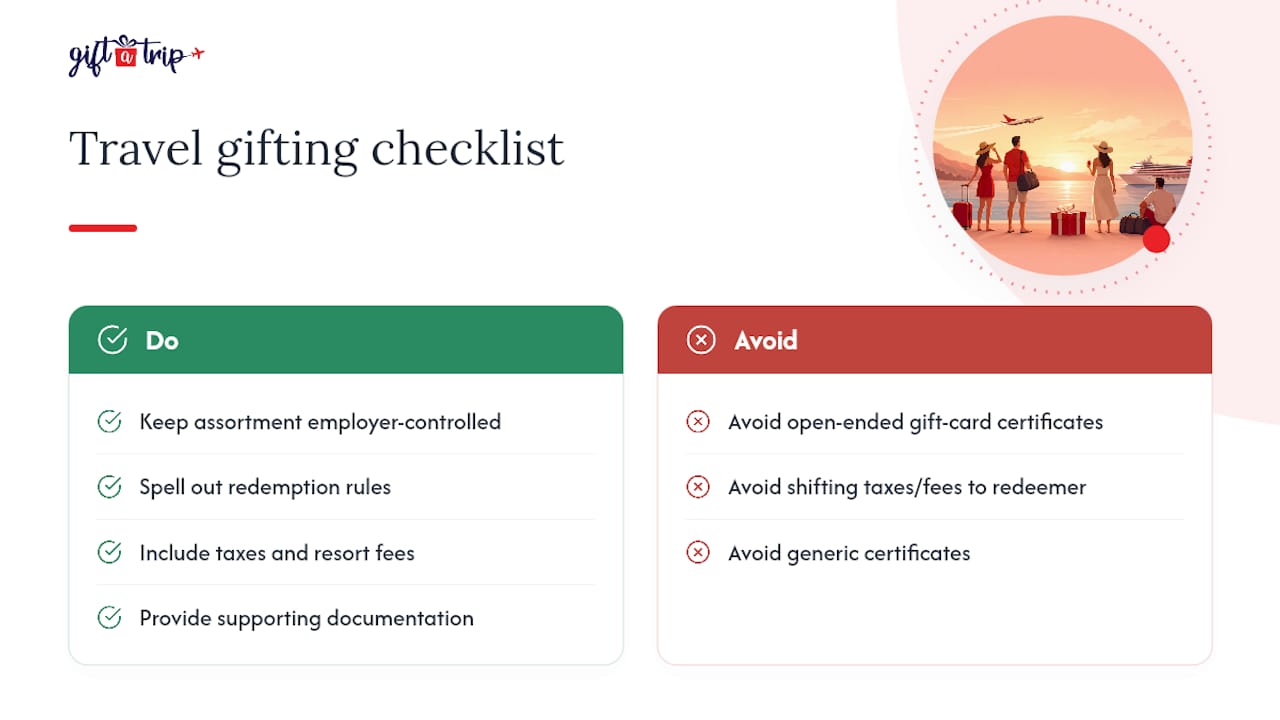
Gift A Trip distributes travel certificates for resorts, hotels, and cruise lines, and we build our programs with the cash-equivalent question in mind from the start. A certificate that behaves like an open-ended gift card is treated as cash for tax purposes. One that points to a defined, employer-selected set of tangible travel packages has a stronger case for noncash treatment.
Our recommendation for corporate clients: keep the assortment employer-controlled, spell out redemption rules clearly, and make sure taxes and resort fees are already built into the certificate so there’s no surprise cost at redemption. Our guide to gifting employee travel walks through the documentation that supports this approach step by step.
If your HR team is planning a recognition program built around travel rewards, our travel certificate distribution guide for HR and events covers the operational side, and browsing Virgin Voyages cruise certificates gives a sense of what a curated, employer-selected package actually looks like in practice.
Primary Sources Worth Bookmarking
For the original guidance behind everything above, start with Publication 15-B and the IRS de minimis fringe benefits page. Read the regulatory text at 26 C.F.R. §1.132-6, and for practitioner-level analysis of how courts apply IRC §102©, see The Tax Adviser’s breakdown of employer gift taxation.
Why Most HR Teams Get This Wrong Anyway
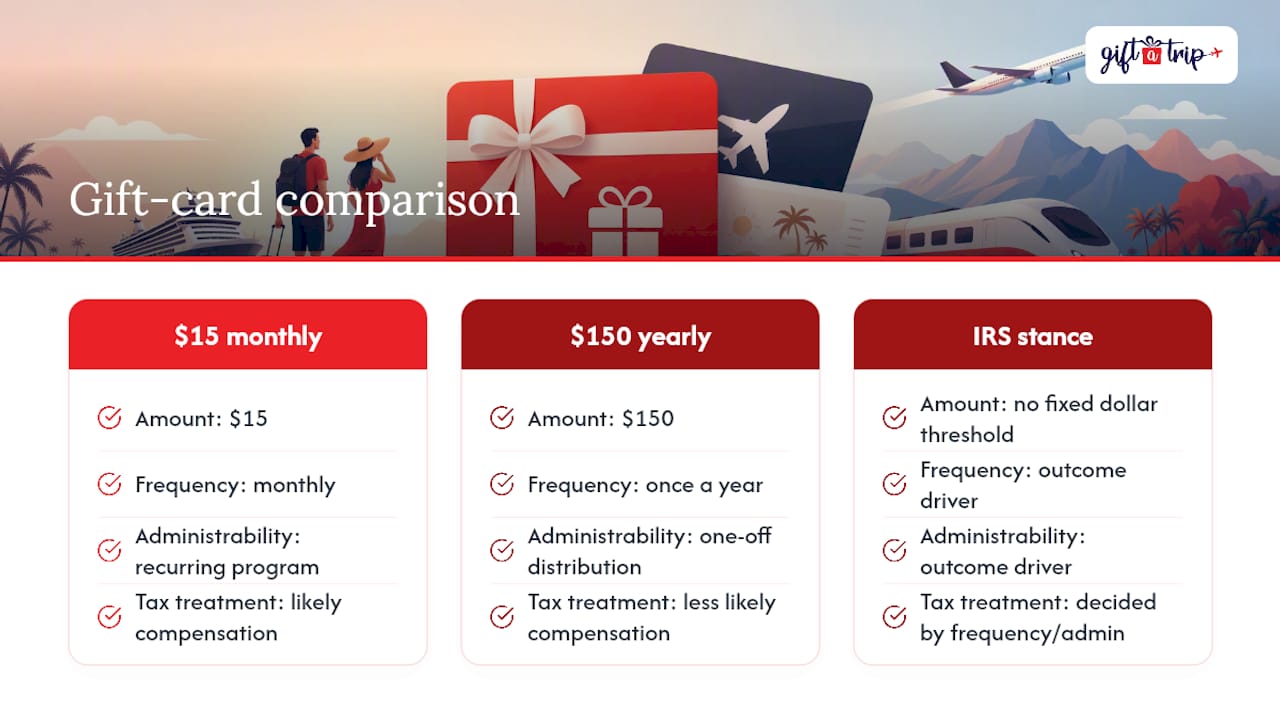
The conventional advice on employee gifts treats “small” as a synonym for “safe.” It isn’t. The IRS never set a dollar threshold for de minimis treatment, and the research here is consistent on that point: frequency and administrability decide the outcome, not price. A $15 gift card given every month is worse, tax-wise, than a $150 gift given once a year, because the monthly cadence turns it into a program, and programs get compensation treatment.
The other place conventional wisdom fails is the “gift” label itself. Calling something a gift doesn’t make it one under the tax code. Courts have made that presumption hard to overcome outside genuinely personal relationships, and HR teams that lean on the word “gift” in a policy document are building on sand.
If there’s one thing to prioritize, it’s documentation before distribution, not after. Write the policy, define the assortment, cap the frequency, and get payroll looped in before the first item goes out the door. That sequence is what actually holds up, not the intention behind the gift.
— Donovan
Sources
- Publication 15-B (2026), Employer’s Tax Guide to Fringe Benefits | Internal Revenue Service
- Tax consequences of employer gifts to employees | The Tax Adviser
- 26 C.F.R. §1.132-6 (de minimis fringe benefits) | Legal Code (Cornell LII)
FAQ
How much can an employer gift an employee tax-free?
There’s no set dollar amount. A gift qualifies as tax-free only if it meets the de minimis standard (infrequent, noncash, and administratively impractical to track) or the achievement award exclusion, and both depend on frequency and structure rather than a specific price.
Can you give an employee a cash bonus without taxes?
No. Cash and cash-equivalent items like gift cards are always taxable wages, subject to income tax withholding, Social Security, and Medicare, regardless of the amount or the occasion.
How much can I gift an employee?
You can give any amount, but anything beyond a genuinely occasional, low-value noncash item is treated as taxable compensation. The relevant question isn’t “how much” but “how often and in what form.”
How much can a federal employee accept as a gift?
Federal employee gift acceptance rules fall under separate ethics regulations for government workers, not the IRS employer gift tax rules covered here, so private-sector HR teams should not apply that standard to their own programs.