
A travel package sells at an auction when the bidder can picture the trip and trust the fine print. Tell the story of the exact moment the winner will enjoy, state what is included in countable terms, put every restriction in plain view, and tie the item to your cause. For organizers who want that story to rest on a certificate with taxes and resort fees covered and minimal blackout dates, Gift A Trip’s travel certificates are built for charity auctions.
This guide covers how to write the story, what the description must contain, how it should change for live, silent and online formats, and a template you can copy.
TL;DR
- Start with the experience, not the object: describe the hour the winner will love most, with specific numbers instead of adjectives.
- Give every package four parts: what it is, what is included, why you would want it, and every restriction.
- Write two versions: a scannable catalog description, and a short stage brief for the auctioneer if the lot is live.
- Name restrictions (expiration, blackout dates, booking lead time, guests) in the same warm tone as the rest of the copy. Surprises after winning are what damage trust.
- Link the trip to the mission with one concrete line about where the money goes.
Table of Contents
- Why travel packages reward good storytelling
- Start with the experience, not the object
- The four parts every travel description needs
- Tie the trip to your mission
- Live, silent and online: one trip, three versions
- A template you can copy
- What we think about storytelling and travel lots
- Put the story on a certificate that is easy to redeem
- Checklist before you print the card
- FAQ
- Sources
Why travel packages reward good storytelling
Travel is the category where a story pays off most. In BetterUnite’s Spring 2026 data, covering roughly 90,000 confirmed bids across 259 organizations, travel and experiences were under 20% of items listed but drove nearly 40% of revenue per item. A travel package averaged $834, against $101 for gift cards and $194 for wine and food baskets.
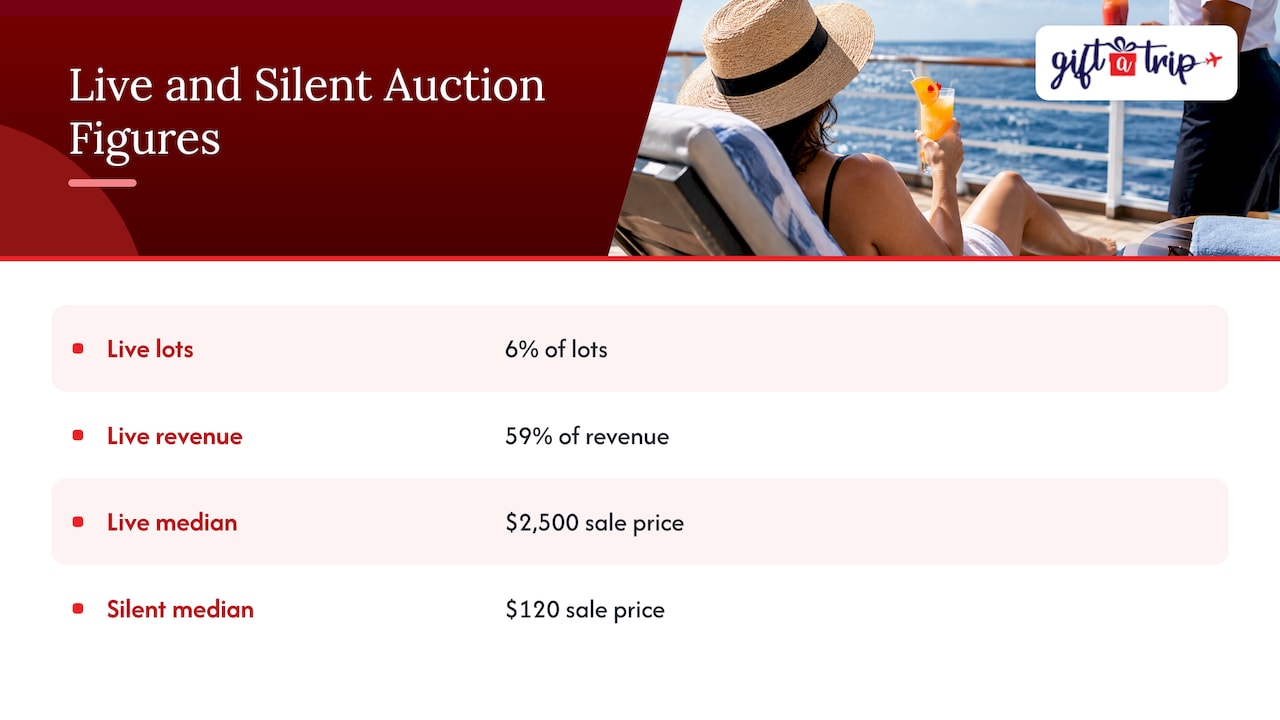
The same dataset shows where the stakes are highest. Live auction items were 6% of lots but 59% of revenue, and the median live item sold for $2,500 against $120 for a silent item. Top lots included a private Tuscany villa escape and a Belize private island trip.
The reason is simple. Nearly everyone budgets for vacation, so a travel lot asks bidders to move money they already plan to spend, rather than find new money. A good story helps them decide that this is the trip they want to spend it on.
A caution on figures: auction-industry blogs publish a lot of percentages for how much a story lifts bidding. Treat them as directional. What you can rely on is the mechanism: bidders hold back when they do not understand what an item includes, why it is special or how easily they can use it, as Fox Fundraising and Auctions observes. Clear, vivid copy answers those questions before the bidder has to ask.
Start with the experience, not the object
Auctioneer Carrie Frugé points out that most descriptions read like inventory rather than invitations. A fact alone is not a reason to raise a paddle or tap a screen. Her fix is to picture the exact hour someone would enjoy the item most and open with that.
For travel, that moment is rarely “Seven nights, ocean-view room.” It is the first morning on the balcony, the table for two at sunset, the kids running toward the pool. Pick one moment and write it in the second person.
Weak: Three-night resort stay. Value $1,200.
Stronger: Wake up three mornings in a row with the ocean outside your window and nothing on the calendar. Breakfast on the terrace, an afternoon at the spa, and a long dinner with no one watching the clock.
The second version still needs its facts, which come next. But it gives the bidder a reason to read them.
Make the title do one job
The title has to convince someone standing a few feet from the bid sheet that the paragraph below is worth reading. In Frugé’s example, a “Bourbon Basket” became an evening of rare pours at a distiller’s table for four, and it drew three bids in twenty minutes. Blackbaud makes the same point for travel: a “Tuscany Culinary Escape” beats “Trip to Northern Italy”.
Keep titles near 60 characters, lead with the benefit, and avoid piling on superlatives. BiddingForGood’s catalog tip sheet asks for eye-catching titles without excessive embellishment.
Use specifics instead of adjectives
The team at 32auctions argues that persuasion is mostly a by-product of specificity: dinner for four with wine pairing and dessert beats “a wonderful evening out” because it is concrete. Momo Good gives a travel version: a $2,000 package called “Beach Getaway” underperforms the same package described as five nights at a private oceanfront villa that sleeps eight, steps from the beach, with a welcome basket and beach gear.
Count things. Nights, guests, meals, rounds of golf, spa treatments, airport transfers. Numbers build trust faster than “luxurious” ever will.
The four parts every travel description needs
32auctions recommends a four-part structure, at 60 to 150 words and longer for high-value lots, because a $1,500 travel package is a considered purchase. Adapted for travel:
- What it is. The destination, property or cruise line, and the type of stay.
- What is included, in countable terms. Nights, guests, meals, activities, and whether tax, gratuity, resort fees or transportation are covered.
- Why you would want it. One or two lines of story: the moment, the place, the feeling.
- Every restriction. Expiration date, blackout dates, booking lead time, age requirements, occupancy limits, transferability and any geographic limits.
Fox Fundraising and Auctions asks for a clearly labeled restrictions section and lists the same items, including whether tax and gratuity are included. Ecuadane’s guide adds the practical reason: a package that looks impressive but is hard to schedule disappoints the winner and creates extra work for your staff.
Say the restrictions out loud
It feels risky to print blackout dates beside a beautiful photo. It is not. Frugé’s line is that what kills trust is not a restriction but discovering one after you have already won. 32auctions makes the same case: stating limits plainly builds confidence, and the alternative is an angry email weeks later. BiddingForGood warns that unclear restrictions cause bid retractions and lost revenue.
Write the restrictions in the same warm voice as the rest of the copy, under a labeled line such as “Good to know.”
Choose a package that is easy to redeem
The story can only be as good as the trip is easy to book. This is where the underlying product matters. Certificates with taxes and resort fees already covered and minimal blackout dates leave you very little to explain in the restrictions box, which keeps the description short and the winner happy. Our guide to avoiding expiration and booking restrictions explains what to look for before you commit, and how to source travel auction items covers the sourcing side.
Tie the trip to your mission
Every auction item carries a second story: the cause. Silent Auction Pro suggests one specific, warm line connecting the item to the mission, for instance a winning bid that helps send twelve more kids to camp this summer. A picture of where the money goes lifts a good bid into a great one.
Personal voices help too. OneCause’s 2025 report found that 63% of auction attendees rated testimonials from people directly affected by an organization’s work highly, and that sharing personal stories during live auctions or on the auction site builds emotional connection. A short beneficiary quote near your top travel lot is worth the space.
If a donor has a story, use it. Greater Giving’s template example describes a donor who proposed on the same Mediterranean cruise twenty years earlier and hopes the winner enjoys it as much as he did. Crediting the donor by name gives the item a face and a relationship.
Live, silent and online: one trip, three versions
The same package needs different writing depending on the room.
| Format | What the story must do | What to prepare |
|---|---|---|
| Silent | Stand alone on a bid sheet with a clear opening, the strongest benefit first, scannable details | A 60 to 150 word description, a photo, a “Good to know” line |
| Live | Give the auctioneer a launchpad with atmosphere while the facts stay clear | A short stage brief: headline, top three selling points, restrictions to announce, mission connection |
| Online | Do all the selling with no in-person energy | Strong photography, a fuller description, restrictions near the top |
This follows Fox Fundraising and Auctions, which recommends preparing both a polished catalog description and a stage brief for live travel packages, and Ecuadane, which notes that online auctions rely on photos and copy alone.
Silent auctions
Silent auctions suit smaller packages and broad-appeal trips: a weekend getaway, a spa day, a golf stay. Silent Auction Pro suggests a 40 to 70 word body for experience items, with sensory detail and time-and-place cues. Its example turns a flat “two nights at a cabin” listing into an invitation to wake up to pine air and no alarm clock, with the terms gathered below. For display, see our silent auction display ideas, and for the final minutes, our silent auction closing strategies.
Live auctions
Live auctions should hold fewer lots, and each needs a strong story, clear value and enough appeal to create visible competition. Momo Good’s live auction guide puts the typical live lineup at 5 to 15 premium lots, with luxury travel generating competitive bidding because the value is clear and aspirational. Show each lot on screen with a photo, short description and starting bid while the auctioneer speaks.
The Gala Team suggests starting live bids lower than you would expect. Work backward from an estimated $4,000 selling price through six to ten bids, since more bids create momentum and usually a higher final price. It also advises ordering lots from lowest to highest value, then ramping down slightly, so scarcity builds before the biggest items.
BetterUnite co-founder Leya Simmons raises a fair question from the Spring 2026 numbers: if live items were 6% of lots but 59% of revenue, is your sourcing effort proportional? Spend as much time on the story for your two or three live trips as on the whole silent table.
Online auctions
Without a room to build energy, the photo and the first two lines carry the lot. Frugé advises using a real photo of the actual place, such as a villa’s private plunge pool, in place of a stock beach image, and asking donors for real photos. Put restrictions high enough that no bidder has to hunt for them. Our charitable auction travel workflow guide walks through the process from listing to redemption.

A template you can copy
Greater Giving’s template has the fields: item name, item number, donor information, description, value, important details and restrictions. Combine that with the four-part structure:
Title: Three Mornings on the Water: A Resort Escape for Two
Donor: [Name of donor or business]
The moment: Wake up to the sound of the sea, with breakfast on the terrace and the whole day open.
Included: Three nights for two guests, [meals, activities, transfers], taxes and resort fees covered.
Your bid helps: [One specific outcome, such as sending twelve more kids to camp this summer.]
Good to know: Use within [number] months. Blackout dates: [list]. Book at least [number] days ahead. Guests must be [age]. Value: $[amount].
Keep your own details exact. Never fill a bracket with a guess: if you do not know the blackout dates, find out before you print the card.
What we think about storytelling and travel lots
We see charity travel lots go wrong in two ways. The story is vague, so no one can picture the trip. Or the story is beautiful, but the redemption terms are a maze, and the winner’s excitement turns into paperwork.
Our view is that the story and the product have to match. A certificate designed with taxes and resort fees covered and minimal blackout dates lets you write a confident, short restrictions line, and a confident restrictions line is what lets the story do its work. Your winner should be able to read the card, bid, and book without a surprise in between.
That is why we build travel certificates for gifting, rewards and charitable auctions, with secure digital delivery and room for a personal message. The trip is the gift. The story is how the bidder gets to want it.
Donovan
Put the story on a certificate that is easy to redeem
If you are filling a catalog or building a live-auction lineup, Gift A Trip offers travel certificates for resorts, hotels, cruises and golf and spa getaways, with taxes and resort fees included and minimal blackout dates. There is no minimum order, so you can start with a single headline lot. Browse the cruise, resort and golf and spa certificates, or see Flex Trip Collections for a package that lets the winner choose.

For a polished hand-over at the gala, Red Box Delivery is $69 one-off, and you can read more on the gift delivery page. For ideas on what to pair with your travel lot, see our creative auction item ideas and our guide to experiential auction items.
Checklist before you print the card
- Does the title lead with a benefit and stay near 60 characters?
- Does the first line describe a moment, not an object?
- Are inclusions countable (nights, guests, meals), and does it say whether tax, gratuity, fees and transport are covered?
- Are expiration, blackout dates, booking lead time and guest limits in a labeled line?
- Is there a real photo, not a stock image?
- Is there one specific line on what the winning bid does for your cause?
- For a live lot, is there a stage brief with the headline, three selling points, restrictions to announce and the mission connection?
Our auction travel mistakes and checklists page goes further on the errors that cost organizers the most.
FAQ
How long should a travel auction description be?
For most silent auction items, 60 to 150 words is a good range, and Silent Auction Pro suggests 40 to 70 words for a short experience item. Go longer for high-value trips, because a bidder weighing a $1,500 package needs every detail. Keep paragraphs short and use bullets for inclusions.
Should I list blackout dates and expiration in the description?
Yes. Put them in a labeled line such as “Good to know,” in the same friendly tone as the rest. Plain restrictions build bidder confidence and prevent retractions and complaints after the event.
What should I say differently for a live auction?
Give the auctioneer a short stage brief: the headline, the top three selling points, the restrictions to announce and the link to your mission. The catalog description still carries the full facts, while the auctioneer adds atmosphere and story.
How do I link a trip to my cause?
Add one specific line about what the winning bid does, such as sending a set number of kids to camp. A concrete picture of where the money goes works better than a general appeal. If a donor or beneficiary has a short, true story, use it with their permission.
Sources
- BetterUnite: Inside the Numbers, Spring 2026
- OneCause: 2025 State of Nonprofit Auctions Report
- Fox Fundraising and Auctions: Auction Item Description Tips
- BiddyUp Auctioneer: How to Write Auction Item Descriptions That Sell
- Silent Auction Pro: How to Write Auction Item Descriptions
- 32auctions: Silent Auction Item Descriptions
- Momo Good: How to Price Auction Items
- Momo Good: Live Auction Fundraiser Guide
- The Gala Team: Live Auction Guide
- Ecuadane: Nonprofit Auction Items
- Greater Giving: Write Compelling Auction Item Descriptions
- Blackbaud: Structure Your Silent Auction Bid Sheets
- BiddingForGood: Tips for Building Catalog Items