
A gift card RFP (request for proposal) is a written invitation that asks vendors to bid on the same job under the same rules, so you can compare them side by side. The template below follows the structure public buyers actually use: scope, ordering and delivery, security, pricing, schedule and scoring. If your program includes travel rewards for sales teams, employees or auction winners, add a travel certificate category to the scope. We sell digital and physical travel certificates, so the travel-specific questions in this template are ones we expect to answer ourselves.
TL;DR
- Write the RFP around your program: use cases, recipients, regions, estimated volumes, card values and delivery methods. Vendors can only price what you describe.
- Use one pricing exhibit for every bidder, and ask for an all-inclusive per-card cost so hidden fees cannot creep in.
- Ask specific questions about formats, expiration, delivery failures, balance checks, fraud controls and recipient support.
- Score proposals on more than price. Public RFPs typically award to the proposal that is most advantageous overall.
- For travel rewards, add questions on taxes, fees, blackout dates and redemption rules.
Table of Contents
- When a gift card RFP makes sense
- The template: sections to include
- How to score the proposals
- Extra questions for travel certificates
- Where the client fits
- Our perspective
- FAQ
- Sources
When a gift card RFP makes sense
An RFP is a competitive process. Northern Arizona University’s gift card incentive RFP, for example, states that the award goes to the responsible proposal most advantageous overall, weighing scope, service availability, quality, reputation and price, not price alone.
That makes it the right tool when:
- You spend enough on rewards, incentives or gifts that a one-off purchase no longer fits, or your finance team needs a documented selection.
- Several departments (HR, sales, marketing, events) buy separately and you want one vendor, one invoice and one set of controls.
- You want to compare physical cards, digital codes and certificates under the same terms.
For a small pilot, such as 10 to 50 recipients, a full RFP is more than you need. A short quote request with the same questions below does the job, and our bulk gift card fulfillment page is built for that size of order.
A related term: an RFI (request for information) is a lighter document that asks vendors what they can do before you commit to a formal bid. Minnesota’s 2026 gift card incentive RFI, for instance, asks vendors to answer a common set of numbered questions and invites supporting specifications or quotations. Many teams run an RFI first and then turn the best questions into an RFP.
The template: sections to include
The Northern Arizona RFP is a useful model for structure. It contains an introduction, scope of work, pricing and payment, schedule, evaluation criteria, proposal format, certifications, contract terms and project resources, followed by detailed technical and pricing proposals from the vendor. Copy that skeleton and fill it in as follows.
1. Introduction and background
Two or three paragraphs: who you are, what the program is for and why you are issuing the RFP. Name the contact person for questions and the only channel vendors may use. Keeping all questions in one channel keeps the process fair.
2. Program scope
This is the section most teams underwrite. Before you issue anything, define the use cases (service awards, sales incentives, customer loyalty, event prizes, charity auction items), the recipients, the regions, the estimated volumes and values, the delivery methods and your decision timeline. Be concrete:
- Number of cards or certificates per year and the likely range of values.
- Whether recipients are employees, customers, or both.
- Whether orders come in one or two big batches or in a steady flow.
- Which departments will place orders.
The New York Attorney General’s office did this in a 2025 RFP clarification, stating an expected 1,000 to 2,000 cards a year, values from $25 to $500 and an average of $250, while noting that the needs could vary. Give vendors a range like that and they can quote realistically.
3. Products, formats and redemption
Ask each vendor to describe:
- Physical and electronic formats, and which retailers or brands are covered.
- Any geographic limits on where a card or certificate can be redeemed.
- Whether cards are reloadable.
- Available denominations.
- Expiration, value-reduction or inactivity policies, and when the value guarantee begins.
- What happens to unused funds, and whether unused cards can be returned or refunded.
- Activation and balance-check methods.
These map to the lifecycle questions in Minnesota’s RFI, which asks about denominations, value guarantees, expiration and refunds.
4. Ordering and delivery
Ordering is where day-to-day pain lives. The Northern Arizona RFP asks about portal features, direct ordering by departments, single and bulk orders, minimum and maximum quantities, on-demand activation, order limits and multiple denominations. Add your own questions on delivery:
- Delivery methods (email, text link, mail, courier) and typical delivery times.
- Expedited options and what they cost.
- How failed deliveries are handled, and whether you get tracking and delivery confirmation.
- Whether you can add branding and a personal message.
On digital delivery, the Printing Industries of America’s 2025 report on digital gift card programs recommends secure, fast delivery, flexible links, personal messages, branding and mobile-wallet redemption. Turn each into a yes-or-no line in your response form.
5. Security, privacy and fraud controls
Require vendors to describe how they secure and keep confidential any sensitive information, how authorized users can see current online activity reports, and how cards are deactivated, tracked and balance-checked. Minnesota’s RFI goes further and asks vendors to describe controls for high-value orders, including configurable approval workflows for orders over $100, alongside fraud prevention and integration capabilities.
Good questions to add:
- How are codes generated and protected?
- How are balance lookups secured?
- How is suspicious activity monitored?
- How is a compromised card blocked and replaced?
- Who on your team can approve, view and export orders?
Treat issuance, activation, balances, reversals and reconciliation as one connected chain. A vendor that is strong on delivery but vague on reversals will cost your finance team time later.
6. Recipient support
Ask who recipients contact when a code fails, a certificate cannot be redeemed or a card is lost. Ask about hours, escalation paths and accessibility for recipients with disabilities. A reward that frustrates the person receiving it defeats the purpose of the program.
7. Pricing exhibit
Build one pricing sheet and require every vendor to complete it. The Northern Arizona RFP uses a single exhibit to request prices for physical and digital cards, fund transfers, replacements, handling, training, setup and other fees. It also asks about paying by credit card without extra fees, early-payment discounts, single-use account payments and any exceptions to the contract terms.
The New York Attorney General’s clarification shows a clean way to compare: require all implementation costs to be included in an all-inclusive per-card cost, with other fees receiving no consideration in the evaluation. Whether you adopt that rule or not, ask for it so that a low headline price cannot hide a long list of extras.
A simple comparison grid:
| Cost item | Vendor A | Vendor B | Vendor C |
|---|---|---|---|
| Per-card or per-certificate cost, digital | |||
| Per-card cost, physical | |||
| Setup and training | |||
| Shipping and expedited delivery | |||
| Replacement of lost or failed items | |||
| Taxes, gratuities and resort or service fees | |||
| Payment terms and early-payment discount |
Fill the grid for the same volume and the same mix of denominations, or the totals will not compare.
8. Schedule
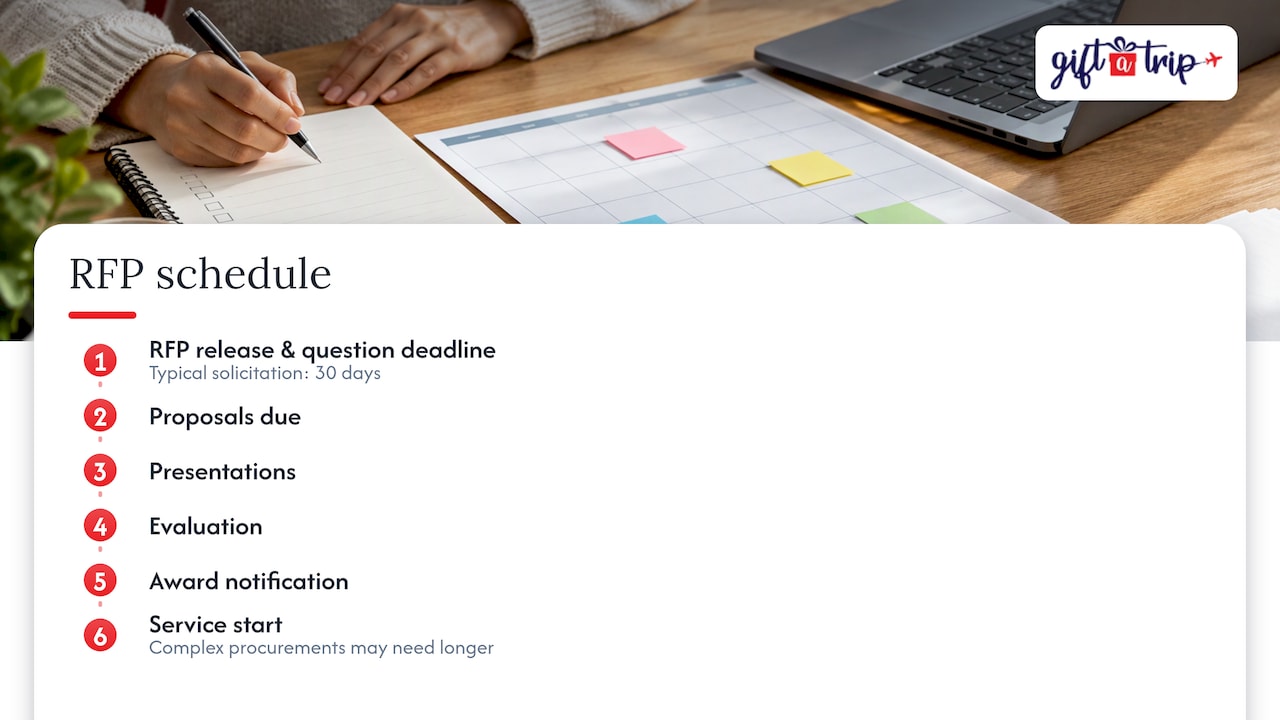
List the milestones: RFP release, deadline for questions, proposals due, presentations, evaluation, award notification and service start. The Northern Arizona RFP follows this sequence. As for timing, the University of Texas Southwestern’s procurement handbook says a 30-day solicitation period is typical for many RFPs, while complex procurements may need longer and evaluation, presentations and negotiations can extend the overall schedule.
Work backward from your busiest gifting window. If a holiday program matters to you, see our holiday gift card lead times before you fix the award date.
9. Proposal format, certifications and contract terms
Require numbered responses that match your question numbers, vendor contact details, any certifications you need, and the contract terms you expect. Invite supporting specifications or sample quotations, as the Minnesota RFI does. Numbered answers let you score each vendor line by line.
How to score the proposals
Publish your criteria and weights in the RFP so vendors know what matters. Here is a starting set you can adjust to your priorities:
| Criterion | Suggested weight | What to look for |
|---|---|---|
| Product fit | 20% | Brands and formats that match your recipients |
| Security and controls | 20% | Approval workflows, fraud monitoring, reporting |
| Ordering and delivery | 20% | Bulk and single orders, delivery speed, tracking |
| Total cost | 20% | All-inclusive cost on the shared pricing exhibit |
| Support and references | 20% | Recipient support, escalation, customer references |
These weights are our suggestion, not a standard. If you run mostly urgent sales incentives, give delivery more weight. If finance sign-off drives the decision, raise cost and reporting.
Two practical habits improve scoring. First, score each criterion independently before anyone looks at the totals. Second, hold vendor presentations only after written scoring, so a polished demo does not override the paper.
Extra questions for travel certificates
Travel rewards are different from retail cards. The value is a stay or a trip, so the redemption rules matter more. If travel is part of your program, add these questions to the product section:
- Are taxes, gratuities and resort fees included in the certificate price, or does the recipient pay them at the destination?
- What are the blackout dates, and how many are there?
- How long does a recipient have to redeem, and can the validity period be extended?
- Which brands and destinations are covered: resorts, hotels, cruise lines, vacation packages?
- Can recipients choose among options, or is the trip fixed?
- Can you add a personal message and branding to each delivery?
On the first point, our guide to how taxes are handled in travel certificates explains what to ask. If airfare is on your list, read the airline gift card restrictions that HR teams should check before committing.
Where the client fits
We built Gift A Trip for the buyers in this template: HR and sales managers, event planners, charities running fundraising auctions and retailers offering promotional rewards. Here is what we offer against the criteria above:
- Pricing: our certificates are designed with taxes, gratuities and fees covered, so the price you compare is the price you pay.
- Order size: no minimum order, with bulk ordering for corporate and event programs. Our step-by-step bulk ordering guide shows how it works for US companies.
- Delivery: secure digital delivery, with personalized messaging. Gift boxes, including custom, branded boxes for corporate orders, are available through our corporate gifting page. Red Box Delivery is a one-off $69 fee, listed on our gift delivery page.
- Redemption: minimal blackout dates and certificates redeemable for resorts, hotels, cruise lines and vacation packages from major brands.
- Program design: Custom Trip Selection Sites, Custom Flex Trip Collections and airfare vouchers in all denominations for organizations that want recipients to choose their own trip.
If you are drafting an RFP that includes a travel category, you can send our corporate gifting team your scope and your pricing exhibit and we will answer it line by line. Start at our corporate gifting page.
Our perspective
Most gift card RFPs are written around retail cards, and then a travel reward gets added as an afterthought. That is a missed chance. A trip is the reward people remember, and it is the one most sales and HR teams say they want to give but find hard to administer.
What we have built at Gift A Trip is meant to take that administration off your plate: no minimum order, secure digital delivery, personalized messages, bulk orders and certificates that cover taxes and fees, with minimal blackout dates. When a buyer asks us the questions in this template, those are the answers we want to be able to give plainly.
So our advice is to write the RFP around the reward you want recipients to feel, not only the card format. Put a travel certificate category in the scope, ask for all-inclusive pricing, and let recipients choose from resorts, hotels, cruises and vacation packages. That is how a program stops being a line item and becomes something people talk about.
Donovan
FAQ
How long should a gift card RFP be?
Long enough to define scope, pricing, security and scoring, and no longer. Most of the length belongs in the vendor response form, not in your introduction. Numbered questions keep answers short and easy to compare.
How many vendors should I invite?
Invite enough to get a real comparison, typically three to five, and make sure each covers the product types you need. Public buyers often post the RFP openly, but a private company can invite a shortlist. Give every vendor the same documents and the same deadline.
Do I need an RFP for a small gift card order?
Not usually. For a small pilot, a short quote request with your volume, values, delivery method and timeline is enough. Use the same pricing grid so you can compare quotes fairly, and keep the full RFP for programs with higher volume or several departments.
Should the RFP include travel certificates?
If you want recipients to receive a trip rather than a retail balance, yes. Add a category for resorts, hotels, cruises and vacation packages, and ask about included taxes and fees, blackout dates and redemption windows. Our corporate gifting page outlines how we handle corporate travel rewards.
What is the biggest mistake in gift card RFPs?
Comparing quotes that are not built on the same assumptions. Different volumes, denominations or fee definitions make totals meaningless. A single pricing exhibit and an all-inclusive per-card cost fix most of that.
Sources
- Northern Arizona University gift card incentive RFP (2021)
- Minnesota gift card incentive request for information (2026)
- New York Attorney General RFP 24-009, Purchasing Memorandum No. 3 (2025)
- University of Texas Southwestern procurement and contract management handbook
- Printing Industries of America, 2025 Best Digital Gift Card Programs