
A travel gift approval workflow is a short, written path every travel reward or gift follows before anyone is promised a trip: who asks, what they must state, which dollar threshold sends the request to which approver, and where the decision is recorded. Build it around fixed thresholds, one request form and one record, and a sales incentive, a client thank-you or an auction donation all move through the same routine in days. Because our certificates can be ordered in any quantity and delivered digitally, one reward or a few hundred can run through the same approval path.
TL;DR
- Set dollar thresholds first: low-value gifts approve automatically, mid-value gifts go to a manager, high-value or sensitive gifts go to compliance or finance.
- Every request states the recipient, the relationship, the business reason, the description and the cost. Approvers decide from that form alone.
- Treat a vacation reward for an employee as taxable wages. Route it through payroll, not just through the approver.
- Keep one record per decision, including denials and exceptions. That record is your proof the control works.
- Fixed, itemized travel certificates make the cost and description on the form easy to complete.
Table of Contents
- What a travel gift approval workflow does
- Who needs which version
- Step 1: Set the thresholds
- Step 2: Build one request form
- Step 3: Route by risk, not by habit
- Step 4: Decide, notify, and keep the denial
- Step 5: Send the reward through payroll or finance
- Step 6: Review the program once a year
- A worked example
- Put the workflow to work with Gift A Trip
- Our view on approval workflows
- FAQ
- Sources
What a travel gift approval workflow does
A travel gift is any trip, cruise, resort stay or airfare voucher given to an employee, a customer, a partner or a prize winner. The risk is not the trip itself. It is a trip handed out without a decision: a manager promising a cruise to a sales team, a client receiving a resort stay in the middle of a contract renewal, a payroll team learning about a prize after year-end.
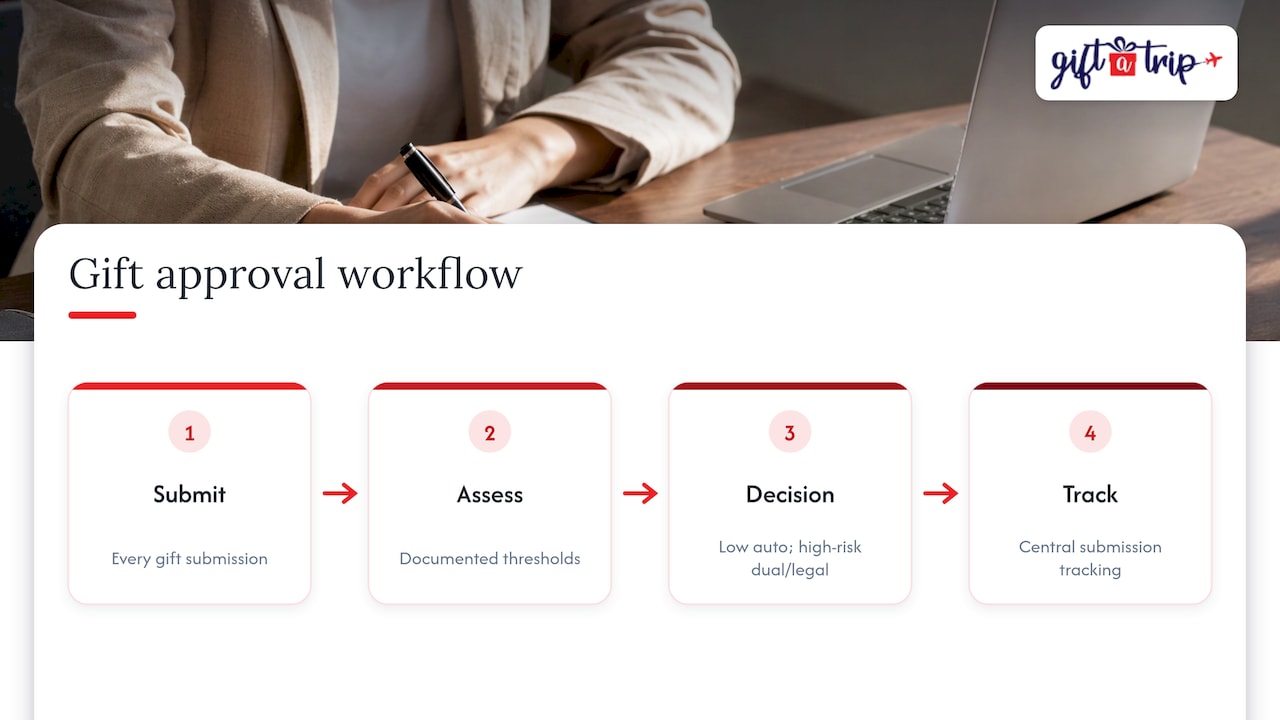
A workflow is a pre-clearance process. Ethico’s guide to building one describes it as documented thresholds and branching logic, with auto-approval for low-value items, dual or legal review for high-risk ones, and central tracking of every submission. The same scenario then follows the same path whoever submits it.
Citi’s corporate travel policy guidance adds a point that matters for incentive programs: rewards can pull bookings outside managed tools, so the policy has to be explicit, and delayed pre-trip approvals are a known driver of higher travel costs. Fast approval is part of the design, not an afterthought.
Who needs which version
The steps below are the same for everyone. What changes is the approver and the tax treatment.
| Program | Typical requester | Typical approver | Main tax question |
|---|---|---|---|
| Sales incentive or employee award | Sales or HR manager | Department head, HR, payroll | Wages on Form W-2 |
| Client or partner thank-you | Account manager | Manager, then compliance above a threshold | $25 business gift limit |
| Event prizes and giveaways | Event planner | Event owner, finance | Prize income for the winner |
| Charity auction item | Development director | Board treasurer or executive director | Fair market value and donor receipts |
| Retail or promotional reward | Marketing lead | Marketing head, finance | Prize income, deduction rules |
Step 1: Set the thresholds
Thresholds turn a judgment call into a rule. Published examples show the range:
- Mitratech’s gifts and entertainment template auto-approves items under $25, auto-rejects items over $250, and sends $25 to $249 to manager review and, if advanced, compliance review.
- GAIN’s guide suggests automatic approval below $50, manager approval from $50 to $100 and compliance and ethics approval above $100, and says to tailor the figures to local costs.
- Diebold Nixdorf’s policy requires pre-approval in North America for gifts over $75 and entertainment over $150 per person.
A trip is rarely under $50, so a travel program usually needs its own tiers. A workable starting point, to be adjusted to your budget and your counsel’s advice:
- Tier 1, manager sign-off: rewards inside a pre-approved program budget, such as a standard sales-contest prize.
- Tier 2, manager plus HR or finance: any reward above the program’s standard value, or any reward to a single person in a second award within the year.
- Tier 3, compliance or legal: any gift to a client in an active negotiation, to a public official, or above your top dollar limit.
Add a cumulative limit as well. Ethico recommends cumulative limits and prohibited categories alongside per-item thresholds, because ten small gifts to one person can add up to a large one.
Step 2: Build one request form
Approvers decide only as well as the form lets them. A US company’s gifts and hospitality policy requires the beneficiary’s full name, title and organization, the justification, a description and the cost, with approval by the line manager and the compliance officer. Use that as the base and add what travel needs:
- Recipient name, role and, for a client, the organization and the current deal status.
- Business reason: sales target met, work anniversary, client milestone, auction donation.
- What is being given: certificate type, destination category, face value, any added airfare voucher.
- Total cost, including any delivery or presentation cost.
- Whether a spouse or guest is included.
- Tax route: payroll wages, business gift, prize or charitable item.
Lenovo’s global policy shows how strict a large company gets: written pre-approval of the third party, expense type, business purpose, projected value and date, no payment for family members or personal guests, and payment made directly to the service provider rather than to an individual. You do not need to copy that level, but the discipline of naming the purpose and value up front is worth borrowing.
Where we help: a certificate has a defined description and value, so the “what and how much” lines of the form are filled in from the order itself. Our corporate gifting page lists custom trip selection sites, airfare vouchers in all denominations and custom Flex Trip Collections, so a program can be defined once and reused for each request.
Step 3: Route by risk, not by habit
Risk-based routing means the same dollar amount can take different paths depending on who receives it. Ethico gives examples: dual approval for gifts over $200 involving a vendor in active negotiations, and legal review for gifts involving government officials. GAIN goes further and says requests involving public officials should always be reviewed by ethics and compliance whatever the amount.
For a travel program that means three routing questions on the form:
- Is the recipient an employee, a customer, a prospect or a public official?
- Is a purchase decision pending with the recipient’s organization?
- Does the total exceed the cumulative limit for this person this year?
If the answer to any is yes, the request goes up a tier. Everything else stays in the fast lane.
Privately sponsored travel for government personnel is its own regime. The US Senate Ethics Committee, for example, requires a pre-travel package at least 30 days before departure and does not approve trips retroactively. Do not offer a trip to a government employee without checking the recipient’s own agency rules first, and route it to your legal counsel.
Step 4: Decide, notify, and keep the denial
In practice, as one compliance guide describes it, an ethics officer or counsel reviews the submission against company thresholds, usually within a few business days, and the requester is told the outcome. If it is denied, the gift is declined or returned, and the denial itself is recorded as evidence the control works.
Set a service level you can keep, such as two business days for Tier 1 and Tier 2. A slow workflow teaches managers to skip it.
For exceptions, copy the structure of Lockheed Martin’s ethics policy: an exception request names the people involved, the type of courtesy, its fair market value, when and where it is offered, any government affiliation and the benefit to the company, and the ethics officer or counsel answers in writing.
Step 5: Send the reward through payroll or finance
Approval is not the end. The approved gift must reach the right ledger. For employee and sales rewards, the tax treatment decides it.
Employee and sales team rewards
IRS Publication 525 says that awards for outstanding work, including vacation trips won for meeting sales goals, are included in income at fair market value and reported on Form W-2. Gift certificates given as holiday gifts are also taxable wages whatever the amount.
The employer deduction rules point the same way. Section 274(j) caps deductions for employee achievement awards at $400 or $1,600 per employee per year, and the tangible property that qualifies excludes gift certificates, vacations, lodging and event tickets. Treasury’s regulation 1.274-2 provides that an employer’s expense for a vacation trip given to an employee is deductible when it is treated as compensation and wages for withholding. KPMG’s payroll report makes the same point for gift cards and coupons that can be redeemed for cash value.
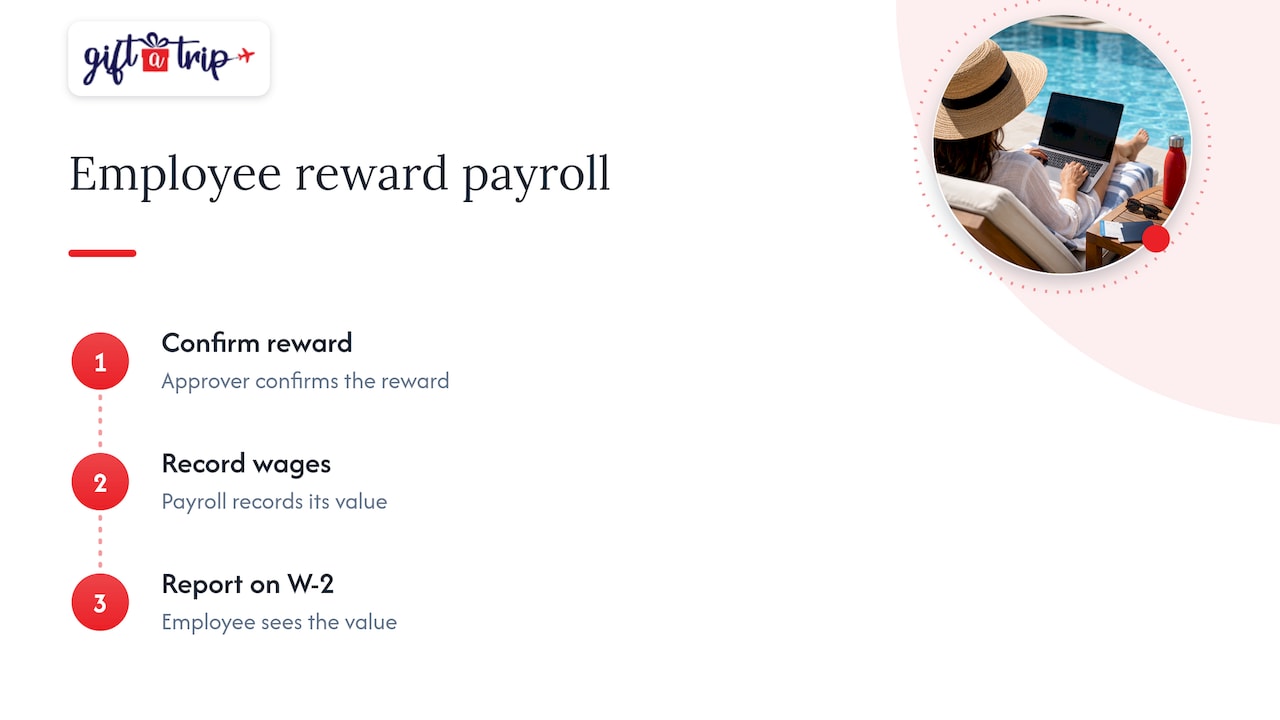
Practical consequence: your workflow needs a payroll step. The approver confirms the reward, payroll records the value as wages and the employee sees it on the W-2. If you want to reward a team with travel, plan for the tax cost on the recipient’s side so the reward lands as a pleasure, not a surprise. We cover the mechanics in our guide to gifting employee travel with tax-smart solutions.
Customers, retailers and partners
For business gifts, the IRS limits the deduction to $25 per person per year, and a gift to a customer’s family member generally counts as an indirect gift to the customer. A trip will exceed that quickly. Prizes to non-employees, such as retailers who beat a sales quota, are treated differently: the regulation above says a vacation trip given as a prize includible in the winner’s gross income is considered directly related to the active conduct of business and deductible. Have your tax adviser confirm the treatment of each program before launch.
The IRS also requires records. Its small business FAQ says to keep timely proof of business purpose, description, amount and date. The request form in Step 2 already captures all four, which is the point of building the form well.
Charity auctions
If your organization auctions a trip, the winner’s deduction depends on what they paid against the trip’s value. IRS Publication 526 gives the example of a bidder who pays no more than the fair rental value of a beach house week and so makes no deductible contribution. Record the fair market value of each travel item before the auction so receipts and acknowledgments are accurate, and have the board treasurer approve the item list.
Step 6: Review the program once a year
Policies fail when they sit unread or when only junior staff follow them. LegalClarity’s team recommends training with realistic ambiguous scenarios and applying the rules to executives as well. Once a year:
- Pull the log and count approvals, denials and exceptions by tier.
- Check turnaround time against your service level.
- Compare the tiers with current costs, and update the tax notes if the rules changed.
- Rerun two or three real cases with managers so they can say no without damaging a relationship.
Thresholds can also move for reasons outside your control. For 2026, for instance, the US Office of Government Ethics raised its executive-branch gift reporting threshold to more than $525 from any one source. That applies to federal executive-branch employees, not private companies, but it is a reminder to review limits on a schedule.
A worked example
A regional sales director wants to reward the three top reps with a resort stay each. She submits one form per rep: name, role, “exceeded annual quota,” a resort stay certificate, its face value and a note that payroll will report it as wages. The value is above the Tier 1 limit, so HR reviews it too. HR approves in two days, payroll records the value for the W-2, and the certificates go out digitally. Each decision sits in the log with its date. If the same director later wanted to thank a client during a renewal, the form would route to compliance because a purchase decision is pending. Same form, different path.
Put the workflow to work with Gift A Trip
Once the approval path is clear, the next question is what to approve. We sell digital and physical travel certificates for resorts, hotels, cruises and vacation packages from major brands, with taxes, resort fees and gratuities included and minimal blackout dates. There is no minimum order, and orders can be placed in bulk with personalized messaging.
For programs, our corporate gifting page covers custom trip selection sites, airfare vouchers in all denominations, custom Flex Trip Collections and custom, branded gift box delivery. If you want a physical presentation, Red Box Delivery is $69 one-off. For ready-made options, browse cruises, resorts and golf and spa getaways, or the Flex Trip Collections.

If you are building the program from scratch, our guides on how to organize gifting programs for HR and managers and step-by-step employee reward gifting pair well with this workflow.
Our view on approval workflows
We think a good approval workflow should make a generous program easier to run, not harder. The managers who skip approval are rarely trying to dodge rules. They are busy, and the form is slow.
So we design around speed and clarity. A reward with a fixed description and a clear value is simple to approve in minutes. A program with custom trip selection sites, set denominations and personalized messaging lets HR approve the program once and then let managers draw from it.
That is why we offer corporate gifting with no minimum order, bulk ordering, secure digital delivery and taxes, resort fees and gratuities included in the certificate price. When the cost on the form is the cost the recipient experiences, there is less to reconcile later.
Write the thresholds, build the form, record every decision, and then spend your energy on the part that matters: choosing a trip that someone will remember.
Donovan
FAQ
Who should approve a travel gift?
The requester’s manager approves routine rewards inside a set program budget. Higher values, client gifts during active negotiations and anything involving public officials go to compliance, legal or finance. The right split is the one your thresholds define, and published examples such as GAIN’s put compliance approval above $100 for general gifts.
Is a travel reward for an employee taxable?
Generally yes. The IRS says prizes such as vacation trips won for meeting sales goals are included in employee income at fair market value and reported on Form W-2. Ask your payroll provider or tax adviser how to report each program.
What dollar limit applies to client travel gifts?
The IRS business gift deduction limit is $25 per person per tax year, with narrow exceptions. Many companies also set their own, lower approval thresholds. Set yours in the policy and have counsel confirm it, especially for clients in regulated industries.
How long should approval take?
A few business days is typical for reviews that need an ethics officer or counsel. For routine rewards, set a shorter service level, such as two business days, so managers do not work around the process.
Can the same workflow cover charity auction items?
Yes. Use the same form, with fair market value as a required field and the board treasurer or executive director as approver. Fair market value drives what bidders can deduct, so record it before the event.
Sources
- Ethico: Gifts and Entertainment Compliance Policy pre-clearance workflow
- Citi: Corporate Travel Policy
- Mitratech: Gifts and Entertainment Template Guide
- GAIN: Gifts & Entertainment Management
- Diebold Nixdorf: Gifts, Entertainment & Travel Policy
- Gifts, Entertainment and Hospitality Policy
- Lenovo: Global Gift, Entertainment, Corporate Hospitality and Travel Policy
- US Senate Ethics Committee: privately sponsored travel
- LegalClarity: Gifts and Entertainment Policy
- Lockheed Martin: CPS-008
- IRS Publication 525 (2025)
- 26 U.S.C. Section 274 (GovInfo)
- eCFR: 26 CFR 1.274-2
- KPMG: Payroll 2025 year-end report
- IRS Publication 463 (2025)
- IRS: Income & Expenses 8
- IRS Publication 526 (2025)
- Federal Register: Office of Government Ethics final rule