The best silent auction displays do four things. They put items at eye level, light them evenly, label them so a guest can bid in seconds, and sit on the path guests already walk. Everything below serves those four goals, and none of it needs a big budget. Most of it needs boxes, tablecloths, a few clip lights and a little planning.
This guide covers ten ideas for 2026 events, from table layout to bid sheets to how to show a travel certificate so it looks as good as a basket of wine.
TL;DR
- Build one concentrated display on a route guests already walk, with aisles about four feet wide, and keep it away from the registration desk and the bar queue.
- Add height with risers hidden under tablecloths, and light every item evenly with warm, glare-free lighting.
- Give each lot one bid sheet or display sheet with number, description, value, starting bid, increment, donor and closing time.
- Mix categories and price points instead of segregating them, and stagger closing times to create urgency.
- Show experience items, such as travel, with a photo, a framed certificate and a clear card explaining how to redeem.
Table of Contents
- 1. Choose one layout that fits the room
- 2. Put the display where guests already walk
- 3. Add height with risers hidden under tablecloths
- 4. Light every item, and avoid glare
- 5. Make signs and bid sheets do the selling
- 6. Mix categories instead of separating them
- 7. Present baskets with one clear theme
- 8. Display travel and experience items so they feel real
- 9. Color-code sections and stagger the closing times
- 10. Plan for access, space and safety
- Our perspective on travel lots
- Show your travel lot with Gift A Trip
- A simple setup timeline
- FAQ
- Sources
1. Choose one layout that fits the room
Start with the floor plan, not the decor. Event planners commonly choose among a horseshoe (U) layout, long central rows, islands, or a perimeter-plus-islands plan, depending on room shape and item count. Map D’s display guide recommends keeping aisles around four feet wide so two people can pass each other.
A one-way loop or U-shaped flow with no dead ends works well because guests keep moving and never have to turn back through a crowd. CharityAuctions suggests three- to four-foot aisles, items that are visible and reachable, and extra space around premium pieces.
A quick way to pick:
| Room or crowd | Layout that tends to work |
|---|---|
| Long, narrow room | Central rows with open ends, or a perimeter run along one wall |
| Square ballroom | Islands with walking space on all sides |
| Small room, under about 40 lots | U-shape or horseshoe against three walls |
| 200 or more lots | Perimeter plus islands, with color-coded sections |
Tape the footprint on the floor before the day. If two people with plates cannot pass each other in a taped aisle, the real one will bottleneck.
2. Put the display where guests already walk
Location beats decoration. Guests who never walk past your tables never bid on them.
Handbid’s display-area guide recommends a spot that is visible and accessible to everyone, but not directly in front of registration, the main ballroom entrance or the bar, and it warns that narrow hallways are poor locations. Marquam Agency suggests placing sale tables front and center with room for foot traffic on all sides.
Two practical tips:
- Route guests past the tables. GalaBid recommends one well-positioned area rather than items scattered around the venue, ideally along routes to the bar or restrooms.
- Anchor with your best lots. RallyUp’s silent auction guide recommends placing high-value items near the bar, food or main mingling area.
One concentrated, supervised display is easier to browse, light and staff than three small ones.
3. Add height with risers hidden under tablecloths
A flat table of items reads as clutter. Height gives the eye a path and lets guests see items at the back.
Map D recommends tiered risers, vertical racks, easels and shelves, and mannequins for apparel. On a small budget, a nonprofit fundraiser described in a 2017 post by Michelle Paige used shoe boxes, storage bins, packing boxes and paint cans under tablecloths as inexpensive risers.
A simple three-level build:
- Place sturdy boxes or bins at the back of the table.
- Add a smaller layer in the middle.
- Drape the whole table in one cloth, so the steps disappear.
- Put your tallest or most valuable item on the top step and smaller lots in front.
Test each riser with a firm push before you load it. A wobbling stack of bottles is a safety problem as well as a visual one.
4. Light every item, and avoid glare
A dim corner of a ballroom kills bids. If the venue does not light the auction area well, Greater Giving points to battery-operated lights that sit flush on tables as a low-cost fix.
What to aim for:
- Even, warm light across the table, so labels are readable.
- Clip-on LEDs or small uplights aimed at signs, not at guests’ eyes, as CharityAuctions suggests, along with neutral, non-glossy linens.
- Angled light on the features you want noticed, a point also made by BiddingOwl.
- No glare on glass, frames or shiny items. Move the light or tilt the item.
Battery candles and string lights add atmosphere, but keep them away from the bid sheets so nobody squints to read a starting bid.
5. Make signs and bid sheets do the selling
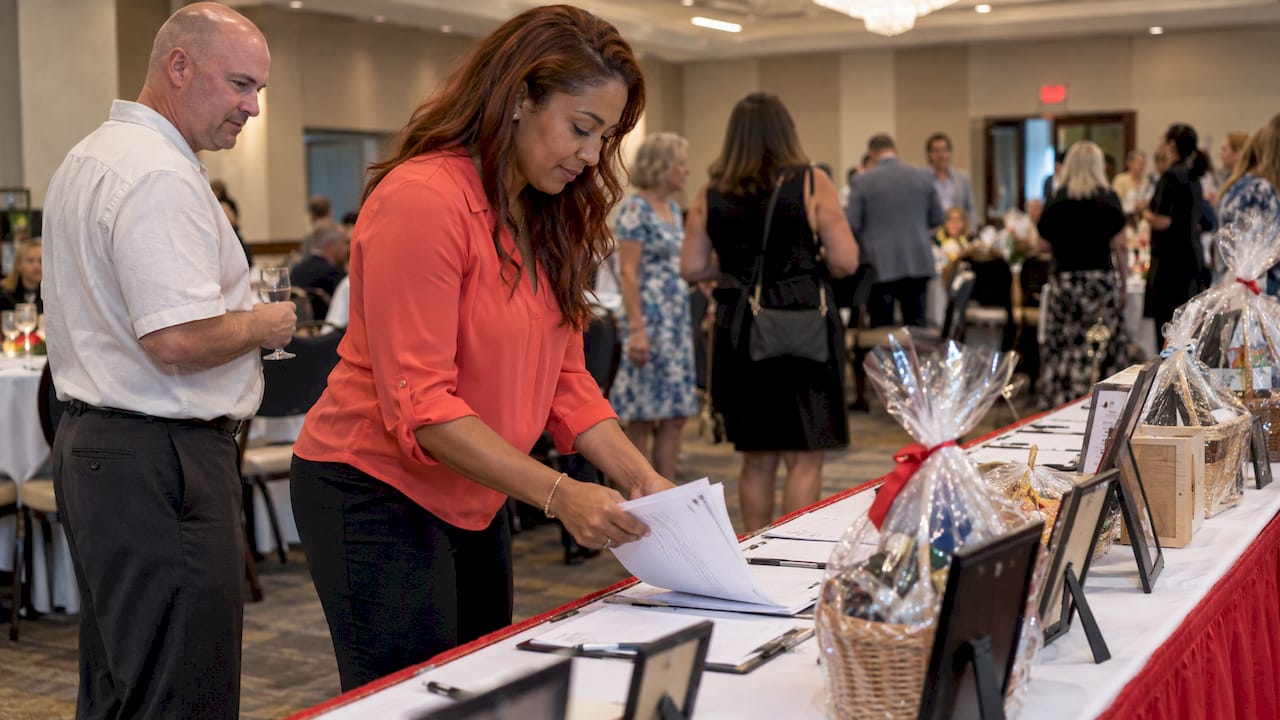
A good sign answers the questions a guest would otherwise ask a volunteer. 32auctions distinguishes the display sheet from the bid sheet and recommends one item per sheet. A complete display sheet includes:
- Item name and number
- A vivid, short description
- Fair-market value
- Starting bid and bid increment
- Donor credit
- A photo
- A QR code, if you accept mobile bids
- Closing time, or how bidding ends
CharityAuctions adds restrictions, blackout dates, expiration and redemption steps for experience items. That matters most for travel and services, where the guest needs to know the rules before bidding.
For paper bid sheets, Zeffy’s bid sheet guide recommends large fonts, the exact close time on every sheet, clear increments and spare pens, plus a bidder-number system to cut sign-up friction. Map D suggests placing sheets at the front edge of the table, secured with a clipboard, stand or frame, at a height that standing guests and wheelchair users can both use.
Clarity beats decoration. Short, scannable descriptions and an uncluttered table reduce bidder uncertainty.
6. Mix categories instead of separating them
It feels tidy to give wine one table, spa one table and travel one table. But Greater Giving advises mixing items rather than separating every table by category, because category-only sections may limit browsing and impulse bidding.
Other guides take a middle path. BetterWorld suggests grouping similar items, such as travel packages or art, so guests can find their interests. A workable compromise:
- Group by theme within a table, but put a different theme on the next table.
- Put a high-value lot at the end of each run, and a lower-priced one beside it.
- Keep related lots, such as a hotel stay and a dining certificate, close enough to inspire a pairing.
Also leave breathing room. Marquam Agency’s guidance is at least two feet of space between items on a table, so each one reads as its own lot.
7. Present baskets with one clear theme
Baskets are the classic silent auction item, and the most often overstuffed. CharityAuctions’ basket guide recommends one clear theme per basket, a one-line name, a card listing the contents, and numbering that matches the bid sheet.
Budget touches from the Michelle Paige post: second-hand-store baskets, tissue or paper filler to lift the contents for visibility, and cellophane bags with ribbon. Set themed baskets side by side, grouped by theme or price tier, as Map D suggests.
A “getaway” basket is a natural place to include a travel certificate: a framed card, a beach towel, sunscreen and a paperback. The certificate is the headline, and the basket tells the story around it.

8. Display travel and experience items so they feel real
Experience lots are tricky because there is nothing to pick up. A guest cannot hold a week at a resort. Handbid notes that physical items can be displayed directly, while photos and descriptions in stands work when the actual item must stay behind the scenes. Travel falls squarely into the second group, so the photo does the work.
What works for a travel lot:
- A large, bright destination photo as the focal point, in a frame or on an easel.
- The certificate itself, or a mock-up of it, in a clear holder beside the photo.
- A short benefit-first title, such as “Seven Nights by the Water”, rather than a brand name alone.
- A plain redemption card: how the winner books, any blackout dates, and the expiration.
- A matching small prop such as a luggage tag or a seashell.
If you are choosing what to auction, our guides on what makes a good auction item, why experiential auction items work and creative auction item ideas can help you decide before you design the table. For the logistics of getting a travel lot from donor to winner, see our charitable auction travel workflow and the checklist of common auction travel mistakes.
9. Color-code sections and stagger the closing times
The display does not stop at the table. It also has to manage the clock.
Greater Giving recommends staggered closing times for multiple sections, which creates urgency and gives staff time to prepare checkout and pickup, and closing silent sections before dinner seating. It also states that most silent auction bidding happens in the final 30 minutes, and suggests color-coding sections so guests can see which area closes next. Printing bid sheets on colored paper that matches the section is an easy way to do it.
For the close itself, wikiHow’s silent auction guide suggests announcing the end at least 10 and 5 minutes beforehand, naming one person’s watch as the official time, and collecting sheets and pens promptly. Marquam Agency adds that you should pull the sheets the moment the auction closes.
10. Plan for access, space and safety
A display that some guests cannot approach is a display that loses bids. Guidance from the Washington Pavilion’s ADA specifications for vendors says accessible displays should sit next to an accessible route, leave enough clear floor space for wheelchair or scooter users to pass and examine objects, and offer an alternative, such as bringing items closer, when a display cannot be changed.
In practice:
- Keep aisles clear of cords, easels and chair backs.
- Set bid sheets and pens at a height reachable from a seated position.
- Keep at least one good lot per table within easy reach.
- If you use mobile bidding, test Wi-Fi and cellular service in the actual event room, as RallyUp recommends.
For a specific venue, ask the venue’s event manager or an accessibility consultant what applies to your space.
Our perspective on travel lots
We see the same pattern at many charity events. The travel lot is often the most valuable item in the room and the least visible, because a certificate is a flat piece of paper next to a bright basket.
Our view is that a travel lot deserves the best spot on the table. Give it a large photo, a clean card that explains how the winner redeems it, and a place on the route guests walk. A guest who understands the prize bids with more confidence.
That is why our certificates are designed for gifting and auctions. They offer wide brand coverage across resorts, hotels and cruises, with digital delivery and minimal blackout dates, so the card on your table can be short and clear.
Donovan
Show your travel lot with Gift A Trip
If your auction needs a travel item, you can browse resort, hotel and cruise certificates, including Royal Caribbean certificates and golf and spa resort stay certificates. Our approach to taxes, resort fees and secure digital delivery is designed to keep the redemption card simple.

For a presentation piece, our Red Box Delivery option is a one-off $69. Organizations ordering for several events or sponsors can look at corporate gifting options. For more on the lots themselves, read travel rewards for fundraising and our step-by-step guide to charity auction gift certificates.
A simple setup timeline
Use this order on the day so nothing is rushed:
- Four hours before: confirm the layout against the taped floor plan and set up tables and risers.
- Three hours before: drape tables, place items and stand them at their final heights.
- Two hours before: print and place display sheets and bid sheets, with pens, one item per sheet.
- One hour before: add lighting and check for glare from the guest side of the table.
- Before doors open: walk the loop yourself, from a seated height too, and fix any dead ends.
For wider event planning, our charity event planning tips for travel auctions add the other pieces around the display.
FAQ
What is the best way to display silent auction items?
Use nice tables, a clear layout, even lighting and readable signs. Add height with risers under tablecloths, give each item its own bid sheet, and keep aisles around four feet wide. Put your strongest lots where guests already walk.
How do you display silent auction items on a small budget?
Hidden boxes, bins and shoe boxes under cloths work as risers. Second-hand baskets, tissue filler and cellophane make baskets look full. Clipboards, colored paper, markers and volunteer monitors cover the rest of the setup.
How should a travel certificate be displayed?
Use a large destination photo, a framed or clear-holder certificate, a short title and a card with redemption steps, restrictions and the expiration. Guests cannot touch the prize, so the photo and the card carry the sale.
Should silent auction items be grouped by category?
Some grouping helps guests find their interests, but guidance from auction specialists favors mixing categories and price points so guests browse more widely. A theme per table with a mix of price levels is a balanced approach.
Sources
- Silent Auction Display Ideas: Layouts and Signage, Map D
- Auction Item Display Tips, CharityAuctions
- Silent Auction Basket Ideas, CharityAuctions
- Greater Giving best practices
- 15 Best Silent Auction Display Ideas, BiddingOwl
- How to create inviting silent auction displays, BetterWorld
- How to Set Up and Display Silent Auctions, Marquam Agency
- Silent Auction Display Sheets and Bid Sheets, 32auctions
- Free Silent Auction Bid Sheet Template, Zeffy
- How to Run a Silent Auction, RallyUp
- Creating an Effective Silent Auction Display Area, Handbid
- Onsite Charity Auction Display Best Practice Guide, GalaBid
- How to Run a Silent Auction, wikiHow
- Decorate a Fundraising Auction for Cheap, Michelle Paige Blogs
- Vendor Compliance with the Americans with Disabilities Act, Washington Pavilion