
The best way to close a silent auction is to pick one clear end time, publish it everywhere, close before the crowd’s attention moves to the next thing, and stagger sections if you have more than a few dozen items. Do that and the last 15 minutes will bring in more bids than the first three hours. This guide gives you nine tactics for in-person, online and hybrid events, with timing examples you can copy.
TL;DR
- Close in the evening: roughly 7 to 9 pm local time for online auctions, and before dinner or the live program for in-person events.
- Online, run five to ten days. In the room, plan about 90 minutes of total bidding.
- Announce the close at 15 and 5 minutes, then close exactly on time.
- Stagger section closes for larger catalogs, and decide your soft-close rule before bidding opens.
- Have checkout, bagging and pickup ready before the first section closes.
Table of Contents
- 1. Choose a closing time bidders can actually attend
- 2. Give online bidding a long enough runway
- 3. Close before the live auction, not after the room has moved on
- 4. Stagger your section closes
- 5. Announce the close three times, then stop on schedule
- 6. Make the final stretch feel like an event
- 7. Decide your soft-close rule before bidding opens
- 8. Publish rules that remove arguments at the close
- 9. Plan checkout before the clock runs out
- A sample closing timeline for a 150-guest gala
- Our perspective on closing with travel items
- Add a travel section that bids up at the close
- Quick checklist before you close
- FAQ
- Sources
1. Choose a closing time bidders can actually attend
For online auctions, one fundraising guide recommends a mid-evening close of roughly 7 to 9 pm local time, and warns against working-day and midnight closes. Another says the last day routinely brings a disproportionate share of bids, so close when people are off work and on their phones.
For in-person events, work backward from your program. One event consultant suggests wrapping up all fundraising, including checkout, by 10 pm for a weekend evening and 9 pm on a weeknight, so guests can pay and leave without feeling stuck.
A quick test: picture your most likely bidder. If she is at her desk, on a plane or asleep at your close time, move it.
2. Give online bidding a long enough runway
Most community auctions do well with seven to ten days of online bidding. Another platform guide puts the typical range at five to ten days. The long window is not about the middle days. It lets every supporter see the catalog, tell a friend and set a reminder, so the final hours have an audience.
A simple online schedule:
| Day | What happens |
|---|---|
| Day 1 | Launch to your email list and social channels |
| Days 2 to 4 | Feature a few items each day, share bid totals |
| Days 5 to 6 | Reminder emails and texts to bidders who have not yet bid |
| Final day | Morning reminder, one-hour warning, evening close |
3. Close before the live auction, not after the room has moved on
Advice differs here, so match it to your event. One charity auctioneer says you want to close the silent auction before the live auction starts, with silent tables closed before dinner seating and about 90 minutes of total bidding for most events. Another guide calls closing after the live auction the most popular approach, with a 5 to 15 minute countdown after the live portion sufficient to drive last-minute bids.
Here is how we would choose:
- Seated dinner with a live auction: close before guests sit, or in waves around dinner. Attention is hardest to hold once the program starts.
- Cocktail-style event or hybrid: a short post-live countdown can work because guests are still standing, still holding phones, and still near the items.
- Online-only: close in the evening and let the platform handle the clock.
The common thread is attention. Close when most guests are still free to bid and before they are pulled elsewhere. One consultant puts it plainly: shut the auction down once you have diverted the crowd’s attention away from it.
4. Stagger your section closes
Closing every item at once creates a stampede at the tables and a long line at checkout. Day-of guidance for nonprofits says to avoid closing every item at the same time and to keep guests’ undivided attention on the auction during the final minutes.
Staggering spreads bidder attention so people can focus on one contest at a time, and at in-person events it moves guests through checkout in waves. Three real-world patterns:
- 15-minute framework: one guide closes Section A at 6:45 pm, B at 7:00 pm and C at 7:15 pm for a 7:30 pm seating, with all silent activity finished before guests sit.
- Zone pulls: another operator guide suggests pulling some items at 8:00 and further zones at 8:15 and 8:30 to keep larger auctions manageable for volunteers.
- Two halves: for a 40-item auction, one fundraising guide closes the first half 20 to 30 minutes before dinner service ends and the second half 15 to 20 minutes later as the program begins, with stage announcements at 15 and 5 minutes.
The charity auctioneer mentioned above suggests roughly 8 to 10 minutes between section closings. Put your highest-value and most contested items in the later sections, so the room stays engaged until the end.
Smaller catalogs are different. For a modest item count, closing everything together is fine, and staggering is mainly for large auctions or when it helps manage checkout waves.
5. Announce the close three times, then stop on schedule
Publish the close time in three places: entrance signage, item-table signage, and a verbal announcement at 15 and 5 minutes before close. Some guides suggest announcing 5 to 10 minutes in advance and again when you close. Pick a cadence, then repeat it for every section so guests learn the rhythm.
A script that works for an emcee:
- “Section A closes in 15 minutes. Walk the tables, check your bids.”
- “Five minutes. If you are not winning an item you love, now is the moment.”
- “Pencils down. Section A is closed.”
Then close at the time you promised. Moving the deadline teaches bidders that deadlines are negotiable, and the next event will be harder.
6. Make the final stretch feel like an event
The countdown is your best urgency tool. Online timed-auction guidance calls it the most powerful urgency tool and recommends reminding bidders by email, text and social posts, plus “last chance” previews near the end.
One fundraising guide suggests sending a reminder the morning of closing day and another an hour before, naming items within reach. At in-person events it also suggests projecting live bid activity and having the emcee announce the close.
Operations guidance goes further. One charity auction guide describes the final five-minute push before each section closes as the most critical period for revenue and says effective closing management can add 15 to 25 percent to section revenue. Treat that as the vendor’s figure, not a guarantee, but the direction is clear: staff the final minutes.
Practical touches:
- Put one volunteer at each section to answer questions and nudge undecided bidders.
- Use the one-hour text to name a few items where the gap to the leading bid is small.
- Keep the music and the speeches off during the last five minutes.
7. Decide your soft-close rule before bidding opens
Sniping is the habit of placing a winning bid in the last seconds, leaving no time to respond. Many platforms handle it with a soft close, which extends an item’s end time by a few minutes when a bid lands in the final moments.
How it works varies, so read your platform’s documentation:
- One system extends an item’s end time when a qualifying bid arrives within the last two minutes, and keeps extending for back-to-back bids.
- Another lets you set the trigger window, extension length and a maximum total extension, so a bidding war cannot run forever.
- Some platforms do not extend at all. One explains that the clock reaches zero and bidding closes immediately, regardless of when the last bid was placed.
Either choice is fine if you state it. A soft close rewards competitive items and keeps bidders from feeling ambushed. A hard close is simpler and creates sharper urgency. Whichever you pick, put it in the rules and the reminder emails so nobody is surprised.
8. Publish rules that remove arguments at the close
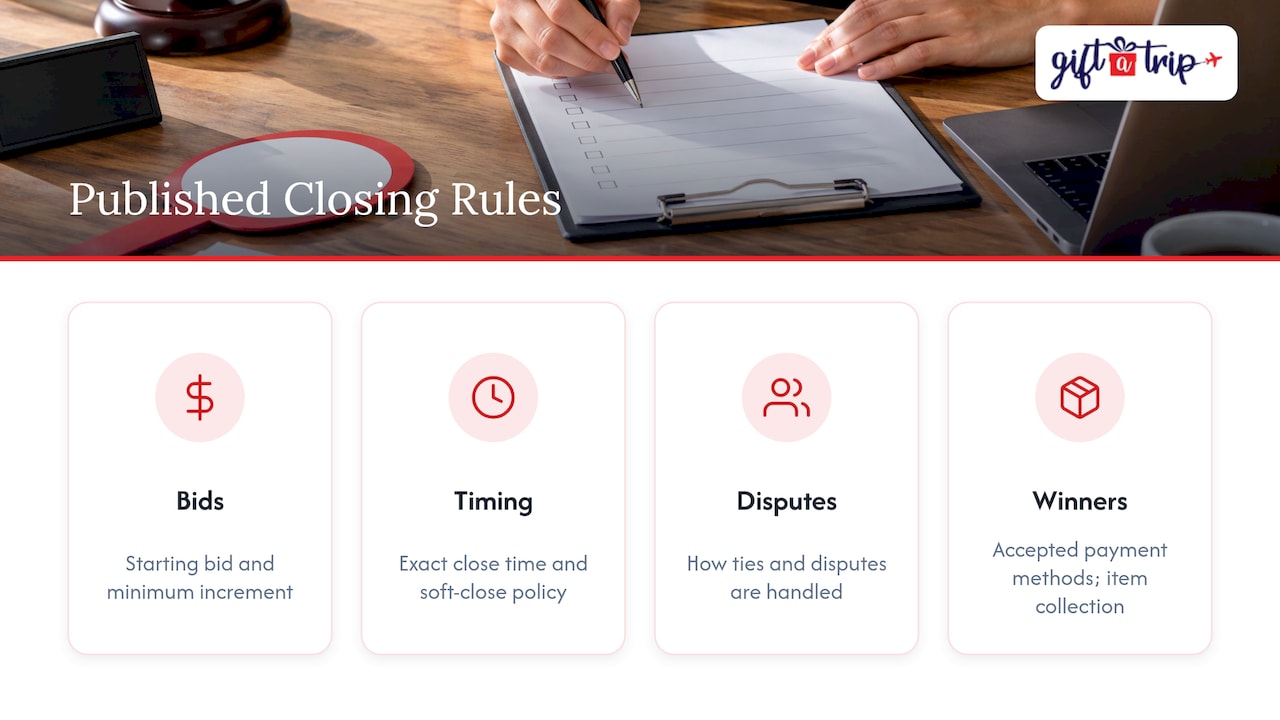
Most closing disputes come from unclear rules, not unreasonable bidders. Your published rules should cover the starting bid and minimum increment, the exact close time, the soft-close policy, how ties and disputes are handled, accepted payment methods, and when and how winners collect items.
A nonprofit rules template notes that bidders must know bidding starts and ends at the posted times and that bids after the close are invalid. That only holds if you enforce it.
For paper bid sheets, be explicit about the pull. One guide tells organizers to pull sheets right after the countdown and says an incompletely written bid does not count. The same guide notes you can start collecting from the other end if a few buyers place last-minute bids, but a bid must be complete when the sheet is pulled.
Assign runners to collect sheets and close down areas as sections end, rather than leaving all collection until the end.
9. Plan checkout before the clock runs out
A smooth close can be undone by a slow checkout. Winners are happiest, and most generous next year, when paying and collecting takes minutes.
Online: at the scheduled end, bidding stops, the highest valid bid wins, and Buy It Now options are no longer available. The system generates invoices and sends notification emails automatically. Your next steps are reviewing results, monitoring payments, following up on unpaid invoices, and arranging pickup, delivery or fulfillment. Release items only once paid.
In person: have checkout generate statements and take payment, then let guests retrieve items. For pickup, group items by winning bidder number, use labeled bags with a bid-sheet copy stapled on, and sort bags by number. For large events, staggered closes also give staff time to prepare checkout and pickup while later sections are still bidding.

Travel items need extra care. Certificates and vouchers are not handed over in a bag the way a gift basket is. Winners need clear redemption steps, so print them on the item card and in the receipt. Our guide to the charitable auction travel workflow walks through that handoff, and the common auction travel mistakes checklist covers what to tell winners before they leave.
A sample closing timeline for a 150-guest gala
Here is one way to put the tactics together for a weeknight in-person event with a 7:30 pm seated dinner. Adjust the times to your venue.
| Time | Action |
|---|---|
| 5:30 pm | Doors open, silent auction opens, close times posted at entrance and tables |
| 6:30 pm | Emcee announces the full closing schedule |
| 6:30 pm | Runners take positions at each section |
| 6:30 pm | Checkout team is set up and bags are labeled |
| 6:30 pm | Hold the last mingling window |
| 6:45 pm | 15-minute warning for Section A, then 5-minute warning at 6:55 |
| 7:00 pm | Section A closes, sheets pulled, winners sent to checkout |
| 7:00 pm | Section B warnings begin |
| 7:10 pm | Section B closes |
| 7:20 pm | Section C, with your best items, closes |
| 7:30 pm | Guests are seated and the live program begins |
The gaps between sections are shorter here than the 8 to 10 minute guidance above, so scale them to your headcount and volunteers. If you have fewer than 40 items, collapse this to two sections.
Our perspective on closing with travel items
We work with organizations that put travel certificates on their auction tables, and the closing moment looks different for them than for baskets and gift cards.
A travel item carries a story. Bidders imagine the trip, so they bid longer and with more feeling. That is why we suggest putting travel in the final section of a staggered close, where the room is already warm and the countdown is loudest.
It also helps that a digital travel certificate needs no bagging, no storage and no trip to the pickup table. The winner gets a clear way to redeem, and your volunteers spend the closing minutes on the items that are physical.
Our platform has no minimum order, so you can start with a single showpiece item or build a full travel section. If you need a presentation piece for the winner’s table, our delivery options are designed for that.
Donovan
The what makes a good auction item guide covers why experiences draw competitive bidding.
Add a travel section that bids up at the close
If you want a closing-section anchor, browse our cruise, resort and golf and spa certificates. They are digital, so there is nothing to carry out of the venue, and taxes and fees are covered in our pricing. For an in-person reveal, our Red Box Delivery is a one-off $69.

Working on several auction items at once? Our step-by-step guide to charity auction gift certificates shows how to set one up from start to finish.
Quick checklist before you close
- Close time chosen for your audience, and posted in three places.
- Soft-close policy decided and written into the rules and reminders.
- Section schedule built, with the best items closing last.
- Emcee script ready, with 15 and 5 minute announcements.
- Runners assigned to every section.
- Reminder emails and texts scheduled for the morning and one hour before.
- Checkout team, bags and invoices ready.
- Redemption instructions ready for travel and other non-physical items.
FAQ
What time should a silent auction end?
For online auctions, a mid-evening close around 7 to 9 pm local time works best, because supporters are off work and on their phones. At in-person events, close before dinner or before the live program pulls attention away. Weeknight events usually target wrapping up by 9 pm, and weekend events by 10 pm.
How long should a silent auction run?
Online, five to ten days is typical for community and nonprofit auctions, with the last day producing a large share of bids. In person, about 90 minutes of total bidding is a common target. Longer is fine if guests have other things to do between bids.
Should I stagger closing times?
For larger catalogs, yes. Staggered closes let guests focus on one section at a time and spread checkout across waves. For a small auction, one shared close time is simpler and works well.
What is a soft close and do I need one?
A soft close extends an item’s end time when a bid arrives in the final minutes, so late bidders get a chance to respond. You do not need one, but you must decide before bidding opens and tell bidders which rule applies. Many platforms let you set a maximum total extension.
What should I do right after bidding ends?
Online, review the winners and let the system send invoices, then follow up on unpaid ones before releasing items. In person, pull the sheets, run checkout, and hand over bagged items sorted by bidder number. For travel certificates, give winners clear redemption instructions.
Sources
- Silent auction closing strategy guide
- How to run a silent auction, online or in person
- Silent auction rules and etiquette
- When to close your silent auction
- Silent auction day-of checklist
- Closing out a silent auction without frustrated guests
- Timed online auction strategies
- Silent auction best practices for in-person events
- Charity auction operations guide
- Staggered closings for silent auctions
- Options for closing a silent auction
- How to increase bidding at a charity auction
- What happens when an online auction ends
- Silent auction soft close feature
- Bid extension settings for bidders
- How online auction timing and closing works
- Running a silent auction online or at your event
- When a silent auction should open and close
- Silent auction commandments from a charity auctioneer
- Silent auction rules for nonprofits
- Silent auction bid sheet template