
A travel stipend gives people money to cover trip costs under rules you set. A gift card gives them a fixed balance to spend at one merchant or anywhere a card network is accepted. The stipend is a benefit and the gift card is a reward. If you want a reward that feels like a trip and not like a paycheck, a third option sits between them: a travel certificate tied to a real stay, cruise or vacation package.
This guide compares all three on flexibility, administration, tax treatment and fit, so HR managers, sales leaders and event planners can pick the right one for the job.
TL;DR
- A travel stipend is an allowance or reimbursement for travel costs. The employer sets what it covers and how it is paid.
- A gift card is a stored-value card. Open cards work almost anywhere, closed cards work at one merchant, and the tax treatment follows the cash value.
- Under IRS guidance, gift certificates with cash-equivalent value are generally taxable. A stipend is tax-free only when it meets accountable-plan rules.
- Stipends suit ongoing, policy-driven travel benefits. Gift cards suit quick, low-effort thank-yous. A travel certificate suits milestone rewards, sales incentives, auctions and personal gifts.
- Whatever you choose, write down who receives it, who approves it and how you track it.
Table of Contents
- What a travel stipend is, and what a gift card is
- How each one works in practice
- Travel stipend vs gift card vs travel certificate
- How the IRS sees them
- When each option fits
- Our perspective
- How to choose: a short checklist
- Where Gift A Trip fits
- FAQ
- Sources
What a travel stipend is, and what a gift card is
A travel stipend is an allowance an employer provides toward travel-related costs. These can include transit fares, rideshares, gas, tolls, lodging, meals, baggage fees and parking. Some employers fix the amount up front. Others reimburse what the employee actually spent.
The design is flexible. According to PeopleKeep’s overview of travel stipends, employers can offer them as one-time bonuses, as recurring payments (monthly, quarterly or yearly), or as reimbursement of actual costs. The stipend is about the expense. It exists because travel costs money, and the policy defines what counts.
A gift card is about the reward. The UMass travel and expense policy defines gift cards as certificates or cards holding a specific monetary value. That covers bank-issued cards, which act like cash, and cards restricted to particular retailers.
The Incentive Research Foundation breaks prepaid cards into three groups in its study of prepaid cards in incentive programs:
- Open cards work wherever major credit cards are accepted.
- Closed cards work at a single vendor.
- Restricted cards work at a venue or for a specific range of goods or services.
That last distinction matters for travel. A “travel gift card” can mean a card good at one airline or hotel brand, an open-loop card that happens to pay for flights, or a certificate redeemed for a particular kind of trip. They behave very differently.
How each one works in practice
Travel stipends
The employer decides three things: which expenses are covered, how much money is available, and how the employee receives it. Common delivery methods include a fixed deposit, reimbursement against receipts, or funds loaded onto a company card.
Some organizations anchor the amount to federal per diem rates. The GSA publishes those rates for lodging and meals by location, and many employers use them as a ceiling or reference point.
For workers on temporary assignments, a stipend is often paid automatically with wages each pay period, so the employee never files an expense report. For a standard travel benefit, though, the typical model is a set budget plus a policy that says what the money may be spent on.
Gift cards
The mechanics are simpler. You buy a card with a stated value and hand it over. The recipient spends it where the card allows. There is no policy to enforce after the handoff, which is why gift cards are so popular for quick recognition.
In the IRF survey, 37% of incentive planners said prepaid cards were easier to administer than most rewards, and 20% said they were more flexible. The same research tells organizations to decide in advance what happens to unspent funds after a card expires: does the provider keep them, or do they come back to you?
Travel stipend vs gift card vs travel certificate
Here is the side-by-side view. The travel certificate column reflects how Gift A Trip designs its own product, not a market-wide rule.
| Factor | Travel stipend | Gift card | Travel certificate |
|---|---|---|---|
| What it is | Allowance or reimbursement for travel costs | Stored value at one merchant or on an open network | Certificate redeemed for a stay, cruise or vacation package |
| Who sets the rules | Employer policy | Card issuer | Certificate terms and the travel brand |
| Feels like | A benefit or expense policy | Cash substitute or retail treat | A trip, a memorable gift |
| Administration | Policy, approvals, often receipts | Light: buy, distribute, track | Light: choose, deliver digitally or in a box |
| Recordkeeping | Heavy if reimbursed under an accountable plan | Distribution log, recipient list | Distribution log, recipient list |
| Tax treatment | Excludable only under an accountable plan; otherwise taxable | Generally taxable when cash-equivalent | Depends on facts; confirm with a tax adviser |
| Best for | Ongoing travel benefits, remote work retreats, commuting | Spot recognition, small thank-yous | Milestones, sales incentives, auctions, honeymoons |
How the IRS sees them
This is where most employers get surprised, so read this section before you set a budget. It is general information, not tax advice, so check specifics with your payroll provider or a CPA.
Gift cards. The IRS says gift certificates redeemable for general merchandise, or with cash-equivalent value, are taxable. A narrow exception covers occasional meal money or transportation fare for working beyond normal hours. Further IRS guidance states that cash-equivalent fringe benefits such as gift certificates or charge or credit cards are generally not excludible as de minimis benefits. The IRF adds that the closer a prepaid card is to fully open, the more it becomes a cash substitute, and that the IRS treats open prepaid cards as cash wages subject to tracking, reporting and withholding.
Stipends. Treatment depends on structure. Under IRS rules, travel reimbursements are excluded from gross income and exempt from employment taxes when paid under an accountable plan. That plan requires a business connection, substantiation with receipts or equivalent documentation, and return of any excess.
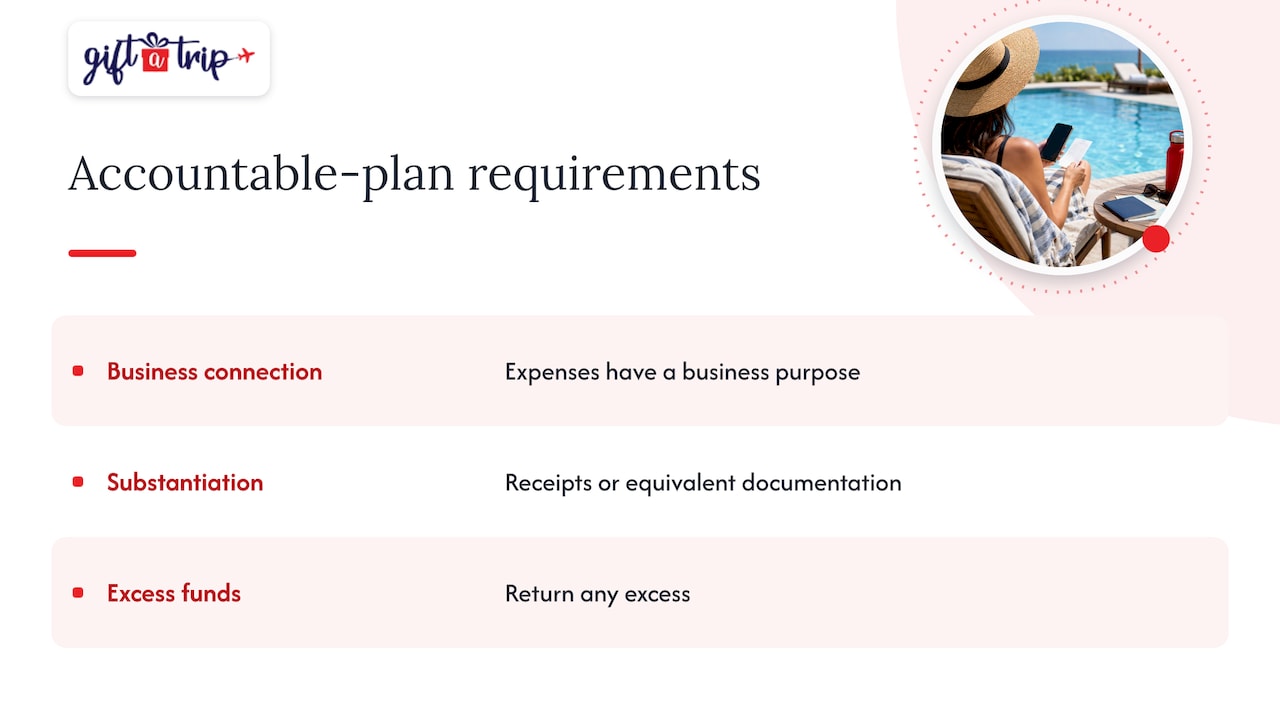
A stipend that skips those steps is a different story. IRS guidance explains that if an arrangement does not require substantiation or lets employees keep excess funds, the payments are treated as nonaccountable, and they become subject to income tax and employment tax withholding.
Travel stipends for non-employees, such as training participants or students, are a separate case. FIU’s tax guidance notes that these are generally treated as financial support rather than expense reimbursement, and so are typically taxable unless a specific exemption applies.
Travel certificates. Because the treatment of a reward depends on the facts, we do not offer a blanket answer here. Our own overview of how taxes are handled in travel certificates explains how to think about it, and your tax adviser should confirm how it applies to your program.
The practical takeaway: a stipend is the only one of the three with a clear path to tax-free treatment, and that path comes with paperwork. If you want zero paperwork, treat any cash-like reward as taxable income and plan your budget accordingly.
When each option fits
Employee rewards and recognition
For a long-term benefit that applies to everyone, a stipend works well. PeopleKeep notes that offering travel stipends to all employees can support an inclusive culture when the benefit is designed as a universal perk and not a limited incentive.
For recognition tied to a moment, such as a work anniversary, a record quarter or a retirement, the reward should feel like a gift, not a reimbursement. A gift card can do that, but it often disappears into groceries and gas. A trip is remembered. Our guides on vacation gift vouchers for employee recognition and hotel gift certificates for employee recognition walk through how teams use them.
Sales incentives
Sales teams respond to a visible prize. A stipend rarely works as a contest reward, because it reads as an expense budget and not a win. Gift cards are easy to hand out, but a $100 card is forgettable next to a cruise or resort week. Tiered travel certificates let you match the prize to the result: a golf or spa getaway for the top quartile, a cruise for the top performer.

The IRF makes a related point: prepaid cards are often used to substitute for cash, but many organizations find they work better as a thoughtful, personal reward when matched to the recipient’s interests. A travel certificate is that idea taken further.
Events and milestone celebrations
Event planners need prizes that can be handed over on stage and redeemed later. A certificate or a boxed gift fits that. A stipend does not suit a raffle or an awards night. A gift card does, but a modest one rarely delivers a “wow” moment. If you are building an event program, our travel certificate distribution guide for HR and events covers how to hand certificates out and keep track of them.
Charity auctions and fundraisers
Auction bidders want something with a story and a perceived value above a card balance. A cruise or resort stay certificate gives bidders a concrete experience to compete for. If you pair it with a local experience, such as team-building tour vouchers for a group outing, you can build a bundled lot that appeals to more bidders.
Personal gifts
For birthdays, anniversaries and honeymoons, a gift card says “go buy something.” A trip certificate says “go away together.” Stipends are not a personal gift format at all.
Our perspective
We talk to HR teams and sales managers who are stuck between two familiar choices. One is a stipend that needs policy and receipts. The other is a gift card that people forget they own. Neither is wrong. Both leave a gap when the goal is to make someone feel appreciated.
Our view is that the best recognition is a specific experience. A stipend asks the employee to do the planning and the paperwork. A gift card asks them to decide what to buy. A travel certificate gives them the destination, the brand and the story they tell colleagues afterward.
That is why we built Gift A Trip around certificates for resorts, hotels, cruises and vacation packages from major brands. We design them to be simple to give. Taxes and resort fees are covered in our pricing, blackout dates are kept to a minimum, there is no minimum order, and you can add a personal message. Delivery is digital and secure, and a custom-branded gift box is available for bulk orders.
We also think a certificate program is easier to defend internally than a vague cash-like perk. It has a clear purpose, a clear recipient and a clear log of who received what. If you need a flexible variation, Flex Trip Collections let recipients choose from a curated set, so you are not guessing their travel style.
— Donovan
How to choose: a short checklist
Work through these questions in order. They will usually point to one answer.
- Is this an ongoing benefit or a one-time reward? Ongoing and policy-driven points to a stipend. One-time points to a gift card or certificate.
- Do you want to review receipts? If yes, a stipend under an accountable plan is built for it. If no, choose a reward that does not pretend to be a reimbursement.
- Who is the recipient? Employees, customers, donors and bidders are treated differently for tax and policy purposes. FIU’s guidance stresses that taxability depends on the recipient’s role and on whether a payment is reimbursement or support.
- How memorable should it be? Spot thanks can be small. A milestone should feel like an occasion.
- What controls do you need? Even a modest program should record who ordered, who approved and who received.
- What happens to unused value? Check expiration terms before you buy, and decide who benefits from unspent funds.
On controls, the National Endowment for the Humanities offers a useful model. For gift cards bought with NEH funds, recipients must keep written controls: separate purchasing and approval duties, secure storage, and distribution logs. You may not be an NEH grantee, but the same discipline protects any corporate program from fraud and confusion.
Common mistakes to avoid
- Calling a bonus a stipend. If there is no substantiation and the employee keeps the excess, expect it to be handled as wages.
- Buying open-loop cards in bulk without a plan. They behave like cash, and that has payroll consequences.
- Skipping the policy. A one-page rule on eligibility, amounts and approvals saves a lot of awkward questions later.
- Ignoring the recipient’s situation. A stipend for someone who never travels is wasted. A cruise for someone who cannot leave home is too. Let people choose where you can.
Where Gift A Trip fits
If your goal is to reward people with something they will actually use and remember, browse our cruise, resort and hotel certificates. Teams that want something more tailored can look at our corporate gifting options, which include custom trip selection sites, airfare vouchers in all denominations, custom Flex Trip Collections and branded gift box delivery.

If you want a physical presentation for an awards night or a milestone, our Red Box Delivery is a one-off $69. For individual gifts, start on our homepage, and for the redemption steps your recipients will follow, see the travel certificate redemption process guide.
FAQ
Is a travel stipend the same as a per diem?
Not exactly. A per diem is a daily allowance for lodging and meals, often based on federal rates. A stipend is a broader term for any allowance toward travel costs. Some employers use per diem rates as a reference when sizing a stipend.
Can you pay for flights with a gift card?
It depends on the card. An open-loop prepaid card generally works wherever its card network is accepted, so it can often pay for flights. A closed-loop card works only at its own merchant. Check the card’s terms before buying. If you want airfare as a reward, airfare vouchers are offered in multiple denominations.
Are gift cards taxable to employees?
Generally, yes when they are cash or cash-equivalent. The IRS says gift certificates redeemable for general merchandise or with cash-equivalent value are taxable, with a narrow exception for occasional meal money or transportation fare for overtime work. Confirm your situation with a tax professional.
Which is easier to administer, a stipend or a gift card?
Gift cards are usually lighter: buy, distribute, log. A stipend under an accountable plan requires substantiation and return of excess funds. In the IRF survey, 37% of incentive planners found prepaid cards easier to administer than most rewards.
What is the best alternative to a gift card for travel rewards?
A travel certificate tied to a stay, cruise or vacation package is a strong option because the reward is the trip itself. Our overview of travel gift cards explained shows how the formats differ.
Sources
- De minimis fringe benefits, Internal Revenue Service
- INFO 2004-0035, Internal Revenue Service
- Revenue Ruling 2003-106, Internal Revenue Service
- Accountable plan guidance 200020055, Internal Revenue Service
- It’s In the Cards: Prepaid Cards in Incentive Programs, Incentive Research Foundation
- Key Terms and Definitions, UMass Office of the President
- Tax Treatment of Travel Reimbursements, FIU Controller’s Office
- Allowability of Prepaid and Gift Cards, National Endowment for the Humanities
- What is a travel stipend?, PeopleKeep
- Per diem rates, U.S. General Services Administration