
For most travelers, hotel points are worth more spent on hotel stays than swapped for gift cards. Gift cards win only in narrow cases: when you need a fixed, spendable balance, when you are giving a present, or when points are about to expire or lose value. If you are an employer weighing the two as rewards, the answer shifts again, because the tax treatment and the emotional payoff differ. This guide covers both sides: the points holder deciding how to redeem, and the person buying something to give.
TL;DR
- Redeeming hotel points for gift cards usually returns less than 1 cent per point, while room redemptions often return far more.
- Point values differ widely by program. As of October 2026, NerdWallet estimates Hyatt at 1.8 cents and Hilton Honors at 0.4 cent.
- Use the hurdle rate: divide the cash price by the points required, and compare the result with your program’s average value.
- For gifts, a gift card is flexible but cash-like. A travel certificate gives a specific experience the recipient is more likely to remember.
- Employer-issued gift cards are taxable wages, whatever the dollar amount.
Table of Contents
- What you are really comparing
- What hotel points are worth in 2026
- What happens when you convert points to gift cards
- The hurdle rate: a two-minute test
- Choosing a program by where you actually stay
- Gift cards vs miles: the same logic
- Giving a gift: points, gift card or travel certificate?
- Our perspective: why a trip beats a balance
- For employers: the tax angle you cannot ignore
- Quick decision guide
- Where our certificates fit
- FAQ
- Sources
What you are really comparing
“Hotel points” and “gift cards” sound like two forms of the same money, but they behave differently.
Hotel points are a currency issued by a loyalty program. The program sets the rules, can change award prices, and can devalue the currency. Their worth depends on what you buy with them: a free night at a property you actually want to visit can be worth several times what the same points fetch in a catalog.
A gift card is stored cash value. A $100 card is $100, with no volatility, but it also has no upside. It is spent at a specific retailer, hotel chain or marketplace, and some come with restrictions on where and how they work.
So the question is rarely which one is better in the abstract. It is which one turns your effort, whether earning points or buying a gift, into the most usable value.
What hotel points are worth in 2026
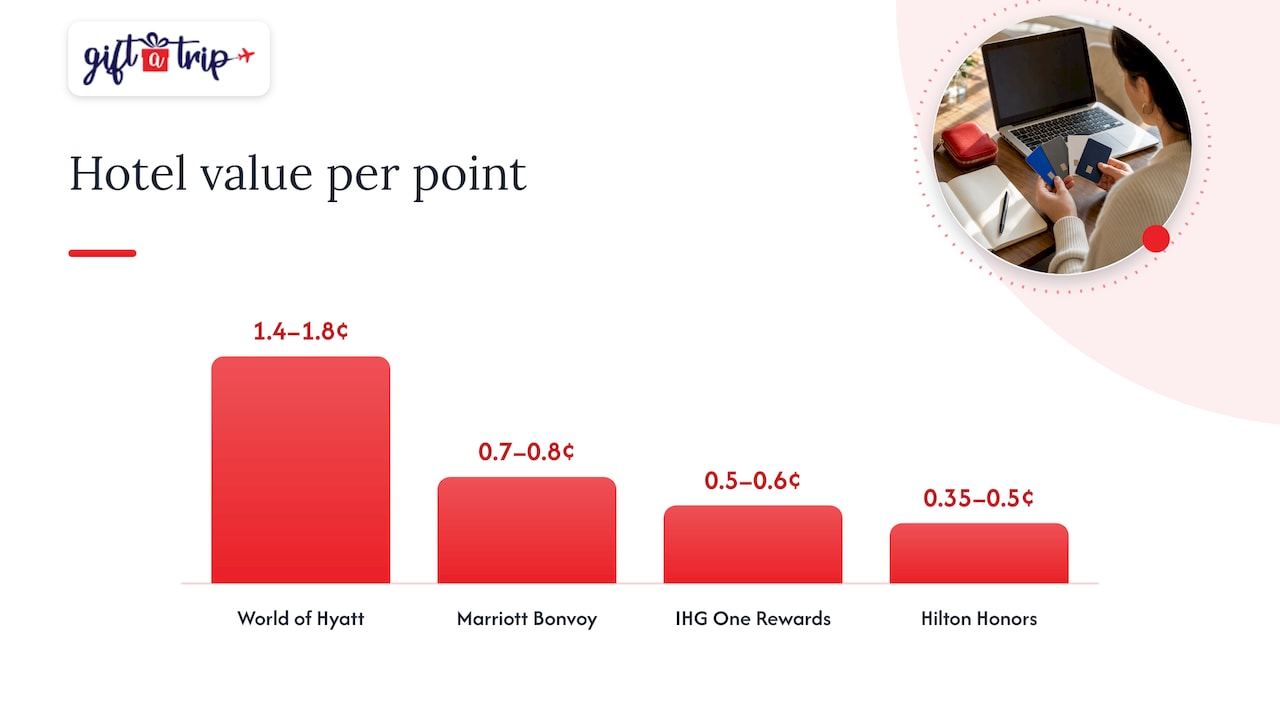
The first step is knowing your program’s baseline. Estimates vary by who runs the numbers, but the pattern is consistent: Hyatt is far ahead, and Hilton sits at the bottom.
| Program | Approximate value per point |
|---|---|
| World of Hyatt | 1.4 to 1.8 cents |
| Marriott Bonvoy | 0.7 to 0.8 cents |
| IHG One Rewards | 0.5 to 0.6 cents |
| Hilton Honors | 0.35 to 0.5 cents |
Those ranges come from High Earner Playbook’s September 2026 analysis, and NerdWallet’s October 2026 valuations land in the same neighborhood: 0.7 cent for Marriott Bonvoy, 0.6 for IHG, 0.4 for Hilton and 1.8 cents for Hyatt. Treat every figure as an estimate. Most major programs now use dynamic or semi-dynamic award pricing, so what you pay for a given night can move from week to week.
A useful consequence: 50,000 Marriott points at roughly 0.7 to 0.8 cents are worth about $350 to $400 toward a stay, while 50,000 Hilton points at 0.35 to 0.5 cents are worth about $175 to $250. The same number of points can mean very different amounts of travel.
What happens when you convert points to gift cards
The short version: you almost always lose value.
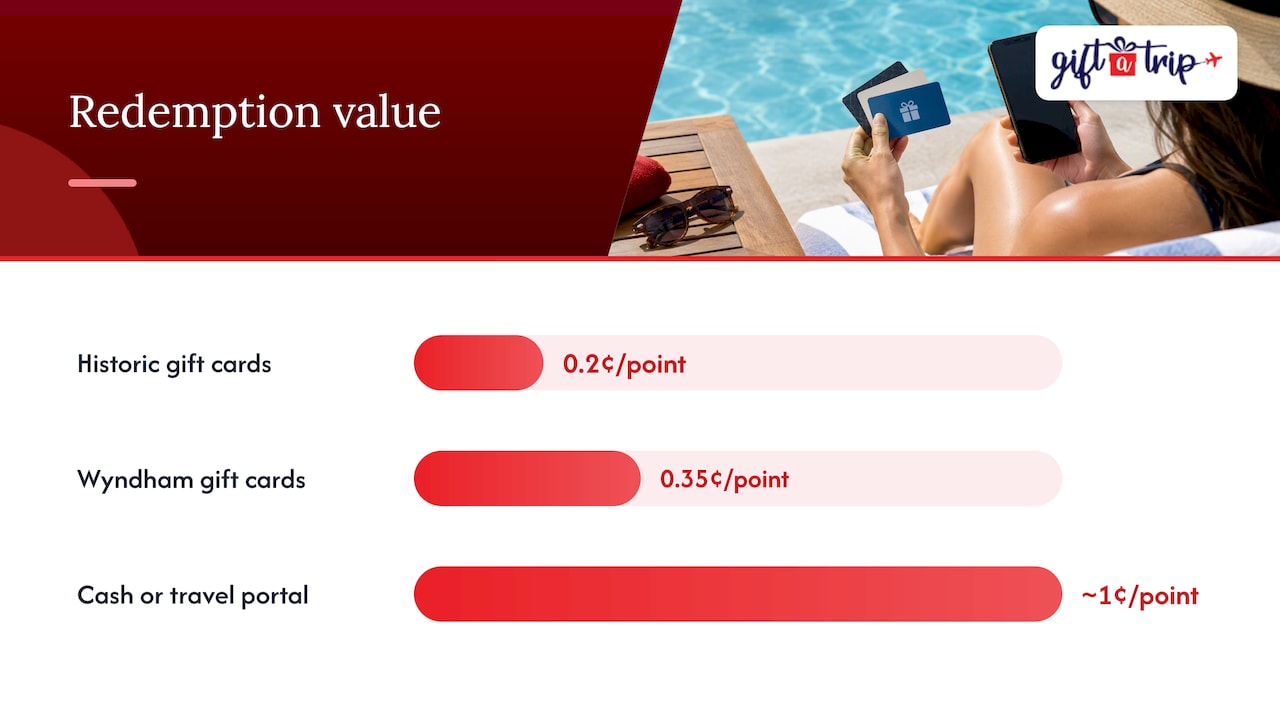
Hotel programs that offer gift cards in their catalogs price them at a premium. Wyndham points redeemed for gift cards can yield as little as 0.35 cent each, and historically some programs asked for more than 50,000 points for a $100 card. That is a rate of 0.2 cent per point, a fraction of what a free night typically returns.
The broader redemption picture, per Cardocrat’s 2026 guide, is that cash and travel-portal redemptions are worth about 1 cent per point, transfers to airline and hotel partners can beat that, and gift cards tend to sit below both.
There is one more trap. Some card portals let you buy gift cards with shopping rewards. That can look like a deal, but the same source warns about opportunity cost: you might collect a $50 card and give up more in points or cash back by booking directly or through a better channel.
When a gift card still makes sense
There are honest exceptions:
- Points are about to expire or be devalued. The common advice is to redeem within about six months if you hold Hilton or Marriott points, since both programs tend to devalue annually. Hyatt is the exception, with points often worth saving for strong redemptions.
- You have a small leftover balance. A few thousand points that cannot cover any award night are better as a card than as nothing.
- You are short on cash during the holidays. Redeeming points for gifts can cover a tight month, but it generally yields less value than travel redemptions. That is a trade of value for convenience, and you should make it knowingly.
Outside those cases, spend points on stays.
The hurdle rate: a two-minute test
Financial writers recommend a simple check before you redeem anything. As Cardocrat explains, divide the cash price of the room by the points required. If the result is lower than your program’s average cents-per-point value, pay cash and save the points for a stronger use.
A worked example, with illustrative numbers:
- A hotel night costs $240 in cash, or 30,000 points.
- $240 divided by 30,000 points is 0.8 cent per point.
- For a Marriott member, that is at or just above the 0.7 to 0.8 cent average, so it is a fair redemption.
- For a Hyatt member with a 1.8 cent benchmark, it is a weak one, and the points are better saved.
Now compare a gift card at 0.35 cent per point. It fails the test in nearly every scenario.
Choosing a program by where you actually stay
Per-point value is only half the story. A program with a high value per point is no use if it has no hotel where you are going.
The experts quoted by High Earner Playbook make this point: the best program depends on your travel pattern. Hyatt has a smaller footprint but higher per-point value, while Marriott may suit you better for sheer coverage in smaller cities, even at a lower value per point. Look at the last twelve months of your own stays, not a theoretical chart.
If you are also deciding which co-brand card should feed those points, this overview of travel rewards credit card types is a handy way to match a card to your spending.
Gift cards vs miles: the same logic
Miles follow the same rule as hotel points. When you hold a co-brand airline or hotel card, redeeming for award travel is usually better than redeeming for merchandise or gift cards. Gift cards are the floor of what your currency can do, not the ceiling. Before you convert miles, price the flight in cash, divide by the miles, and compare against what that currency normally returns.
Giving a gift: points, gift card or travel certificate?
If your goal is a present rather than your own trip, the comparison changes.
Gift card. Easy and flexible, but it reads as cash. A card for a hotel brand or a booking platform often gets folded into everyday spending and forgotten.
Transferring points. Some programs let you gift or pool points, but the recipient needs an account, and the points inherit all the volatility described above.
Travel certificate. A certificate tied to a resort, cruise or vacation package gives the recipient a specific trip to look forward to. It also avoids the problem of an under-sized card that leaves them paying the difference out of pocket.
That last point is where we have a view, below.
Our perspective: why a trip beats a balance
We sell travel certificates all day, so we are not neutral, but we also see what people ask for. Most buyers come to us with the same worry: they want a gift that does not feel like a payment. A gift card is a balance. A travel certificate is a plan.
We built our offering around removing the friction that makes travel gifts disappointing. Certificates are redeemable for resort, hotel, cruise and vacation packages from major brands. Taxes and resort fees are covered in the certificate price, blackout dates are kept to a minimum, and there is no minimum order, so a single gift and a company-wide program are both fine. Delivery is digital and secure, and you can add a personal message.
For employers the bigger point is how the reward is perceived. The Incentive Research Foundation’s Voice of the Market study notes that employees prefer cash and gift cards for their utility, yet incentive travel is often seen as a total reward experience that creates lasting memories cash cannot replicate. That matches what we hear from HR and sales managers: people remember the week on the beach, not the $100 that disappeared into groceries.
If you are comparing points and cards purely as a consumer, use the hurdle rate and spend points on stays. If you are giving, ask what you want the person to remember.
— Donovan
For employers: the tax angle you cannot ignore
HR teams often reach for gift cards because they feel simple and low-risk. The tax treatment says otherwise. Under IRS rules, as summarized by Corporate Traditions, gift cards from an employer are treated as cash equivalents. They cannot be excluded as de minimis fringe benefits, even for a $10 card. They are taxable wages, reported on the employee’s W-2 and subject to federal, state and payroll taxes.
The ForestNation business gift card guide makes the same point from the budget side: gift cards are not a tax-efficient hack, and a company has to account for both the card and the payroll tax burden. Rules differ by recipient, and a client or vendor is treated differently from an employee, so confirm your situation with your payroll provider or tax adviser before you set up a program.
We do not claim travel certificates escape payroll rules. Whatever you give an employee, check the tax treatment with a professional first. What a certificate changes is the reward itself: a defined trip with included taxes and fees, and no hotel loyalty program to manage. Our guide on secure digital travel certificates and HR taxes goes into the administrative side.
If travel is not the right fit for every team member, mixing rewards helps. These wellness incentive ideas are one example of a non-travel option to run alongside a travel program.
Quick decision guide
| Your situation | Best move |
|---|---|
| Holding Hyatt points | Save them for stays and strong redemptions |
| Holding Hilton or Marriott points | Use within about six months, on stays |
| Small leftover balance | A gift card is acceptable |
| Giving a personal gift | A travel certificate or a gift card sized to the trip |
| Rewarding a sales team | Travel certificates, plus check tax treatment |
| Running a charity auction | Trip certificates, which bidders understand at a glance |
Where our certificates fit
If you want to give a trip rather than a balance, start with our travel certificate catalog, which covers resorts and hotels, cruises, and golf and spa getaways. For a flexible gift where the recipient picks the destination, look at our Flex Trip Collections. Organizations can set up custom trip selection sites, airfare vouchers and branded gift boxes through our corporate gifting page. If you want a physical presentation, Red Box Delivery is a $69 one-off fee, and the details are on the gift delivery page.
FAQ
Is it ever smart to convert hotel points to gift cards?
Only in narrow cases, such as a tiny leftover balance or points about to expire. Catalog rates can fall below 0.5 cent per point, while stays often return well above that. Run the hurdle rate first.
Which hotel points are worth the most?
As of October 2026, NerdWallet’s valuations put World of Hyatt first at 1.8 cents per point and Hilton Honors last at 0.4 cent. Value per point is not everything, though. Where the brand has hotels near you matters just as much.
Should I redeem or save my points?
For Hilton and Marriott, the common advice is to redeem within about six months because of regular devaluations. Hyatt points are the exception and are often saved for high-value redemptions. Always compare the cash price to the points price before you decide.
Are gift cards a good employee reward?
They are convenient, but the IRS treats employer gift cards as taxable wages at any amount. Employees often value them for their usefulness, while incentive travel tends to create a stronger emotional impression. Many companies use both, depending on the goal.
Are gift cards or travel certificates better for a present?
A gift card suits someone who wants full freedom. A travel certificate suits you if you want the recipient to take an actual trip. Our guide on how to gift travel certificates covers the choices.
Sources
- How Much Are Travel Points and Miles Worth in 2026? (NerdWallet)
- Hotel Points Value in 2026 (High Earner Playbook)
- How to Redeem Wyndham Points for Gift Cards (WalletHub)
- How to Redeem Points for Maximum Value (Cardocrat)
- Hotel Loyalty Points Value 2026 (Travel Anywhere)
- Employee gift etiquette: what HR leaders need to know (Corporate Traditions)
- Business Gift Cards: Tax, Bulk Buying and Better Options (ForestNation)
- Voice of the Market, Part 1 (Incentive Research Foundation)