
A workable client appreciation travel budget starts with tiers, not one number. Give your top accounts a real trip, give your mid-size accounts a smaller travel reward, and keep a low-cost gesture for everyone else. Then reserve about a sixth of the total for the costs that never appear on the first quote, and have your tax advisor confirm how each gift is treated before you buy.
Below you will find the benchmarks for 2026, a tier model you can adapt, the hidden cost buckets, the tax questions to settle first, and a short checklist for turning the plan into an order.
TL;DR
- Budget by client tier. Spend the most on the few accounts that drive the most revenue, and keep a modest gesture for the long tail.
- Benchmarks: North American incentive programs averaged about $6,000 per person in 2025, but a client gift does not need to look like a full incentive trip.
- Plan for the hidden costs. In one operator breakdown, about 17% of a trip budget went to production, transfers, staffing, fees and contingency.
- Check the tax treatment before you commit. The IRS limits the business gift deduction to $25 per recipient per year, with exceptions you should review with a professional.
- A travel certificate lets the client choose the destination and date, which keeps your cost fixed and the experience personal.
Table of Contents
- What the benchmarks say you should spend
- Build the budget in tiers
- The hidden costs that break budgets
- Check the tax treatment before you buy
- Spend on feeling valued, not on logistics
- Our perspective on travel as a client gift
- Plan the budget in six steps
- Match the certificate to the tier
- Order for your client list with Gift A Trip
- FAQ
- Sources
What the benchmarks say you should spend
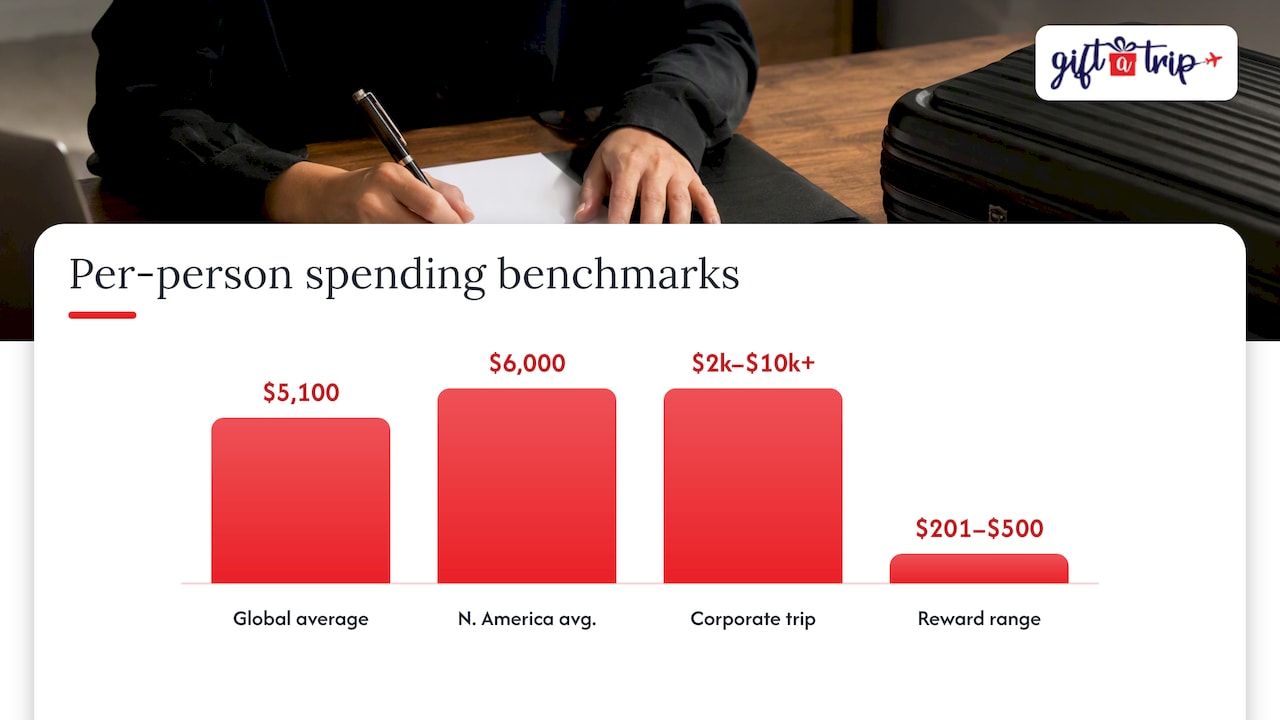
Start with what the incentive industry spends, then scale down. The 2025 Incentive Travel Index put the global average at $5,100 per person, with North America at $6,000, and 59% of North American programs exceeded $5,000 per person. Those figures cover full group programs with flights, hotels, meals and production.
Another planner guide puts the cost of a corporate incentive trip at $2,000 to $10,000 or more per person, with a short domestic trip for a mid-size sales team at the lower end.
Most client appreciation budgets are nowhere near that. You are not hosting a group. You are rewarding a relationship, usually one client at a time. So treat those numbers as a ceiling for your very best accounts and as proof that travel is a category people already pay real money for.
One more signal helps if you also reward your own team. According to the Incentive Research Foundation’s Stephanie Harris, organizations are focusing more on rewards in the $201 to $500 range to engage a wider base of people instead of only top performers. The same logic works for clients: a meaningful mid-range reward for many beats a lavish one for a handful.
Build the budget in tiers
Start from your client list, not from a total. Rank clients by annual revenue, margin, strategic importance or years with you. Then assign each tier a gift level and a headcount.
The model below is our planning framework, not an industry statistic. Replace the placeholders with your own numbers.
| Tier | Who | What the gift looks like | How to set the amount |
|---|---|---|---|
| Tier 1: Anchor accounts | The few clients behind a large share of revenue | A full trip certificate: resort stay, cruise or golf and spa getaway, with a personal note from the account owner | Tie it to a small percentage of annual account revenue, signed off by finance |
| Tier 2: Growth accounts | Clients with real expansion potential | A shorter getaway or a flexible certificate they can apply to several destinations | Set a fixed amount per client so the cost is predictable |
| Tier 3: Loyal long tail | Smaller or newer clients | A low-cost gesture, a handwritten card, or a travel-related item | Keep it small and fix the total for the whole group |
Work out the cost in three steps:
- Count clients in each tier.
- Multiply by the per-client amount.
- Add the contingency and delivery costs described below.
If the total is more than leadership will approve, cut the number of Tier 1 recipients before you cut the quality of the gift. A small gift that feels cheap can do more harm than no gift.
For a deeper look at gift tiers and documentation, see our guide to tax-smart client gift budget guidelines.
The hidden costs that break budgets
First-time planners tend to price the big items and forget the rest. In one operator’s cost breakdown, hotel took 27% of the budget, airfare 21% and food and beverage 18%. Another 17% went to production, AV, staffing, ground transfers, destination management fees and contingency.
That breakdown describes group incentive events, so your own mix will differ. The lesson still holds for client gifting: the line items you leave off are the ones that cause the overrun. Check these before you finalize:
- Taxes, resort fees and gratuities. A certificate that looks cheap can add these at checkout or at the property. Ask exactly what is included.
- Airfare. Many travel gifts cover lodging only. Decide whether to add flight funds.
- Delivery and presentation. A premium presentation costs more than an email.
- Hospitality around the gift. If you hand it over at a dinner or event, the meal and venue cost belongs in the same budget. For that part of the plan, this guide to setting a catering budget for business events is a useful reference, though its examples are from the UK.
- Contingency. Hold back a reserve for replacements, upgrades and last-minute additions.
We advise keeping a contingency line from the start. It is much easier to return unspent money than to ask for more.
Check the tax treatment before you buy
This is the part that surprises finance teams most often, so settle it first. The rules below are federal US rules. State rules and your own situation may differ, so confirm with a CPA or tax advisor.
Gifts to clients
IRS Publication 463 says businesses can generally deduct no more than $25 of the cost of business gifts per recipient per tax year. Incidental costs such as engraving, packing and shipping are excluded from that limit if they do not add substantial value to the gift.
That does not forbid a larger gift. It limits how much of it you can deduct. Some companies decide that a Tier 1 trip is worth the cost even when the deduction is capped, and others structure the program differently. That is a decision for your tax advisor, not for a blog post.
Gifts to your own employees
If the same budget also covers employees, be careful about calling a certificate a small perk. The IRS notes that cash equivalents, including gift cards redeemable for general merchandise, are never excludable as de minimis fringe benefits. Many businesses assume small-value cards are non-taxable, and it is a frequent compliance surprise for HR and finance departments.
How a particular travel certificate is classified depends on its terms and your facts. Our guides on how taxes are handled in travel certificates and how to gift employee travel with tax-smart solutions walk through the questions to bring to your advisor.
Spend on feeling valued, not on logistics
A bigger budget does not guarantee a better reaction. Incentive experts say budget pressure does not have to hurt the experience. Strategies such as prioritizing status, like priority seating or early access, over lavish spending can raise perceived value without raising hard costs.
Three habits carry over to client travel gifts:
- Personalize. Experts recommend survey-based planning to learn what makes the experience special for each person, including personal milestones. For clients, that can be as simple as asking your account manager what the client’s family likes to do.
- Leave room. Experienced planners build in white space, at least one full day or evening with nothing scheduled. A certificate gives that freedom by design, because the client plans the trip.
- Let them extend. In one industry report, 57% of incentive winners extend their stay before or after the dates. A flexible certificate lets a client do the same without you paying for extra nights.
These findings come from incentive travel, not from client gifting specifically. We use them as a guide to what recipients value, not as proof of what your clients will do.
Our perspective on travel as a client gift
We sell travel certificates all day, so we see the same budgeting mistakes repeatedly. Here is what we would tell a sales or HR lead sitting across the table.
First, fix the price you pay and let the client choose the trip. A certificate does that. You commit to a number, the recipient picks the resort, cruise or golf and spa stay, and you never manage a booking for someone else’s vacation.
Second, ask what is included before you compare prices. Our positioning is all-inclusive pricing, with taxes, gratuities and fees covered, minimal blackout dates and no minimum order. A certificate that leaves those out is a lower sticker price with a higher real cost, and an awkward moment for the person you meant to thank.
Third, do not start with the top tier. Start with the list. A well-chosen gift for twenty clients usually does more for the business than an extravagant one for two. For the reasoning, see why travel works for client appreciation.
Fourth, treat presentation as part of the budget. A thoughtful note and a polished delivery change how the gift lands, and they cost far less than upgrading the trip.
— Donovan
Plan the budget in six steps
- Define the goal. Retention, renewal, referrals or a thank-you after a big project. The goal decides who gets what.
- Rank your clients and assign tiers.
- Set per-client amounts and total them.
- Add the hidden-cost reserve. Use the 17% figure above as a starting point and adjust it for your program.
- Get tax guidance on both client gifts and any employee rewards, and document the business purpose.
- Choose the format and delivery. Decide between a single resort or cruise certificate and a flexible collection, then plan the presentation and timing.
If you also run employee programs from the same budget, our travel incentive cost guide for HR teams shows how to price those separately.
Match the certificate to the tier
- Tier 1: A resort, cruise or golf and spa certificate gives the most memorable result. Browse cruises, resorts and golf and spa getaways, or look at specific brands such as Royal Caribbean certificates and golf and spa resort stay certificates.
- Tier 2: Flex Trip Collections let the client choose from several destinations, which suits clients whose tastes you do not know yet.
- Large lists: For bulk programs, our corporate gifting page covers custom trip selection sites, airfare vouchers in all denominations, custom Flex Trip Collections and custom branded gift box delivery.
Order for your client list with Gift A Trip
We built Gift A Trip so a business can reward clients with travel without handling bookings. You pick the certificates, add a personal message and deliver them digitally. For a premium moment, our Red Box Delivery is a one-off $69 fee. If you are buying for a whole list, start on our corporate gifting page and tell us how many clients are in each tier.
FAQ
How much should a business budget for client appreciation travel?
There is no single correct figure. Set it by tier: a larger amount for a few anchor accounts, a fixed mid-level amount for growth accounts, and a small gesture for the rest. Reference points like the $6,000 North American incentive average are for full group programs, so treat them as an upper bound.
Are client travel gifts tax deductible?
The IRS generally limits the deduction for business gifts to $25 per recipient per tax year. Exceptions and incidental costs have their own rules. Ask your CPA how a travel certificate is treated in your situation.
What hidden costs should I add to the budget?
Add delivery and presentation, any airfare you want to include, taxes and fees if the certificate does not cover them, and a contingency reserve. In one operator’s breakdown, 17% of the total went to these kinds of items.
Is a travel certificate better than choosing the trip for the client?
For most client gifts, yes. You fix your cost, and the client picks the place and the dates, including a longer stay if they want one. Choosing the trip for them makes sense only when you know their preferences well.
Sources
- 2025 Incentive Travel Index survey highlights
- IRS Publication 463: Travel, Gift, and Car Expenses
- IRS: Fringe benefits guide, de minimis rules
- How to plan a corporate incentive trip
- The incentive travel questions planners stop asking
- President’s Club cost per person forecast
- Stephanie Harris on the incentive market
- Incentive planners on pain points and solutions
- Incentive travel trends and opportunities
- Great escapes: creating bespoke incentives