
Jump to Section:
- Table of Contents
- How prepaid travel certificates work: formats, delivery, and inclusions
- How to buy safely: payment, bulk orders, and documentation
- Tax and employer treatment: what payroll teams need to know
- Red flags and scam-avoidance checks before you pay
- Redemption logistics and getting full value for recipients
- How organizations run certificate programs at scale
- When prepaid travel certificates are the right call
- Where to buy: a direct option for individuals and bulk orders
- FAQ
- Sources
- Recommended
Prepaid travel certificates are vouchers you buy in advance that a recipient later redeems for a cruise, resort stay, or vacation package, and they work well for gift-givers, HR teams, and event planners who want to offer an experience without picking the dates or destination themselves. They suit people who value flexibility over a fixed itinerary. Travel certificates are often issued through secure digital delivery, and buyers should always confirm consumer protections like the FTC’s gift card rules before paying.
TL;DR:
- Most travel certificates are either digital for quick delivery or physical for presentation, with denominations allowing flexible redemption among cruise, resort, or package options.
- Confirm whether taxes, fees, blackout dates, and brand restrictions are included in the certificate’s terms before purchase, as vague disclosures often lead to surprises.
- Use credit cards for payment to retain dispute rights, and request written terms covering cancellations, refunds, and redemption procedures, especially for bulk or corporate orders.
- Employers must treat travel certificates as taxable wages or gross-up payments, as they are not considered de minimis fringe benefits under IRS rules.
- Be wary of scams demanding wire transfers or gift cards, and always verify refund policies, booking examples, and clear expiration dates before paying.
Table of Contents
- How prepaid travel certificates work: formats, delivery, and inclusions
- How to buy safely: payment, bulk orders, and documentation
- Tax and employer treatment: what payroll teams need to know
- Red flags and scam-avoidance checks before you pay
- Redemption logistics and getting full value for recipients
- How organizations run certificate programs at scale
- When prepaid travel certificates are the right call
- Where to buy: a direct option for individuals and bulk orders
- FAQ
- Sources
How prepaid travel certificates work: formats, delivery, and inclusions
Most sellers offer certificates in two formats: digital, which arrives by e-mail within minutes to a few business days, or physical, which ships and typically takes longer to process. Digital delivery suits last-minute gifting and bulk corporate orders, while physical certificates fit milestone gifts or auction prizes where presentation matters.
Denominations vary by seller. Our Flex Trip Collections let a recipient choose among cruise, resort, or package options rather than locking them into one brand, and our travel certificates overview breaks down how categories like cruises, resorts, and golf and spa getaways differ in redemption style.
Before buying, check what the certificate actually covers. Reputable sellers spell this out in the terms rather than leaving it vague:
- Whether taxes and resort fees are included in the certificate value or billed separately at check-in.
- How many blackout dates apply and during which seasons.
- Whether the certificate names a specific brand (like a particular cruise line) or allows substitution.
A certificate that is silent on these points is a certificate you should ask more questions about before you pay.
How to buy safely: payment, bulk orders, and documentation
Paying by credit card gives you dispute rights that other payment methods do not. The FTC’s scam-prevention guidance recommends credit cards specifically because they are easier to contest than cash, debit, or wire transfers if a seller fails to deliver.
Follow these steps before you commit to a purchase:
- Confirm the seller accepts standard credit card payment and never one that insists on wire transfer, gift card, or cryptocurrency.
- For bulk or corporate orders, ask about custom messaging, branded delivery boxes, and whether certificates can be distributed individually to a list of recipients.
- Request written terms covering cancellation, refunds, blackout dates, and exact booking instructions before paying, not after.
- Save the confirmation e-mail and any redemption code separately from the certificate itself.
Pro Tip: Ask for a sample confirmation e-mail or redemption walkthrough before placing a bulk order. A seller that can show you the exact recipient experience is one that has done this before.
For organizations ordering in volume, our corporate gifting page outlines branded box options and distribution support, which matters when you are sending dozens or hundreds of certificates at once rather than a single gift.
Tax and employer treatment: what payroll teams need to know
Employers handing out travel certificates as rewards or incentives need to treat them as taxable compensation in nearly every case.
According to IRS Publication 15-B, cash and cash-equivalent benefits, including gift certificates, are never excludable as de minimis fringe benefits, meaning they cannot be written off as a small, tax-free perk the way a holiday turkey or occasional event ticket might be.
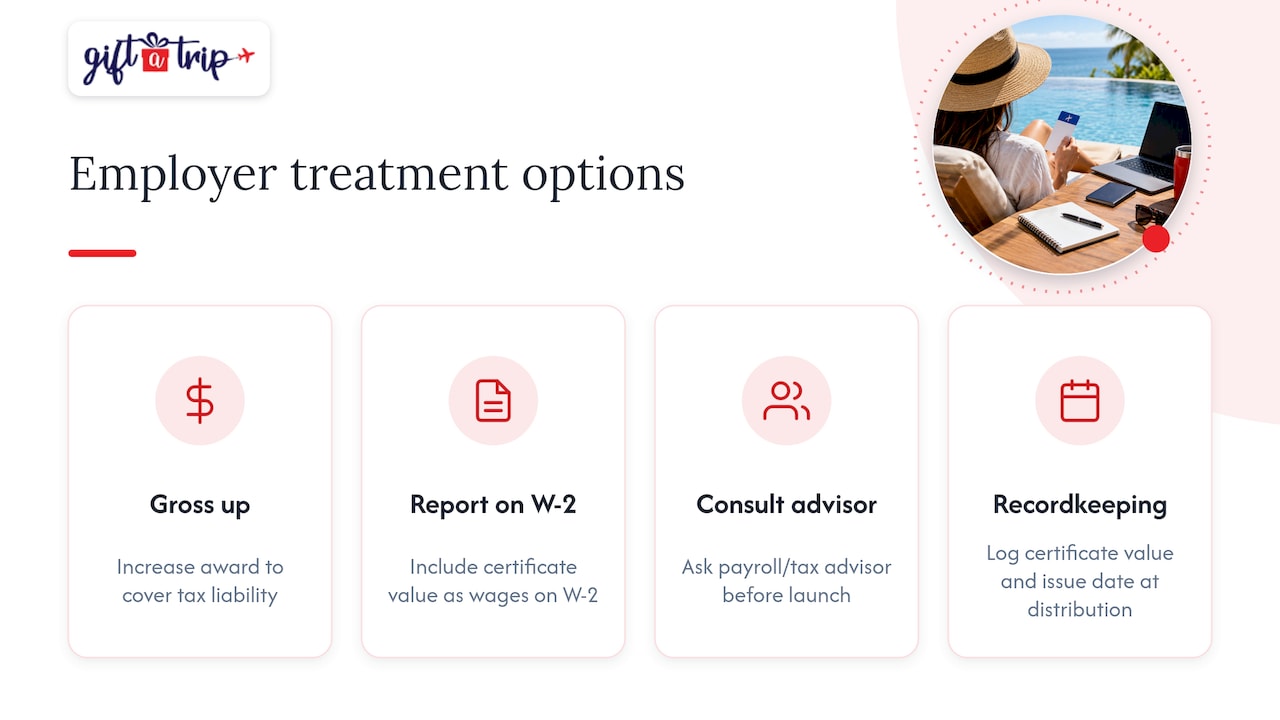
That leaves a few practical paths for employers. You can gross up the award to cover the employee’s tax liability, so the net value matches the intended reward. You can report the certificate’s value as wages on the employee’s W-2, which is the more common approach for incentive programs. Or you can route the question to a payroll or tax advisor before the program launches, especially for recurring reward programs where the tax treatment compounds over a year. Our tax treatment guide walks through how this applies to both purchasers and employers. Keep records of certificate value and issue date at the time of distribution, not at year-end, so nothing gets missed during payroll reconciliation.
Red flags and scam-avoidance checks before you pay
Travel certificate scams tend to share a few patterns, and the FTC’s guidance on vacation club scams is a useful baseline for spotting them. Scammers often demand payment by wire transfer, gift card, or cryptocurrency because those methods are hard to trace and nearly impossible to reverse.
Before paying any seller, check for these signals:
- A demand for wire transfer, gift card, or cryptocurrency payment instead of a credit card.
- Vague or missing disclosure of fees and expiration dates, which the FTC requires sellers to state clearly and prominently.
- Refusal to provide a written cancellation or refund policy before you pay.
- High-pressure tactics pushing you to decide or pay immediately.
- No verifiable booking examples, partner confirmations, or public reviews you can check independently.
If a seller cannot produce a written refund and cancellation policy on request, treat that as a reason to walk away rather than a detail to chase down later.
Redemption logistics and getting full value for recipients
Redemption friction is where most certificate complaints start, so it pays to check the fine print before you gift or distribute one. Confirm blackout dates, how far in advance the recipient needs to book, and whether the certificate restricts them to specific resorts or departure cities.
A few checks protect the recipient from surprise costs:
- Verify whether taxes and resort fees are built into the certificate value or charged separately at booking.
- Ask how far ahead the recipient must request dates, since many packages require 60 to 90 days’ notice.
- Check whether the certificate names a specific brand or allows a choice among several, which affects availability.
Our redemption process guide walks through typical booking windows and blackout patterns so recipients know what to expect.
Pro Tip: For high-value certificates, consider recommending trip insurance options to the recipient. NAIC guidance notes that travel insurance, including cancel-for-any-reason policies, can protect prepaid trip costs but usually costs extra and reimburses only part of the expense, so it is worth the added cost mainly on larger packages.
How organizations run certificate programs at scale
Corporate buyers running ongoing reward or recognition programs need a distribution process that scales past a handful of recipients. Individualized redemption codes delivered securely by e-mail reduce the risk of a shared code being used by the wrong person, and branded physical delivery works well for milestone awards or client gifts where presentation matters.
Procurement and HR teams should request a short checklist from any vendor before signing off on a bulk order:
- Confirmation of secure, individualized delivery for each recipient rather than one shared code.
- A bulk invoice structure that matches your purchasing and approval workflow.
- Redemption reporting so you can track who has used their certificate and who has not.
- A single admin contact for questions, replacements, or delivery issues.
Our distribution guide for HR and events covers these workflows in more detail for teams managing larger reward programs.
When prepaid travel certificates are the right call
Experience-based rewards tend to outperform cash or merchandise for morale when the goal is memorability rather than utility. A certificate signals that an employer or gift-giver put thought into the occasion, and the flexibility of choosing a date later removes the planning burden that makes a fixed-date trip feel like an obligation rather than a reward.
They are a weaker fit when redemption friction is high or when a recipient has no interest in travel at all. A tight blackout calendar or a destination-specific restriction can turn a generous gesture into a frustrating one.
The quick heuristic: if your recipient values flexibility and experience over immediacy, a certificate beats cash. If they need something usable this week, it does not.
— Donovan
Where to buy: a direct option for individuals and bulk orders
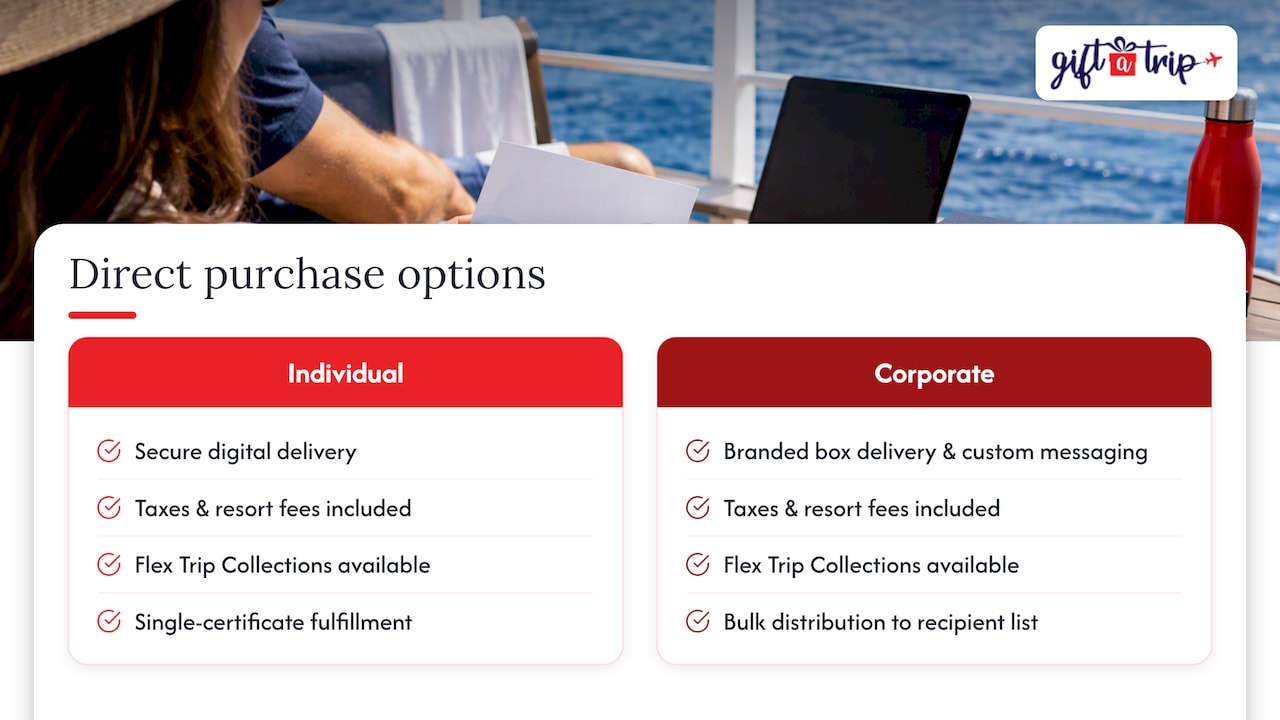
We built Gift A Trip around the exact friction points covered above: unclear fees, rigid dates, and clunky bulk distribution. Our certificates cover cruises, resorts, and golf and spa getaways, and our Flex Trip Collections let a recipient pick their own path instead of committing them to one brand or property.

For individual gifts, certificates are available directly with secure digital delivery and taxes and resort fees built into the stated price rather than surfacing later. For corporate orders, our bulk and branded gifting options support custom messaging, branded box delivery, and distribution across a recipient list, which matters once you are sending more than a few certificates at a time. Browse our full certificate selection to compare cruise, resort, and package options side by side before you order.
This article is general information, not a substitute for advice from a qualified financial advisor. Consult a qualified financial professional about your own circumstances before acting on anything here.
FAQ
Can you use prepaid travel certificates like cash for any trip?
No, most prepaid travel certificates are redeemable only through the issuing seller’s partner network of cruise lines, resorts, or packages, not as general-purpose cash. Always check whether the certificate restricts you to specific brands or allows a choice among several before buying.
Are prepaid travel certificates taxable when given as employee rewards?
Yes. IRS Publication 15-B states that gift certificates and vacations are generally taxable to employees and cannot be excluded as de minimis fringe benefits, so employers typically report the value as wages or gross up the award to cover the tax.
How do prepaid travel certificates compare to a regular credit card for booking travel?
A certificate locks in a specific experience or brand in advance, while a credit card gives full flexibility over where and when you travel but offers no built-in discount or bundled inclusions. Credit cards also carry stronger dispute protections if a travel purchase goes wrong, which is worth keeping in mind for any payment you make outside the certificate itself.
What should I do if a certificate seller asks for payment by gift card or wire transfer?
Treat that request as a major warning sign and decline it. The FTC warns that legitimate travel sellers accept standard payment methods like credit cards, while wire transfers, gift cards, and cryptocurrency are favored by scammers because they are difficult to trace or reverse.
Do prepaid travel certificates expire?
Many do carry an expiration window, and sellers are required to disclose it clearly under FTC gift card rules. Always confirm the expiration date and any extension options in writing before you buy or gift one.
Sources
- Publication 15-B (Employer’s Tax Guide to Fringe Benefits) — IRS
- FTC gift card tips and rules
- Should I get travel insurance? — NAIC