
Jump to Section:
Flexible date travel certificates are travel gift vouchers redeemable for hotel, resort, cruise, or vacation package stays that let recipients pick travel dates within an open redemption window. Expect booking rules and possible top up payments during peak periods. They work well for personal gifts, employee rewards, and bulk incentive programs, but the amount of real flexibility depends entirely on the terms you check before you buy.
TL;DR:
- The actual value of travel certificates can be reduced by peak demand prices and the need for top-up payments during high season or special events.
- Certificates that are dollar value credits may require additional payments if retail rates exceed the credit during booking, especially for popular travel dates.
- Booking restrictions such as blackout dates, limited inventory, and specific supplier rules can affect a recipient’s ability to use the certificate as intended.
- For corporate use, travel certificates are taxable wages and must be tracked and reported through payroll, with extra administrative steps required.
- Guaranteeing certificate value involves checking redemption policies, understanding whether it is fully inclusive of fees, and choosing flexible options that let recipients pick their travel dates.
Table of Contents
- How flexible date certificates work from purchase to redemption
- Checklist for individual gift givers before you buy
- Checklist for corporate buyers: tax, reporting, and contracts
- How dynamic pricing and top up payments affect real value
- Ordering, delivery, and support: what to expect from a provider
- What actually matters when you buy one
- Why Gift A Trip simplifies flexible date gifting
- FAQ
- Sources
How flexible date certificates work from purchase to redemption
Most certificates fall into one of two models, and the difference changes how much a recipient can actually get for their trip.
- Price locked voucher: this guarantees a specific stay, cabin category, or package regardless of seasonal rate swings, as long as it is booked within the valid window.
- Dollar value credit: this assigns a fixed dollar amount toward any eligible stay, which means the recipient covers any difference when the retail rate runs higher than the credit.
Redemption generally follows a predictable sequence:
- The recipient logs in to the issuer’s redemption portal using the certificate code.
- They browse available dates or properties and confirm inventory before locking anything in.
- The certificate value is applied automatically, and any balance due is charged separately.
- A confirmation number and standard booking documentation follow, the same as any paid reservation.
Booking constraints tend to show up in three places: limited inventory during high demand weeks, supplier specific blackout periods (a cruise line’s holiday sailings, for example), and standard carrier or resort rules around room category and length of stay. The actual rules live in the issuer’s terms and conditions, inside the redemption portal itself, or with customer service, so reading that fine print before purchase saves a recipient from discovering restrictions after the gift is already given. A dedicated breakdown of how these certificates function is worth reviewing if you want the mechanics in more detail.
Checklist for individual gift givers before you buy
A travel certificate is only a good gift if the person on the receiving end can actually use it without frustration. A few checks up front prevent most of the common complaints.
- Confirm the expiration date and any inactivity fee rules, and keep the receipt and terms. Federal protections set a floor of at least five years before funds expire, with inactivity fees barred for the first 12 months.
- Ask whether the certificate is a locked price voucher or a dollar credit, since that determines whether peak season pricing creates an out of pocket cost later.
- Check whether taxes, resort fees, and gratuities are already included or billed separately at booking.
- Review transferability: some certificates lock to the original recipient’s name, which matters if you are gifting on someone’s behalf or might need to change the name later.
- Decide on presentation. Instant digital delivery suits a quick gift, while a physical box adds ceremony for a birthday, anniversary, or honeymoon.
State rules can layer on top of the federal floor, so it is worth a quick check of U.S. gift card expiration laws if the certificate will sit unused for a while.
Pro Tip: Screenshot or save a PDF of the certificate’s terms at purchase. Redemption portals sometimes update their policy pages, and you want the version that was active when you bought it.
Checklist for corporate buyers: tax, reporting, and contracts
Buying travel certificates as employee rewards or sales incentives involves more paperwork than a personal gift, mostly because of how the IRS treats them.
Tax treatment comes first. IRS Publication 15-B states that gift certificates and gift cards are generally treated as cash equivalents, which means they are usually included in an employee’s wages. Travel certificates do not qualify for the de minimis fringe benefit exclusion the way a small, infrequent item might, so most programs need to plan for payroll inclusion rather than assume the reward is tax free.
That tax reality drives a short list of administrative steps:
- Track issuance by employee and date so the value can be reported accurately.
- Communicate the taxability clearly to recipients before they redeem, not after.
- Route the dollar value through payroll where the law requires it, rather than treating it as an off the books perk.
Beyond tax, procurement decisions matter at scale:
- Negotiate bulk order discounts and ask about customization options for branded or themed rewards.
- Confirm delivery scheduling that matches your event or award ceremony timeline.
- Get a written policy on unredeemed certificates after the window closes, since finance teams need that for budget forecasting.
- Push for long redemption windows, minimal blackout dates, reissue options, and all in pricing that already covers fees.
A guide built specifically around flexible employee incentives covers these logistics in more depth, and a distribution guide for HR and events is useful once you are ready to roll a program out across a team.
How dynamic pricing and top up payments affect real value
A certificate’s sticker value and its real world redemption value are not always the same number, and that gap comes down to dynamic pricing. Industry analysis of travel pricing shows that non-refundable inventory has grown and flexible, refundable rates are often priced at a premium over locked in, non-refundable ones. A dollar value credit purchased today can buy less room or cabin than expected if the recipient waits to redeem during a high demand window.
Holiday travel, major events, and peak cruise sailings are the scenarios where a top up payment is most likely. A recipient booking a Christmas week stay or a summer peak sailing should expect the base certificate value to fall short of the full rate, with the difference due at booking.
Travel insurance helps manage the flip side of that risk: cancellations and non-refundable components. Coverage typically addresses trip interruption, cancellation for covered reasons, and some non-refundable deposits, which matters more as non-refundable rates become standard across the industry.
- Buy or recommend certificates with clearly published redemption policies rather than vague “subject to availability” language.
- Suggest travel insurance at the point of delivery, especially for cruise or peak season gifts.
Pro Tip: If a certificate allows it, ask whether it can be structured as a dollar credit with a guaranteed minimum room or seat allotment. That hybrid structure protects against both inventory shortages and pure price inflation.
Ordering, delivery, and support: what to expect from a provider
Fulfillment flexibility matters as much as redemption flexibility, particularly for corporate buyers managing dozens or hundreds of certificates at once. We offer several fulfillment paths built around that need.
- Instant digital codes for buyers who need a certificate delivered same day.
- Red Box Delivery, a physical presentation option for gifts or awards where the unboxing matters, available as a flat one time fee of $69.
- Bulk shipment options for events, conferences, and award ceremonies where many certificates go out at once.
- Custom Trip Selection Sites and Custom Flex Trip Collections for corporate programs that want recipients choosing from a curated set of options.
Good providers back that fulfillment with real support after the sale: help with reissue if a certificate is lost, assistance navigating supplier availability, and a clear point of contact when a recipient hits a snag at booking. Before buying from any provider, insist on transparent terms, a clear statement of what fees are included in the certificate’s value, and a named way to reach support if redemption runs into trouble.
What actually matters when you buy one
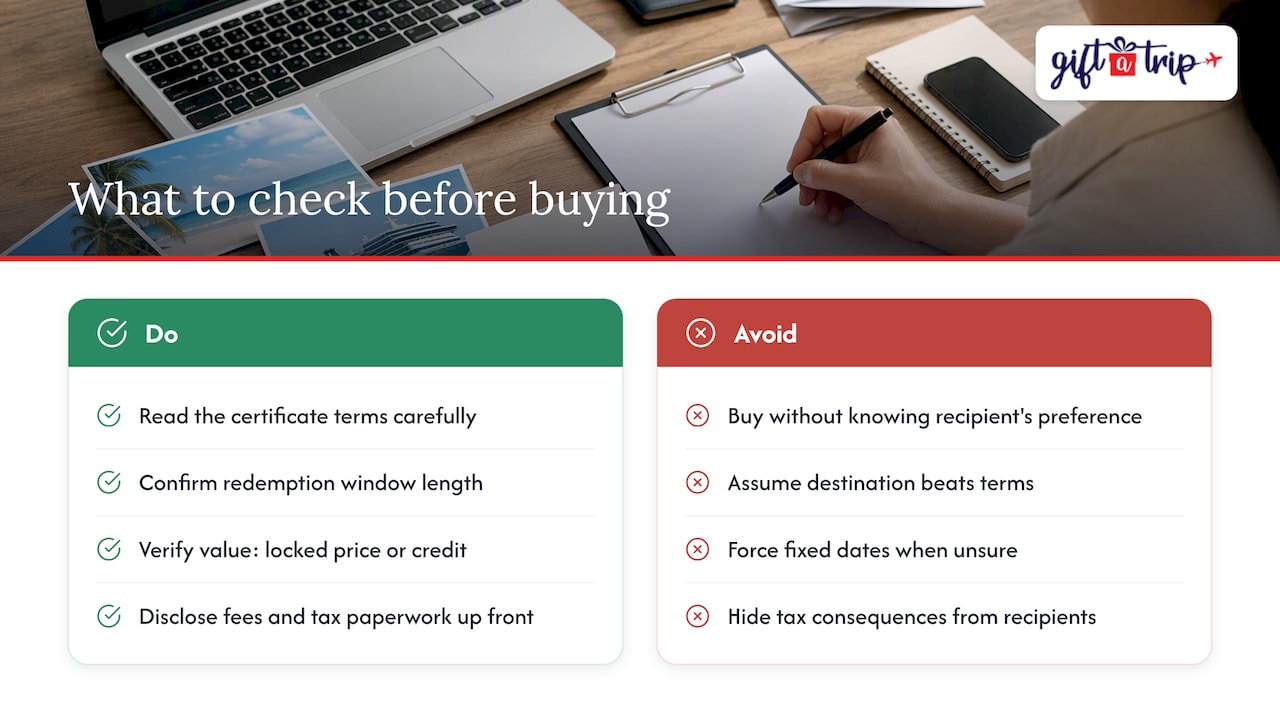
The gap between a travel certificate that delights someone and one that frustrates them almost never comes down to the destination. It comes down to whether the buyer read the terms. Three things decide whether a certificate holds its value: how long the redemption window runs, whether the value is locked to a price or floats as a credit, and how honestly the issuer discloses fees up front.
A cash gift or a straightforward gift card beats a travel certificate when you have no idea what the recipient actually wants. A flexible date certificate wins when the destination type already suits them, such as a cruise lover or a couple overdue for a resort weekend, and the open dates let them pick the right week instead of forcing a fixed itinerary. For corporate buyers, the tax paperwork is not optional. Treat it as part of the reward’s cost from day one, and tell recipients what they are getting before the W-2 shows up.
— Donovan
Why Gift A Trip simplifies flexible date gifting
Gift A Trip removes most of the guesswork covered above by building it into the product itself. Flex Trip Collections are structured around open redemption windows and minimal blackout dates, with taxes, gratuities, and resort fees already included in the certificate’s value, so recipients see fewer surprises at booking.

For gifts with presentation in mind, Red Box Delivery adds a branded physical box to any order for a flat $69. Corporate buyers managing bulk incentive programs can request Custom Trip Selection Sites, custom flex collections, and branded gift box delivery built around their own event or recognition program. Whether you are buying one certificate for a honeymoon or a few hundred for a sales incentive, you can start by browsing individual travel certificates or requesting a corporate quote directly.
FAQ
What makes a travel certificate “flexible date” instead of fixed?
A flexible date certificate lets the recipient choose their travel dates within an open redemption window, rather than locking them into a single pre-set trip date. The tradeoff is that availability and pricing at the chosen date can still affect what the certificate covers, so checking the terms matters more than with a fixed date voucher.
Do travel certificates expire, and what are my rights?
Federal rules require gift card and gift certificate funds to remain valid for at least five years from purchase or last load, and inactivity fees cannot be charged during the first 12 months. Some states extend additional protections beyond that floor, so it is worth checking the specific terms attached to your certificate.
Are travel certificates given by an employer taxable?
Yes. IRS Publication 15-B treats gift certificates as cash equivalents, which means they are generally included in an employee’s taxable wages rather than excluded as a minor fringe benefit. Employers should plan to report the value through payroll rather than assume it is tax free.
Why might I have to pay extra when redeeming a certificate?
Dynamic pricing means peak dates, holidays, and high demand sailings often cost more than a certificate’s base value covers, especially with non-refundable inventory becoming more common across the industry. A dollar value credit is more exposed to this than a price locked voucher, which is why confirming the certificate type before you buy matters.
How do I verify a travel certificate is legitimate before buying or redeeming it?
Check that the issuer discloses its redemption terms, included fees, and blackout policy clearly, ideally on the same page where you purchase. A legitimate provider will also offer a named customer support channel for redemption help rather than routing everything through a generic inbox.
Sources
- FDIC consumer guidance on prepaid cards and gift cards
- IRS Publication 15-B (Employer’s Tax Guide to Fringe Benefits)
- U.S. tour operator analysis of dynamic pricing and non-refundable travel