Jump to Section:
The single highest-impact move in e-gift delivery is sending from an authenticated domain (SPF, DKIM, DMARC all configured), confirming the recipient’s contact details before you hit send, and pairing every gift with clear, step-by-step redemption instructions. Add a transactional email or SMS fallback for when the first channel stalls. These four moves fix the majority of delivery failures, whether you’re sending one birthday gift card or ten thousand employee rewards, because they attack the three things that actually break e-gift delivery: spam filters, typos, and confused recipients.
TL;DR:
- Authenticating your sending domain with SPF, DKIM, and DMARC significantly improves inbox placement and reduces the risk of delivery failure.
- Verifying recipient contact details twice at checkout and providing clear, numbered redemption instructions helps prevent typos and confusion that cause missed deliveries.
- Using a dedicated transactional email provider, pairing email with SMS fallback, and scheduling sends with buffer times minimize delays and ensure timely delivery.
- Implementing self-service tracking and publishing estimated delivery windows reduce support tickets and improve recipient confidence.
- Securing gift codes with masked or tokenized links, verifying high-value orders, and enforcing MFA prevent fraud and unauthorized redemption.
Table of Contents
- E-Gift Delivery Best Practices You Can Apply Today
- Choosing the Right Channel and the Right Moment
- Getting Your Email Infrastructure Right
- Locking Down Security and Fraud Prevention
- Making the Redemption Feel Like a Gift, Not a Transaction
- Running Bulk and Corporate Sends Without Chaos
- Fixing Delivery Problems Fast When They Happen
- What Changes When the Gift Is an Experience, Not a Code
- A Turnkey Option for Secure Travel Certificate Gifting
- Sources
- FAQ
E-Gift Delivery Best Practices You Can Apply Today
These ten steps cover the gap between “I clicked send” and “they actually redeemed it.”
- Verify the recipient’s email or phone twice at checkout. A single typo sends a gift valued at a notable amount into the void.
- Authenticate your sending domain with SPF, DKIM, and DMARC. Unauthenticated mail gets flagged as suspicious more often.
- Use a transactional email provider, not a marketing platform. Transactional infrastructure prioritizes speed and inbox placement.
- Add a wallet or app-pass option where the platform supports it. It skips the inbox problem entirely.
- Avoid scheduling sends during peak fraud-review windows like late-night or holiday-eve batches.
- Write plain, numbered redemption instructions, not a wall of legal text.
- Enable one-click self-service resend so recipients don’t need to call anyone.
- Show the recipient’s email on the purchaser’s confirmation page to catch mistakes early.
- Track delivery time, redemption rate, and ticket volume as your core health metrics.
- Publish an expected delivery window so people know when to start worrying.
Choosing the Right Channel and the Right Moment
Email, SMS, and wallet passes each solve a different problem, and picking wrong is one of the most common e-gift mistakes senders make. Email works best when the message carries real content, a personal note, redemption steps, an image, or a video, since personalization and richer formatting tend to land better in a full inbox experience than in a text thread. SMS wins on speed and visibility; a text gets opened in minutes, which matters when the gift is time-sensitive or the recipient checks email rarely.
- Email: best for detailed messaging, branded templates, and gifts that include instructions or add-ons.
- SMS: best for immediacy, mobile-first recipients, and last-minute sends.
- Wallet or app passes: best when redemption happens in person or through tap-to-pay, since the recipient never has to hunt for a code.
Scheduled sends carry slightly more risk than instant sends, largely because scheduling systems introduce more points where a queue backlog or a system hiccup can delay delivery. If timing matters, build in a buffer, and for international recipients, schedule around their local morning rather than yours.
Getting Your Email Infrastructure Right
Deliverability is a technical problem before it’s a design problem. Three records control whether your e-gift email lands in the inbox or the spam folder: SPF tells receiving servers which IP addresses are allowed to send on your domain’s behalf; DKIM signs your messages cryptographically so they can’t be tampered with in transit; DMARC tells receiving servers what to do when SPF or DKIM checks fail. Getting all three configured correctly, paired with a dedicated transactional email provider, is the single biggest lever for consistent inbox placement.
- Set up SPF, DKIM, and DMARC on the exact subdomain you send from, not just the root domain.
- Warm up new sending domains gradually. A brand-new domain blasting thousands of messages on day one gets flagged fast.
- Build retry logic for transient failures so a bounced first attempt doesn’t mean a lost gift.
- Monitor your sending queue and set alerts for backlog spikes, especially around holidays.
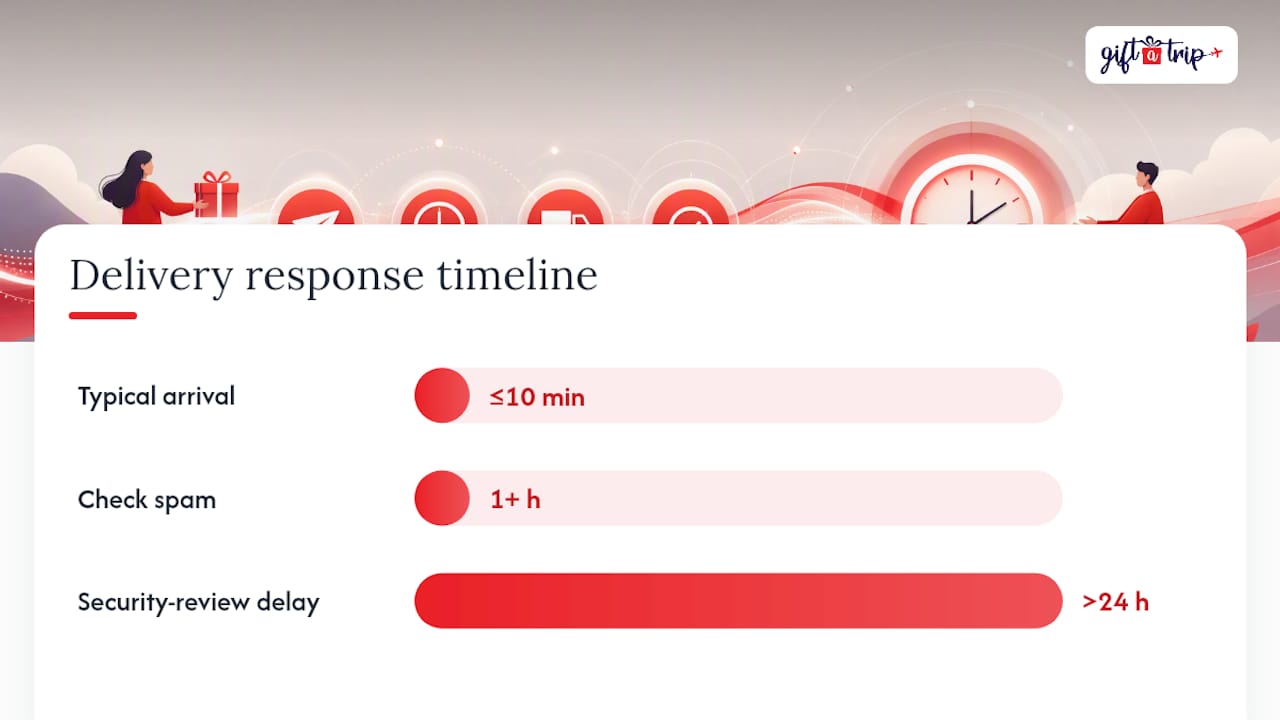
- Publish an estimated delivery window on the confirmation screen. Something like “typically within 10 minutes, up to 24 hours if payment review is triggered.”
Pro Tip: Test your own delivery pipeline by sending yourself a gift from a personal Gmail and a corporate Outlook account. Corporate spam filters are often stricter, and you’ll catch problems before a customer does.
Locking Down Security and Fraud Prevention
Gift codes are cash equivalents, and treating them that way changes how you build the send flow. Never expose a raw redemption code in a plain link or a public-facing page. Use single-use, masked, or tokenized links instead, so a forwarded email or a screenshot doesn’t hand someone else your money.
- Screen high-value orders with extra verification steps before releasing the code.
- Require email or phone verification at checkout, especially for first-time or high-dollar purchases.
- Look for PCI DSS compliance signals when choosing a gifting platform. Vendors handling gift funds should disclose their security posture and support multi-factor authentication as a baseline.
- Use unique passwords and MFA on both the purchasing account and the corporate admin dashboard.
- Instruct recipients to verify the sender’s domain before clicking, since phishing emails often mimic real gift notifications.
Making the Redemption Feel Like a Gift, Not a Transaction
The gap between a forgettable e-gift and a memorable one usually comes down to five minutes of setup work. A personalized message, a branded template, and an optional photo or video turn a code into something that feels intentional rather than automated. Digital gifting works best when personalization and scheduling are treated as core features, not afterthoughts, a principle that applies as much to a $25 coffee card as it does to a personalized travel certificate.
- Write redemption instructions as numbered steps, not paragraphs.
- Offer an add-to-wallet button whenever the platform supports it.
- Include a status or tracking page so recipients can confirm delivery themselves.
A self-service status page consistently cuts “where’s my gift?” support tickets and lifts redemption rates, because recipients who can check status themselves stop emailing support and start using the gift.
Running Bulk and Corporate Sends Without Chaos
Corporate and rewards teams face a different scale of problem: one bad batch send can generate hundreds of tickets overnight.
- Use idempotent API calls so a network timeout during a bulk send never issues duplicate gifts.
- Test every campaign with a small batch first, then ramp up volume gradually rather than firing the full list at once.
- Send purchaser confirmations showing exact recipient details so HR or admin teams can catch errors before complaints roll in.
- Publish a support SLA for gift delivery issues (24 to 48 hours is typical) so recipients and purchasers know what to expect.
- Track delivery time distribution, redemption rate, and support-ticket rate per campaign, since these three metrics are the standard way rewards programs measure distribution health.
Fixing Delivery Problems Fast When They Happen
Most “missing” e-gifts fall into one of four buckets: fraud review holds, spam filtering, a wrong recipient address, or a system backlog. Working through them in order resolves the vast majority of cases without needing to escalate.
- Step 1: Confirm the recipient email or phone number shown on the original confirmation.
- Step 2: Have the recipient check spam or junk. A significant share of “missing” e-gifts turn out to be sitting in a spam folder.(https://sharedgifts.online/blog/ultimate-guide-digital-gift-cards-2026).
- Step 3: Check whether the order is on a fraud-review hold, which can add delivery time.
- Step 4: Resend through a different channel entirely (SMS instead of email, or vice versa).
When escalating, ask the purchaser for the order ID, the timestamp of purchase, and the last four digits of the payment card. That’s usually enough for support to trace the transaction without a long back-and-forth.
Pro Tip: Give your support team a pre-written status message for delays: “Your gift is confirmed and typically arrives within 10 minutes. If it’s been longer than an hour, check spam first. Delays beyond 24 hours are usually tied to a security review and we’ll update you directly.” That single message headed off a good chunk of repeat tickets in every operation we’ve studied.
What Changes When the Gift Is an Experience, Not a Code
A resend flow and a status page do the same job whether the gift is a $50 retail card or a certificate for a week at a resort. In travel gifting specifically, the redemption instructions carry more weight, since recipients are booking a trip, not swiping a balance. The core mechanics, verified contact info, authenticated sending, self-service tracking, hold up regardless of what’s behind the code. What changes is the stakes: a lost travel certificate email is a bigger disappointment than a lost coffee card, so the role of food delivery in hospitality and fallback channels and support SLAs matter even more.
— Donovan
A Turnkey Option for Secure Travel Certificate Gifting
If you’d rather not build authentication records, fraud screening, and resend logic from scratch, Giftatrip handles the delivery infrastructure so you don’t have to. The platform offers secure digital delivery, personalized messaging, scheduled sends, and support for corporate bulk orders, covering most of the operational practices outlined above without requiring your own engineering time.
For individual gifting, Flex Trip Collections give recipients the flexibility to choose their own resort, hotel, or cruise redemption later, which sidesteps a lot of the “wrong gift” problem entirely. For HR teams and rewards administrators managing bulk sends, the corporate gifting program supports custom trip selection sites and branded gift box delivery at scale. Check current options and start a certificate order directly on the site to see how the delivery flow works before committing to a campaign.
Sources
These sources back the technical and security claims made above: SmartSMSSolutions on deliverability setup and delay causes, SendOwl on self-service status pages, Tango Card on channel and personalization guidance, Corporate Gifting Stack on vendor security signals, and SharedGifts on delivery timing and troubleshooting.
- SendOwl — Tips for selling digital gift cards
- SmartSMSSolutions — E-Gift Card Delivery Times
- Tango Card — Digital gifting 101
- Corporate Gifting Stack — Security and privacy in gifting platforms
FAQ
What is the best way to send an e-gift card?
Verify the recipient’s email or phone number before sending, use a platform with authenticated email (SPF, DKIM, DMARC), and include clear redemption instructions plus a fallback channel like SMS in case the first delivery attempt fails.
Can I order an e-gift and then forward it to the recipient myself?
Yes, most platforms let the purchaser receive the gift first and forward it manually, though this adds a step where forwarding services or email formatting can strip out redemption links, so sending directly to the recipient is usually more reliable.
What is a clever way to give a gift card?
Pair the digital delivery with a personalized message, a scheduled send timed to a specific moment (a birthday morning, an anniversary), or a physical presentation like a custom branded gift box for an in-person reveal.
How do e-gifts work?
An e-gift is purchased online and delivered electronically, typically through email or SMS, containing a code or link the recipient redeems either online or in person; delivery usually completes within 5 to 10 minutes unless a fraud review or spam filter intervenes.
What’s the most common cause of a delayed e-gift?
Spam filtering catches a large share of delayed e-gifts, which is why recipients should check junk folders first before assuming the gift never sent.