Jump to Section:
For most HR teams, the strongest setup isn’t one platform. It’s choice-based gift cards paired with experiential travel certificates, replacing a single-vendor swag program that quietly generates unused inventory and low redemption rates. Gift cards still dominate reward budgets, and experiential rewards are the fastest-growing category in North America, which is exactly the gap Giftatrip’s travel certificates fill for milestone and top-performer recognition.
A few numbers frame the decision:
- Gift cards remain the most-used reward type across North America and Europe heading into 2026.
- 58% of companies say recipients want more choice in the gifts they received, the top complaint in corporate gifting.
- Adoption, not feature count, is what separates a platform that gets used from one that gets abandoned after quarter one.
If you’re evaluating Snappy alternatives right now, the fastest next step is running a 20 to 30 person pilot with one gift-card provider and one experiential option, then comparing redemption and finance-export quality before signing an annual contract.
Key Takeaways
The strongest Snappy replacement strategy pairs choice-based gift cards for frequent recognition with travel certificates for high-value moments, evaluated against integration, reporting, and fulfillment criteria before signing any contract.
| Point | Details |
|---|---|
| No single category wins | Pair gift-card APIs for frequent rewards with travel certificates for milestone or top-performer recognition. |
| Choice reduces waste | 58% of companies wished recipients had more choice, favoring catalog and marketplace models. |
| Demand a finance export first | Get a sample CSV mapping recipient, denomination, date, and brand before signing any contract. |
| Pilot before scaling | Run a 20 to 30 person pilot for four to six weeks and track redemption rate as your core KPI. |
| Giftatrip fits the experiential tier | Digital delivery, bulk gift boxes, and packages with taxes and resort fees included suit top-tier recognition and client gifting. |
Table of Contents
- What Are the Main Types of Snappy Alternatives?
- How Do You Evaluate a Snappy Alternative Before You Buy?
- What Reward Trends Should Shape Your 2026 Platform Choice?
- What Belongs on Your Implementation and Ops Checklist?
- Why Travel Certificates Are a Strategic Snappy Alternative
- Get Started With Giftatrip for Experiential Corporate Rewards
- Sources
- FAQ
What Are the Main Types of Snappy Alternatives?
Corporate buyers researching Snappy competitors usually land on four distinct categories, and each solves a different problem. Treating them as interchangeable is the most common procurement mistake.
- Gift-card and payout APIs. These platforms push digital gift cards or cash-equivalent payouts through an API, often triggered by an HRIS event like a work anniversary. They’re fast to deploy and simple to reconcile, but the reward itself is generic and easy to ignore in a crowded inbox.
- Merchandise and swag platforms. These run branded stores where employees redeem points for company-logo apparel, tech accessories, or drinkware. They build brand visibility but carry real warehousing and return-rate risk if sizing or taste misses.
- Multi-brand choice catalogs. These marketplaces bundle dozens of retail and travel brands into one redemption screen, letting the recipient pick. Choice-based catalogs consistently reduce wasted rewards compared to single-supplier gifting, though catalog fees can stack up on smaller orders.
- Experiential and travel certificates. These convert reward budget into redeemable stays at resorts, hotels, or cruise lines. They carry higher perceived value per dollar spent and work well for top-tier recognition, though they’re a poor fit for low-value, high-frequency rewards like a $10 coffee thank-you.
Most mature programs don’t pick one category. A typical structure pairs a gift-card API for everyday recognition with travel certificates reserved for annual milestones, sales-incentive winners, or client appreciation, where a bigger gesture actually moves the relationship forward.
How Do You Evaluate a Snappy Alternative Before You Buy?
Run every platform through the same five-point checklist during a demo, and you’ll cut evaluation time roughly in half.
Integration and adoption. Confirm native Slack, Microsoft Teams, and HRIS connections, plus single sign-on. A platform with a richer catalog but no workflow integration will lose to a simpler tool employees actually see, since adoption beats feature parity in almost every recognition program that fails to scale.

Catalog breadth and choice. Ask how many brands and categories are live today, not on a roadmap.

Finance reporting and tax readiness. Request a sample CSV export before you sign anything. You need fields mapping recipient, denomination, date, and brand cleanly enough to support year-end W-2 reporting without a manual rebuild in Excel.
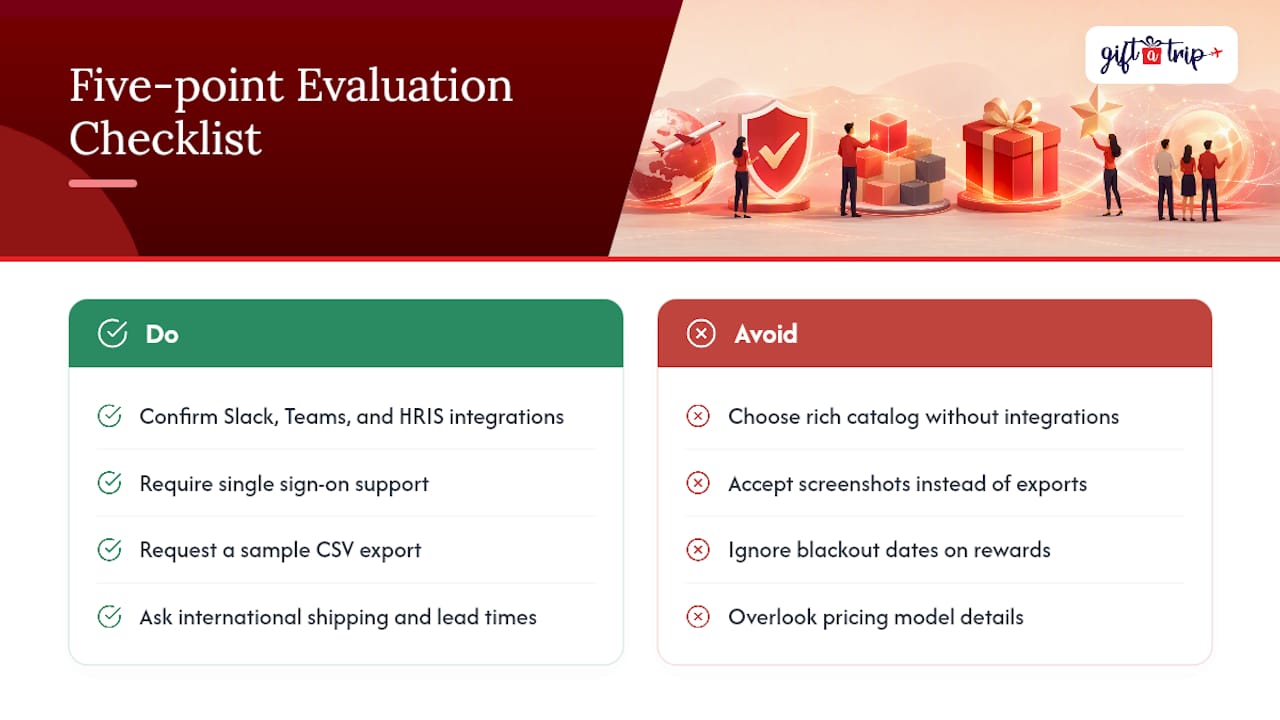
Fulfillment and international coverage. Ask about physical kit lead times, digital delivery windows, blackout dates on travel-based rewards, and whether the platform ships or delivers outside the United States if your workforce is distributed.
Security, SLAs, and pricing. Confirm SOC 2 compliance status, support response times, and whether pricing runs pay-as-you-go, annual minimums, or per-item fees.
Pro Tip: Bring your own finance controller to the demo call. Vendors answer integration questions confidently but often stumble on reporting specifics, and that gap shows up fast when your controller asks for a live export instead of a screenshot.
Ask vendors directly: What HRIS systems do you integrate with today? Can I see a sample export file? What’s your average international delivery time? Do you carry SOC 2 Type II certification? What happens to unused balances after 12 months?
What Reward Trends Should Shape Your 2026 Platform Choice?
The data heading into 2026 points in a clear direction: gift cards aren’t going anywhere, but they’re no longer the whole story. Gift cards remain the most widely used reward type across North America and Europe, and organizations are increasingly favoring choice-based or brand-specific cards over single-retailer options. At the same time, experiential rewards, travel certificates chief among them, are growing faster than any other category in North America as companies shift toward fewer, higher-quality gestures instead of bulk swag.
That shift changes how you should split a reward budget:
- Use everyday gift cards for frequent, low-value recognition (peer shoutouts, small milestones).
- Raise per-person merchandise budgets rather than buying more low-cost items. Fewer, better items outperform bulk swag on perceived value.
- Reserve travel certificates for top-tier moments: tenure anniversaries, President’s Club winners, and client relationships worth protecting.
A workable rule of thumb: keep gift cards for anything under roughly $100 in reward value, move to curated merchandise between $100 and $250, and shift to experiential travel certificates above that threshold, where the emotional payoff of a trip outweighs a bigger number on a gift card balance. Our employee recognition travel guide breaks down how HR teams are structuring that split for 2026 rollouts.
What Belongs on Your Implementation and Ops Checklist?
Most platform failures aren’t about the reward. They’re about what happens in finance and ops six weeks after launch, when nobody can reconcile what was sent to whom.
- Lock down finance exports first. Require a sample CSV showing recipient, denomination, date, brand, and order ID before signing. Retrofitting this after launch costs far more time than confirming it upfront.
- Contract fulfillment SLAs in writing. Get committed timelines for physical kit delivery, digital delivery cadence, and a documented returns process for merchandise sizing issues.
- Negotiate payment terms early. Decide between invoice billing and card payment, confirm any order minimums, and get the refund or credit policy for unredeemed balances in writing.
- Document data privacy and consent. Confirm how recipient data (names, emails, addresses for physical shipping) is stored, who has access, and how long records are retained.
- Pilot before you scale. Run a 20 to 30 person pilot for four to six weeks, track redemption rate and time-to-redeem as your core adoption KPIs, then expand only after finance has validated one full reconciliation cycle.
Pro Tip: Treat the pilot’s finance reconciliation as the real go/no-go gate, not the employee feedback survey. A reward everyone loves is worthless if your controller can’t close the books on it.
Our guide to organizing gifting programs for HR and managers walks through a fuller version of this checklist with sample pilot templates.
Why Travel Certificates Are a Strategic Snappy Alternative
Giftatrip’s travel certificates map directly onto the procurement checklist above. Delivery is digital and secure, bulk orders support customizable gift boxes for large cohorts, and packages can include taxes and resort fees upfront, so finance sees one clean number instead of a surprise invoice later. Blackout dates are kept minimal, which matters when a reward’s whole value proposition is flexibility.
Where this fits best:
- Tenure milestones (5, 10, 15 years) where a gift card feels transactional
- Top-performer sales incentives where the reward needs to feel earned, not routine
- Client appreciation and charitable auction prizing, where a travel certificate reads as a genuine gesture rather than a line-item gift
A recognition program built entirely on point balances and catalog browsing eventually feels like a chore. The programs that actually retain people usually include at least one reward that feels like a genuine occasion, not a transaction.
That said, travel certificates aren’t the right fit for high-frequency, low-dollar recognition. If you need to send hundreds of $15 thank-yous a month, a gift-card API still does that job better. Convenience matters here too, and research on business travel consistently shows friction kills adoption of any experiential reward, which is exactly why minimal blackout dates and simple redemption matter as much as the destination itself.
A practical read on where this actually lands
Most vendor comparisons oversell feature lists and undersell the boring stuff that determines whether a program survives its first year: clean finance exports, real integration, and rewards people actually redeem. If you’re serious about moving off Snappy, run the finance-export test before you run a feature demo. Then pilot one gift-card option against one experiential option side by side. The data will tell you more in six weeks than any sales deck will in six months.
— Donovan
Get Started With Giftatrip for Experiential Corporate Rewards
Giftatrip is the direct alternative for teams that want the experiential half of a rewards program without building a travel booking process from scratch. Where a gift-card API gives you a flexible dollar amount and a merch platform gives you a branded item, Giftatrip gives you a redeemable stay at a resort, hotel, or cruise line, with taxes and resort fees already built into the package and minimal blackout dates so recipients actually use what they’re given.
That structure suits HR teams layering an experiential tier on top of an existing gift-card program, incentive administrators running a President’s Club prize, and event planners sourcing charity-auction items that draw real bids. Bulk orders come in customizable gift boxes, so a batch of 50 certificates for a sales team looks and feels intentional rather than like 50 separate transactions.
If you’re building next year’s incentive budget, start with our travel certificate distribution guide for HR and events to see order minimums and bulk options, or go straight to the travel certificate shop to check current packages from Virgin Voyages, major resort brands, and cruise lines before your next recognition cycle locks in.
Sources
For deeper research, see the Incentive Research Foundation’s 2026 industry outlook, GIFQ’s guide to bulk gift-card buying, and Giftatrip’s vacation voucher strategic gifting guide for program design details.
- Industry Outlook for 2026: Merchandise, Gift Cards, and Event Gifting – Incentive Research Foundation
- B2B Gift Cards for Employees: Bulk Buying Without the Ops Headache | GIFQ
- The State of Corporate Gift Boxes 2026: What Companies Struggle With a – GiftAFeeling
FAQ
What Companies Are Similar to Snappy?
Snappy competes with gift-card and payout API platforms, merchandise and swag portals, and choice-based multi-brand catalogs; for experiential and travel-based rewards specifically, Giftatrip serves that same corporate gifting need through travel certificates.
What Is Snappy Used For?
Snappy is typically used for employee recognition and client gifting, letting recipients choose a gift from a curated catalog rather than receiving a fixed item.
Are Travel Certificates a Realistic Snappy Alternative?
Yes, for higher-value recognition moments like tenure milestones or top-performer incentives. Giftatrip certificates include taxes and resort fees and carry minimal blackout dates, making redemption straightforward for recipients.
How Long Does It Take to Implement a New Rewards Platform?
Most organizations run a pilot of four to six weeks with a small cohort before expanding, allowing finance to validate one full reconciliation cycle ahead of a broader rollout.
Should We Use One Platform or Combine Several?
Combining categories generally performs better than a single vendor: a gift-card API for frequent recognition alongside travel certificates or curated merchandise for milestone and top-tier rewards.