Jump to Section:
TL;DR:
- Digital delivery makes travel rewards instant, trackable, and scalable, fueling faster growth in the global market. It reduces operational costs, enables real-time measurement, and offers personalized options, driving recipient engagement. Implementing multi-rail fallback and detailed metrics ensures program reliability and continuous improvement.
Digital delivery makes travel rewards instant, trackable, and scalable — and that combination is why digital gift cards now grow 2.5× faster than physical ones in a global gifting market worth roughly $957 billion. For corporate program managers and individual buyers alike, the shift from mailed certificates to secure e-delivery isn’t just a convenience upgrade. It changes what you can measure, how fast recipients act, and how much the whole operation costs to run.
TL;DR:
- Speed: Recipients get rewards instantly, tightening the behavior-to-reward loop.
- Measurement: Real-time delivery and redemption data lets you optimize continuously.
- Choice: Multi-brand digital catalogs let recipients pick what actually matters to them.
Table of Contents
- How digital delivery reshapes the rewards experience
- Why timing and delivery method change recipient behavior
- Operational patterns that reduce delivery failures and support load
- What digital delivery reveals: the metrics that actually matter
- Security, fraud prevention, and policy considerations for U.S. digital rewards
- How digital travel certificates work from send to redemption
- Corporate program design: checklist and pilot plan
- How Giftatrip implements digital delivery best practices
- When should you choose digital-only, physical, or a hybrid approach?
- Key Takeaways
- The part most programs get wrong
- Travel rewards programs that move fast start here
- FAQ
- Useful sources and further reading
How digital delivery reshapes the rewards experience
The practical advantages stack up fast. Here’s what drives adoption among both consumers and corporate programs:
- Immediacy: A digital travel certificate lands in a recipient’s inbox within minutes of purchase, not days after a print run.
- Operational savings: No printing, no postage, no inventory. Physical rewards carry fulfillment costs such as production, packaging, shipping, and returns that digital delivery helps eliminate.
- Scalability: Sending many certificates to a distributed sales team costs about as much effort as sending a few, due to scalability. Bulk ordering with personalized messaging is table stakes for modern platforms.
- Personalization: Surveys show personalization rates near 73% for perceived value among recipients. Multi-brand catalogs let each person choose what resonates.
- Sustainability: No packaging, no transport emissions, no unsold inventory sitting in a warehouse.
- Global redemption: Digital delivery crosses borders without customs delays or currency friction.
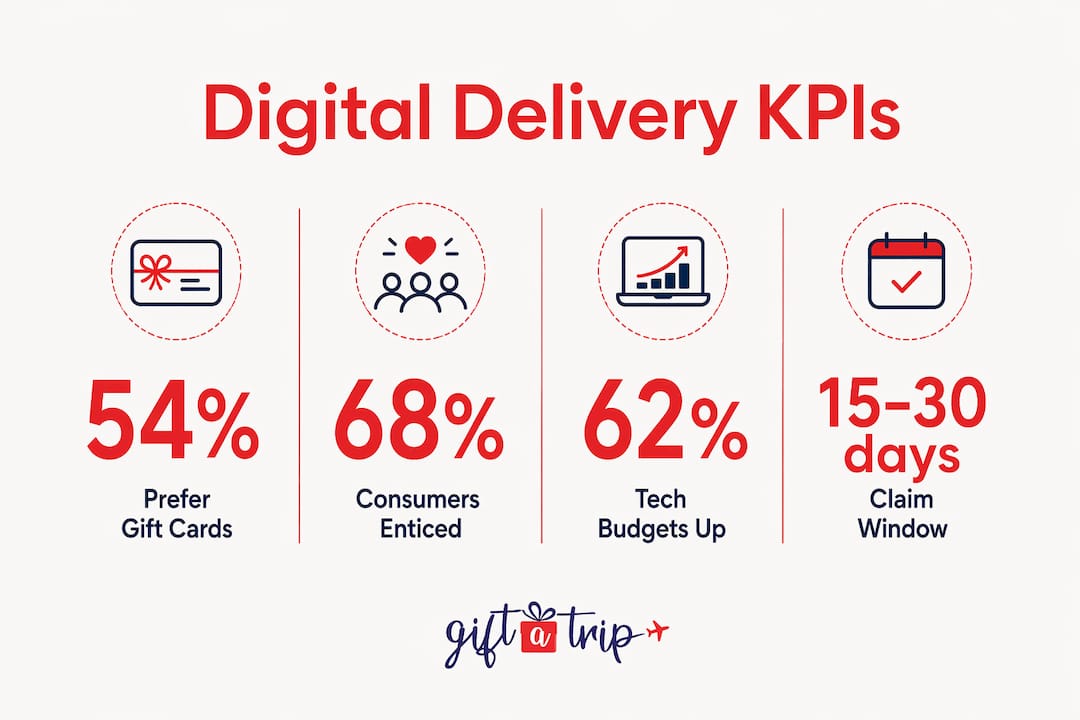
54% of employees prefer gift cards over other reward formats, and 68% of consumers call them an enticing incentive. Those numbers reflect a real preference shift, not a trend.
Pro Tip: Match reward type to campaign goal before you pick a platform. For ongoing loyalty programs, use non-expiring Standard rewards. For short consumer campaigns where speed matters, use time-bound Promotional rewards with a claim-by date. The dual-engine model keeps both working without conflict.
Why timing and delivery method change recipient behavior
Immediacy strengthens the reward-behavior link. Physical rewards can produce stronger long-term memory. Both statements are true, and understanding the tension between them is what separates well-designed programs from ones that just send stuff.
Behavioral science indicates that the closer a reward arrives to the behavior it reinforces, the stronger the association. Digital delivery wins here by default. When a sales rep closes a deal and gets a travel certificate notification the same afternoon, the connection between effort and recognition is hard to miss.
The Giftbit Incentives Trend Report notes that consumer incentive claim times improved notably for Promotional rewards in recent years, while employees and relationship-based recipients are taking more time — choosing deliberately rather than claiming quickly.
Practical implications for program design:
- Use instant digital delivery for consumer promos, flash campaigns, and sales contests where speed amplifies the reward loop.
- Use physical or hybrid formats for high-touch milestones where the tangible object adds memorable value.
- Match claim-by windows to audience behavior: short deadlines for consumers, at least 15–30 days for employees.
Operational patterns that reduce delivery failures and support load
Start with this: use multi-rail delivery with intelligent fallback logic and automated retries. Single-channel digital solutions solve speed but create friction when an email bounces or a recipient never opens the notification. Choice Digital’s analysis shows multi-rail delivery raises redemption and cuts manual reissues.
Delivery attempt flow:
- Send via preferred digital rail (email or SMS).
- If undelivered after a set window, trigger an automated retry or alternate channel.
- If still unclaimed, escalate to a physical fallback or flag for manual reissue.
- Log all outcomes to a centralized reporting dashboard.
Operational KPIs to monitor:
| Metric | What to track | Healthy signal |
|---|---|---|
| Delivery success rate | Percentage of sends confirmed delivered | Should be high |
| Time-to-claim | Hours/days from send to recipient action | Trending down over campaigns |
| Support tickets per 1,000 sends | Volume of “where’s my reward?” contacts | — |
62% of North American organizations expect to increase program technology budgets, which means the infrastructure to support these KPIs is increasingly available and expected.

Pro Tip: Set up a branded reward status page so recipients can check delivery themselves. Automated status pages cut “where’s my reward?” tickets without adding headcount. Pair it with a branded email template that includes a direct redemption link.
What digital delivery reveals: the metrics that actually matter
Digital delivery provides real-time visibility into delivery, redemption, and engagement. That visibility is the foundational ROI lever — without it, you’re guessing at what works.
| Metric | Definition | What a good trend looks like |
|---|---|---|
| Time-to-claim | Time from send to recipient claim | Shortening over successive campaigns |
| Redemption rate | % of issued rewards actually used | Rising; low rates signal catalog mismatch |
| Breakage | Value of unredeemed Promotional rewards | Controlled; reinvest into future sends |
| Average order value | Spend per redemption event | Stable or rising with catalog quality |
| Retention lift | Change in repeat engagement post-reward | Positive correlation with reward timing |
Use these signals to iterate. If redemption rates are low, the catalog may not match recipient preferences. If time-to-claim is long for a consumer promo, consider adjusting the claim window or adding reminder notifications. Plot redemption rate against send timing to find the days and hours when recipients are most likely to act.
Security, fraud prevention, and policy considerations for U.S. digital rewards
Secure delivery and fraud controls are non-negotiable, but standard controls mitigate most risk without adding operational complexity.
Core controls every program should implement:
- Single-use e-codes: Each certificate generates a unique, one-time code that expires on use.
- Expiry policy governance: Document claim-by dates clearly; align with state escheatment laws for unclaimed funds.
- Transactional audit trails: Log every send, claim, and redemption event with timestamps.
- Role-based access control (RBAC): Limit who on your team can issue or reissue rewards.
- Escheatment-ready workflows: U.S. unclaimed property laws vary by state; your platform should flag dormant balances before they become a compliance issue.
- Spam-filter mitigation: Use a recognized sending domain and plain-text fallback to keep reward emails out of junk folders.
A quick vendor-selection checklist: confirm the platform uses tokenized delivery, provides audit logs you can export, supports RBAC, and has a documented escheatment process for your state.
How digital travel certificates work from send to redemption
A digital travel certificate generates a redeemable code or account-based credit that the recipient uses on a supplier booking engine or a partner portal. The flow is straightforward.
Typical lifecycle:
- Send: Buyer purchases and sends the certificate; recipient receives an email with a unique code.
- Notify: Automated confirmation lands in the recipient’s inbox, often with a branded message.
- Claim: Recipient activates the code on the redemption portal, usually within the claim window.
- Redeem: Recipient books a stay, cruise, or vacation package directly through the platform.
- Post-redemption reporting: Sender sees confirmation of use in the program dashboard.
Claim window norms:
- Consumer promotions: short windows (days to a week) create urgency and faster action.
- Employee and relationship rewards: 15–30 days minimum to allow deliberate choice.
Edge cases to plan for:
- Unredeemed rewards: Promotional certificates expire; Standard certificates don’t. Choose based on your audience.
- Change requests: Build a reissue workflow for recipients who lose access to their original email.
- Taxes and resort fees: In the U.S., many travel certificates exclude these by default. Giftatrip covers taxes and resort fees in its certificates, removing a common friction point at booking. For more on why that matters, see resort fees and travel gifts.
Corporate program design: checklist and pilot plan
Pilot small, measure delivery and redemption metrics, then scale with automation. That sequence prevents wasted budget and surfaces catalog or timing issues before they affect thousands of recipients.
Program design checklist:
- Segment recipients (consumers vs. employees vs. VIP clients) before choosing reward type.
- Set personalized messaging for each segment.
- Choose Standard vs. Promotional reward engine based on campaign goal.
- Confirm taxes and resort fees are covered in the certificate value.
- Set up bulk ordering with individual personalization fields.
- Define reporting cadence (weekly during pilots, monthly for ongoing programs).
- Confirm escheatment compliance for unclaimed Promotional rewards.
Pilot plan:
- Select a cohort of 50–100 recipients for the first send.
- Use the HR distribution guide to configure bulk delivery and tracking.
- Measure delivery success rate, time-to-claim, and redemption rate at 30 days.
- Survey recipients for NPS change.
- Adjust catalog, claim window, or messaging based on results.
- Scale to full program with automation enabled.
How Giftatrip implements digital delivery best practices
Giftatrip provides a turnkey digital travel certificate workflow that supports bulk ordering, personalized messaging, secure single-use digital delivery, and certificates that include taxes and resort fees.
Platform capabilities:
- Secure digital delivery with unique redemption codes per certificate.
- Bulk ordering with customizable gift boxes and personalized messaging fields.
- Certificates redeemable at resorts, hotels, cruise lines, and vacation packages from major brands.
- Taxes and resort fees covered, with minimal blackout dates.
- HR and events distribution workflows for corporate programs.
Use cases:
- Employee milestone gifting: A manager sends 25 anniversary certificates to tenured staff; each arrives personalized, with a booking link ready to use.
- Customer incentive campaigns: A brand runs a purchase-with-reward promotion; digital certificates deploy automatically at scale with no fulfillment overhead.
- Bulk event gifting: A conference organizer sends attendee appreciation certificates post-event, tracked through a single dashboard.
For travel incentive trends shaping corporate programs in 2026, Giftatrip’s resource library covers the operational and behavioral shifts in detail.
When should you choose digital-only, physical, or a hybrid approach?
Default to digital for scale and measurement. Use hybrid approaches where memorability or premium gifting matters. That’s the short answer; here’s the decision framework.
| Delivery objective | Recommended approach |
|---|---|
| Instant recognition at scale | Digital |
| Consumer promo with urgency | Digital (Promotional, short claim window) |
| Premium milestone or anniversary | Hybrid or physical |
| VIP client recognition | Hybrid (digital delivery, physical keepsake) |
| Global distributed workforce | Digital |
Scenario examples:
- Consumer promo: A retailer rewards purchase behavior with a digital travel certificate. Speed and scale favor digital-only.
- Employee 10-year anniversary: A physical card or branded box alongside a digital certificate creates a memorable moment the employee keeps.
- VIP client recognition: A luxury travel certificate delivered digitally but accompanied by a handwritten note hits both immediacy and memorability. Convenience in business travel contexts, as hospitality research notes, is increasingly the deciding factor for high-value recipients.
Key Takeaways
Digital delivery is the fastest, most measurable way to run a travel rewards program — and the data it generates is what lets you improve every subsequent campaign.
| Point | Details |
|---|---|
| Speed drives behavior | Instant digital delivery tightens the reward-behavior link; consumer claim times improved notably for Promotional rewards in recent years. |
| Multi-rail ops reduce failure | Use preferred digital rail first with automated fallback to cut support tickets and manual reissues. |
| Dual reward engines matter | Standard (non-expiring) rewards suit loyalty programs; Promotional (time-bound) rewards suit consumer campaigns. |
| Hybrid beats pure digital for milestones | Physical or hybrid delivery improves memorability for high-touch recognition moments. |
| Giftatrip covers the full workflow | Giftatrip’s certificates include taxes and resort fees, support bulk ordering, and come with an HR distribution guide for corporate programs. |
The part most programs get wrong
Most reward programs treat delivery as a logistics problem. Get the thing to the person. Done. What they miss is that how the reward arrives is part of the reward itself.
A travel certificate that lands in someone’s inbox with a personalized message, a clean redemption link, and no hidden resort fees at checkout communicates something different than a generic gift card code in a plain email. The former says the sender thought about the experience end-to-end. The latter says they didn’t. Recipients notice, even if they can’t articulate why.
The behavioral science case for immediacy is solid, but immediacy without quality is just fast noise. The programs that build real loyalty combine instant delivery with genuine choice, clear redemption paths, and no friction at the booking stage. That’s the combination worth optimizing for in 2026.
Travel rewards programs that move fast start here
Giftatrip is the direct route from “we need to reward these people” to “certificates are in their inboxes” — without the fulfillment overhead, hidden fees, or manual reissue headaches that slow most programs down. Certificates cover taxes and resort fees upfront, bulk ordering ships with personalized messaging, and the HR distribution workflow handles tracking from send to redemption.
Two things that matter for program managers: every certificate uses secure single-use digital delivery, and the HR and events distribution guide walks you through bulk setup, claim tracking, and reporting in one place. For teams ready to act now, vacation gift certificates for corporate programs is the right starting point.
FAQ
What is the role of digital delivery in rewards programs?
Digital delivery makes rewards instant, trackable, and scalable. It tightens the behavior-to-reward loop, eliminates fulfillment costs, and provides real-time redemption data that programs can use to optimize continuously.
How do digital travel certificates work for employees?
A recipient gets a unique redemption code by email, claims it through a booking portal, and applies it to a hotel, resort, or cruise reservation. Giftatrip certificates cover taxes and resort fees, so there are no surprise charges at checkout.
What claim window should I set for employee rewards?
Give employees at least 15–30 days to claim, since they tend to choose deliberately rather than act immediately. Consumer promotions can use shorter windows to create urgency and faster action.
When does a hybrid reward approach make more sense than digital-only?
Use hybrid delivery for high-touch milestones like work anniversaries or VIP recognition, where a physical element adds memorability. Digital-only works best for scale, speed, and global distribution.
How does digital delivery reduce program operating costs?
Digital rewards eliminate production, packaging, shipping, and returns. Those savings can be reinvested into higher-value certificates or broader program reach without increasing the total budget.
Useful sources and further reading
- Giftbit 2026 Incentives Trend Report — Covers the dual-engine model (Standard vs. Promotional rewards), claim-time trends, and audience-specific design guidance. Essential reading for program managers.
- Corporate Gifting Statistics 2026 — Market size data, employee preference figures, and personalization statistics. Useful for building the business case for digital rewards.
- Industry Outlook for 2026: Merchandise, Gift Cards, and Event Gifting — Incentive Research Foundation data on technology budget trends in North American reward programs.
- The Rise of Instant Rewards | CarltonOne — Explains the immediacy vs. memorability trade-off and practical implications for hybrid program design.
- The Overlooked Engagement Moment | Choice Digital — Makes the operational case for multi-rail delivery and intelligent fallback logic.
- Digital Gift Cards in Rewards Programs | Employee Benefit News — Covers the financial and engagement case for digital gift cards in employee recognition.
- What Are Digital Travel Certificates? | Giftatrip — Product-level explainer covering delivery mechanics, redemption flow, and certificate types available through Giftatrip.
- Travel Certificate Distribution Guide for HR and Events | Giftatrip — Step-by-step bulk fulfillment and tracking guide for corporate program managers.