Jump to Section:
TL;DR:
- Effective milestone celebration gifting involves a structured process focused on meaningful recognition and timely delivery. Proper planning, personalized choices, and intentional messaging create lasting impact and foster genuine connections. Automation supports consistency, ensuring recipients feel valued at important moments.
The milestone celebration gifting process is a structured approach to recognizing key achievements with thoughtful, well-timed gifts that build genuine connections. Done right, it covers everything from identifying the right milestone type to setting a budget, selecting a meaningful gift, and delivering it with intention. Most organizations treat gifting as an afterthought. The ones that get it right treat it as a repeatable system. This guide walks through every stage of that system, with current 2026 industry standards and practical examples for both individuals and corporate planners.
What is the milestone celebration gifting process?
The milestone celebration gifting process is the end-to-end practice of planning, selecting, and delivering gifts that mark significant personal or professional achievements. Industry professionals also call this “milestone recognition,” a term used in HR and rewards management to describe the formal acknowledgment of service, growth, or life events. Both terms describe the same core practice: making someone feel genuinely seen at a moment that matters.
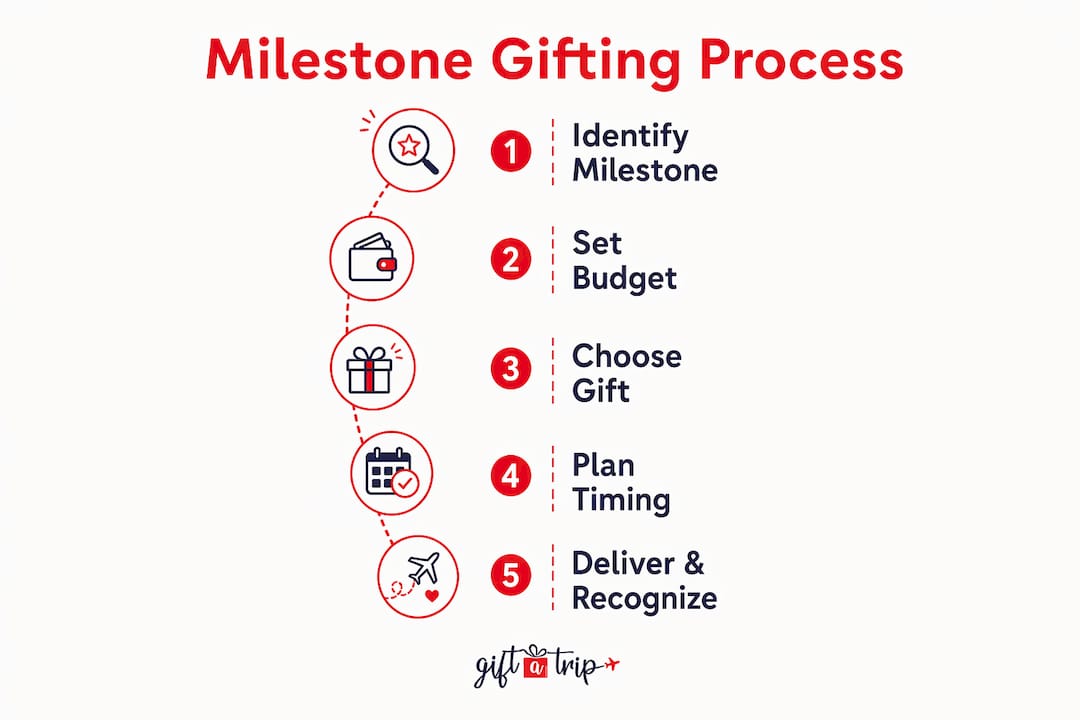
The process has four stages. First, you identify the milestone type and its emotional weight. Second, you set a budget aligned to the occasion. Third, you select and personalize the gift. Fourth, you deliver it with a message and presentation that reinforce the recognition. Skipping any stage produces the kind of gift that lands flat, the generic mug or the late card that arrives two weeks after the anniversary.
Consistent execution of gifting rituals signals value and inclusion more powerfully than the gift itself. That finding reframes the entire process. The gift is not the point. The ritual is.
What are common types of milestone celebrations?
Milestone celebrations fall into two broad categories: personal and organizational. Each carries a different emotional weight, and that weight should shape your gift approach.
Personal milestones include:
- Birthdays, especially landmark ages like 30, 40, 50, and 60
- Weddings and anniversaries
- Graduations and academic achievements
- New babies and family expansions
- Retirements and career transitions
Organizational milestones include:
- Work anniversaries at 1, 3, 5, 10, 15, 20, and 25 years
- Promotions and new role transitions
- Sales targets and performance achievements
- Team or company anniversaries
- Project completions and product launches
The emotional stakes differ significantly between these categories. A 25-year work anniversary carries decades of loyalty and deserves a gift that reflects that depth. A one-year work anniversary is meaningful but calls for a lighter touch. Personal milestones like weddings or retirements often blend professional and personal identity, so gifts should feel warm and individual rather than corporate.
Cultural context also shapes the right approach. In some workplaces, public recognition during a team meeting is the highest honor. In others, a private, handwritten note from the CEO carries more weight. Understanding the recipient’s preference before choosing the format is as important as choosing the gift itself.
How to plan budget and timing for milestone gifting
Budget and timing are the two variables that most organizations get wrong. Both have clear industry standards, and following them removes guesswork from the process.

Setting the right budget
Industry guidance recommends milestone gift budgets between $75 and $150 per recipient, using a starting formula of $20–$30 per year of service to build tiered rewards. That formula creates a logical, defensible structure that scales with tenure.
| Milestone type | Recommended budget range |
|---|---|
| Spot recognition | $25–$50 |
| Work anniversary (1–4 years) | $75–$100 |
| Work anniversary (5–9 years) | $100–$150 |
| Top performer award | $200+ |
| Client or executive gift | $100–$250 |
Qualified service award plans also carry a tax advantage worth noting. Awards up to $1,600 per employee per year are tax-exempt under IRS rules for qualified plans. That number gives HR teams a concrete ceiling for structuring annual gifting budgets without triggering taxable income for recipients.
Timing your gifts correctly
Triggering milestone gifts 2–4 weeks in advance is the industry standard to accommodate selection, production, and shipping. Production timelines typically run 7–10 business days. That means a gift ordered the day before an anniversary will almost certainly arrive late, and late delivery erodes the entire intended impact.
Pro Tip: Set calendar alerts or HRIS triggers 30–60 days before each milestone date. That buffer covers custom production, approval workflows, and any shipping delays, especially for remote recipients.
A practical gifting program for HR teams maps every milestone date at the start of the year and assigns budget codes in advance. That single step eliminates the most common failure mode: the rushed, impersonal gift ordered in a panic.
What are effective gift selection strategies for milestone celebrations?
Gift selection is where the process either earns loyalty or wastes budget. The research is clear on what works.
Choice-based gifting catalogs show a 47–52% retention impact compared to roughly 20% for cash rewards. That gap is significant. When recipients choose their own gift, they feel respected and seen. When they receive a fixed item they did not want, the gift signals that the giver did not think about them specifically.
Effective gift selection follows these principles:
- Prioritize choice over convenience. Offer a curated catalog rather than a single fixed item. Even three options feel more personal than one.
- Balance symbolic and practical. A keepsake like an engraved item carries emotional weight. A practical gift like travel certificates or premium drinkware gets used. The best gifts do both.
- Avoid over-branding. Unbranded or lightly branded items are preferred for long-term appreciation. A gift covered in a company logo feels like promotional merchandise, not a personal keepsake.
- Match the gift tier to the milestone weight. A five-year anniversary deserves more than a one-year gift. The difference signals that tenure is genuinely valued.
- Integrate experiences. Experiential gifts paired with tangible keepsakes create recognition moments that recipients talk about and remember.
Employees prefer gifts that integrate into daily routines over purely symbolic items. Popular categories include drinkware, desk accessories, wellness products, and premium stationery. Travel experiences rank especially high for milestone-level awards because they create memories that outlast any physical object.
Pro Tip: For five-year-plus milestones, pair a personalized keepsake with a travel certificate. The keepsake sits on the desk as a daily reminder. The trip becomes a story the recipient tells for years.
How to automate and manage milestone gifting logistics
Scaling a gifting process without automation leads to missed dates, inconsistent budgets, and frustrated recipients. The solution is to build the process into your existing systems.
Setting up automated triggers
- Connect your HRIS data. Pull anniversary dates, promotion dates, and performance milestones directly from your HR information system. Manual tracking in spreadsheets creates gaps.
- Set alerts 30–60 days in advance. Automated systems that trigger alerts this far ahead allow consistent planning and execution. That window covers manager approvals, personalization, and shipping.
- Assign manager roles. Managers should receive automated reminders with a link to the approved gift catalog and a pre-written message template. This keeps the process consistent without requiring HR to manage every individual gift.
- Integrate fulfillment. Connect your gift catalog to a fulfillment system that handles shipping directly. For digital gifts like travel certificates, delivery is instant and requires no physical logistics.
- Track and report. Log every gift sent, the budget used, and the delivery date. That data supports annual program reviews and budget planning.
Logistics for remote and hybrid teams
Remote recipients require extra lead time and address verification. A gift that arrives at an old address or gets lost in transit does more damage than no gift at all. Digital delivery solves this problem entirely. Digital travel certificates deliver instantly to any email address, regardless of the recipient’s location.
| Delivery method | Lead time needed | Best for |
|---|---|---|
| Physical gift, standard shipping | 2–3 weeks | Office-based recipients |
| Physical gift, custom production | 3–5 weeks | Engraved or branded items |
| Digital certificate | Same day | Remote, hybrid, or last-minute |
| Experience voucher | 1–2 weeks | High-value milestone awards |
How to create meaningful recognition moments around milestone gifts
The gift is the vehicle. The recognition moment is the destination. Personalized messages from managers or senior leaders amplify the impact of any gift more than the gift’s monetary value alone. Recipients weigh the message and timing more heavily than the cost of what they received.
Building a strong recognition moment involves several deliberate choices:
- Write a specific message. Reference the recipient’s actual contributions, not a generic “thank you for your service.” Specificity signals that the recognition is real.
- Match the format to the person. Some people want public acknowledgment in a team meeting. Others prefer a private note. Ask or observe before deciding.
- Involve peers. A tribute compilation from teammates, a recognition wall post, or a short video from colleagues adds emotional depth that no gift can replicate on its own.
- Use quality packaging. Careful presentation, including high-quality packaging and personalized messaging, serves as a visual signal of genuine appreciation. A beautifully presented gift communicates effort before it is even opened.
“Recognition is not about the gift. It is about the moment when someone realizes their work has been seen, valued, and remembered. The gift is the proof of that moment.”
Timing the presentation to coincide with the actual milestone date, not a week later at the next convenient meeting, preserves the emotional connection between the gift and the achievement it honors. Delays in gift presentation erode the intended impact and signal a lack of care, even when the gift itself is excellent.
Key Takeaways
A well-executed milestone celebration gifting process combines structured budgeting, timely delivery, personalized selection, and intentional recognition moments to create lasting impact.
| Point | Details |
|---|---|
| Define the milestone type first | Match gift tier and format to the emotional weight of the occasion. |
| Follow budget standards | Use $20–$30 per year of service as a baseline, with milestone gifts in the $75–$150 range. |
| Trigger gifts 30–60 days early | Build in time for production, approvals, and shipping to avoid late delivery. |
| Choose choice over fixed gifts | Choice-based catalogs show up to 52% retention impact versus 20% for cash. |
| Pair the gift with a personal message | Recognition weighted by message and timing outperforms gift cost alone. |
Why the process matters more than the present
The gifting programs I have seen fail share one trait: they treat the gift as the whole effort. A budget gets approved, a generic item gets ordered, and the box shows up on someone’s desk with no note, no context, and no ceremony. The recipient feels like a line item, not a person.
The programs that build real loyalty do the opposite. They treat the gift as the final step in a process that starts weeks earlier with intention. The manager writes a specific message. The gift reflects something the recipient actually values. The presentation happens at the right moment, not whenever it is convenient.
The automation piece surprises most people. Many assume that automating gifting makes it feel less personal. The opposite is true. Automation handles the logistics so that managers can focus entirely on the human part: the message, the moment, and the meaning. When the system reminds a manager 45 days in advance, they have time to think carefully about what to say. When the system handles shipping, the manager is not scrambling the day before.
The other mistake I see consistently is over-branding. A gift covered in a company logo is not a gift. It is marketing material. The recipient knows the difference immediately. Lightly branded or unbranded gifts that reflect the recipient’s actual interests carry far more weight and stay in use far longer.
The bottom line is that the process is the gift. Get the process right, and almost any thoughtful gift will land well. Get the process wrong, and even an expensive gift will feel hollow.
— Donovan
Travel gifts that make milestone moments unforgettable
Milestone celebrations deserve gifts that create memories, not just objects that collect dust. Giftatrip specializes in digital travel certificates redeemable at top resorts, hotels, and cruise lines, making them one of the most flexible and memorable options for any milestone occasion.
Whether you are recognizing a 10-year work anniversary, a retirement, or a personal life achievement, Giftatrip’s travel certificate options cover every budget tier and occasion. Certificates are delivered digitally, so they work perfectly for remote teams and last-minute recognitions. Taxes and resort fees are included, and blackout dates are minimal. For organizations building a scalable gifting program, Giftatrip also offers bulk ordering with customizable gift boxes and personalized messaging. Explore the full range of corporate travel gift ideas to find the right fit for your next milestone celebration.
FAQ
What is milestone gifting?
Milestone gifting is the practice of presenting a meaningful gift to recognize a significant personal or professional achievement, such as a work anniversary, retirement, or graduation. The goal is to acknowledge the achievement in a way that feels personal and proportionate to its importance.
What budget should I set for a milestone gift?
Industry standards recommend $75–$150 for milestone gifts, using a base formula of $20–$30 per year of service to build tiered awards. Qualified service award plans allow up to $1,600 per employee annually to remain tax-exempt under IRS rules.
How far in advance should I plan a milestone gift?
Plan at least 2–4 weeks in advance to cover selection, production, and shipping. For custom or engraved items, allow 3–5 weeks. Setting automated HRIS alerts 30–60 days before each milestone date is the most reliable approach.
What types of gifts work best for milestone recognition?
Choice-based catalogs, experiential gifts, and practical items that integrate into daily routines consistently outperform fixed or heavily branded gifts. Travel certificates rank among the highest-impact options for significant milestones because they create lasting memories.
How does personalization improve the milestone gifting process?
Personalization, through specific manager messages, recipient-chosen gifts, and quality presentation, signals genuine appreciation rather than routine compliance. Research shows recipients weigh the message and timing of recognition more heavily than the monetary value of the gift itself.