TL;DR:
- A structured employee reward gifting program motivates staff through personalized, meaningful rewards, boosting engagement and retention.
- Successful implementation relies on building leadership support, defining recognition types, and setting participation goals before launch.
Step by step employee reward gifting is a structured recognition process that enables organizations to systematically motivate employees using personalized, meaningful rewards. The industry term for this practice is “employee recognition gifting,” and it covers everything from digital gift certificates to experiential travel rewards. Done well, it drives measurable gains in engagement, retention, and performance. Done poorly, it wastes budget and breeds cynicism. This guide gives HR professionals and corporate managers a clear, phased framework to plan, launch, and sustain a program that actually works.
What prerequisites do you need before starting a reward gifting program?
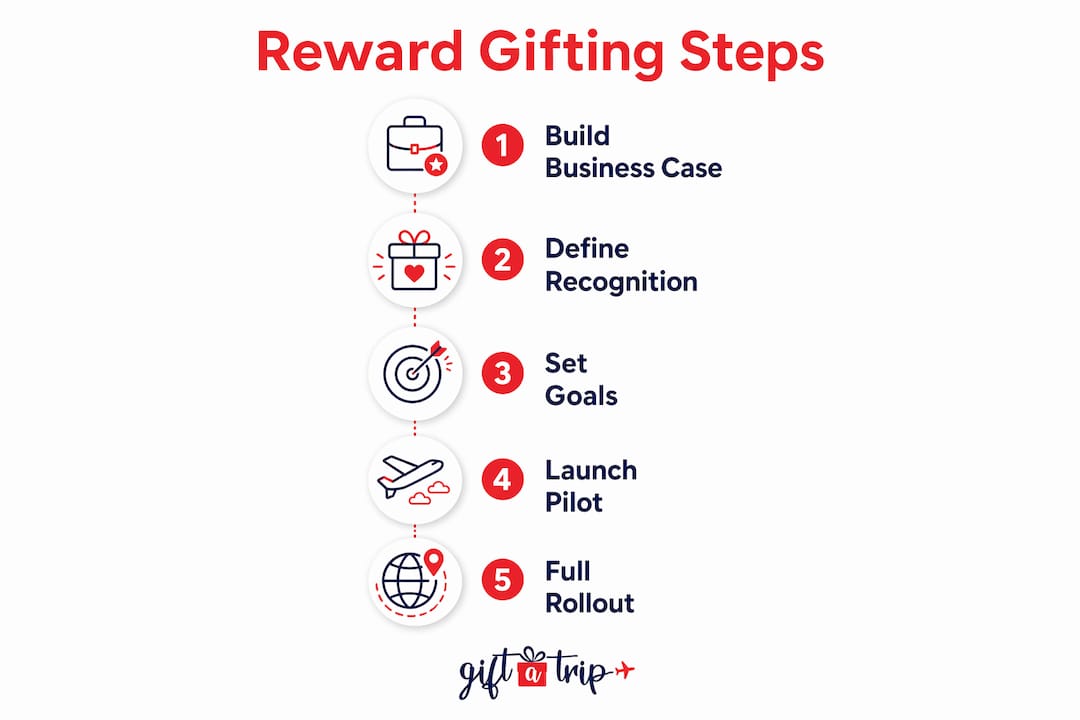
Jumping directly to software and rewards without building the architecture first results in abandoned programs. The groundwork you lay before launch determines whether your employee recognition process becomes a cultural fixture or a forgotten initiative.

Build the business case first
Leadership buy-in is non-negotiable. Present recognition as a business investment, not a perk. Tie your proposal to retention costs, productivity data, and engagement survey results. Budget conversations go smoother when HR frames gifting as a driver of measurable outcomes rather than a feel-good expense.
Define your recognition types and reward formats
Decide which behaviors you will recognize: tenure milestones, performance achievements, peer nominations, or all three. Then select your reward formats. The three main categories are points-based systems, physical or digital gift cards, and experiential rewards such as travel certificates. Combining tangible, experiential, and flexible options meets diverse employee preferences and promotes both retention and culture. That mix matters because a single reward type rarely satisfies a workforce with varied motivations.
Set participation and frequency goals upfront
Define what success looks like before you spend a dollar. Set a target participation rate, a recognition frequency goal, and a redemption rate benchmark. Programs that skip this step have no baseline to measure against and no trigger to act when adoption stalls.
Pro Tip: Set your minimum viable participation threshold at 60% before moving from a pilot to a full company launch. Programs that miss this mark in pilots typically need criteria review or additional manager training before scaling.
The table below outlines the core prerequisites every HR team should confirm before selecting a platform or ordering rewards.
| Prerequisite | What to confirm |
|---|---|
| Leadership support | Executive sponsor identified and budget approved |
| Recognition criteria | Behaviors and milestones clearly defined |
| Reward formats | Mix of tangible, experiential, and flexible options selected |
| Platform requirements | Scalable delivery, digital fulfillment, and reporting capabilities |
| Frequency goals | Target recognition moments per employee per month established |
How do you execute a step by step employee reward gifting program rollout?
A phased rollout is the most reliable path from concept to company-wide adoption. Effective recognition programs require intentional, scalable frameworks with clear recognition flows and reinforced behaviors. The 90-day model below gives HR teams a repeatable structure.
The 90-day phased rollout
-
Days 1–14: Manager pilot. Select 10–30 managers across departments. Run a focused two to four week pilot. Pilots this size identify blockers like unclear criteria before a company-wide launch creates larger problems. Collect structured feedback at the end of week two.
-
Days 15–30: Criteria and platform refinement. Use pilot feedback to sharpen recognition criteria, fix platform friction points, and update manager training materials. If participation in the pilot falls below 60%, pause and diagnose before proceeding. Programs that miss the 60% threshold in pilots often require criteria review or additional manager coaching.
-
Days 31–60: Department pilot. Expand to two or three full departments. Introduce peer-to-peer recognition alongside manager-driven awards. Run a short internal challenge, such as a recognition sprint, to build momentum. Track participation weekly and address low-activity managers directly.
-
Days 61–90: Company-wide launch. Roll out to the full organization with a clear internal communications campaign. Announce the program through all-hands meetings, email, and your intranet. Assign a recognition champion in each department to sustain visibility.
Pro Tip: Managers drive 70% of recognition volume in the first 90 days. Inactive managers are the single strongest predictor of program failure. Prioritize manager activation before any other metric.
Troubleshooting low participation
Low participation in the first 30 days usually signals one of three problems: unclear criteria, platform friction, or manager disengagement. Run a quick diagnostic. Survey five to ten employees and five managers separately. Ask what is confusing, what feels burdensome, and what would make recognition easier. Act on the findings within one week. Speed of response signals organizational commitment and keeps early adopters engaged.
What are effective gifting strategies to maximize employee engagement?
Personalized, choice-based rewards are the most effective gifting strategy available to HR teams in 2026. Flexible reward options increase employees’ feelings of meaningful recognition by 60% and their sense of connection by 61%. That data point has a direct implication: one-size-fits-all gift cards underperform because they signal that the organization did not think about the individual.
Reward types that drive motivation
The strongest programs combine three categories:
- Tangible gifts: Physical items, branded merchandise, or gift cards with broad redemption options
- Experiential rewards: Travel certificates, event tickets, cooking classes, or spa experiences that create lasting memories. Experiential gifting is a compelling alternative that creates memorable, personal reward moments employees associate with the organization long after the moment passes.
- Social recognition: Public acknowledgment in team meetings, company newsletters, or digital recognition feeds
Pro Tip: Time rewards within 48 hours of the recognized behavior. Delayed recognition loses its reinforcement value. The closer the reward is to the action, the stronger the behavioral signal.
Frequency matters as much as format. High engagement requires four or more recognition moments per employee per month to positively impact culture and performance. Most programs fall short of this threshold because they rely on managers to initiate recognition without structure or reminders.
| Reward category | Motivational impact | Best use case |
|---|---|---|
| Tangible gifts | Immediate satisfaction, visible appreciation | Milestone anniversaries, performance awards |
| Travel certificates | High perceived value, lasting memory | Top performer rewards, annual recognition |
| Peer recognition | Belonging and community | Daily culture reinforcement |
| Points-based systems | Flexibility and autonomy | Ongoing engagement across all levels |
Digital gifting platforms remove logistics barriers by enabling employees to choose and arrange delivery, reducing fulfillment time to days. That speed advantage matters because HR teams managing bulk gifting manually often face weeks of coordination that erodes the recognition moment’s impact.
How do you measure success and optimize your employee reward gifting program?
Recognition programs treated with analytical discipline, tracking participation and engagement metrics quarterly, outperform those relying on gut feeling. Measurement is not optional. It is the mechanism that separates programs that grow into culture from programs that quietly die.
Track these four metrics from day one:
- Participation rate: The percentage of employees who give or receive recognition each month
- Recognition frequency: Average number of recognition moments per employee per month, with four as the minimum target
- Redemption rate: The percentage of rewards claimed within 30 days of issuance
- Manager activity rate: The percentage of managers who have given at least one recognition in the past 30 days
Use these metrics as early warning indicators. A redemption rate below 50% signals reward relevance problems. A manager activity rate below 60% signals training or accountability gaps. Address both before they compound.
Schedule quarterly program reviews with HR leadership. Refresh reward catalogs at least twice per year to prevent catalog fatigue. Run engagement campaigns, such as themed recognition weeks or department challenges, to re-energize participation between reviews.
Pro Tip: Treat your employee recognition process as a strategic initiative with the same rigor you apply to performance management. Assign an owner, set quarterly targets, and report results to leadership on a fixed cadence.
Recognition frequency and manager involvement have a multiplier effect on program success and employee engagement. When both are high, programs build self-sustaining momentum. When either drops, the entire program loses energy faster than most HR teams expect.
Key Takeaways
A structured, phased employee reward gifting program built on clear criteria, manager activation, and personalized rewards is the most reliable path to measurable engagement gains.
| Point | Details |
|---|---|
| Build prerequisites first | Secure leadership buy-in, define criteria, and set participation goals before selecting a platform. |
| Use a 90-day phased rollout | Start with a manager pilot of 10–30 people, then expand by department before a company-wide launch. |
| Prioritize personalized rewards | Choice-based rewards increase meaningful recognition feelings by 60% compared to one-size-fits-all options. |
| Hit the frequency threshold | Aim for four or more recognition moments per employee per month to drive measurable culture impact. |
| Measure and adjust quarterly | Track participation rate, redemption rate, and manager activity as leading indicators of program health. |
Why manager activation is the real make-or-break factor
Most HR teams spend the majority of their planning time on platform selection and reward catalogs. That is the wrong priority. After working closely with recognition program rollouts, the clearest pattern is that manager behavior determines outcomes more than any other variable.
Managers drive the majority of recognition volume in the first 90 days. When managers are disengaged, employees receive little recognition regardless of how good the platform is or how generous the reward catalog looks. The technology does not fix a human activation problem.
The programs I have seen fail almost always share one trait: they launched company-wide without a structured pilot. Skipping the pilot phase feels like saving time. It actually costs months of recovery work when adoption stalls and leadership loses confidence in the program.
The programs that succeed combine two things that rarely appear together in the same initiative: tangible, high-value rewards and consistent social recognition. Travel certificates and experiential gifts create the emotional peaks that employees remember and talk about. Peer recognition and manager shoutouts create the daily rhythm that keeps engagement alive between those peaks. You need both. One without the other produces either a program that feels transactional or one that feels hollow.
Adapting rewards to individual preferences is not a luxury. It is the mechanism that makes recognition feel personal rather than procedural. When employees can choose a reward that fits their life, the recognition lands differently. That difference shows up in retention data.
— Donovan
Travel certificates as a standout reward for your gifting program
HR teams looking to add a high-impact experiential option to their reward mix will find that travel certificates consistently outperform generic gift cards in perceived value and employee satisfaction.
Giftatrip offers digital travel certificates redeemable at resorts, hotels, and cruise lines from major brands, with taxes and resort fees covered and minimal blackout dates. Certificates are delivered digitally, so HR teams can distribute rewards to large groups in days rather than weeks. Giftatrip also supports personalized messaging and bulk ordering, making it practical for milestone programs, top-performer awards, and annual recognition events. For teams ready to add a memorable experiential tier to their reward program, corporate travel gift ideas from Giftatrip are worth reviewing as a starting point.
FAQ
What is the first step in building an employee reward gifting program?
The first step is securing leadership buy-in and defining a budget. Without executive support and clear recognition criteria, even well-funded programs fail to gain traction.
How many recognition moments does an employee need per month?
Research shows four or more recognition moments per employee per month is the threshold for measurable impact on culture and performance.
Why do pilot programs matter before a company-wide launch?
Pilots with 10–30 managers over two to four weeks surface blockers like unclear criteria before they affect the full workforce, saving significant recovery time.
What metrics should HR track to measure program success?
Track participation rate, recognition frequency, redemption rate, and manager activity rate. These four metrics serve as early indicators of program health and signal where to adjust.
Are experiential rewards more effective than gift cards?
Personalized, choice-based rewards including travel certificates and experiences increase employees’ feelings of meaningful recognition significantly more than standard gift cards, because they signal individual consideration rather than generic appreciation.