
TL;DR:
- Digital travel certificates serve as cryptographically signed identity credentials used at borders or as redeemable vouchers for travel experiences, with different types offering varying levels of independence and security. They enhance travel efficiency through pre-travel verification, biometric checks, and contactless procedures, significantly reducing border processing times and operational costs. Additionally, travel certificates function as valuable gift solutions for corporate, consumer, and fundraising purposes, emphasizing experience over cash rewards while maintaining strong security and privacy protections.
A digital travel certificate (DTC) is a cryptographically signed digital representation of your passport or travel document data, designed to verify your identity before and during international travel without requiring manual document checks. DTCs are standardized by ICAO and recognized by the International Air Transport Association (IATA), making them a globally coordinated shift in how travelers prove who they are. This guide covers what digital travel certificates are, how they work, why they matter for travelers and businesses, and how the same term applies to travel gift certificates used for rewards, gifting, and charitable fundraising.
What are digital travel certificates and how do they work?
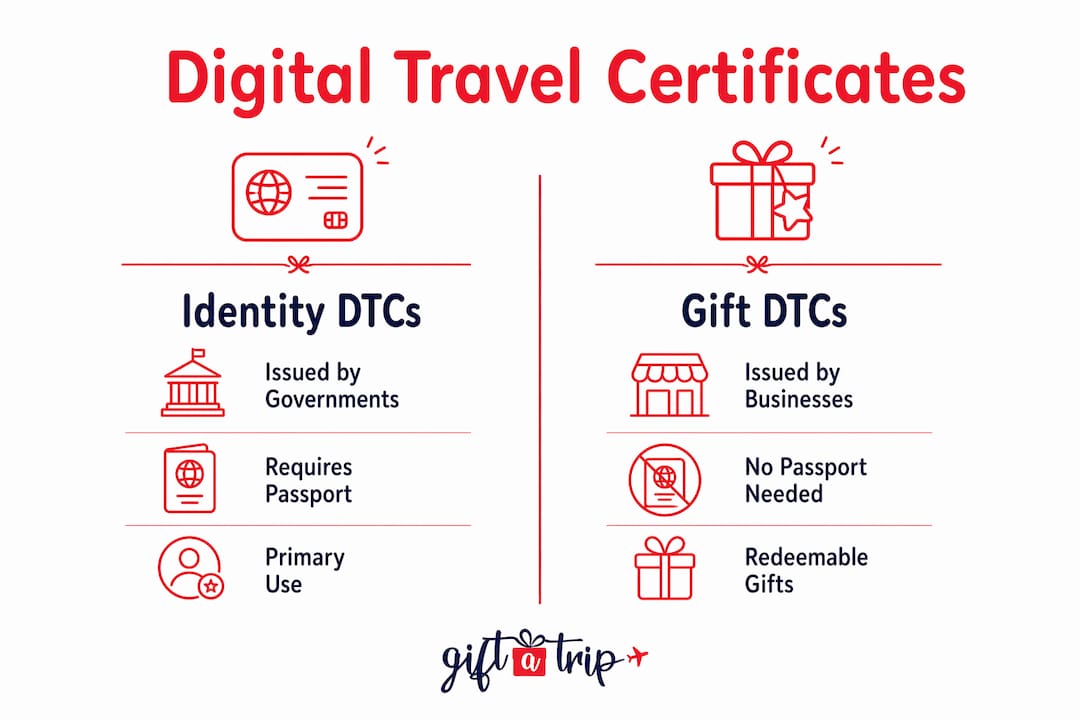
Digital travel certificates exist in two distinct but related contexts. The first is the identity credential context: a secure, government-linked digital document that replaces or supplements your physical passport at border controls and airline check-ins. The second is the gifting and rewards context: a digital voucher redeemable for hotel stays, cruises, or vacation packages. Both share the same name, and understanding the difference saves real confusion when you encounter the term.

In the identity credential context, DTC types are standardized into three categories by ICAO and the EU Digital Identity Wallet framework. Type 1 is self-derived by the traveler from their own ePassport using NFC scanning. Type 2 is government-issued with a higher assurance level and includes a physical component. Type 3 operates as a fully standalone digital credential with its own lifecycle, independent of a physical passport.
The table below compares the three DTC types at a glance:
| DTC Type | Issued by | Physical passport required | Primary use |
|---|---|---|---|
| Type 1 | Traveler (self-derived) | Yes | Pre-travel data sharing |
| Type 2 | Government authority | Yes (companion) | Full digital verification |
| Type 3 | Government authority | No | Standalone digital travel |
Physical passports remain mandatory internationally despite digital progress. Hybrid systems combining both physical and digital credentials are the expected norm during this transition period. Airlines like those operating under IATA’s digital travel programs use DTCs integrated with mobile wallets and biometric data to automate check-in, boarding, and eligibility verification.
Pro Tip: If you travel frequently, check whether your country’s passport authority has launched a Type 1 DTC app. Several EU member states and IATA partner airlines already support NFC-based credential sharing before you reach the airport.
Why use digital travel certificates for faster, smarter travel?
The core advantage of a DTC is that it moves identity verification away from the physical border and into the pre-travel window. IATA’s Director General has stated that DTCs transform travel verification, not merely digitize it. That distinction matters because earlier verification means fewer bottlenecks at airports, fewer inadmissible passengers (INADs) on flights, and lower fines for airlines.
The operational benefits are concrete:
- Faster border processing. Pre-travel data sharing allows automated eligibility checks before a passenger even reaches the gate, cutting queue times significantly.
- Reduced INADs. Airlines face heavy fines when passengers are denied entry at destination. Automated admissibility checks using DTCs reduce this risk before boarding.
- Lower operational costs. Transitioning to digital credentials reduces costs from manual admissibility checks, improving efficiency and passenger throughput across the entire journey.
- Contactless journeys. Biometric authentication at check-in, bag drop, and boarding replaces manual document handling, reducing physical touchpoints.
- Better passenger experience. Airlines using DTC-integrated systems report improvements in passenger Net Promoter Scores (NPS) and operational cost per available seat mile (CASM).
The passenger experience benefit is not trivial. Contactless, frictionless travel is a measurable competitive advantage for airlines and airports. Facephi’s research shows that automated biometric workflows combining verifiable credentials result in frictionless travel that improves both KPIs and customer satisfaction simultaneously.
Are travel certificates safe? Security and privacy explained
Security is the most common concern travelers raise about digital credentials, and the architecture behind DTCs is built specifically to address it. Public Key Infrastructure (PKI) ensures that every DTC is tamper-proof and verifiable at border controls. The cryptographic signature on a DTC cannot be forged without access to the issuing authority’s private key, which makes fraudulent credentials detectable immediately.
Privacy protections are equally deliberate. The design principles behind DTCs follow a clear framework:
- Data minimization. A DTC shares only the attributes required for a specific transaction. A boarding pass check does not need your full address or marital status.
- Explicit user consent. Data is shared only with user approval, giving travelers sovereign control over their identity data at every step.
- Anti-tracking design. DTCs are engineered to prevent cross-border tracking of travelers by limiting data retention and correlation between checkpoints.
- Biometric linkage. Pre-travel biometric linkage ensures the credential represents the correct traveler, verified with a tamper-proof signature that border controls can authenticate instantly.
Industry leaders at Biometric Update stress that privacy-by-design principles are the foundation of traveler trust in digital credentials. Without them, adoption stalls regardless of the efficiency gains on offer.
Pro Tip: Store your DTC in a certified mobile wallet app rather than a generic photo storage app. Certified wallets enforce encryption and access controls that standard apps do not provide.
How to use travel certificates for gifting, rewards, and fundraising
The second meaning of “digital travel certificate” is the one most relevant to Giftatrip’s audience: a digital voucher redeemable for a specific travel experience. These are not identity documents. They are flexible gift solutions that function like a prepaid travel credit, redeemable at resorts, hotels, cruise lines, and vacation packages from major brands.
The gifting use case is straightforward. You purchase a digital travel certificate online, it is delivered securely by email or through a branded digital gift box, and the recipient redeems it for a stay or voyage of their choice. Giftatrip covers taxes and resort fees in many certificates and operates with minimal blackout dates, which makes the redemption experience genuinely flexible rather than frustrating.
For businesses, the applications go further:
- Employee recognition. Travel certificates are among the highest-perceived-value rewards in corporate incentive programs. A weekend resort stay outperforms a cash bonus of equivalent value in employee satisfaction surveys because experiences create lasting memories.
- Sales team motivation. Top-performer travel rewards tied to quarterly targets drive measurable behavior change. Giftatrip’s bulk order options with customizable gift boxes make this scalable for teams of any size.
- Customer loyalty programs. Travel certificates for loyalty rewards give brands a differentiated incentive that generic discount codes cannot match.
- Charitable fundraising. Travel certificates are a proven auction item at charity galas and online fundraisers. A Virgin Voyages cruise certificate, for example, generates bidding excitement that a gift card never does.
The table below compares travel vouchers and travel certificates in a gifting context:
| Feature | Travel voucher | Digital travel certificate |
|---|---|---|
| Delivery format | Email or print | Secure digital delivery or branded gift box |
| Redemption flexibility | Often tied to one brand | Redeemable across multiple brands and destinations |
| Inclusions | Varies widely | Taxes and resort fees often included |
| Corporate bulk options | Rarely available | Available with customization |
| Charitable auction value | Moderate | High perceived value, drives competitive bidding |
Digital travel certificates as gift products are also gaining traction in the hospitality sector. Hotels and resorts recognize that a guest arriving with a travel certificate has already committed to the experience, which improves booking predictability and reduces last-minute cancellations.
Key takeaways
Digital travel certificates serve two distinct purposes: identity verification in international travel and experiential gifting in rewards and fundraising programs, and understanding both uses unlocks their full value.
| Point | Details |
|---|---|
| Two meanings, one term | DTCs are both identity credentials and redeemable travel gift products depending on context. |
| Three DTC identity types | Type 1 is self-derived, Type 2 is government-issued with a physical component, Type 3 is fully standalone. |
| Security is built in | PKI cryptography and biometric linkage make DTCs tamper-proof and verifiable at every checkpoint. |
| Privacy is by design | Data minimization and explicit consent mean travelers control exactly what information is shared. |
| Gifting value is high | Travel certificates outperform cash rewards in employee and customer satisfaction due to experiential impact. |
The shift I think most people are underestimating
I have spent years watching the travel industry promise digital transformation and deliver incremental upgrades. DTCs feel different, and not because the technology is flashier. The shift is structural. Moving identity verification from the border to the pre-travel window is not a convenience feature. It is a redesign of how governments and airlines manage risk, and it has real consequences for everyone who flies internationally.
What concerns me is the gap between the technology’s readiness and public awareness. Most travelers I speak with have no idea that a Type 1 DTC can already be derived from their ePassport in several countries. They are still handing over physical passports at check-in counters that are already equipped to read digital credentials. The adoption lag is not technical. It is informational.
For businesses, the gifting application of travel certificates is the more immediately practical opportunity. Corporate incentive programs that still rely on Amazon gift cards are leaving measurable engagement on the table. A travel certificate tied to a Virgin Voyages sailing or a resort stay creates a story the recipient tells for years. That word-of-mouth value does not show up in the line-item cost comparison, but it is real.
My honest advice: if you manage a rewards program or plan corporate gifting for 2026, move at least a portion of your budget toward experiential travel certificates now. The window where this feels differentiated and premium will not stay open indefinitely.
— Donovan
Discover digital travel gift certificates from Giftatrip
Giftatrip makes it simple to send a travel experience as a gift, reward, or fundraising prize. Whether you are recognizing a top employee, celebrating a milestone anniversary, or running a charity auction, Giftatrip’s digital travel certificates cover stays at leading resorts, hotels, and cruise lines with taxes and resort fees included.
From Virgin Voyages cruise certificates to customizable bulk gift boxes for corporate teams, Giftatrip delivers secure digital certificates with personalized messaging and minimal blackout dates. Browse the full range at Giftatrip’s gift delivery shop and find the right certificate for any occasion or program.
FAQ
What is a digital travel certificate?
A digital travel certificate is either a cryptographically signed identity credential derived from a passport for use at border controls, or a redeemable digital voucher for travel experiences like hotel stays and cruises. The term covers both uses depending on context.
Are digital travel certificates safe to use?
Yes. Identity-based DTCs use Public Key Infrastructure and biometric linking to prevent tampering and fraud. Gift-based travel certificates from platforms like Giftatrip are delivered securely by email with encrypted transaction records.
Do I still need a physical passport with a digital travel certificate?
Currently, yes. Physical passports remain mandatory internationally. Type 1 and Type 2 DTCs complement your passport rather than replace it. Only Type 3 DTCs are designed to operate as standalone credentials, and these are not yet universally accepted.
How do businesses use digital travel certificates for rewards?
Businesses use travel certificates as employee recognition awards, sales incentives, and customer loyalty rewards. Platforms like Giftatrip offer bulk ordering with customizable gift boxes, making it practical to deploy travel certificates at scale across teams or customer bases.
What is the difference between a travel voucher and a travel certificate?
A travel voucher is typically tied to a single brand and offers limited flexibility. A digital travel certificate, particularly from a platform like Giftatrip, is redeemable across multiple destinations and brands, often includes taxes and fees, and carries higher perceived value for gifting and auction purposes.