Jump to Section:
TL;DR:
- Offering travel packages as rewards significantly enhances employee motivation and long-term engagement by creating emotional memories. Travel incentives outperform cash bonuses in perceived value, loyalty, and performance, especially when well-designed with transparent fees and personalized options. Implementing small pilot programs can demonstrate their effectiveness, making travel rewards a strategic investment in workforce retention and company culture.
Offering travel packages as rewards is the single most effective non-cash strategy for driving employee motivation and long-term engagement in corporate environments. Research from SITE and Maritz confirms that incentive travel ranks first among all non-cash motivators across every working generation. Cash bonuses get absorbed into daily expenses within days. A trip to a Caribbean resort, a cruise on Virgin Voyages, or a mountain lodge getaway becomes a story employees tell for years. For HR professionals and corporate managers building reward strategies that actually move the needle, travel packages are not a luxury add-on. They are a strategic investment in workforce performance.
Why offer travel packages as rewards: the motivational case
Travel rewards work because they operate on a fundamentally different psychological level than cash. Experiential rewards create lasting happiness through an anticipation phase that material rewards simply cannot replicate. From the moment an employee learns they have earned a trip, the motivation cycle begins. They research destinations, plan activities, and share their excitement with colleagues. That anticipation extends engagement and performance well before the reward is even redeemed.

The emotional transformation that travel creates is what researchers call the “memory dividend.” Unlike a cash deposit that disappears into a mortgage payment, a travel experience generates a lasting emotional association with the employer who made it possible. Employees connect the positive feelings from that trip directly to the organization that rewarded them. That connection is nearly impossible to replicate with a check.
The numbers support this clearly:
- 94% of employees report being highly motivated by individual travel incentives, spanning all generations from Gen Z to Baby Boomers.
- Employees in travel incentive programs show a 22% performance increase compared to colleagues who are not enrolled.
- The perceived value of travel rewards consistently exceeds their actual cost to the organization, giving HR teams strong return on every dollar spent.
“Travel rewards activate the full engagement cycle: from the announcement of the reward, through the anticipation, the experience itself, and the post-trip reflection. Each phase reinforces the employee’s connection to the company.” — Arrivia Insights
Cash rewards, by contrast, are transactional. They satisfy in the short term but rarely generate the kind of emotional loyalty that retains top performers. When you understand the psychology, the answer to why use trips as rewards becomes obvious: experiences outlast transactions.
How travel rewards strengthen corporate culture and loyalty
Travel packages as incentives do more than motivate individual employees. They send a cultural signal to the entire workforce. When a company invests in sending a top performer to a resort in Cancún or on a cruise through the Mediterranean, every employee in that organization notices. The message is clear: exceptional performance earns exceptional recognition.
The SITE and Maritz study produced data that every HR director should have on their desk. 89% of incentive trip attendees reported stronger loyalty to the sponsoring company after their trip, and 93% said they were eager to earn the incentive again. Those figures represent a loyalty and re-engagement rate that no merchandise catalog or points system comes close to matching.
Travel rewards also strengthen team cohesion when structured as group incentive trips. Shared experiences in a new environment break down workplace hierarchies and build genuine relationships between colleagues. Sales teams that travel together consistently report stronger collaboration back in the office. The benefits of travel rewards extend well beyond the individual recipient.
Here is what travel rewards communicate at the organizational level:
- You are valued beyond your salary. The company invested in your personal enrichment, not just your output.
- Performance has visible, meaningful consequences. The reward is public and memorable, not a private bank transfer.
- The organization sees you as a whole person. Travel rewards acknowledge that employees have lives, families, and aspirations outside of work.
For HR professionals building corporate engagement strategies, travel packages create the kind of emotional equity that keeps high performers from answering recruiter calls.
Designing effective travel reward programs for maximum impact
A travel reward program that is poorly designed will underperform regardless of how generous the travel packages are. The structure of the program determines whether employees feel genuinely motivated or vaguely confused about how to earn and redeem their rewards. Clear performance linkage and easy redemption are the two factors most directly tied to program success.
Follow this framework when building your program:
- Define measurable performance criteria. Tie travel rewards to specific, quantifiable goals: sales targets, customer satisfaction scores, project completion milestones, or retention benchmarks. Vague criteria produce vague motivation.
- Offer personalized and flexible options. A 28-year-old single employee and a 45-year-old parent of three have very different travel preferences. Personalization and flexible booking options significantly increase engagement with travel reward programs.
- Build in transparency from day one. Communicate exactly what the reward covers: flights, accommodation, meals, taxes, and resort fees. Ambiguity erodes trust before the trip even happens.
- Use technology platforms to reduce administrative friction. Travel loyalty technology enables scalable, personalized rewards delivery without requiring complex in-house infrastructure. Platforms like Giftatrip handle digital delivery, customization, and redemption support so HR teams can focus on program strategy rather than logistics.
- Layer travel rewards with shorter-term incentives. Travel works best as a peak reward for sustained performance. Combine it with monthly recognition, spot bonuses, or public acknowledgment to maintain motivation across the full performance cycle.
Pro Tip: Run a pilot program with one team or department before rolling out company-wide. Collect feedback on the redemption experience, perceived value, and any friction points. Use that data to refine the program before scaling.
Here is how travel packages compare to other common reward types on the dimensions that matter most to HR professionals:
| Reward type | Motivational longevity | Perceived value | Personalization | Cultural impact |
|---|---|---|---|---|
| Travel packages | High (months to years) | Very high | High with flexible options | Strong |
| Cash bonus | Low (days to weeks) | Moderate | Low | Minimal |
| Merchandise | Low to moderate | Moderate | Low | Minimal |
| Points-based systems | Moderate | Low to moderate | Moderate | Low |
How do travel rewards compare to cash bonuses?
Travel packages consistently outperform cash bonuses on every long-term motivational metric. Cash is fungible. It enters a checking account and immediately competes with rent, groceries, and car payments. The emotional connection to the employer who provided it fades within days. Travel creates a distinct, memorable experience that employees associate permanently with the organization that rewarded them.
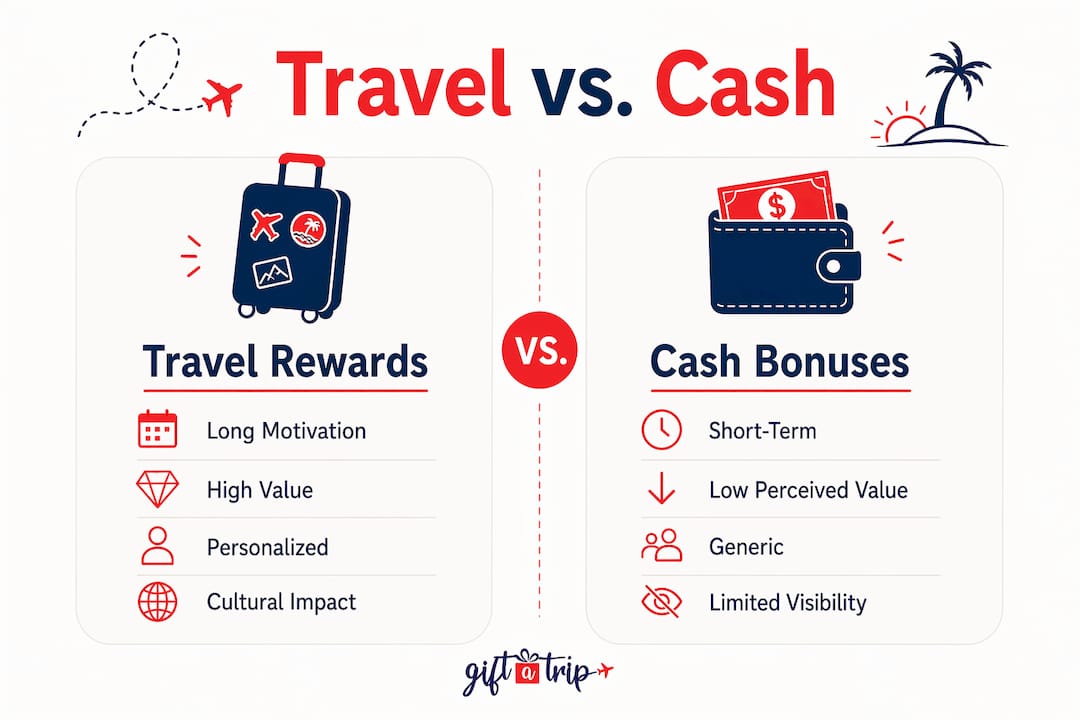
The perceived value advantage is particularly significant for HR budget planning. A travel certificate worth $800 in actual cost to the company is perceived by the employee as a $1,500 or $2,000 experience because of the emotional weight attached to it. That gap between cost and perceived value is the core financial argument for travel rewards programs.
Travel rewards also outperform cash in one area that HR professionals rarely discuss openly: social visibility. An employee who receives a cash bonus tells almost no one. An employee who earns a trip to a resort tells their entire team, their family, and their LinkedIn network. That social amplification reinforces the cultural message of the program and motivates peers who have not yet earned the reward.
Merchandise and points-based systems fall short for different reasons. Merchandise feels generic unless it is highly personalized, and most catalog-style programs offer items employees would not choose for themselves. Points systems create engagement but rarely generate the emotional intensity that drives peak performance. For motivational travel rewards that produce measurable behavior change, no other reward category competes.
Common challenges in travel reward programs and how to solve them
The most damaging mistake in any travel reward program is the hidden fee problem. Unexpected taxes, booking fees, and fuel surcharges can transform a reward that felt generous into one that feels like a burden. When an employee discovers that their “free” resort stay requires $300 in fees at checkout, the motivational value of the reward collapses entirely. The employer’s investment is wasted, and the employee’s trust is damaged.
Complexity in the redemption process creates a similar problem. If earning a travel reward requires navigating a confusing portal, calling a support line, or managing multiple booking steps, participation rates drop. Program clarity and ease of redemption are not optional features. They are the foundation of program effectiveness.
Inclusivity is the third challenge HR teams consistently underestimate. A workforce with employees across different life stages, family structures, and physical abilities requires flexible travel options. A solo adventure package motivates a 25-year-old differently than it motivates a parent who wants a family resort experience. Build your program with enough variety to serve the full range of your workforce.
Pro Tip: When evaluating travel reward platforms, ask specifically whether taxes and resort fees are included in the certificate value. Giftatrip covers taxes and resort fees within its travel certificates, which eliminates the hidden cost problem before it starts.
Key takeaways
Travel packages outperform every other non-cash reward category because they generate emotional connections, lasting memories, and measurable loyalty that cash bonuses and merchandise cannot replicate.
| Point | Details |
|---|---|
| Travel beats cash on motivation | 94% of employees report high motivation from travel incentives versus short-lived satisfaction from cash bonuses. |
| Loyalty impact is measurable | 89% of incentive trip attendees report stronger loyalty to the sponsoring company after the experience. |
| Performance gains are real | Employees in travel reward programs show a 22% performance increase compared to non-participants. |
| Program design determines success | Clear criteria, flexible options, and transparent fee structures are non-negotiable for effective programs. |
| Perceived value exceeds actual cost | Travel certificates deliver higher perceived value than their cost, making them budget-efficient for HR teams. |
Why I think most companies are still underusing travel rewards
I have spent years watching HR teams default to cash bonuses because they feel safe and simple. I understand the logic. Cash is measurable, distributable, and requires no vendor relationship. But that simplicity is exactly the problem. Safe reward strategies produce safe results, and safe results do not retain your best people or push your average performers toward excellence.
What I have observed consistently is that the companies getting the most out of travel rewards are not the ones with the biggest budgets. They are the ones with the clearest program design. A $600 resort certificate with transparent terms, flexible booking dates, and a personal message from the CEO will outperform a $1,000 cash bonus every single time on loyalty and re-engagement metrics. The emotional architecture of the reward matters more than the dollar amount.
The other thing most articles will not tell you: the announcement of a travel reward is often more motivating than the reward itself. When you publicly recognize an employee and tell their team that they have earned a trip, you create a moment of social recognition that ripples through the entire organization. That moment costs nothing extra. It is pure program design, and most companies leave it on the table.
My honest recommendation is to start smaller than you think you need to. Run one program, with one team, with one clear performance goal tied to a specific travel certificate. Measure the engagement data, collect the feedback, and let the results make the case for scaling. The data will do the work for you.
— Donovan
How Giftatrip makes corporate travel rewards effortless
Giftatrip specializes in digital travel certificates built specifically for corporate reward programs. Whether you are recognizing a top sales performer, rewarding a project team, or building a company-wide incentive program, Giftatrip offers flexible certificates redeemable at resorts, hotels, cruise lines, and vacation packages from major brands. Taxes and resort fees are covered, blackout dates are minimal, and delivery is fully digital, which means your HR team spends zero time on logistics. You can explore digital travel gift delivery to see how simple it is to send a memorable reward at scale. For teams looking to build a full incentive framework, the flexible travel certificate guide walks through every option available to corporate clients.
FAQ
Why are travel packages more effective than cash rewards?
Travel packages create lasting emotional memories tied directly to the employer, while cash bonuses are absorbed into everyday expenses within days. Research shows 94% of employees report high motivation from travel incentives, a rate no cash program matches.
How do travel rewards improve employee retention?
According to the SITE and Maritz study, 89% of incentive trip attendees feel stronger loyalty to the sponsoring company after the experience. That emotional connection directly reduces turnover intent among high performers.
What is the biggest mistake in travel reward programs?
Hidden fees and complicated redemption processes are the most common program killers. Unexpected costs at checkout destroy the perceived value of the reward and damage employee trust in the program.
How should HR teams structure a travel incentive program?
Tie travel rewards to specific, measurable performance goals and offer flexible booking options to accommodate diverse employee preferences. Program clarity and ease of redemption are the two factors most directly linked to participation and impact.
Are travel rewards cost-effective for smaller companies?
The perceived value of travel certificates consistently exceeds their actual cost to the organization, making them budget-efficient even for smaller HR teams. Starting with a pilot program for one department allows companies to measure ROI before committing to a full rollout.