
Jump to Section:
TL;DR:
- A corporate travel certificate can be either a rewards voucher for incentives or an insurance document associated with a travel account. Confusing these types causes operational errors, so organizations must clearly distinguish and properly handle each. Implementing structured policies for distribution, tracking, and compliance significantly improves program effectiveness and employee engagement.
A corporate travel certificate is a business-issued document that functions either as a rewards voucher for employees and clients or as an insurance and coverage certificate tied to a corporate travel account. These two meanings are distinct, and confusing them creates real operational problems for HR teams and travel managers. Understanding which type you are working with determines how you source it, distribute it, and manage compliance around it. This guide breaks down both categories, explains how each works in practice, and gives you a clear framework for using travel incentive certificates as a strategic reward tool in 2026.
What is a corporate travel certificate, and what types exist?
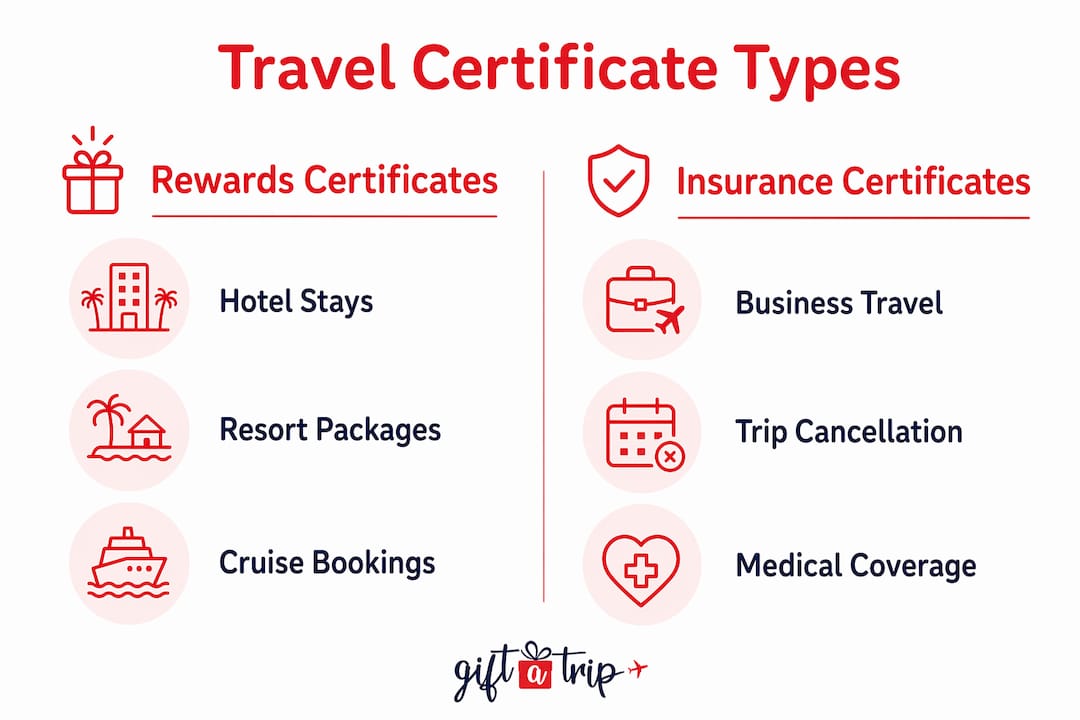
A corporate travel certificate falls into one of two categories: a rewards voucher used for employee and client incentives, or an insurance documentation certificate issued by a financial or travel account provider. Both carry the word “certificate,” but they serve entirely different purposes and require different handling.

Travel rewards certificates are prepaid vouchers redeemable for hotel stays, resort packages, cruises, or vacation bundles. Companies distribute these to recognize top performers, reward sales milestones, retain key clients, or mark anniversaries. Providers like Giftatrip offer digital certificates redeemable at major hotel brands and resort chains, with taxes and fees included and minimal blackout dates. These certificates function as corporate recognition tools that deliver a tangible, memorable experience rather than a cash deposit.
Insurance and coverage certificates are a separate category entirely. American Express, for example, issues a Business Travel Account Certificate as a formal PDF document with an effective date confirming insurance coverage for cardholders traveling on company accounts. This document is corporate travel documentation in the legal and compliance sense. It is not a gift and cannot be redeemed for a hotel room.
| Type | Purpose | Issued by | Used for |
|---|---|---|---|
| Travel rewards certificate | Incentive or recognition gift | Giftatrip, travel reward platforms | Employee rewards, client appreciation |
| Insurance certificate | Proof of coverage | American Express, insurers | Compliance, travel account documentation |
| Loyalty program certificate | Points-based redemption | Airlines, hotel chains | Frequent traveler benefits |
| Corporate gifting voucher | Bulk gifting for events | Corporate gift providers | Milestones, conferences, onboarding |
HR and travel managers must clarify certificate types early in program planning to prevent sending the wrong document to the wrong recipient. Distributing an insurance certificate to an employee expecting a vacation reward creates confusion and erodes trust in the program.
How do corporate travel certificates work as employee and client rewards?
Travel rewards certificates work as flexible, high-perceived-value alternatives to cash bonuses. Travel certificates serve as meaningful gifts that employees and clients can redeem for vacations, which builds loyalty in ways that a direct deposit rarely does. The experience of booking a resort stay stays in memory far longer than a line item on a pay stub.
The redemption process for most business travel certificates follows a predictable structure. The company purchases certificates from a provider, either individually or in bulk. Recipients receive a digital certificate with a unique code and redemption instructions. They then visit the provider’s platform, select their destination or travel package, and apply the certificate code at checkout. Giftatrip’s digital delivery model, for example, allows HR teams to send certificates instantly with personalized messaging, which makes the reward feel curated rather than generic.
Eligibility criteria vary by program design. Some companies restrict certificates to employees who hit specific performance thresholds, such as exceeding quarterly sales targets by 15% or completing a leadership development program. Others use certificates as universal recognition gifts for company anniversaries or team milestones. The flexibility of the format means you can tailor the reward tier to the achievement level. A weekend resort stay suits a department-level recognition, while a full vacation package fits a top-performer annual award.
Common examples of corporate travel certificate reward programs include:
- Sales incentive programs where regional managers receive certificates upon closing a defined revenue target
- Employee of the month programs where a monthly winner receives a two-night hotel certificate
- Client appreciation campaigns where key accounts receive a resort certificate at the close of a fiscal year
- Onboarding gifts where new hires at senior levels receive a travel certificate as part of their welcome package
Pro Tip: Always include a direct support contact or redemption guide with every certificate you distribute. Recipients who cannot figure out how to redeem a certificate within the first 48 hours often abandon it entirely, which wastes your budget and undermines the reward’s impact.
What are the operational and compliance implications?
Corporate travel certificates carry compliance responsibilities that most HR teams underestimate until something goes wrong. The operational stakes differ sharply depending on which certificate type you are managing.
For insurance and coverage certificates, the compliance requirements are non-negotiable. Corporate travel policies establish rules for expense approvals, payment methods, and receipt handling, and insurance certificates sit within that framework as proof of coverage. If an employee travels on a corporate account and a claim arises, the absence of a valid insurance certificate creates legal exposure for the company. These documents must be stored, versioned, and accessible to travel managers at all times.
For rewards certificates, the compliance picture is different but still requires structure. Follow these steps to keep your program clean:
- Define eligibility in writing. Document who qualifies for a certificate, under what conditions, and at what value tier. Ambiguity leads to disputes.
- Set an expiration policy. Most travel certificates carry expiration dates. Communicate these clearly to recipients at the time of distribution.
- Track certificate issuance. Maintain a log of every certificate issued, to whom, and at what value. This supports tax reporting and budget reconciliation.
- Align with your corporate travel policy. Documented process clarity enhances program effectiveness and employee adherence. If your travel policy restricts certain destinations or travel periods, confirm your certificate provider accommodates those constraints.
- Separate certificate types in your records. Never file rewards certificates alongside insurance documentation. The two serve different functions and belong in different administrative systems.
Pro Tip: If your company uses a corporate card program like an American Express Business Travel Account, request a copy of the insurance coverage certificate from your account manager and store it in your travel policy documentation folder. Most companies only discover they need it after an incident.
The most common operational error is conflating the two certificate types during program setup. An HR manager who searches for “corporate travel certificate” and lands on insurance documentation may inadvertently build a rewards program around the wrong framework, or vice versa. Getting the terminology right at the start of program design prevents downstream errors that are expensive to unwind.
How to choose and implement the right corporate travel certificate program
Selecting the right certificate program starts with defining your objective. A client appreciation program has different requirements than an employee performance incentive. The provider you choose, the certificate value, and the redemption experience all need to match the purpose.
Use these criteria to evaluate providers:
- Redemption network: Does the provider offer hotels, resorts, and cruise lines that match your recipients’ preferences? A certificate redeemable only at budget properties will not land well with a senior executive audience.
- Digital delivery capability: Bulk digital delivery with personalized messaging reduces HR administration time significantly. Giftatrip supports customizable digital gift boxes for bulk orders, which suits large-scale corporate programs.
- Fee transparency: Confirm whether taxes, resort fees, and booking fees are included in the certificate value. Hidden fees at redemption damage the recipient experience and reflect poorly on the program.
- Expiration terms: Certificates with 12-month or longer validity windows give recipients genuine flexibility. Shorter windows create pressure that turns a reward into a stressor.
- Support for recipients: Redemption workflows and assistance channels increase successful usage and satisfaction. Choose a provider that offers clear instructions and a support channel for recipients who need help booking.
| Selection criterion | Why it matters | What to look for |
|---|---|---|
| Redemption network | Determines perceived value | Major hotel brands, resorts, cruises |
| Fee inclusion | Affects actual value received | Taxes and resort fees covered |
| Delivery method | Affects HR workload | Instant digital delivery, bulk options |
| Expiration window | Affects recipient flexibility | 12 months or longer |
| Recipient support | Affects redemption success rate | Dedicated help channel or guide |
Once you select a provider, the rollout process matters as much as the certificate itself. Distribute certificates with a personal message from leadership, a clear redemption guide, and a deadline reminder schedule. Recipients who receive a certificate with no context or instructions are far less likely to use it. Tracking redemption rates also gives you data to refine future programs. If 30% of certificates go unredeemed, that signals a communication or usability problem worth fixing before the next cycle.
Key takeaways
A corporate travel certificate is either a rewards voucher or an insurance document, and treating them as interchangeable creates compliance failures and wasted budgets.
| Point | Details |
|---|---|
| Two distinct certificate types | Rewards vouchers and insurance certificates serve different purposes and require separate handling. |
| Rewards certificates drive loyalty | Travel experiences outperform cash bonuses in memorability and long-term employee engagement. |
| Compliance requires documentation | Insurance certificates must be stored and accessible; rewards certificates need issuance logs and expiration policies. |
| Provider selection determines success | Fee transparency, redemption network quality, and recipient support define the program’s actual value. |
| Communication drives redemption | Certificates distributed without context or instructions have significantly lower redemption rates. |
Why most corporate travel certificate programs underperform
I have reviewed dozens of corporate rewards programs over the years, and the pattern is almost always the same. The company selects a certificate provider, purchases a batch, sends them out in a generic email, and then wonders why employees seem indifferent. The certificate itself is rarely the problem. The delivery and context almost always are.
The second issue I see consistently is that HR teams do not distinguish between the two types of corporate travel certificates until something goes wrong. A travel manager once told me she spent three weeks trying to figure out why employees were calling the insurance provider to book hotel rooms. The company had distributed the wrong document entirely. That kind of error is avoidable with 20 minutes of terminology alignment at the start of program design.
The Global Business Travel Association’s CCTE program exists precisely because corporate travel management is more complex than it appears from the outside. Travel managers who invest in that kind of structured knowledge handle certificate programs, compliance documentation, and rewards strategy with far fewer errors.
My honest recommendation: treat your travel certificate program as a product launch, not an administrative task. Define the audience, craft the message, test the redemption flow before you distribute, and measure the outcome. The companies that do this report higher redemption rates, stronger employee satisfaction scores, and better ROI on their recognition budgets. The ones that treat it as a checkbox exercise get checkbox results.
— Donovan
Explore travel certificates for your corporate rewards program
Giftatrip offers a full range of digital travel certificates designed specifically for corporate rewards, client appreciation, and employee recognition programs. Every certificate covers taxes and resort fees, ships instantly via secure digital delivery, and is redeemable at major hotel brands, resorts, and cruise lines with minimal blackout dates.

Whether you are building a sales incentive program, recognizing a top performer, or sending a year-end gift to a key client, Giftatrip makes the process straightforward. Bulk ordering includes customizable gift boxes and personalized messaging options, so every certificate feels intentional rather than transactional. Browse the full corporate rewards catalog to find the right certificate tier for your next program, or visit Giftatrip’s gift delivery platform to place a bulk order today.
FAQ
What is a corporate travel certificate used for?
A corporate travel certificate is used either as a rewards voucher for employee and client incentives or as an insurance documentation certificate tied to a corporate travel account. The two types serve entirely different purposes and should never be confused in program administration.
What does a travel certificate cover?
A rewards travel certificate typically covers hotel stays, resort packages, or cruise bookings, often including taxes and resort fees. An insurance travel certificate, such as the American Express Business Travel Account Certificate, covers travel-related insurance claims for corporate cardholders.
How do you get a corporate travel certificate for rewards?
You purchase rewards-based business travel certificates directly from providers like Giftatrip, either individually or in bulk. Most providers offer digital delivery with personalized messaging, making distribution straightforward for HR teams managing large programs.
How do corporate travel certificates compare to cash bonuses?
Travel certificates deliver higher perceived value than equivalent cash bonuses because they create a memorable experience rather than a forgettable deposit. Research supports that travel rewards certificates improve employee loyalty and engagement more effectively than direct cash payments of the same amount.
What are the compliance requirements for corporate travel certificates?
Rewards certificates require issuance logs, expiration policies, and alignment with your corporate travel policy. Insurance certificates must be stored as formal documentation and made accessible to travel managers, as they serve as proof of coverage during business travel.