Jump to Section:
TL;DR:
- Strategic gifting uses tangible rewards to boost employee loyalty, engagement, and performance through psychological activation. Properly designed recognition programs, especially with timely, personalized, and well-framed gifts, significantly improve retention and organizational effectiveness. Incorporating experiential rewards like travel certificates creates lasting memories, fostering stronger motivation and team bonds.
Strategic gifting is defined as the deliberate use of tangible rewards to activate employees’ psychological reward systems, driving measurable gains in loyalty, engagement, and performance. The role of gifting in employee motivation goes far beyond seasonal gestures. Research from Workhuman shows that employees recognized for goal contributions are 5x more personally invested in company initiatives. That number reframes gifting entirely. It is not a perk. It is operational infrastructure for organizational performance.
What the research says about gifting and employee motivation
The evidence connecting workplace gifting to motivation is specific, recent, and difficult to ignore. A 2026 Snappy study found that 72% of employees say receiving a work-anniversary gift would increase their likelihood of staying at their company. That figure represents a direct link between a single gifting moment and a retention outcome that costs organizations an average of one to two times an employee’s annual salary to reverse.
The same Snappy research reveals a critical gap: 85% of employees say anniversary gifts make them feel more appreciated, yet only 47% have ever received one. This gap is not a budget problem. It is a program design problem, and it represents one of the highest-return fixes available to HR leaders today.
Workhuman’s 2026 findings add another dimension. Recognition tied to strategic goals produces a 72% increase in employees’ understanding of company strategy and a 122% improvement in alignment with strategic initiatives. This means gifting, when connected to meaningful work contributions, does not just make people feel good. It makes them more effective contributors to organizational goals.
“Being thanked in the last month is associated with a 21% higher psychological safety score.” — Workhuman, 2026
Psychological safety is the foundation of high-performing teams. When gifting and recognition increase psychological safety by 21%, the downstream effects include better collaboration, higher risk tolerance, and stronger innovation output. The Incentive Research Foundation (IRF) further contextualizes the scale: 356 of 400 organizations studied offered rewards and recognition programs, confirming that gifting is not an outlier strategy. It is standard operating procedure for competitive employers.
How gifts interact with intrinsic motivation
Not all gifting produces motivation. Poorly designed programs can actually reduce it. Self-Determination Theory, developed by psychologists Edward Deci and Richard Ryan, identifies three core psychological needs: autonomy, competence, and relatedness. Gifts that satisfy these needs reinforce motivation. Gifts that undermine them create what behavioral scientists call the overjustification effect.

The overjustification effect occurs when extrinsic rewards crowd out intrinsic motivation by signaling that the work itself is not worth doing without a reward. An employee who genuinely loves solving customer problems may start to feel that enthusiasm is transactional if every positive outcome triggers a cash bonus tied to a specific metric. The gift shifts from recognition to control, and the psychological experience of work changes accordingly.
The fix is framing. Gifts presented as appreciation for who someone is and what they contributed preserve autonomy. Gifts presented as payment for hitting a target erode it. The language around the gift matters as much as the gift itself. “We noticed how you handled the Q3 client crisis and wanted to recognize that” lands differently than “Here is your Q3 performance reward.”
Pro Tip: Frame every gift with a specific, personal acknowledgment of the behavior or contribution it recognizes. A one-sentence handwritten note or personalized digital message transforms a generic gift card into a meaningful recognition moment.
Behavioral design guidance from Sue Behavioural Design reinforces this: framing and timing adjustments reduce the perceived controlling nature of rewards and preserve the autonomy-supportive effect that keeps intrinsic motivation intact. The practical implication for HR leaders is to audit not just what you give, but how and when you give it.
Comparing gifting formats: which type fits which goal
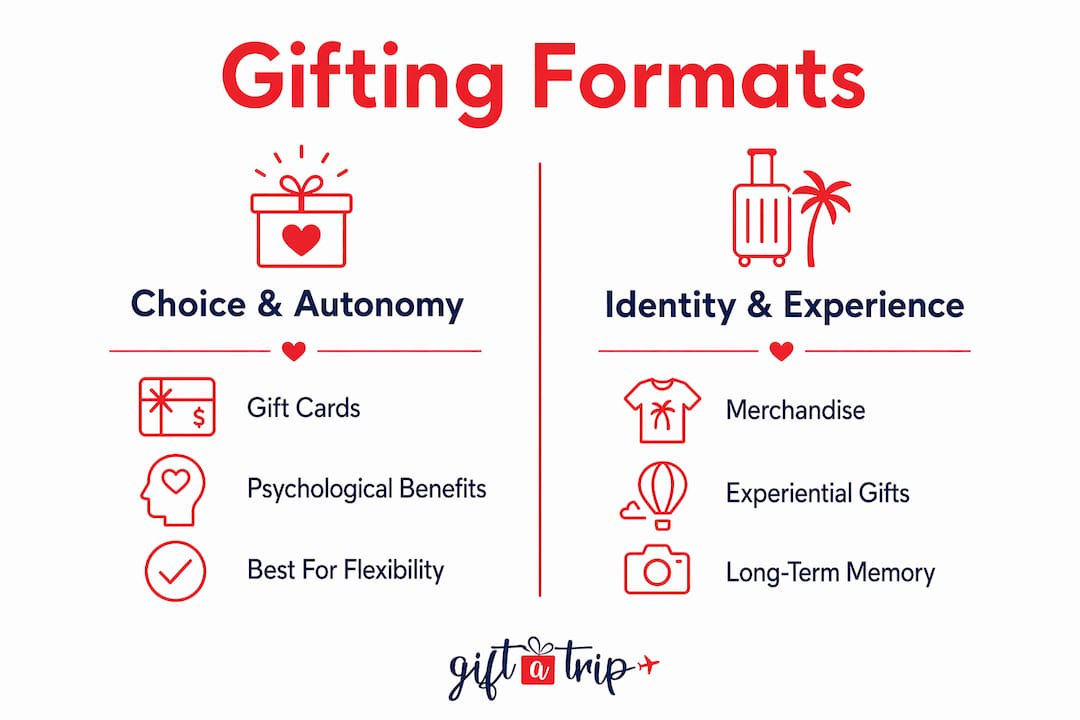
The Incentive Research Foundation’s 2026 industry outlook identifies three primary gifting formats used by organizations: gift cards, merchandise, and event or experiential gifts. Each format produces a distinct psychological outcome, and matching format to goal is where most HR programs either succeed or waste budget.
| Gift Format | Primary Psychological Outcome | Best Used For | 2026 Trend |
|---|---|---|---|
| Gift cards | Choice and autonomy | Broad-appeal rewards, flexible recognition | 30%–34% of program allocations; 70% of North American organizations plan increased use |
| Merchandise | Identity and personalization | Milestone recognition, team belonging | Growing emphasis on personalization over generic branded items |
| Experiential/event gifts | Memory creation and bonding | High-impact moments, team cohesion, executive recognition | Evolving toward experiential integration with travel and events |
Gift cards dominate because they respect employee autonomy. When an employee chooses how to spend a reward, the act of choosing reinforces the sense that the organization trusts their judgment. That trust is itself motivating. The IRF data showing 70% of North American organizations anticipate increased gift card use reflects this psychological reality.
Merchandise works differently. A branded jacket or a high-quality item tied to a team achievement becomes an identity signal. The employee wears or uses the item and is reminded of the recognition moment each time. This creates what psychologists call an “extended self” effect, where the object reinforces belonging and pride in the organization.
Experiential gifts, including travel certificates, team events, and resort stays, produce the strongest long-term memory associations. Shared experiences create social bonds that outlast the experience itself. For employee recognition strategies targeting retention and team cohesion, experiential rewards consistently outperform transactional ones because the memory of a great experience is more durable than the memory of receiving a check.
Best practices for integrating gifting into recognition programs
Recognition programs combining tangible gifts with meaningful acknowledgment reduce turnover by up to 45% and increase engagement. That outcome requires deliberate program design, not ad hoc generosity. Here is how to build a gifting program that produces those results consistently.
-
Map your gifting calendar to the employee lifecycle. Onboarding, 90-day milestones, work anniversaries, promotions, and project completions are all high-impact moments. Closing the gap on anniversaries alone addresses one of the most documented deficits in employee motivation programs.
-
Prioritize recency over magnitude. Workhuman’s research confirms that being thanked in the last month produces a 21% higher psychological safety score. A smaller, timely gift outperforms a large annual one. Build recognition into monthly or quarterly rhythms rather than relying on year-end programs.
-
Personalize at scale. The Snappy 2026 data shows 73% of employees say personalization is the most important factor in meaningful recognition. Use employee preference data, manager input, and lifecycle triggers to match gift format to individual. A travel certificate for an employee who loves adventure communicates attention in a way that a generic gift basket never will.
-
Pair every gift with public acknowledgment. The gift activates the reward pathway. The public acknowledgment amplifies it by adding social recognition to the emotional experience. Announce recognition in team meetings, internal channels, or company newsletters.
-
Avoid excessive branding on gifts. A heavily branded item signals that the gift is marketing, not appreciation. Reserve branding for items where it genuinely adds pride, such as team gear for a high-performing unit.
Pro Tip: Use HR software integrations with platforms like Workday, BambooHR, or Rippling to automate gifting triggers at key lifecycle moments. Automation removes the execution gap that causes most recognition programs to fail.
Only 32% of companies consistently get employee appreciation right. That figure means 68% of organizations are leaving a proven retention and engagement lever largely unused. The opportunity cost is measurable in turnover rates, disengagement scores, and productivity losses.
Key takeaways
Strategic gifting is the highest-return, lowest-utilized lever in most HR recognition programs, and closing the execution gap requires matching gift format, timing, and framing to specific motivational goals.
| Point | Details |
|---|---|
| Gifting drives retention | 72% of employees say a work-anniversary gift increases their likelihood of staying at their company. |
| Timing matters more than size | Recognition within the last month raises psychological safety scores by 21%, outperforming infrequent large rewards. |
| Framing determines motivational impact | Gifts framed as appreciation preserve intrinsic motivation; gifts framed as performance payment risk the overjustification effect. |
| Format should match the goal | Gift cards build autonomy, merchandise signals identity, and experiential gifts create lasting memory and team bonding. |
| Personalization is non-negotiable | 73% of employees rate personalization as the most important factor in meaningful recognition, yet only 32% of companies deliver it consistently. |
Why gifting programs fail when they should succeed
I have reviewed enough recognition program post-mortems to identify the pattern clearly. Organizations invest in gifting, see modest results, and conclude that gifting does not work. The real problem is almost always one of three things: the gifts are generic, the timing is wrong, or the framing signals control rather than appreciation.
The behavioral science here is not complicated, but it requires discipline to apply. Self-Determination Theory has been validated across decades of research. The overjustification effect is real and predictable. Yet most HR programs are designed around convenience and budget cycles rather than psychological principles. A $50 gift delivered the week after a meaningful contribution, with a specific personal message, will outperform a $500 year-end bonus in motivational impact. That is a counterintuitive result that most finance teams will push back on, but the Workhuman data backs it up.
What I find most underutilized is experiential gifting at the individual level. Team events get budget. Individual travel rewards rarely do. Yet a travel certificate given to a high performer who just delivered a critical project creates a memory that the employee will associate with your organization for years. That memory is a retention asset. It is also a recruitment asset, because people talk about experiences in ways they never talk about cash bonuses.
The organizations getting this right treat gifting as infrastructure, not as a line item to cut when budgets tighten. They embed recognition triggers into workflows, they train managers on framing, and they measure the outcomes. The gap between those organizations and the 68% who are getting appreciation wrong is not resources. It is intentionality.
— Donovan
Elevate your recognition program with travel gifting
Experiential rewards produce the strongest motivational outcomes, and travel certificates are among the most flexible and memorable options available to HR leaders today. Giftatrip specializes in digital travel certificates redeemable at major resorts, hotels, cruise lines, and vacation packages, with taxes and resort fees included and minimal blackout dates. Whether you are recognizing a work anniversary, rewarding a top performer, or building a milestone recognition program, Giftatrip’s corporate gifting solutions make it straightforward to deliver high-impact experiential rewards at scale. Explore how travel-based recognition can transform your employee motivation strategy.
FAQ
What is the role of gifting in employee motivation?
Gifting activates the brain’s reward system and creates emotionally resonant recognition moments that increase loyalty, engagement, and alignment with organizational goals. Research shows employees recognized for goal contributions are 5x more personally invested in company initiatives.
How do gifts improve employee retention?
Tangible gifts tied to meaningful acknowledgment reduce turnover by up to 45% and increase engagement, according to recognition program research. Work-anniversary gifts alone increase retention likelihood for 72% of employees who receive them.
What types of gifts are most effective for employee motivation?
Gift cards offer flexibility and respect employee autonomy, merchandise reinforces identity and belonging, and experiential gifts such as travel certificates create durable memories and team bonding. The most effective format depends on the specific motivational goal and the individual employee.
How often should organizations give employee gifts?
Recognition frequency matters more than gift size. Workhuman’s 2026 research shows that being thanked within the last month produces a 21% higher psychological safety score, making monthly or quarterly gifting rhythms more effective than annual programs.
Can gifting undermine employee motivation?
Yes. Gifts framed as performance payments rather than appreciation can trigger the overjustification effect, where extrinsic rewards crowd out intrinsic motivation. Framing gifts as recognition of specific contributions, rather than as contingent rewards for hitting targets, preserves intrinsic motivation.