Jump to Section:
TL;DR:
- Travel certificates are highly effective non-cash rewards that motivate employees and enhance loyalty through memorable experiences. Proper program design, clear communication, and choosing flexible, inclusive options maximizes redemption rates and impact across all workforce segments. Emerging trends shift focus toward personalized, flexible travel incentives that build lasting emotional connections beyond traditional cash bonuses.
Travel certificates are flexible, non-cash rewards that corporate managers and event planners use to motivate employees, recognize top performers, and drive measurable business outcomes. Knowing how to use travel certificates for incentives means understanding both their motivational psychology and their operational mechanics. A SITE and Maritz study confirms that travel is the leading non-cash motivator, consistently outperforming cash bonuses across every workforce generation. Platforms like Giftatrip make this process accessible by offering digital travel certificates redeemable at resorts, cruise lines, and hotel brands with minimal blackout dates and covered fees.
How to use travel certificates for incentives: what you need first
Before you distribute a single certificate, you need to understand exactly what you are handing out. Travel certificates, also called travel vouchers or incentive travel certificates, come with specific terms that directly affect whether recipients actually use them.

Key terms to review before launch
The most common constraints across travel certificate programs include activation deadlines, booking lead times, blackout dates, and non-transferability clauses. Travel vouchers commonly include booking lead times, blackout dates, and activation deadlines explicitly listed on the terms. This means a recipient who waits too long to activate their certificate may lose it entirely, even if they were genuinely excited to use it.
The table below compares the most common voucher terms you will encounter when sourcing certificates for a corporate program.
| Term | What it means | Risk if ignored |
|---|---|---|
| Activation deadline | Certificate must be registered within X days of issue | Forfeiture before the trip is ever booked |
| Booking lead time | Reservations must be made 30 to 60 days in advance | Recipient misses preferred dates |
| Blackout dates | Certain peak periods are unavailable | Frustration and low redemption rates |
| Non-transferability | Certificate is issued to one named person | Gifting or reselling is not permitted |
| Expiration date | Certificate expires if unused by a set date | Wasted incentive budget |
For distribution and tracking, tools like spreadsheet-based redemption logs, HR platforms such as Workday or BambooHR, and dedicated incentive management software help you monitor who has activated their certificate and who has not. Giftatrip supports bulk corporate orders with customizable gift boxes and personalized messaging, which reduces the administrative burden on your team.
Pro Tip: Send a one-page activation guide to every recipient the same day you distribute certificates. Spell out the deadline, the booking steps, and a contact for questions. This single action prevents the majority of preventable forfeitures.
Step-by-step process for integrating travel certificates into your program
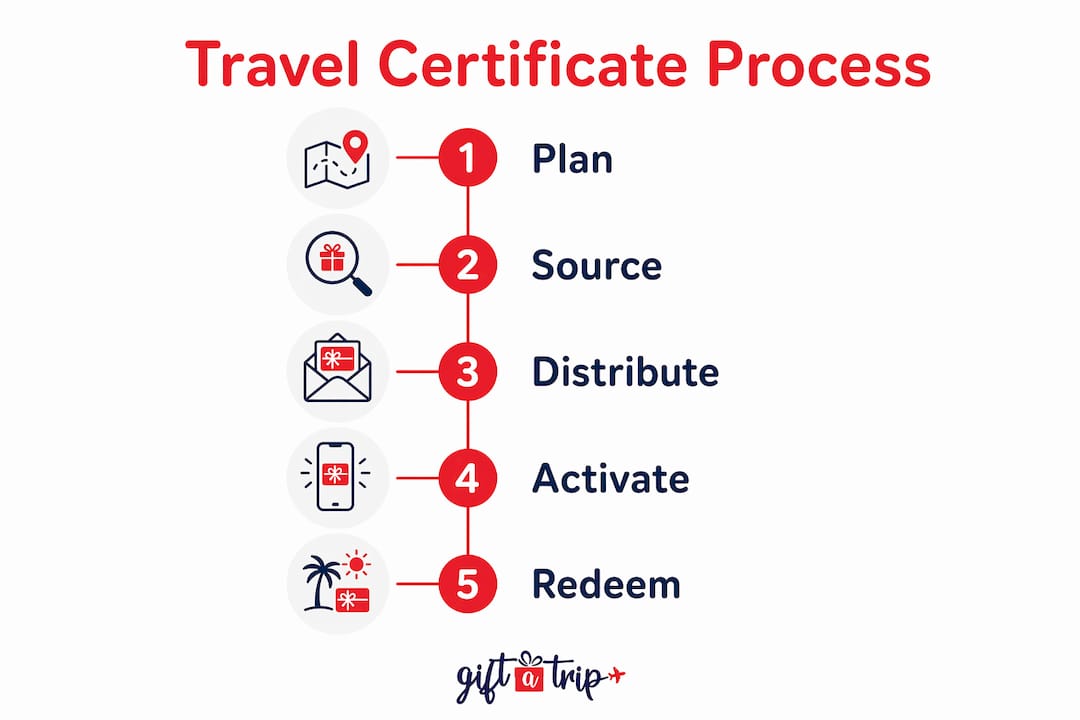
The process for travel incentives follows a clear sequence. Skipping any step reduces both participation rates and the emotional impact of the reward.
-
Define your performance goals. Decide what behavior or outcome the incentive is meant to drive. Sales quota attainment, customer satisfaction scores, safety records, and project milestones are all valid targets. The goal must be specific, measurable, and communicated before the program launches.
-
Set qualification criteria. Determine who qualifies and at what threshold. You can use an all-or-nothing model (hit the target, earn the certificate), a tiered model (bronze, silver, gold certificates with increasing value), or a points-based model where participants accumulate points redeemable for travel. Effective program promotion drives motivation and ensures participants understand the process and benefits from day one.
-
Choose the right travel experiences. Match the certificate type to your audience. Resort stays work well for families. Cruise certificates appeal to couples and adventure-seekers. Golf getaway certificates target a specific professional demographic. Flexibility and inclusion are key drivers that determine whether a trip feels personally motivating and worth pursuing, so offering multiple options increases perceived value.
-
Source and procure certificates. Work with a provider that covers taxes and resort fees, offers minimal blackout dates, and supports digital delivery. Giftatrip’s corporate gifting program provides individual incentive travel certificates with these features built in, which simplifies procurement for event planners managing large cohorts.
-
Promote the program internally. Use email campaigns, team meetings, and intranet posts to explain how participants qualify, what the reward includes, and how to track progress. Ambiguity kills motivation. The more clearly you communicate the prize, the higher your participation rate.
-
Distribute certificates and confirm activation. Issue certificates immediately after a participant qualifies. Delayed rewards lose emotional impact. Confirm that each recipient has activated their certificate within the required window and follow up with anyone who has not.
-
Track redemption and gather feedback. Monitor booking rates and collect post-trip feedback. This data tells you which certificate types generated the most excitement and helps you refine the next program cycle.
Pro Tip: Build a 30-day check-in into your program calendar. Contact every certificate holder at the 30-day mark to confirm they have activated and booked. This one touchpoint can recover redemptions that would otherwise expire.
Common challenges when using travel certificates as incentives
Even well-designed programs run into obstacles. Knowing the most frequent failure points lets you build safeguards before they become problems.
- Activation forfeitures. Failure to brief employees explicitly causes preventable forfeitures even when employees are motivated to use the incentive. A certificate that expires unused is a wasted budget line and a demotivated employee.
- Inventory and booking limitations. Popular destinations and peak travel periods fill quickly. Recipients who delay booking find their preferred options unavailable, which reduces satisfaction even when the certificate itself has value.
- Non-transferability confusion. Employees sometimes assume they can give a certificate to a family member or sell it. When they discover they cannot, the incentive feels restrictive rather than generous. Address this in your initial communication.
- Blackout date conflicts. School holidays, summer weekends, and major events are frequently blacked out. If your workforce skews toward parents, this constraint significantly limits usability. Choose providers with minimal blackout restrictions.
- Cancellation penalties. Some certificates carry fees for date changes or cancellations. Recipients who book and then face a life change may end up penalized, which creates a negative association with your program.
Pro Tip: Create a one-page checklist for recipients that covers activation steps, booking deadlines, blackout periods, and the cancellation policy. Distribute it with the certificate and again at the 30-day check-in. Checklists reduce confusion and increase redemption rates.
How do travel certificates compare to cash bonuses and other rewards?
Individual travel is rated as extremely motivating by 61% of respondents in the SITE and Maritz study, with group travel ranked second. Both outperform cash bonuses, gift cards, and recognition programs. That gap matters because it directly affects whether your incentive program changes behavior or simply gets absorbed into a paycheck.
| Reward type | Motivational impact | Memorability | Perceived value | Flexibility |
|---|---|---|---|---|
| Travel certificate | Very high | Very high | High | High |
| Cash bonus | Moderate | Low | Moderate | Very high |
| Gift card | Moderate | Low | Moderate | Moderate |
| Recognition award | Moderate | Moderate | Low to moderate | Low |
| Group incentive trip | High | Very high | Very high | Low |
The psychological reason travel outperforms cash is straightforward. Cash gets spent on bills and disappears without a memory attached to it. A resort stay or cruise creates a distinct experience that the recipient associates with your organization’s recognition. That emotional connection drives the loyalty effect. Among incentive-trip attendees, 89% say they are more likely to stay in their role and report stronger loyalty after the trip. No cash bonus produces that retention outcome.
The role of travel certificates in sales incentives is well established, but the types of travel incentives now extend far beyond the sales floor. 60% of qualifiers in current programs work in operations or technology roles, with less than 10% in sales. This shift means corporate managers across every department can justify travel certificate programs as retention and performance tools, not just sales acceleration tactics. The benefits of travel-based rewards apply equally to a logistics team that hit a safety milestone and a software team that delivered a product on time.
Program design elements like guest choice and intentional recognition moments enhance emotional impact and return on investment. Letting a recipient bring a partner or choose between a beach resort and a city hotel transforms a generic reward into a personal experience. That personalization is what makes travel certificates outperform every other non-cash reward category.
Key takeaways
Travel certificates outperform cash bonuses in motivation and retention because they create lasting emotional experiences that recipients associate directly with your organization’s recognition.
| Point | Details |
|---|---|
| Front-load communication | Brief every recipient on activation deadlines, blackout dates, and booking steps before they receive the certificate. |
| Match certificates to your audience | Offer resort, cruise, or niche options like golf getaways to reflect the preferences of your specific workforce. |
| Extend beyond sales teams | Operations and technology employees respond equally well to travel incentives, broadening your program’s reach. |
| Track activation at 30 days | A single check-in at the 30-day mark recovers most at-risk redemptions before certificates expire. |
| Travel beats cash on loyalty | 89% of incentive-trip recipients report stronger loyalty and higher likelihood of staying in their role after the experience. |
Why intentional travel certificates are the future of employee incentives
I have spent years watching corporate incentive programs cycle through the same mistakes. A company launches a cash bonus structure, sees a short-term performance spike, and then watches engagement flatten within two quarters. The money gets spent, the memory fades, and the motivational effect evaporates.
What I find genuinely different about travel certificates is the permanence of the experience. When you hand someone a certificate for a Virgin Voyages cruise or a resort stay in Cancún, you are not giving them money. You are giving them a story they will tell for years. That story is attached to your brand, your recognition, and the moment you said “you earned this.”
The shift I am watching in 2026 is the broadening of who qualifies. For too long, incentive travel was a sales department privilege. The data now confirms what good managers already knew: your operations lead who kept the warehouse running through a supply chain crisis deserves that certificate just as much as your top closer. Programs that reflect this reality see higher engagement across the entire organization, not just the revenue-generating functions.
The other change worth noting is the move toward flexibility in experience design. Rigid group trips with fixed itineraries are losing ground to individual certificates that let recipients choose their destination, travel dates, and companions. Future incentive programs must be more intentional, flexible, and inclusive to reflect evolving workforce demographics and preferences. That is not a trend. It is a structural shift in what employees expect from recognition.
If you are still defaulting to gift cards or year-end bonuses, you are leaving motivation on the table. The advantages of travel rewards over cash are now backed by enough data that the conversation has moved from “should we try this?” to “how do we design it well?”
— Donovan
How Giftatrip makes travel certificate incentives simple
Corporate managers and event planners need a procurement partner that handles the complexity so they can focus on program design. Giftatrip offers digital travel certificates redeemable at resorts, hotels, and cruise lines, with taxes and resort fees covered and minimal blackout dates built in.
Whether you are rewarding a single top performer or running a tiered program for 500 employees, Giftatrip’s bulk ordering and personalized messaging options scale to your needs. For high-impact rewards, the Virgin Voyages cruise certificates are a standout option that consistently generates strong recipient enthusiasm. You can also explore the full range of flexible travel certificates to find the right fit for your audience and budget. Giftatrip handles secure digital delivery, so your incentive program runs without the logistical friction that kills momentum.
FAQ
What are travel certificates used for in corporate programs?
Travel certificates are non-cash rewards issued to employees or clients to recognize performance, celebrate milestones, or drive specific business outcomes. They are redeemable for hotel stays, resort packages, or cruise experiences and are used across sales, operations, and technology teams.
How do travel incentives work for employee rewards?
A manager sets a performance target, and employees who meet it receive a travel certificate redeemable for a pre-selected travel experience. The certificate typically requires activation within a set window and booking in advance of the travel date.
Why do travel certificates outperform cash bonuses?
Individual travel outperforms cash because it creates a memorable experience tied to the recognition moment, while cash is absorbed into everyday spending without a lasting emotional association. 89% of incentive-trip recipients report stronger loyalty after the trip.
What types of travel incentives work best for diverse teams?
Resort stays, cruise certificates, and niche options like golf getaways cover the broadest range of employee preferences. Offering multiple certificate types within a tiered program increases perceived value and participation across different workforce segments.
How do you prevent travel certificate forfeitures?
Distribute a clear activation guide with every certificate, set a 30-day check-in reminder, and choose a provider with minimal blackout dates and flexible booking windows. Explicit upfront briefing on deadlines and terms eliminates the majority of preventable forfeitures.