
Jump to Section:
TL;DR:
- Resort fees, added per night and often hidden from advertised prices, can significantly increase travel gift costs.
- Understanding and accounting for these fees ensures that gift recipients are not surprised by unexpected charges at check-in.
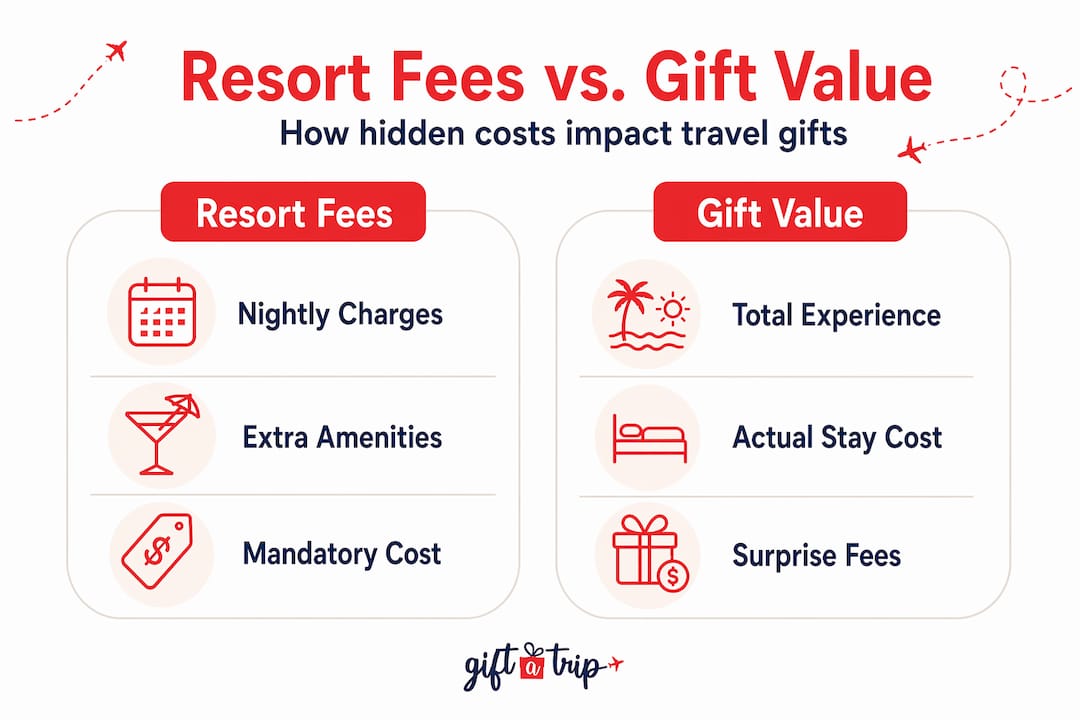
A prepaid travel gift sounds like the ultimate present, but resort fees can quietly unravel that promise before the recipient even arrives at check-in. Resort fees are mandatory per-night charges added on top of the base room rate and taxes, and they rarely appear in the advertised price. For anyone buying a hotel stay as a birthday present, anniversary surprise, or corporate reward, this gap between what you pay and what your recipient owes can be jarring. Knowing how these fees work, and how to avoid gifting someone an unexpected bill, is the difference between a genuinely generous experience and an awkward one.
Table of Contents
- What are resort fees and why do they matter for travel gifts?
- How resort fees shift the true value of a travel gift
- Resort fee waivers: Loyalty programs, award stays, and special cases
- Fee transparency rules, tax guidance, and best practices for gift buyers
- Perspective: Why the headline rate is the wrong number for travel gifts
- Find travel gifts that deliver real value (and clear pricing)
- Frequently asked questions
Key Takeaways
| Point | Details |
|---|---|
| Resort fees are often hidden | These mandatory nightly charges can significantly increase the total cost of a travel gift. |
| Full cost clarity is crucial | Always calculate the total price of a travel gift—including fees and taxes—before buying or gifting. |
| Fee waivers aren’t guaranteed | Loyalty points and certificates may not always remove resort fees, so check the details carefully. |
| Transparency rules help shoppers | U.S. laws now require hotels to display all mandatory fees up front, aiding gift givers’ budgeting. |
| Practical steps can save money | Compare total prices, ask hotels about available amenities, and seek waivers when possible. |
What are resort fees and why do they matter for travel gifts?
To understand why these fees matter for your gift budget, let’s look at what they actually are and how they work.
Resort fees are flat, per-night charges that hotels add separately from the published room rate. Properties justify them by bundling amenities into a single line item. The list typically includes:
- Wi-Fi and internet access
- Pool and beach access
- Fitness center use
- In-room coffee or bottled water
- Newspaper or digital content subscriptions
- Local and toll-free phone calls
- Parking validation (sometimes partial)
- Activity programs or resort shuttles
Here’s the catch: guests often already pay for some of these things through their room rate, or they simply don’t use them. Yet the fee is non-negotiable. As resort fees materially change the total trip cost versus the advertised rate, the budgeting shock hits especially hard when a gift is involved.
Resort fee ranges at a glance:
| Property type | Typical nightly fee | Notes |
|---|---|---|
| Mid-range resort | $15–$30 | Urban and suburban properties |
| Beachfront resort | $30–$50 | Hawaii, Florida, Caribbean popular |
| Luxury urban hotel | $25–$45 | City properties adding “destination fees” |
| Casino resort | $35–$60+ | Las Vegas notorious for high fees |
| Boutique resort | $20–$40 | Varies widely by brand |
For a five-night stay at a Las Vegas resort charging $50 per night in resort fees, your recipient faces $250 in out-of-pocket costs on top of whatever you already gifted. That’s a jarring welcome to their vacation. For corporate travel gift ideas, the stakes are even higher because company reputation sits behind every reward you send.
Pro Tip: Always look up the specific property’s resort fee before purchasing any travel gift. Search the hotel name plus “resort fee” or “destination fee” to find the exact nightly amount. Many property websites list it under “policies” rather than the booking page.
The confusion runs deep for both personal and business gifts. A corporate manager who purchases a hotel voucher worth $400 may believe they’ve fully covered a two-night stay. If the resort charges $40 per night in fees plus taxes, the actual cost to the recipient jumps considerably above what the gift covered. That disconnect is not just a financial issue. It’s a relationship issue.
How resort fees shift the true value of a travel gift
Now that you understand what resort fees are, see how they directly affect the final value of your travel gift, with practical examples.
Consider two scenarios that play out constantly in the gifting world.
Scenario A: Birthday getaway
A parent books a two-night beach hotel stay as a birthday present. The advertised rate is $150 per night, so the gift certificate covers $300. But the resort charges a $45 nightly resort fee. The birthday recipient arrives excited, then learns they owe $90 in fees, plus applicable taxes on those fees. The gift that felt generous becomes an unfinished present.
Scenario B: Corporate rewards stay
A sales manager selects a resort package as a quarterly performance reward for a top employee. The package price looks solid on paper. But the travel incentives guide makes clear that without covering ancillary costs, the reward can feel tone-deaf. An employee who expects a “free” trip and then pays $200 out of pocket walks away with a mixed memory of the recognition.
Fees ranging from $15 to $50 per night sound small in isolation, but they compound quickly across multi-night stays. Here is a simple cost comparison to show the gap:
| Stay length | Room rate (per night) | Resort fee (per night) | Total room cost | Total with fees |
|---|---|---|---|---|
| 2 nights | $175 | $35 | $350 | $420 |
| 3 nights | $150 | $45 | $450 | $585 |
| 5 nights | $120 | $50 | $600 | $850 |
| 7 nights | $100 | $40 | $700 | $980 |
The gap between “gift value” and actual total cost grows in direct proportion to the stay length, which is exactly the opposite of what most gift buyers expect.
Steps from gift selection to recipient use:
- Gift buyer selects a hotel stay based on the advertised nightly rate.
- The advertised rate does not include resort fees or taxes.
- A certificate or voucher is issued for the room rate amount only.
- The recipient makes a reservation and sees the total price (room plus fees).
- At checkout, the resort charges the nightly fee per day stayed.
- The recipient pays fees out of pocket unless the gift explicitly covered them.
- The gift buyer learns about the shortfall, often after the fact.
For properties in vacation-heavy destinations, reviewing beachfront booking tips before selecting a property can reveal fee levels that standard listing pages hide. This one extra step protects both your budget and your recipient’s experience. The best vacation gift certificates solutions account for this from the start.
Pro Tip: If you’re gifting a multi-night resort stay, add the resort fee total to your budget before you buy. That means doing the math: nightly fee multiplied by the number of nights. Include that amount in the gift value so your recipient truly arrives with everything covered.

Resort fee waivers: Loyalty programs, award stays, and special cases
Beyond basic bookings, let’s explore how fee waivers work when gifting travel through points, certificates, or loyalty programs, and where the pitfalls lie.
Many people assume that booking through a loyalty program means fees disappear. That’s partially true and partially a myth worth clearing up before you gift.
Loyalty programs can sometimes waive resort fees on award stays, but the rules vary dramatically by brand, property, and even the type of award booking used. Here’s what typically applies:
- Top-tier elite members at some chains receive automatic fee waivers as a status benefit.
- Standard award stays do not always include fee waivers, even when the room itself is covered by points.
- Cash-plus-points bookings almost never include fee waivers because the stay is partially a cash transaction.
- Prepaid certificate bookings follow their own rules, which vary by issuer and property.
- Brand-specific policies at one chain may be entirely different at another, even within the same travel category.
“Gift buyers should treat resort fees as potentially still owed even when a booking is made with points or a certificate, depending on brand/property rules.” AwardWallet
This is critical information for anyone considering a loyalty-linked travel gift. You might book through a program expecting the recipient to pay nothing extra, but the property still charges the fee at checkout. The recipient’s surprise is entirely avoidable with upfront research.
For gift buyers working with corporate travel certificate guide resources, the best practice is to treat every booking as though resort fees apply until you confirm in writing that they do not. Call the property directly. Get the confirmation in writing. Then pass that information along to the recipient so they arrive fully prepared.
Pro Tip: When gifting a stay at a loyalty program property, contact the hotel’s front desk directly, not the reservation line, to confirm whether the specific award booking or certificate will trigger a resort fee. Policies shift, and what the brand website states may differ from what a specific property charges.
There are edge cases where fees are waived regardless of status. If a resort is under construction, if amenities listed under the fee are unavailable, or if the property is running a promotional period, management may reduce or eliminate the fee. But you cannot count on this. Document any waiver promise in writing before finalizing a gift booking.
Fee transparency rules, tax guidance, and best practices for gift buyers
Armed with fee knowledge and waiver options, you should also know what the law, IRS, and industry best practices say about transparency and proper budgeting.
The U.S. has moved toward stronger fee disclosure. The FTC’s Rule on Unfair or Deceptive Fees requires businesses, including hotels, to display total prices inclusive of mandatory fees. Since this rule took full effect in May 2025, most U.S. hotels must show the total cost upfront rather than advertising a low rate and revealing fees only at checkout. This is a significant win for gift buyers because it means the price you see when booking should now reflect what your recipient actually owes.
However, transparency rules apply to the booking interface, not to the resale of gift certificates. A certificate issued six months ago may reflect a price that pre-dates fee disclosures. Always verify current fee structures when the recipient redeems.
On the tax side, things matter a great deal for corporate gifts. IRS Publication 463 addresses lodging costs during business travel and confirms that mandatory fees charged by hotels as part of the accommodation cost are generally included in the deductible lodging expense. This means if your company gifts an employee a travel reward that includes a mandatory resort fee, that fee may be part of the legitimate reimbursable travel cost.
| Expense type | Tax treatment | Notes |
|---|---|---|
| Room rate | Deductible (business travel) | Must be ordinary/necessary |
| Mandatory resort fee | Deductible with room rate | Treated as part of lodging cost |
| Optional amenities | Generally not deductible | Must be separate and chosen |
| Gift certificate value | May be taxable to employee | Check fringe benefit rules |
Best practices for gift buyers, whether purchasing for personal or corporate occasions:
- Always request the all-in nightly price when researching hotels. Compare total cost, not room rate alone.
- Ask about fee waivers at the property level before committing to a specific hotel.
- Use the total cost as your gift value benchmark, not the published room rate.
- For corporate gifts, consult HR or finance on taxable fringe benefit rules before distributing large-value travel rewards.
- For group travel, group travel cost savings research shows that negotiating directly with properties for fee reductions can yield meaningful savings at volume.
“When fees can range from $15 to $50 per day, comparing total costs rather than headline rates is the only honest way to budget a travel gift.”
For individual travel rewards programs, building fee coverage directly into the reward amount protects the program’s credibility. Recipients who use a reward without unexpected fees become advocates for the program. Recipients who face surprise costs at checkout do not.
Pro Tip: Build a simple spreadsheet for any travel gift purchase. Columns for hotel, nightly rate, resort fee per night, number of nights, tax rate, and total cost. That one extra minute of math will save you from gifting a trip with an unpleasant financial asterisk attached.
Perspective: Why the headline rate is the wrong number for travel gifts
Here is a more pointed take from inside the industry: the hotel industry’s long reliance on low headline rates is a kind of bait that gift buyers in particular absorb at face value. When you’re buying something for someone else, you’re not the one who discovers the final bill. Your recipient is. That means the emotional impact of the hidden fee lands somewhere you’ll never directly see: at a resort check-in desk, when your gift recipient slides their card for a charge they didn’t expect.
The nightly headline rate has become a teaser number. It’s optimized to attract clicks, not to represent what a stay actually costs. For personal gifts like birthdays and anniversaries, the headline rate is an especially dangerous anchor because people share those numbers: “I got you a $200-a-night hotel stay,” only for the recipient to pay an extra $50 per night on top.
Corporate reward programs feel this even more acutely. Employee recognition hinges on the recipient feeling valued. A resort fee that an employee must pay out of pocket, on a trip given as a reward, directly contradicts the message the company intended to send. Some hotel fees can even exceed room cost, which makes the headline rate not just misleading but potentially embarrassing for the gift buyer.
The solution is not to avoid resort-based gifts. Resorts offer incredible experiences. The solution is to shift how you frame your gift’s value. Anchor the gift on the all-in cost, including fees and taxes, and either cover those costs inside the gift or clearly communicate to the recipient what they may owe. That honesty is what distinguishes a thoughtful travel gift from a pleasant-sounding one. We believe the best reward certificate recognition programs are built exactly on that principle: total transparency, with no asterisks.
Find travel gifts that deliver real value (and clear pricing)
Ready to gift a trip without hidden costs? Here are solutions tailored for confident, surprise-free travel gifting.
At Gift A Trip, we’ve built our entire platform around the idea that a travel gift should feel complete when received, not half-finished. Our digital travel certificates cover taxes and resort fees in the stated value, so what you give is what your recipient actually gets to spend on their experience.

Whether you’re looking at digital travel gift examples for a birthday or anniversary, or exploring corporate travel certificates for a recognition program, our offerings present full pricing up front. No surprise fees at checkout for your recipient, no awkward calls explaining what wasn’t covered. You can shop for travel certificates directly on our platform, with options for personal messages, custom gift boxes, and bulk orders for business programs. Every certificate is backed by real resort, hotel, and cruise partnerships built for hassle-free redemption.
Frequently asked questions
What are typical resort fee amounts for hotel stays given as gifts?
Most U.S. hotel resort fees range from $15 to $50 per night, though some luxury and casino properties charge even more, occasionally exceeding the cost of the base room rate itself.
Do resort fees apply on hotel stays booked with gift certificates or points?
Some hotels waive resort fees for award bookings, but fees may still be owed depending on the brand, property, and specific booking method; always confirm with the property before gifting.
Are mandatory resort fees included in the price shown for hotels after recent U.S. transparency rules?
Since May 2025, most U.S. hotels must display total prices including mandatory resort fees up front, per the FTC’s deceptive fees rule, though compliance and enforcement continue to evolve.
Can I ask a hotel to waive a resort fee if amenities are unavailable?
Yes, many properties will adjust or waive the resort fee if the amenities bundled into it are genuinely unavailable during the recipient’s stay; the key is asking at the property before checkout, not after.
How do resort fees affect corporate travel gift reimbursement?
Mandatory resort fees are typically treated as a reimbursable part of the lodging cost during business travel, as IRS Publication 463 classifies them with the overall accommodation expense, though gift certificate values given to employees may carry separate fringe benefit tax implications.