Jump to Section:
TL;DR:
- Travel incentives, like certificates, create lasting memories and emotional connections, often outperforming cash bonuses in motivation and engagement. Cash rewards, however, are practical for immediate financial needs and audiences with limited travel interest. Combining both options strategically aligns with recipient preferences, organizational goals, and current workplace culture trends.
Cash feels like the safe choice. It’s immediate, flexible, and everyone can use it. But incentive travel statistics reveal something most reward managers don’t expect: 94% of top-performing companies report that incentive travel effectively drives business objectives, with average spends of $5,100 to $5,821 per person. That’s a striking signal that travel rewards aren’t just a perk; they’re a strategic tool. Whether you’re an HR manager refreshing your recognition program or someone picking a standout anniversary gift, understanding the real differences between travel certificates and cash bonuses can change how you think about motivation entirely.
Table of Contents
- Understanding travel certificates and cash bonuses
- Comparing benefits: Travel certificates vs cash bonuses
- When to choose travel certificates or cash bonuses
- Implementing travel rewards: Practical steps and pitfalls
- Why the right reward matters more than ever
- Explore flexible travel gifting solutions
- Frequently asked questions
Key Takeaways
| Point | Details |
|---|---|
| Travel rewards drive engagement | Travel certificates are proven to create lasting motivation and loyalty, especially for high-performing teams. |
| Cash offers flexibility | Cash bonuses are valuable for non-travel audiences and companies with limited budgets. |
| Choose rewards strategically | Selecting the right incentive depends on recipient preferences, company goals, and the context of the reward. |
| Implementation matters | A well-planned travel reward program requires clear communication, thoughtful selection, and measurable outcomes. |
Understanding travel certificates and cash bonuses
Before comparing these two reward types head to head, it helps to get clear on what each one actually is and how each functions in practice.
A travel certificate is a prepaid voucher that entitles the recipient to a travel experience, typically a hotel stay, resort package, cruise, or vacation bundle. The value is locked into that experience. At Gift A Trip, for example, certificates cover stays at resorts and hotels from major travel brands, with taxes and resort fees included, and they’re delivered digitally for easy distribution. Reading up on travel certificate basics can clarify exactly what recipients receive and what flexibility they have when redeeming.
A cash bonus, by contrast, is straightforward: money added to a paycheck or issued as a check or gift card. Recipients can spend it however they want, which sounds appealing until you realize that cash often disappears into rent, groceries, or utility bills without creating any memorable association with the giver.
Common use cases for each reward type:
- Travel certificates work well for sales incentives, milestone recognition, top performer rewards, and personal occasions like honeymoons and anniversaries
- Cash bonuses are typically used for year-end bonuses, spot rewards for quick wins, and situations where the recipient’s financial needs outweigh experience preferences
- Travel certificates can be ordered in bulk with personalized messaging, making them ideal for HR teams rewarding large groups
- Cash works when speed and simplicity matter most, especially for immediate, unexpected recognition
Companies like ours see incentive travel as more than a reward. It’s a statement about how much you value someone’s contribution.
Pro Tip: Before selecting any reward, survey your team or consider your gift recipient’s lifestyle. A road warrior who travels constantly may prefer cash, while someone who rarely vacations may light up at the idea of a sponsored resort stay.
Comparing benefits: Travel certificates vs cash bonuses
With the basics understood, it’s time to compare these incentives directly, focusing on performance impact, emotional resonance, and practical strengths for both corporate and personal gifting.
“Travel incentives shine brightest for sales and performance recognition programs, while cash tends to outperform for audiences with limited travel interest or tighter budgets.” — IRF 2026 Trends Report
That distinction from the Incentive Research Foundation matters. It means neither option is universally superior. Context determines everything.
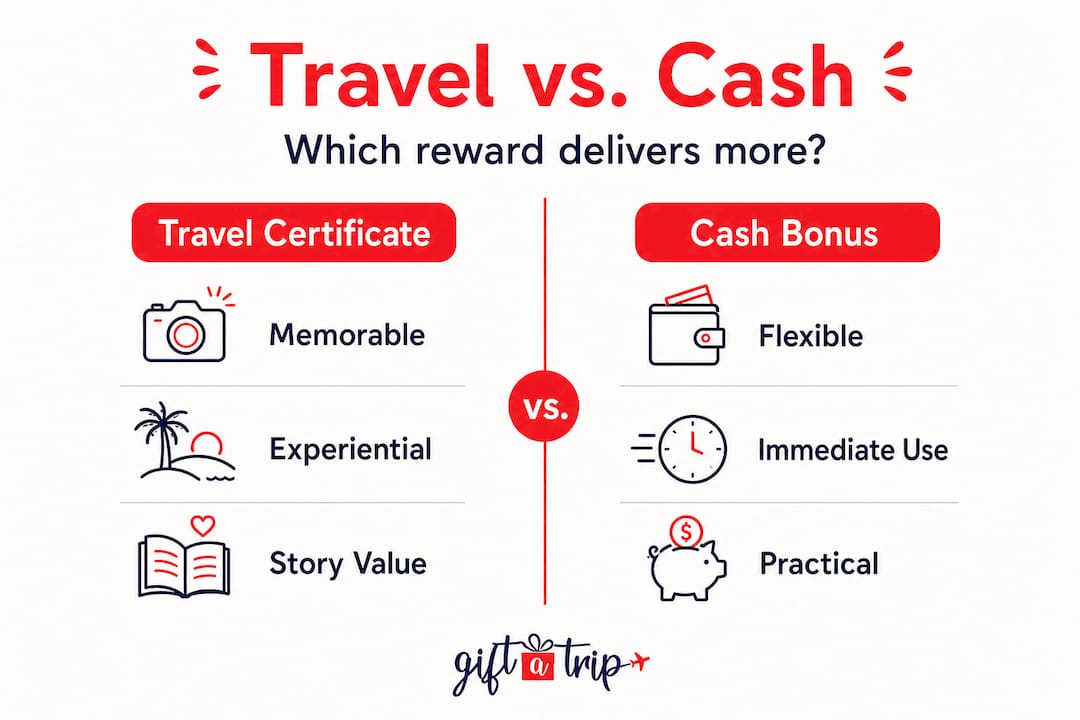
| Factor | Travel certificates | Cash bonuses |
|---|---|---|
| Emotional impact | High: creates lasting memories | Low: quickly absorbed into daily expenses |
| Recall value | Recipient remembers the experience | Rarely recalled after spending |
| Perceived value | Often feels more generous than face value | Perceived at exact dollar amount |
| Flexibility | Tied to travel experiences | Fully flexible spending |
| Engagement boost | Strong for high performers and travelers | Moderate to low long-term engagement |
| Tax treatment | May vary; often simpler for recipients | Taxed as income in most cases |
| Recognition signal | Sends a premium, thoughtful message | Can feel routine or transactional |
| Best for | Sales teams, milestones, personal occasions | Immediate needs, lower travel interest audiences |
Why travel certificates score higher on emotional impact:
The psychological reason travel rewards outperform cash in many scenarios comes down to something called the “trophy value” of incentives. Cash gets mentally categorized as income, and once it’s spent, it’s gone. A resort stay, on the other hand, generates anticipation before the trip, joy during it, and lasting memories after. That three-stage emotional return is something a paycheck simply can’t replicate.
When you want to boost motivation with travel rewards, the goal isn’t just to say “thank you.” It’s to create a story that the recipient tells for years. That storytelling effect ripples outward, making other team members aware of what’s possible when they perform well.
Where cash bonuses make sense:
Cash isn’t without real advantages. It solves immediate financial pressure. For employees who are managing debt, saving for a home, or supporting a family through a tough stretch, a cash bonus is often the most respectful and practical choice. Tying them to a travel experience they can’t afford time off to use would miss the point entirely. The IRF 2026 trends report specifically notes that cash outperforms for lower-travel audiences and leaner budgets, which is an honest acknowledgment that context shapes effectiveness.

Review the full corporate travel rewards guide if you want a deeper breakdown of when each approach makes the most strategic sense for your organization.
When to choose travel certificates or cash bonuses
Armed with comparison data, the next step is knowing which reward fits a specific situation. The decision isn’t random; it comes from understanding your audience, goals, and desired outcomes.
1. Assess your audience’s travel interest. Teams that include young professionals, sales competitors, or people who regularly mention bucket list destinations are prime candidates for travel rewards. If your workforce skews toward employees with young families or limited vacation time, cash may be more appreciated and more respectful of their reality.
2. Define your goal clearly. Are you trying to improve quarterly sales numbers? Retain top performers for another year? Celebrate a work anniversary in a meaningful way? Travel certificates signal aspiration and premium recognition. Cash signals appreciation but can feel expected and routine, especially if it becomes a predictable annual event.
3. Consider your budget and ROI expectations. Travel certificates often deliver more perceived value per dollar than cash because of the trophy effect mentioned earlier. A $500 resort certificate frequently feels like a $1,000 gesture because the recipient associates it with a full vacation experience rather than a dollar amount. The IRF 2026 trends report backs this up, noting that travel incentives outperform cash on engagement ROI for performance-driven programs.
4. Think about the personal occasion context. For weddings, honeymoons, anniversaries, and milestone birthdays, travel certificates are almost always the more memorable choice. No one frames a cash envelope and puts it on the mantle. But a photo from a Riviera resort stay, funded by a travel gift, becomes a story the couple shares for decades.
5. Layer your rewards when possible. The most effective programs often combine both types. Give cash for smaller, immediate wins and travel certificates for major milestone achievements. This keeps employees motivated at every performance level while ensuring the top performers feel genuinely valued.
Pro Tip: Align your reward selection with both the recipient’s preferences and your organization’s broader culture goals. If your company positions itself as forward-thinking and employee-centric, a generic cash deposit sends a different message than a branded resort experience with a personalized note.
Review strategies for travel incentives and business travel certificate solutions for more detailed frameworks tailored to corporate reward programs.
Implementing travel rewards: Practical steps and pitfalls
Once you’ve decided travel rewards are the right fit, execution is everything. A poorly communicated incentive program is nearly as ineffective as the wrong reward entirely.
Key steps for launching a travel rewards program:
- Define eligibility and criteria early. Employees need to know exactly what they’re working toward. Vague criteria breed resentment, not motivation.
- Choose the right certificate type. Resort stays, hotel packages, cruise certificates, and full vacation bundles each serve different audiences. Match the certificate format to the lifestyle of your recipients.
- Set up digital delivery infrastructure. Secure, personalized digital delivery means recipients receive their reward immediately without the friction of mailing physical gift cards.
- Communicate with excitement. Announce the program visually, share the potential travel destinations, and build anticipation before the performance period begins.
- Track and measure engagement. Monitor certificate redemption rates, gather post-trip feedback, and survey employees about motivational impact.
Executing travel rewards through a turnkey platform removes most logistical headaches. The administrative burden of managing travel arrangements, blackout dates, and booking coordination drops significantly when using pre-packaged certificates.
Common pitfalls to avoid:
| Pitfall | Why it hurts | How to prevent it |
|---|---|---|
| Unclear eligibility rules | Creates confusion, reduces buy-in | Define and publish criteria before launch |
| Certificates with too many restrictions | Frustrates recipients, reduces perceived value | Choose options with minimal blackout dates |
| Failure to communicate the reward value | Recipients undervalue the gift | Highlight what’s included: resort fees, taxes, etc. |
| No follow-up or celebration | The experience feels isolated | Create a sharing culture around reward stories |
| One-size-fits-all approach | Misses individual preferences | Offer choice within a curated certificate portfolio |
Companies that follow best practices in incentive travel programs consistently see stronger results. The data from top-performing companies confirms that investing thoughtfully in travel rewards, averaging over $5,000 per person in benchmark programs, generates measurable business outcomes. You don’t need to match that spend level to see impact. Even mid-tier resort certificates drive engagement when they’re delivered with genuine recognition.
Explore resort gift certificate benefits and how travel gifts for recognition elevate employee programs across industries.
Pro Tip: Send a personalized message with every certificate. A few lines about why this specific person earned this reward transforms a digital gift into a moment of genuine recognition. It takes two minutes and dramatically increases the emotional impact.
Why the right reward matters more than ever
Here’s a perspective that most reward conversations skip: the real cost of choosing the wrong incentive isn’t the money spent. It’s the opportunity lost to build a culture that retains great people.
For years, corporate wisdom assumed cash was king because it was measurable. You could calculate the bonus to the cent. But that precision is actually part of the problem. Cash is clinical. It sends a message that says “here is your transaction for good performance.” Travel says something completely different. It says “we want you to experience something extraordinary because of what you’ve contributed.”
This matters enormously right now. The workplace has fundamentally changed. Retention is harder. Expectations are higher. Employees are making career decisions based on how valued they feel, not just how much they earn. A cash bonus that disappears into a monthly budget does almost nothing to build that emotional connection. A resort stay that a family enjoyed together? That becomes part of the employee’s personal story, and it’s associated with your company.
The IRF 2026 trends report signals a continued shift toward experiential incentives even in budget-conscious environments. Companies that recognize this shift early gain a competitive advantage in both recruitment and retention. When prospective employees hear “we send top performers on resort stays,” it signals a culture of genuine investment, not just payroll efficiency.
That said, the best reward leaders we’ve seen don’t pick sides dogmatically. They use travel certificates where experience creates lasting value, and they use cash where practical flexibility respects the recipient’s real needs. Flexibility in reward design, much like the flexibility built into travel certificates themselves, is what creates programs that actually work.
Review the current corporate travel incentive trends to see how leading organizations are structuring their programs in 2026.
Explore flexible travel gifting solutions
If you’re ready to take the next step, flexible travel certificate solutions make finding the perfect reward simpler and more impactful than managing cash distributions or sourcing physical gifts.
At Gift A Trip, we offer a wide range of digital travel certificates redeemable at resorts, hotels, and cruise lines, with taxes and fees covered and minimal blackout dates. Whether you’re building a corporate incentive program or choosing a memorable personal gift, our options are designed to feel premium without the logistical headaches. Browse our top travel gift ideas for inspiration, explore how to make creating lasting memories with gifts effortless with digital delivery, or discover our cruise certificate deals for a standout reward that recipients will genuinely anticipate.
Frequently asked questions
Are travel certificates more motivating than cash bonuses?
Incentive travel proves highly effective, with 94% of top-performing companies reporting strong business impact from travel-based rewards, often outperforming cash in terms of engagement and long-term recall.
When is cash a better reward than travel?
Cash works better for audiences with low travel interest or for situations involving tight budgets, as the IRF 2026 data confirms that travel incentives have the greatest impact in sales and performance-driven contexts.
Do travel certificates offer better long-term value for companies?
Yes, travel incentives consistently link to higher engagement and stronger business outcomes because the experience creates lasting memories, which top companies spending $5,100 to $5,821 per person confirm through measurable performance improvements.
How can I implement a travel rewards program for my team?
Start by identifying your audience’s travel preferences, choose certificates that match their lifestyle, communicate program criteria clearly before launch, and track redemption rates and post-trip satisfaction to measure impact over time.