Jump to Section:
TL;DR:
- Experiential and travel rewards outperform cash and merchandise by creating lasting emotional connections and memorable experiences.
- Strategic, timely, inclusive, and personalized gifting programs build stronger employee engagement, retention, and cultural affinity.
Corporate leaders spend enormous energy designing compensation packages, yet the most powerful retention and engagement tools often cost far less than a salary bump. Top-performing companies overwhelmingly offer travel (93%), points-based rewards (93%), and merchandise (79%) alongside gift cards, signaling a clear shift away from cash-only thinking. This guide walks HR professionals and corporate managers through the evidence-based case for experiential and travel gifting, explains what makes programs genuinely effective, and gives you a practical framework to measure outcomes and avoid the most common mistakes.
Table of Contents
- Why business gifting matters: Engaging the modern workforce
- The science of effective gifting: Personalization and timing
- Gifting travel: Why experiences outperform cash and merchandise
- Proving impact: Measuring ROI of corporate gifting
- Common pitfalls in gifting and how to avoid them
- A fresh perspective: What most companies miss about gifting and recognition
- Ready to inspire your team? Next steps for modern business gifting
- Frequently asked questions
Key Takeaways
| Point | Details |
|---|---|
| Experience over cash | Travel and experiential rewards outperform cash gifts by creating lasting morale and higher engagement. |
| Personalization drives value | Allowing employees to choose rewards and recognizing achievements in ways that feel personal maximize program impact. |
| Measurement is critical | Track outcomes using clear goals and causality to prove ROI and justify investment in gifting programs. |
| Avoid common pitfalls | Ensure gifting is fair, transparent, timely, and includes all employees, especially in hybrid work environments. |
| Turn recognition into memories | Use gifting moments to foster lasting connections and a culture of appreciation within your organization. |
Why business gifting matters: Engaging the modern workforce
Recognition is no longer a “nice to have.” It sits at the center of how modern companies attract, retain, and energize talent. When employees feel genuinely appreciated, discretionary effort increases, turnover drops, and team culture strengthens in ways that a paycheck alone simply cannot replicate.
The problem with purely transactional recognition is that it treats people like cost centers rather than contributors. A bonus lands in a bank account and disappears into rent, groceries, or a utility bill. The emotional impact is minimal and short-lived. Experiential rewards, by contrast, anchor recognition to a memory and a story the employee will retell for years.
Employee gifting and recognition have evolved well beyond the holiday basket. Organizations now treat it as a core component of the employee experience, emphasizing personalization, choice, and inclusion as the primary mechanics that separate high-signal programs from low-signal rituals.
Consider what the data shows about how engagement programs affect workforce outcomes:
| Gifting approach | Employee engagement lift | Retention impact | Emotional memorability |
|---|---|---|---|
| Cash bonus | Low (short-term) | Minimal | Very low |
| Generic gift card | Low to moderate | Low | Low |
| Branded merchandise | Moderate | Moderate | Moderate |
| Travel or experience | High | Strong | Very high |
The table above reflects patterns observed across recognition research. Travel and experience consistently outperform cash on the dimensions that matter most for long-term workforce health.
A few core principles should guide any business gifting strategy:
- Recognition must be strategic. Random acts of gifting create noise, not signal. Build programs with clear goals tied to behaviors or milestones you want to reinforce.
- Frequency matters. Quarterly or milestone-based rewards sustain motivation better than an annual cash distribution.
- Inclusivity is non-negotiable. Programs that exclude remote or part-time employees create resentment, not loyalty.
Understanding travel gifts’ recognition impact can help you build a program that employees genuinely value, rather than one that gets forgotten by February.
“The best recognition programs don’t just reward output. They reinforce identity. Employees want to feel that their contribution mattered to someone who noticed.”
The science of effective gifting: Personalization and timing
Once you recognize gifting’s strategic value, the next step is understanding what makes programs truly effective. The mechanics matter. A well-timed, personally relevant gift from a respected leader creates a fundamentally different experience than a generic reward delivered weeks after the fact.
Recognition rewards work best when they are customized, timely, and fun. These three words sound simple, but most corporate programs fail on at least one of them. Customization requires knowing your people. Timeliness demands process discipline. Fun means choosing rewards that employees genuinely look forward to, not ones that feel obligatory.
Equally important is the delivery context. Gifts should feel personal by allowing employees to choose from a curated selection, and meaningful recognition experiences should involve the manager or senior leaders while also including remote employees. A travel certificate presented publicly by a senior leader during a team meeting carries ten times the emotional weight of an anonymous deposit to a prepaid card.
Here is a practical sequence for delivering a gift that actually lands:
- Define the trigger. Know exactly what behavior, milestone, or outcome you are recognizing. Ambiguous praise creates confusion, not motivation.
- Choose the reward with the recipient in mind. Offer curated options where possible. Letting employees select from a range of travel experiences adds autonomy and raises perceived value.
- Involve leadership in the delivery. A senior leader who personally presents a travel certificate signals that the achievement was noticed at the highest level.
- Time the delivery precisely. Recognition delivered within days of the achievement reinforces the connection between behavior and reward.
- Include remote employees explicitly. Digital travel certificates solve the logistical problem of rewarding distributed teams without any drop in quality or impact.
Pro Tip: If you manage a hybrid or fully remote team, digital travel certificates are one of the few reward types that deliver with equal impact regardless of geography. The flexibility to choose dates, destinations, and travel companions makes them feel genuinely personal, even when delivered digitally.
Explore options for travel incentives personalization and see how enhancing rewards with travel gifts can elevate an existing recognition program.
Gifting travel: Why experiences outperform cash and merchandise
With the mechanics in mind, let’s see why travel and experiences are standing out compared to traditional business gifts. The case is not just anecdotal. It is structural. Experiences engage a fundamentally different part of the human reward system than cash does.

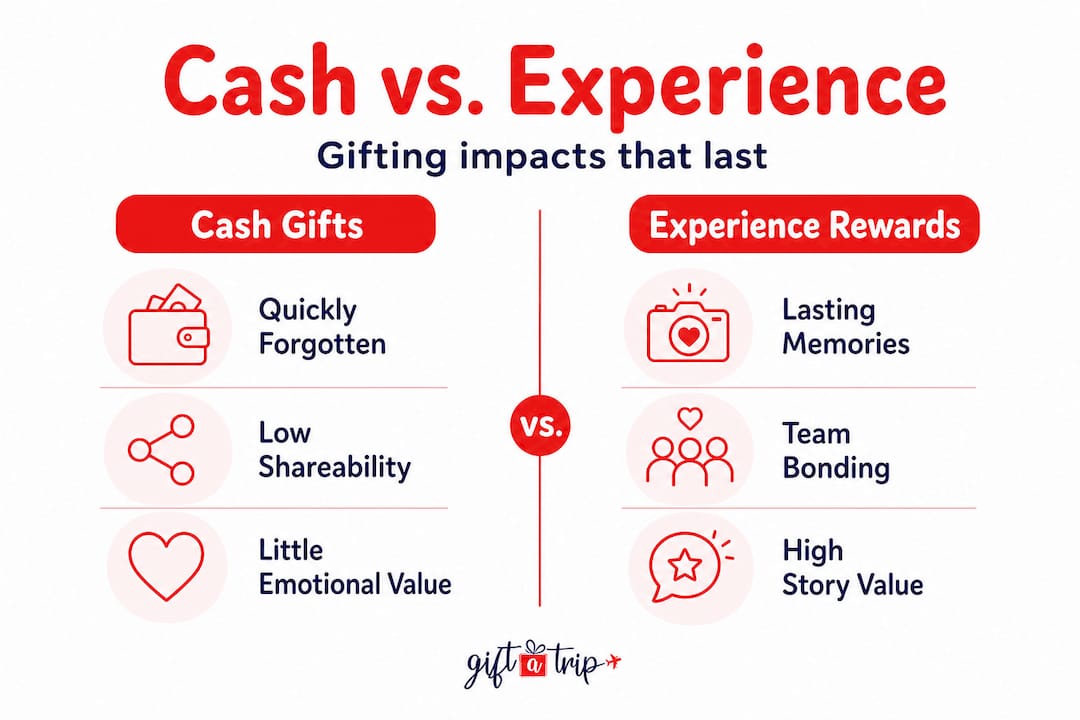
When someone receives money, the brain quickly incorporates it into baseline expectations. Salaries and bonuses become entitlements over time, and any reduction feels like a loss. Experiences, particularly travel, do not follow this pattern. They produce memories that employees associate with their employer, their team, and their own achievement. The emotional return on investment extends well beyond the experience itself.
Experiential gifting is now viewed as performance-relevant by top organizations, not merely a perk to offer once a year. That reframing is critical. When leadership treats a travel reward as a serious tool tied to business outcomes, employees respond in kind.
Compare the four main business gift categories side by side:
| Gift type | Perceived value | Memorability | Shareable? | Ties to company culture? |
|---|---|---|---|---|
| Cash | Moderate | Very low | No | No |
| Gift card | Low to moderate | Low | Rarely | No |
| Merchandise | Moderate | Moderate | Sometimes | Occasionally |
| Travel/experience | High | Very high | Yes | Yes, strongly |
Travel rewards win on nearly every dimension. They are shareable, which means the employee tells coworkers about the trip and extends the recognition moment. They are memorable, which means the emotional association with the employer lasts for years. They are also aspirational: many employees would not book a resort vacation or cruise for themselves, making the gift feel genuinely generous rather than transactional.
The concept of unique personalized travel also matters here. When employees can tailor their travel experience to their own preferences, the gift feels curated rather than generic. A family-friendly beach resort means something completely different to a parent of young children than to a recent graduate, and programs that offer flexibility accommodate both.
Key reasons to make travel a centerpiece of your rewards mix:
- Emotional intensity. Travel creates peak experiences that employees remember and associate with your recognition.
- Social amplification. Employees share vacation photos and stories, organically reinforcing your culture of recognition.
- Aspirational lift. Travel feels like a meaningful upgrade to everyday life, not something that disappears into a bank account.
- Inclusivity through flexibility. Digital travel certificates with minimal blackout dates and covered fees allow employees to travel on their own schedule.
Review travel vouchers for recognition to see how these can be structured for corporate programs of any size.
Proving impact: Measuring ROI of corporate gifting
Offering innovative travel gifts is only half the job. Now, let’s see how you ensure your program delivers measurable ROI. Without measurement, even the best-designed programs eventually lose executive support and budget.
The gold standard for measuring gifting ROI is a measurement-first approach. That means defining your goals before the program launches, identifying the behaviors you want to change, and establishing baselines against which you will compare results. ROI in incentive travel programs has been documented as high as 112.5% when causality is clearly established through pre and post comparisons or behavioral tracking.
Here is a reliable framework for measurement:
| Measurement phase | Key activity | Metric example |
|---|---|---|
| Pre-launch | Set baseline data | Current retention rate, absenteeism, NPS |
| During program | Track participation and engagement | Redemption rate, manager involvement |
| Post-program | Compare behavioral outcomes | Productivity change, turnover reduction |
| Long-term | Assess cultural and network effects | Referral rates, engagement scores |
A practical measurement sequence to follow:
- Set SMART goals before launch. Specific targets like “reduce voluntary turnover by 10% in 12 months” give you a real benchmark to evaluate against.
- Identify your causal chain. Map out why travel rewards should produce the outcome you want. This forces clarity and prevents vague program designs.
- Collect baseline data rigorously. Engagement scores, productivity metrics, and retention figures from the six months before launch are your control point.
- Track behavioral indicators during the program. Participation rates, manager involvement levels, and employee feedback surveys capture real-time signal.
- Report on outcomes against baselines post-program. Use a clear before-and-after comparison to demonstrate value to leadership.
Pro Tip: Don’t overlook soft ROI. Culture improvements, employer brand reputation, and referral rates are harder to quantify but can represent significant financial value. Build a narrative around both hard metrics and culture indicators when presenting to the C-suite.
The guidelines for travel incentives available for corporate programs offer a structured starting point for designing measurement-ready reward structures.
Common pitfalls in gifting and how to avoid them
Even the best-intentioned programs can backfire if not executed thoughtfully. Here’s what to watch out for.
The most dangerous failure mode is perceived unfairness. Because travel rewards create stronger emotion and memorability, they also increase the reputational and HR risk when employees perceive the program as unfair. Unclear eligibility criteria, inconsistent qualification standards, or inequitable access for remote and part-time workers can transform a morale-building initiative into a source of resentment.
Recognition that lacks customization and timeliness risks becoming a low-signal ritual rather than a genuine morale lever. When employees can predict exactly what they will receive and when, the emotional impact evaporates. Predictability is the enemy of delight.
Watch out for these specific pitfalls:
- Vague eligibility criteria. If employees cannot clearly explain who qualifies and why, the program will generate confusion and suspicion rather than motivation.
- Ignoring remote and hybrid workers. Programs built around in-office experiences or physical gifts automatically disadvantage distributed teams. Digital travel certificates eliminate this disparity.
- Skipping the measurement step. Programs without measurable goals get cut when budgets tighten. Always tie your gifting program to a business outcome.
- Delivery without context. A travel certificate sent via automated email without personal acknowledgment loses most of its emotional power. The delivery moment is part of the gift.
- One-size-fits-all reward choices. Offering a single travel destination or experience ignores the diversity of your workforce. Flexibility in redemption is essential.
Making your equitable travel gifting program accessible and transparent from the start is far easier than rebuilding trust after a program goes wrong.
“A gifting program perceived as unfair does more damage to morale than having no program at all. Fairness is not a feature. It is the foundation.”
A fresh perspective: What most companies miss about gifting and recognition
Most HR teams approach gifting as a program architecture problem. They focus on selecting reward types, setting budgets, building approval workflows, and tracking redemption. These are legitimate concerns, but they miss the deeper opportunity.
The companies that get the most from recognition programs are not the ones with the most sophisticated mechanics. They are the ones that understand a simple truth: the goal is not to give a reward. The goal is to create a shared memory that binds employees to each other and to the organization.
When a sales team earns a group travel experience, the value is not just the trip. It is the planning conversations, the shared anticipation, the inside jokes from the trip that surface in team meetings for years afterward. Case studies in travel rewards consistently show that the relational and cultural return from experiential rewards dwarfs the monetary cost.
Most measurement approaches also fall short because they focus exclusively on cost and output. They ask: “What did we spend, and did productivity go up?” They rarely ask: “Did this program change how employees feel about working here? Did it generate stories that attract other talented people? Did it build the kind of team culture that performs under pressure?”
The companies that use gifting as a culture-building tool rather than a compensation substitute are the ones that see outsized results. The shift is subtle but fundamental. Move from “we reward performance” to “we create experiences that define who we are as a team.” That reframe changes everything from program design to how leaders communicate about rewards.
Ready to inspire your team? Next steps for modern business gifting
After exploring strategies and pitfalls, here are effective solutions to launch or upgrade your business gifting approach.
The research is clear: experiential and travel rewards outperform cash on every dimension that matters for sustained engagement. The question is not whether to include them in your recognition mix. The question is how to do it efficiently, equitably, and with maximum emotional impact.
Gift A Trip makes this straightforward for corporate teams of any size. Our corporate gifting solutions include digital travel certificates redeemable at major resorts, hotels, cruise lines, and vacation packages, with taxes and resort fees covered and minimal blackout dates. You can explore unique travel gift ideas curated for recognition programs, and our gifting guide for memorable rewards walks you through building a program your employees will genuinely look forward to. Customizable gift boxes, personalized messaging, and bulk ordering options mean you can scale from a single milestone recognition to a full corporate incentive program without sacrificing quality or personal touch.
Frequently asked questions
What is the biggest benefit of gifting travel instead of cash rewards?
Travel rewards create stronger emotion and long-lasting team memories, leading to higher engagement and morale that persists well beyond the reward itself, unlike cash that quickly becomes invisible in everyday spending.
How do you ensure a gifting program is fair for all employees?
Set transparent eligibility criteria from day one, communicate them clearly to all staff, and choose reward formats like digital travel certificates that give remote and hybrid employees equal access. Clear qualification criteria are essential for program credibility.
When is the best time to give a business gift?
Recognition is most effective when it is timely, delivered right after an achievement, milestone, or clear demonstration of company values. Recognition rewards work best when they are customized and delivered close to the triggering event.
Can business gifting programs really drive measurable ROI?
Yes, measurement-first approaches using goal-setting, behavioral comparisons, and pre and post analysis have demonstrated ROI above 112.5% when programs are properly designed and tracked from the outset.
What makes a corporate gifting program stand out?
Programs that combine personalization, timely delivery, and memorable travel experiences consistently outperform generic alternatives. Gifts should feel personal by offering curated choices, and recognition moments are most powerful when senior leaders are directly involved in the delivery.