Jump to Section:
TL;DR:
- Travel gifting creates lasting memories and enhances motivation better than cash or merchandise.
- Effective programs require careful planning, proper documentation, and compliance with tax regulations.
- Communicating the value and offering employee choice increases engagement and program success.
Generic gift cards and branded mugs rarely move the needle on employee motivation. Travel gifting is different. Incentive travel increases individual performance by 22%, with sales teams seeing a 3:1 ROI per dollar spent. For HR and sales managers who need measurable results, that’s not a small number. This guide walks you through exactly how to build, launch, and manage an employee travel gifting program, covering the right tools, step-by-step delivery, tax compliance, and how to track whether it’s actually working.
Table of Contents
- What is employee travel gifting and why does it work?
- What you need to set up an employee travel gifting program
- Step-by-step: How to gift employee travel effectively
- Compliance, taxes, and tracking: Avoid pitfalls and measure ROI
- A fresh perspective: What most guides miss about travel gifting
- Ready to elevate your team’s motivation with travel rewards?
- Frequently asked questions
Key Takeaways
| Point | Details |
|---|---|
| Boost team performance | Employee travel gifts drive 22% improved performance and exceptional ROI. |
| Plan and comply | Set clear policies, follow IRS rules, and document for tax and HR compliance. |
| Deliver meaningful experiences | Thoughtful presentation and support make travel rewards memorable and impactful. |
| Track what matters | Measure feedback, retention, and productivity to maximize program success. |
What is employee travel gifting and why does it work?
Employee travel gifting means rewarding staff with travel experiences instead of cash bonuses or physical merchandise. The reward can take several forms, each suited to different budgets and recognition moments.
Common formats include:
- Travel certificates: Digital or printed documents redeemable for hotel stays, resort packages, or cruise lines
- Vacation gift cards: Preloaded value toward flights, accommodations, or bundled packages
- Cruise vouchers: Dedicated credits for cruise line bookings, often including cabin upgrades
- Curated travel packages: Full itineraries bundled with accommodations, activities, and sometimes airfare
The reason travel gifts outperform cash is rooted in psychology. Cash gets absorbed into everyday spending and forgotten within days. A trip to a beach resort or a mountain retreat creates a memory that lasts for years and gets talked about at team meetings. That storytelling effect reinforces the culture you’re trying to build.
Companies choose travel gifting for three core reasons: it drives motivation before the reward is received (anticipation is a powerful motivator), it builds loyalty by signaling that the company invests meaningfully in people, and it reduces turnover by creating emotional anchors to the workplace.
“94% of top-performing companies find incentive travel programs effective.”
That figure from the IRF 2026 Trends Report isn’t surprising once you understand the mechanism. Travel rewards activate a different part of an employee’s decision-making than a paycheck adjustment. They feel personal, not transactional.
| Reward type | Memorability | Perceived value | Retention impact |
|---|---|---|---|
| Cash bonus | Low | Moderate | Low |
| Merchandise | Moderate | Low to moderate | Low |
| Travel certificate | High | High | High |
| Experiential package | Very high | Very high | Very high |
For tips for impactful recognition, the data consistently points toward experiences over things. If you want employees to feel genuinely valued, a travel certificate sends a message that a gift card to a coffee chain simply cannot. Our voucher reward program guide breaks down which formats work best for different team sizes and occasions.
What you need to set up an employee travel gifting program
With an understanding of why travel gifting is powerful, here’s how to prepare your organization to roll it out smoothly.
The average per-person spend on incentive travel runs between $5,100 and $5,821, which means this isn’t an impulse purchase. It requires planning, the right vendor relationships, and internal policies that protect both the company and the employee.
Tools you’ll need:
- A travel certificate platform or provider with bulk ordering capability
- A digital delivery system for secure, trackable distribution
- A concierge or booking support service for employees who need help redeeming
- Internal documentation templates for approvals and tax records
Company policy checklist:
- Define eligibility criteria (tenure, performance thresholds, role level)
- Set approval workflows so managers can nominate without bottlenecks
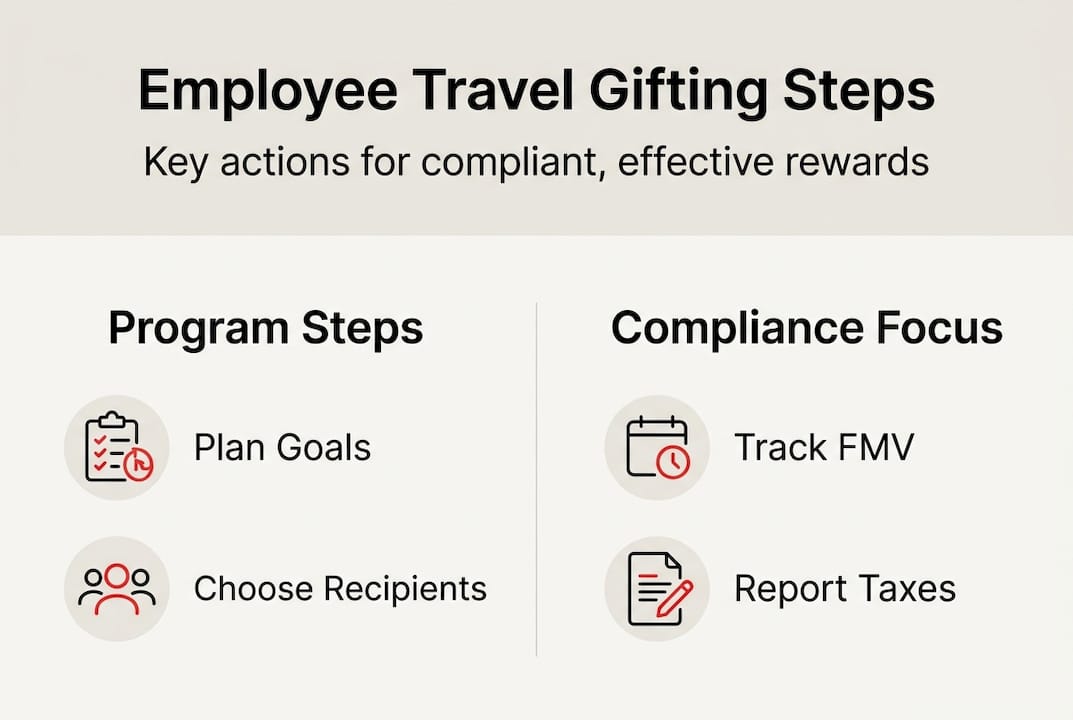
- Establish documentation requirements for fair market value (FMV) reporting
- Decide whether the company will gross-up taxes on behalf of the employee
On the tax side, IRS business travel rules require that travel rewards given purely as compensation are treated as taxable income. You’ll need to document the FMV of any certificate or package issued. The gross-up option, where the company covers the employee’s tax liability on the reward, is increasingly popular because it removes the sting of receiving a gift and then owing taxes on it.

| Setup element | DIY approach | Platform-supported approach |
|---|---|---|
| FMV documentation | Manual, time-consuming | Automated by provider |
| Bulk ordering | Complex logistics | Streamlined with gift boxes |
| Tax compliance | Requires HR/legal review | Provider-supplied documentation |
| Employee booking support | Internal coordination | Concierge service included |
For individual incentive travel programs, using a platform that handles FMV documentation and bulk customization saves your HR team significant time. Explore travel gift package options to match the right format to your recognition goals, and review our corporate certificate guide for a full breakdown of what to include in your policy.
Pro Tip: Always partner with providers who supply FMV documentation as part of the service. It protects your company during audits and removes a major administrative burden from your HR team.
Step-by-step: How to gift employee travel effectively
Now that you have your tools and basics in order, let’s walk through the step-by-step process for delivering travel rewards.
-
Identify qualifying employees and occasions. Define the trigger events: hitting a sales quota, completing a major project, reaching a service anniversary, or winning a peer-nominated award. Be specific. Vague eligibility creates confusion and resentment.
-
Choose the right gift type. Match the reward to the achievement. A weekend resort certificate fits a quarterly performance win. A full cruise package is appropriate for a top annual performer. A flexible travel card works well for milestone anniversaries where personal preference matters most.
-
Prepare the presentation. Timing and delivery matter as much as the gift itself. Present travel rewards publicly when the culture supports it, or privately when the employee prefers discretion. A personalized message explaining why the employee is being recognized doubles the emotional impact.
-
Provide booking support. Don’t just hand over a certificate and disappear. Make sure employees know exactly how to redeem it, who to contact for help, and what’s included. Concierge support reduces friction and increases the likelihood that the reward actually gets used.
-
Follow up after the experience. This step gets skipped constantly, and it’s a mistake. A short post-trip survey captures feedback, generates testimonials, and gives you the data you need to prove program ROI to leadership.
For a deeper look at structuring rewards by team type, the corporate gifting guide covers formats for both individual and group recognition. Our travel incentives guide also outlines how leading companies structure tiered reward systems.
Top programs yield $4 productivity for every $1 invested in incentive travel. That return depends on executing the delivery well, not just purchasing the certificate.
Pro Tip: Survey employees six to eight weeks after their trip, not immediately after. That’s when the lasting impact of the experience becomes clearest in their responses.
Compliance, taxes, and tracking: Avoid pitfalls and measure ROI
Even the best gift can backfire if tax, compliance, or measurement steps are missed. Here’s how to keep your program out of trouble.
In the United States, travel rewards given to employees as recognition for performance are treated as taxable compensation. There’s no de minimis exclusion for travel certificates the way there is for low-value items like a company pen. The IRS requires you to report the FMV of the reward as part of the employee’s W-2 income.
Per IRS Pub 463, to minimize tax exposure, structure more than 50% of a trip as business activity. Pure performance rewards remain fully taxable regardless of structure.
For international programs, tax treatment varies significantly by country. Always consult local tax counsel before issuing travel rewards to employees outside the US.
Key compliance steps:
- Document the FMV of every certificate or package at the time of issuance
- Report travel rewards on employee W-2 forms under wages
- Decide on a gross-up policy and communicate it clearly before issuing rewards
- Keep records for at least three years in case of audit
- Use platforms that generate automatic FMV documentation to reduce manual work
Tracking ROI:
| Metric | How to measure | When to measure |
|---|---|---|
| Employee performance | Pre/post KPI comparison | 30 and 90 days post-reward |
| Retention rate | Turnover data by cohort | 6 and 12 months post-program |
| Engagement score | Pulse surveys | Quarterly |
| Program satisfaction | Post-trip survey | 6 to 8 weeks after travel |
The IRF 2026 Trends Report recommends pairing concierge support with transparent tax communication and measuring outcomes through pre/post surveys and turnover metrics. That combination gives you both the compliance coverage and the performance data your leadership team needs. For flexible employee incentives that simplify compliance tracking, look for platforms that bundle documentation with delivery.
A fresh perspective: What most guides miss about travel gifting
Most HR guides treat travel gifting as a big-budget luxury. That framing keeps mid-sized companies on the sidelines, and it’s wrong.
The real power of a travel certificate isn’t the dollar amount. It’s the specificity of the gesture. A $500 resort certificate feels more meaningful than a $500 cash deposit because it says, “We thought about what would make you feel celebrated.” That intentionality is what drives the retention and engagement numbers, not the price tag.
Smaller teams can absolutely run effective travel gifting programs by starting with one or two certificate tiers and scaling based on results. A weekend getaway for a top quarterly performer costs far less than replacing that employee if they leave.
The other piece most guides skip is communication. The gift itself is only half the equation. How you announce it, what you say in the accompanying message, and whether you follow up afterward determines whether the employee tells the story for years or forgets it by next quarter. Flexibility matters too. Giving employees some choice in destination or timing dramatically increases perceived value without increasing cost. For more travel gifting insights, we regularly share case studies and program frameworks from companies of all sizes.
Ready to elevate your team’s motivation with travel rewards?
If you’re inspired to start, here are the easiest ways to get your employee travel rewards program off the ground.
Gift A Trip makes it straightforward to launch or scale a travel gifting program, whether you’re rewarding one top performer or building a company-wide incentive structure. Our strategic corporate gifting guide walks through how to align certificates with your recognition goals.
With flexible gift solutions that cover taxes and resort fees, minimal blackout dates, and secure digital delivery, we remove the friction that stops most programs from launching. Browse and shop for travel certificates to find the right option for your team today.
Frequently asked questions
Are employee travel gifts taxable?
Yes, most travel gifts are taxable as employee compensation unless structured to qualify as a business activity under IRS rules. Gross-up policies can help offset the tax burden for employees.
What is the best way to present a travel gift to an employee?
Use a personalized certificate or gift card and clearly communicate the details, timing, and booking support available. The message explaining why the employee earned the reward matters as much as the gift itself.
How much should a company budget for employee travel rewards?
Most companies spend between $5,100 and $5,821 per person for incentive travel programs, though smaller certificate-based programs can start at a fraction of that cost.
How can ROI be measured for an employee travel gifting program?
Track pre- and post-program surveys, employee retention rates, and performance metrics to measure ROI. The IRF recommends pairing turnover data with pulse surveys for the most accurate picture.