
Travel prize fulfillment works when three pillars hold together: logistics, compliance, and the winner experience. Miss any one and you get stranded winners, tax exposure, or a state regulator asking why you never filed a bond. The immediate next step is simple: build a checklist against all three pillars before you launch, or bring in a fulfillment partner who already has one.
TL;DR:
- Ensuring travel prize fulfillment depends on effectively managing logistics, compliance, and winner communication, with neglecting any pillar risking support failures.
- Booking and confirming inventory early, aligning the full itinerary, and deciding upfront who pays help prevent booking errors and delays.
- Compliance obligations include detailed rules, state registration thresholds, tax reporting, and proper documentation like affidavits and vendor agreements to avoid legal issues.
- Prompt, multi-channel winner notification and clear documentation requests are critical for a smooth experience and to reduce unclaimed prize rates.
- Using digital travel certificates can significantly reduce fulfillment complexity by covering taxes and fees upfront and simplifying supplier coordination.
Table of Contents
- What Is Travel Prize Fulfillment, Exactly?
- Operational Logistics Checklist for Travel Prizes
- What Legal Documents Do You Need Before Awarding a Trip?
- How Do You Deliver a Smooth Winner Experience?
- Should You Handle Fulfillment In-House or Hire a Specialist?
- How Gift a Trip’s Certificate Model Reduces Fulfillment Friction
- What Running These Promotions Actually Teaches You
- Gift A Trip: Fulfillment Without the Compliance Headache
- Where to Go Next for Compliance and Operations Guidance
- Sources
- FAQ
What Is Travel Prize Fulfillment, Exactly?
Travel prize fulfillment is the operational and legal work of turning a sweepstakes announcement into an actual trip a winner takes without friction. It splits into three interlocking pillars, and coordinating them is what separates a clean promotion from a support nightmare.
- Logistics: sourcing the trip, booking flights and hotels, managing transfers, seats, and baggage.
- Compliance: official rules, tax reporting, state registration, contracts, and releases.
- Winner experience: notification, documentation collection, concierge support, and backup plans if a winner never claims the prize.
Neglect logistics and a winner shows up to a sold-out resort during blackout dates nobody checked. Neglect compliance and you’re issuing a five-figure prize without a signed W-9, which becomes your tax problem, not the winner’s. Effective fulfillment depends on managing all three together, because a breakdown in one pillar almost always creates a visible failure in another.
Operational Logistics Checklist for Travel Prizes
Booking a prize trip is nothing like booking your own vacation. You’re working against claim deadlines, blackout calendars, and a winner who may have never flown business class or dealt with a connecting international itinerary. Here’s the sequence that keeps it clean:
- Source and confirm inventory early. Lock rates and room blocks with the resort, cruise line, or airline before you announce the prize publicly, not after.
- Set a realistic booking window. Give yourself a few weeks between winner confirmation and travel dates for visas, passport checks, and supplier scheduling.
- Align the full itinerary. Confirm flight connections, hotel check-in and check-out windows, ground transfers, and seat and baggage allowances as one package, not separate bookings that might not line up.
- Decide who pays upfront. Sponsor-paid bookings or prepaid certificates beat reimbursement models every time; a winner fronting airfare and waiting for a check often experiences the prize as more work than reward.
- Build your communication templates now. A winner briefing document, a supplier contact list, and a day-of-travel checklist should exist before you need them, not get drafted in a panic the week of departure.
Pro Tip: Keep one shared document listing every supplier’s after-hours emergency line. When a flight gets canceled at 9 p.m. on a Friday, you don’t want to be searching for a customer service number while your winner sits in an airport.
Structuring the package itself matters too. Vendors who specialize in flexible entertainment and event packages know that rigid, single-supplier bookings break more often than modular ones with backup options built in.

What Legal Documents Do You Need Before Awarding a Trip?
This is where most promotions teams underestimate the workload. Compliance for travel prizes touches tax law, state registration statutes, and contract law simultaneously, and getting it wrong is expensive in a way logistics mistakes usually aren’t.
Official rules need to itemize every component of the prize, not just its headline value. List the airfare class, resort fees, transfers, gratuities, and any exclusions, plus the Approximate Retail Value (ARV), blackout dates, the number of eligible travelers, and the claim deadline. Vague rules language is what turns a disappointed winner into a legal complaint. Legal guidance on sweepstakes drafting treats precise ARV calculation as the foundation for both tax and registration decisions downstream.
State registration and bonding kick in above certain thresholds. New York and Florida require registration and bonding for prize pools exceeding certain dollar thresholds, and Rhode Island’s threshold is lower., so build filing deadlines into your launch calendar, not your post-launch scramble.
Tax reporting is non-negotiable once a prize crosses IRS thresholds. Sponsors must collect W-9 information and file 1099 forms before releasing prizes that meet reporting value, and this gets more complicated if a winner claims prizes across multiple promotions in the same year.
Here’s a detail most teams miss entirely: unclaimed and undelivered travel prizes carry state-specific closure requirements, meaning your compliance work doesn’t end at prize delivery.
Required paperwork should include:
- Affidavit of eligibility and liability release
- Publicity release (if you plan to use the winner’s name or image)
- Data processing agreement when winner PII passes to airlines, hotels, or a fulfillment vendor
- Vendor and prize-provider agreements with indemnity clauses
Sponsors should have official rules, vendor agreements, prize-provider agreements, and DPAs finalized before launch, and counsel should review state-filing obligations and contract indemnity language rather than relying on templates alone. Review the full framework in this travel sweepstakes rules compliance guide before you draft anything.
How Do You Deliver a Smooth Winner Experience?
Notification timing sets the tone for everything after it. Prompt and clear notification helps start the winner relationship positively.
- Notify quickly and through multiple channels. Phone plus email, with a defined claim window (commonly 7 to 14 days), keeps momentum and creates a paper trail.
- Bundle the documentation ask. Send the affidavit, W-9, and release together in one workflow rather than three separate follow-ups. Folding W-9 collection into the affidavit step keeps tax paperwork from delaying the actual trip.
- Assign concierge tasks clearly. Sponsors or their fulfillment partner should handle booking, confirmations, and supplier changes; the winner’s job is providing accurate travel dates and documentation, nothing more.
- Plan for no-response. Travel prizes see higher unclaimed rates than typical merchandise prizes, so a pre-defined alternate-winner process and a document retention schedule aren’t optional extras. Prize indemnity insurance, commonly arranged through fulfillment partners for high-value travel prizes, covers you if a claim dispute arises after delivery.
Our guide on running a travel giveaway that actually works walks through the notification sequence in more detail.
Should You Handle Fulfillment In-House or Hire a Specialist?
The honest answer depends on three factors: prize value, your team’s legal bandwidth, and how many trips you’re giving away in a year. A single $2,000 weekend getaway with low entry volume is manageable internally. A multi-market sweepstakes offering five international trips with a $150,000 total ARV is a different animal, and the state filing and tax reporting alone can consume a full-time coordinator’s month.
Run any prospective vendor through this checklist:
- Can they handle state registration and bonding filings, not just advise on them?
- Do they manage 1099 reporting and W-9 collection as part of the service, or hand it back to you?
- What are their logistics SLAs for booking confirmation and supplier changes?
- Do they carry or arrange prize indemnity insurance?
- How do they handle alternate-winner selection and unclaimed-prize timelines contractually?
Pro Tip: Ask any vendor for their data processing agreement before you sign anything else. If they can’t produce one quickly, that’s a signal their compliance program is thinner than their sales pitch.
Weigh this against the business case for travel promotions before deciding, since the return on a well-run travel prize often justifies the added coordination cost.
How Gift a Trip’s Certificate Model Reduces Fulfillment Friction
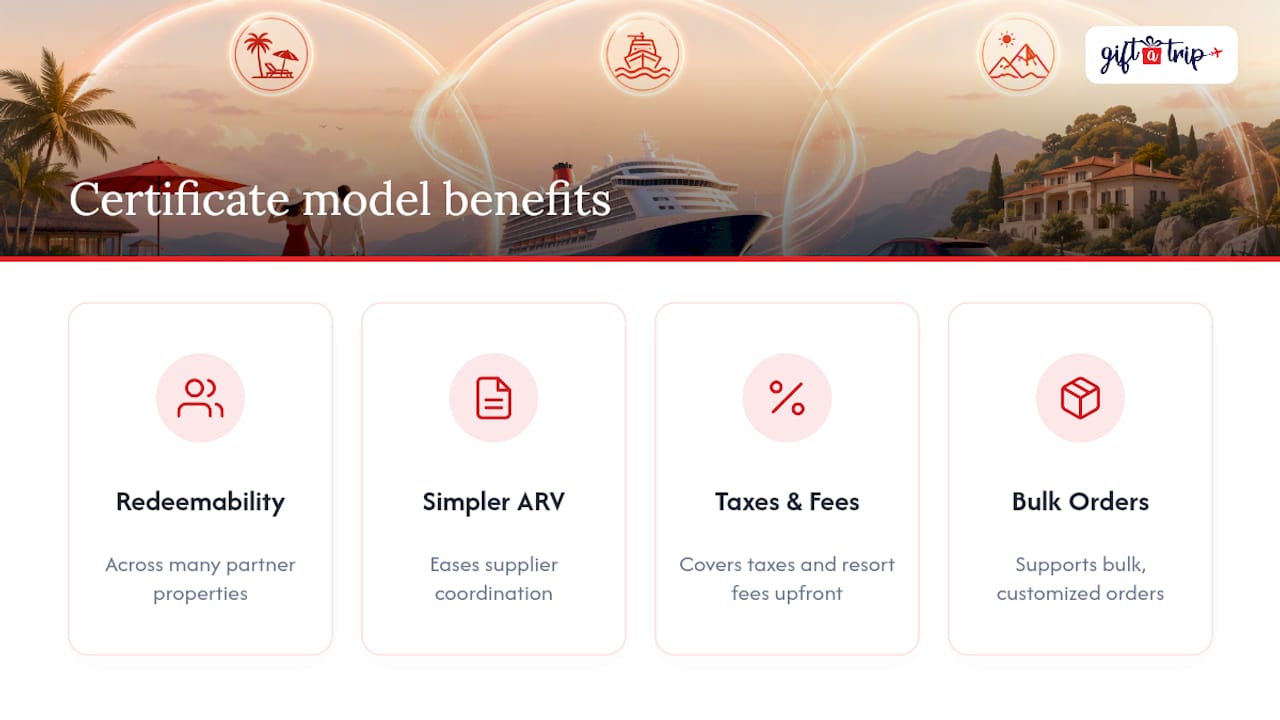
Digital travel certificates sidestep a lot of this complexity. Because a certificate is redeemable across many partner properties rather than tied to one fixed itinerary, publishing ARV and coordinating suppliers gets simpler, not harder. Gift A Trip certificates cover taxes and resort fees upfront, deliver securely and instantly, and support bulk, customized orders for large-scale promotions and corporate events, which removes a meaningful chunk of the logistics and tax burden described above.
What Running These Promotions Actually Teaches You
The lesson that repeats across every travel giveaway is that the three pillars fail together, not separately. A compliance gap almost always shows up first as a logistics headache, because nobody caught the missing paperwork until the winner was already trying to book.
Two things to do immediately: build your compliance checklist before you draft the promotion copy, and decide your alternate-winner policy before you need it, not after a winner goes silent.
— Donovan
Gift A Trip: Fulfillment Without the Compliance Headache
Running a sweepstakes with a high-value trip attached means juggling supplier calendars, tax forms, and state filings all at once. A digital travel certificate that is redeemable at resorts, hotels, and cruise lines, already loaded with taxes and fees covered, and delivered securely the moment you need it can remove a chunk of that load by replacing the multi-vendor booking chain.
That structure maps directly to the decision criteria covered above: less supplier coordination, simpler ARV disclosure, and no winner chasing reimbursement for a flight they booked themselves. For teams running employee rewards, sales incentives, or event prizing at scale, some providers support bulk and custom-branded orders so a hundred certificates go out as smoothly as one. Check our travel certificate distribution guide for HR and events to see how bulk delivery works, or head straight to Gift A Trip’s certificate shop to price out your next promotion.
Where to Go Next for Compliance and Operations Guidance
Start with the 2026 Sweepstakes & Promotions Compliance Guide for tax filing steps, then read contract essentials for promotional sweepstakes for vendor agreement language.
Sources
- 2026 Sweepstakes & Promotions Compliance Guide
- Contracts corner: play rules when advising promotional sweepstakes
- Promotion, prizing, and fulfillment (Brandmovers)
FAQ
What Is Travel Prize Fulfillment?
Travel prize fulfillment is the combined process of booking, legally documenting, and delivering a travel-based prize to a sweepstakes or contest winner, covering logistics, compliance, and winner communication.
Do I Need to Register My Sweepstakes With a State?
Registration and bonding requirements apply in certain states, including New York and Florida above specific prize-value thresholds and Rhode Island at a lower threshold, so check your total prize pool against each state’s rules before launch.
When Do I Need to Collect a W-9 From a Winner?
Collect a W-9 as part of the affidavit and release package before you release a prize that meets IRS 1099 reporting thresholds, so tax paperwork doesn’t delay the trip itself.
What Happens if a Travel Prize Winner Never Claims It?
You need a pre-defined alternate-winner process, since travel prizes see higher unclaimed rates than standard merchandise prizes, and your official rules should specify the claim deadline that triggers it.
Can Digital Travel Certificates Simplify Fulfillment?
Yes. A digital certificate redeemable across multiple partner properties, like those offered through Gift A Trip, simplifies ARV disclosure and reduces the supplier coordination that traditional single-itinerary prizes require.