
For memorable gifts and high-impact employee rewards, multi-brand travel certificates usually outperform brand gift cards; for last-minute or cash-like flexibility, network or single-brand gift cards win. The right pick depends on how much choice the recipient needs, how soon they need to use it, and whether you are buying for one person or managing a reward program.
TL;DR:
- Choose a travel certificate only when the recipient wants to travel and can plan; tight schedules or little interest make a card more practical.
- For gifts needed immediately, network cards offer spending close to cash, while single brand cards work best when you know the recipient’s preferred retailer.
- Federal rules protect gift card funds for at least five years after purchase or last load, with inactivity fees restricted until 12 months of nonuse.
- Corporate buyers should confirm written fee and expiration terms, delivery timing, and reconciliation reporting; compare total redemption cost, not just face value.
Table of Contents
- Multi-brand travel certificates vs brand gift cards at a glance
- Why multi-brand travel certificates often win for memorable gifting
- When brand gift cards are still the right call
- What US buyers should know about fees, expiration, and disclosures
- How to choose between a travel certificate and a gift card
- How our travel certificates fit into this comparison
- The bottom line and your next move
- Why the “safe” gift card default deserves more scrutiny
- Ready to send a travel certificate instead of another gift card
- FAQ
- Sources
Multi-brand travel certificates vs brand gift cards at a glance
The two formats solve different problems, and a quick scan makes the trade-offs obvious.
- Delivery: travel certificates typically ship as a digital code with an optional branded physical box; brand gift cards come as plastic, digital codes, or both, often available same-day in stores.
- Redemption scope: multi-brand certificates work across a curated list of resorts, cruise lines, and hotel groups, while a single-brand card locks spend to one retailer and a network-branded card (Visa, Mastercard, Amex gift cards) spends almost anywhere.
- Emotional impact: experiential certificates tend to land as a bigger, more memorable gift than a card balance, especially for milestones.
- Fees and expiration: both formats fall under the same federal floor on validity and dormancy fees, but how taxes and resort fees are handled varies by provider.
- Admin burden: corporate buyers need bulk ordering, reconciliation, and breakage reporting, features that vary widely between a basic retail gift card program and a dedicated travel certificate platform.
None of these differences make one format universally better. A sales team recognition award and a last-minute coworker gift call for different tools, and the checklist below helps match the tool to the job.
Why multi-brand travel certificates often win for memorable gifting
A travel certificate asks a recipient to do something, not just spend something, and that difference drives how the gift feels. Recipients tend to value experiences they get to choose and plan for over a static balance sitting in an account, which is why travel-based rewards show up so often in milestone gifting and incentive programs.
The practical advantages stack up:
- Choice across categories: a single certificate can cover cruises, resort stays, hotels, or golf and spa getaways instead of locking the recipient into one brand.
- Fewer redemption surprises: certificates that include taxes and resort fees up front remove the most common complaint about travel gifts: hidden costs at checkout.
- Minimal blackout dates: broader availability windows mean recipients are not fighting for a handful of open weekends.
- Corporate tracking: bulk ordering, branded delivery, and reconciliation reporting let HR and incentive teams manage hundreds of certificates the way they would manage any other reward line item.
Pro Tip: Pair a digital certificate with a printed or boxed presentation for in-person events; the physical unboxing moment often matters as much as the trip itself.
The limitation is real too: a certificate only works for someone who actually wants to travel and has the flexibility to plan a trip, so it is a poor fit for recipients with tight schedules or no interest in a getaway.
When brand gift cards are still the right call
Brand and network gift cards earn their place because they ask nothing of the recipient except to spend. There is no itinerary to plan and no redemption window to track beyond the card’s own terms, which makes them the fastest gift to use and the easiest to explain.
- Immediate liquidity: a network-branded card (Visa, Mastercard) functions close to cash and works at nearly any merchant that takes the network.
- Zero learning curve: recipients already know how to use a gift card, unlike a travel certificate that requires booking steps.
- Targeted spend: a single-brand card makes sense when you know exactly where the recipient shops or stays.
- Fast turnaround: for last-minute gifting, a retail or e-gift card can be purchased and delivered in minutes.
The downside is a mismatch risk: a card for a retailer the recipient never visits, or a card for a chain that closes a location, leaves value stranded. Surveys of consumer complaints back this up, and the FTC’s gift card guidance specifically warns buyers to check a retailer’s financial health before purchasing, since funds can become harder to redeem if a merchant closes. Gift cards also tend to register as a lower-effort, lower-emotional-impact gift compared with an experience.
What US buyers should know about fees, expiration, and disclosures
Federal rules set a floor that applies to most gift cards and gift certificates sold in the United States, and knowing them prevents two common mistakes: assuming a card expires fast, or assuming a provider can charge fees freely.
Under CFPB guidance, gift card funds must stay valid for at least five years from the purchase or last load date, and inactivity fees can only be charged after 12 months of no use, and only under specific conditions. The CFPB’s Regulation E commentary also defines the categories that matter for your purchase: store gift cards, gift certificates, and general-use prepaid cards each carry different exemptions and disclosure requirements.
Practical checklist before you buy:
- Ask whether the certificate or card discloses fees and expiration terms in writing at the point of sale.
- Confirm which category the instrument falls into, since that determines which protections apply.
- For corporate orders, request reconciliation reporting so unredeemed value does not become unaccounted budget loss.
One industry outlook notes that gift cards and merchandise remain a leading corporate reward in North American and European programs, with growing interest in multi-merchant and travel-specific certificates that give recipients more say in how they redeem.
How to choose between a travel certificate and a gift card
- Define the outcome you want. A memorable, talked-about gift points toward a travel certificate; pure spend flexibility points toward a card.
- Assess the recipient’s fit. Check travel interest, likely timing, and any constraints like young kids or inflexible work schedules.
- Check operational filters. Bulk ordering, tracking dashboards, included taxes and fees, and breakage reporting matter more as order volume grows.
- Compare total cost, not face value. A $200 certificate that covers taxes and resort fees can beat a $250 card that leaves the recipient paying extras at redemption.
- Ask providers direct questions. Confirm delivery timing, blackout dates, refund policy, and how reconciliation and unredeemed-value reporting work before signing a contract.
Pro Tip: For corporate orders, request the reconciliation terms in writing before purchase: it is the single detail most likely to prevent a budget surprise later.
How our travel certificates fit into this comparison
We built our offering around the gap this comparison keeps surfacing: buyers want the emotional payoff of a travel gift with an easy redemption process. Our digital travel certificates cover resorts, hotels, cruise lines, and vacation packages, and our Flex Trip Collections give recipients a curated set of options instead of locking them into one brand.
For buyers who need scale, our corporate gifting services include custom trip selection sites, airfare vouchers, and custom flex trip collections built for bulk orders. We also offer:
- Secure digital delivery with optional branded gift box delivery for in-person events.
- Personalized messaging for individual gifts and milestone occasions.
- Pricing that covers taxes and resort fees, with minimal blackout dates, to match the fee clarity buyers should expect under the protections above.
These features map directly to the operational filters in the checklist above: inclusions that reduce redemption friction, and delivery options that support both one-off gifts and large reward programs.
The bottom line and your next move
For a single memorable gift or a corporate reward meant to feel like recognition, a multi-brand travel certificate is the stronger pick; for fast, no-questions-asked spending power, a brand or network gift card still wins. An individual buying a honeymoon or anniversary gift should lean toward a travel certificate, while a manager handing out a same-day thank-you gift should lean toward a card.
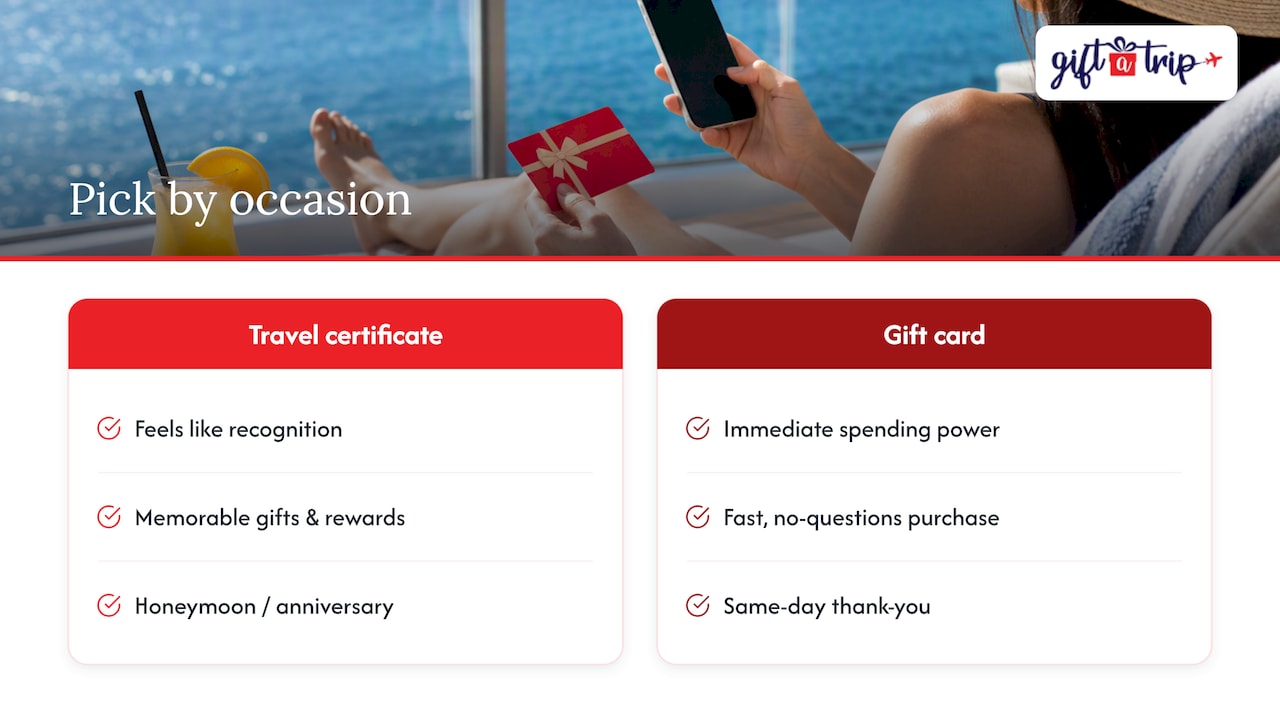
Next steps: pick the certificate type that matches the occasion, ask any provider the delivery and reconciliation questions above, and set up tracking before you place a bulk order.
Why the “safe” gift card default deserves more scrutiny
The conventional advice treats gift cards as the safe, default choice because they are easy to buy and hard to get wrong. That advice undersells how often a card balance just sits unused, quietly becoming the kind of unredeemed value that corporate programs end up writing off. A travel certificate asks more of the recipient upfront, but that extra step is exactly why it tends to get used and remembered rather than forgotten in a drawer.
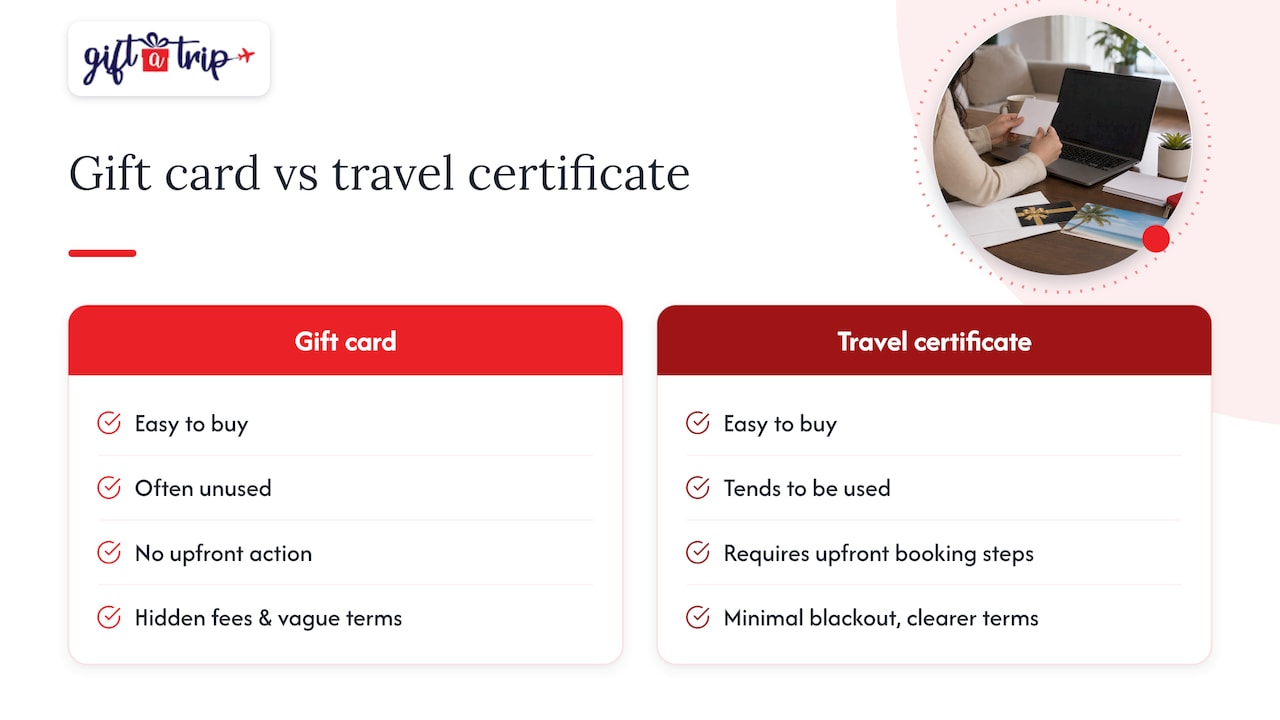
What is overrated here is face value as a proxy for generosity. A card with a bigger number on it means little if the recipient never gets around to spending it or if hidden costs eat into redemption. What matters more is whether the gift removes friction: included fees, minimal blackout dates, and clear reconciliation terms do more for the recipient’s actual experience than a larger balance with vague terms.
If you take one thing from this comparison, prioritize the redemption experience over the sticker price, and verify fee and expiration disclosures before you buy rather than after a recipient complains.
— Donovan
Ready to send a travel certificate instead of another gift card
We make it simple to turn this comparison into an actual gift: choose from resorts, hotels, cruise lines, and vacation packages, and we cover taxes and resort fees so recipients are not stuck with surprise costs at checkout.

For one-off personal gifts, our individual travel certificates let you pick a brand category and add a personal message in minutes. For HR teams and incentive program managers, our corporate gifting page covers bulk ordering, custom branded gift boxes, and the trip selection sites that make distributing dozens or hundreds of certificates manageable. If a cruise is the better fit for your recipient, our Royal Caribbean certificates and golf and spa resort certificates are both available to browse directly. Start by choosing a certificate type that matches your recipient’s interests, then check delivery timing against your gifting date.
FAQ
Can I buy a gift card for someone in another country?
It depends on the issuer: many US retail and network gift cards are restricted to domestic use, while some network-branded cards and travel certificates work internationally if the underlying brand operates there. Always confirm cross-border redemption with the specific provider before buying, since terms vary by issuer rather than by card type alone.
What’s the difference between a gift card and a merchandise card?
A gift card is typically redeemable for a range of goods or services at one retailer or a group of affiliated merchants, while a merchandise credit or card is often issued as a refund or goodwill credit rather than purchased outright. The CFPB’s definitions distinguish these categories because they carry different disclosure and fee rules.
What are the different types of gift cards?
The main categories are single-merchant store cards, cards usable across an affiliated group of brands, and general-use network-branded prepaid cards that work almost anywhere a card network is accepted. Multi-brand travel certificates function similarly to the affiliated-group category but focus specifically on travel redemption across resorts, hotels, and cruise lines.
What retailer has the best selection of gift cards?
There is no single retailer with a universally “best” selection, since the right choice depends on the recipient’s interests and whether you want retail spend or a travel experience. For travel-focused gifting specifically, a multi-brand travel certificate gives recipients a wider range of resorts, cruises, and vacation packages to choose from than a single-brand card.
Sources
- Mixed outlook for corporate incentive gifts (Northstar Meetings Group)
- FTC has gift card tips for holiday buying | Federal Trade Commission
- If my prepaid card expires, do I lose my money? | Consumer Financial Protection Bureau