
An employee recognition travel budget works best as a separate line inside your recognition budget. You decide how many people earn a trip, set a fixed value per reward, and add the costs that surround it: taxes, delivery and administration. Prepaid travel certificates make that line easy to control, because you know the value of each reward before anyone earns it. At Gift A Trip, we sell individual travel certificates for corporate programs with taxes and resort fees covered, so the number you budget is the number you pay.
This guide gives you the formula, the benchmarks from industry research, a worked example and the hidden costs that blow budgets.
TL;DR
- Start with headcount times a per-person amount, then carve out a fixed share for travel rewards so everyday recognition is never starved.
- Industry research put average incentive-travel spend at about $5,100 per person in the 2025 Incentive Travel Index. Individual certificates let you reward at a fraction of that.
- Count the full cost: the reward, taxes, delivery, administration and the tax treatment of the award for the employee.
- Without cash and gift cards, travel is the reward workers prefer most, so a well-sized travel line earns its place.
- Set the value in advance, tie each reward to a specific achievement and keep the rules the same for everyone.
Table of Contents
- How to build the budget: two numbers, one split
- What travel rewards cost: benchmarks for 2026
- A worked example: 150 employees
- The costs people forget
- Why travel earns its share of the budget
- Make the money count: rules for fair travel rewards
- Sales teams: tying the budget to results
- Other buyers: events, auctions and retail promotions
- Put the budget to work
- FAQ
- Sources
How to build the budget: two numbers, one split
The simplest model has three steps.
- Set the total recognition pool. Multiply headcount by an annual amount per employee. You can cross-check the result against a share of payroll, then pick the figure you can defend to finance.
- Split the pool by purpose. The Incentive Research Foundation (IRF) separates broad-based recognition budgets from incentive and reward budgets in its budgeting toolkit. Broad-based recognition covers thank-yous, milestones and small gestures. Incentives and rewards cover bigger, earned prizes such as travel.
- Divide the travel line into reward units. Decide the value of one reward, then the number of people who can earn one. Travel line divided by reward value gives you the number of winners.
The IRF toolkit also lists the categories a full budget should hold: design, awards, technology, communications, administration, events and training. Travel sits inside “awards”, but the other categories still apply. A program with a beautiful reward and no budget for communication gets little attention.
Incentive or recognition: which one is the trip?
The IRF’s award-value study draws a useful line. Incentives are offered beforehand to motivate behavior, recognition comes after an achievement, and travel counts as a tangible non-cash reward. A trip can play either role. A “hit the target and earn a getaway” plan is an incentive. A surprise certificate for a team member who rescued a client account is recognition. Budget both from the travel line, and name which is which when you announce the program.
What travel rewards cost: benchmarks for 2026
Benchmarks help you sanity-check your own number. Most published figures describe group incentive trips, which cost much more per head than an individual certificate.
| Source | Figure | What it measures |
|---|---|---|
| IRF 2026 Trends Report | $5,100 per person, up 4% over the past year | Average incentive-travel spend per person (2025 Incentive Travel Index) |
| Sales & Marketing coverage of the Incentive Travel Index | $4,900 per participant; over a quarter of respondents spent $3,000 to $5,000 | Average and most common spending band (2024 article) |
| Incentive Federation 2022 U.S. study | Median $11,178, average $56,698 | Total spend on employee incentive travel per organization |
The same Incentive Federation study found that 36% of companies offering employee incentives offer incentive travel. That means travel is a recognized, mainstream reward, but not one every employer uses, so it stands out.
What buyers are doing about costs
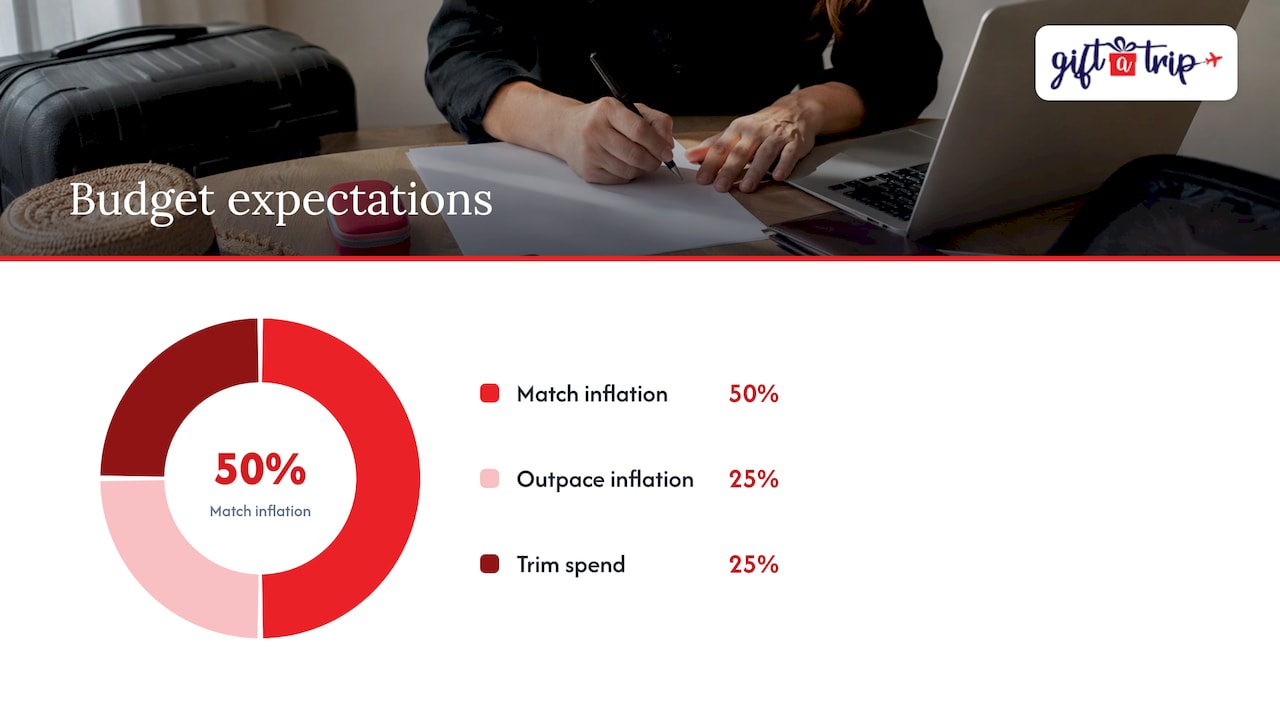
The IRF 2026 Trends Report shows how incentive-travel buyers planned for 2026. Half expected budgets to match inflation, 25% expected budgets to outpace it and 25% planned to trim per-person spending. The most common cost-control measures were reducing gifting (45%), choosing less expensive destinations (42%) and shortening trips (42%).
The lesson for an HR or sales manager: when budgets tighten, the trip gets cheaper or shorter, but it rarely disappears. A flexible certificate lets you keep the reward and adjust its value.
A worked example: 150 employees
This is an illustration of the method, not a benchmark. Suppose you employ 150 people and set aside $300 per head per year for all recognition.
- Total pool: 150 x $300 = $45,000
- Everyday and peer recognition, milestones and events: $30,000
- Travel reward line: $15,000
Now turn the $15,000 into reward units. If you want six top performers to earn a $2,000 travel certificate, that is $12,000. The remaining $3,000 covers delivery, communications and a reserve for mid-year spot awards. If you would rather reward more people, ten certificates of $1,200 spend the same $12,000 and reach more of the team.
Both plans are defensible. The first creates a bigger moment for a few, the second a broader sense that effort is noticed. Pick based on your goal, and write it down before the year starts.
The costs people forget
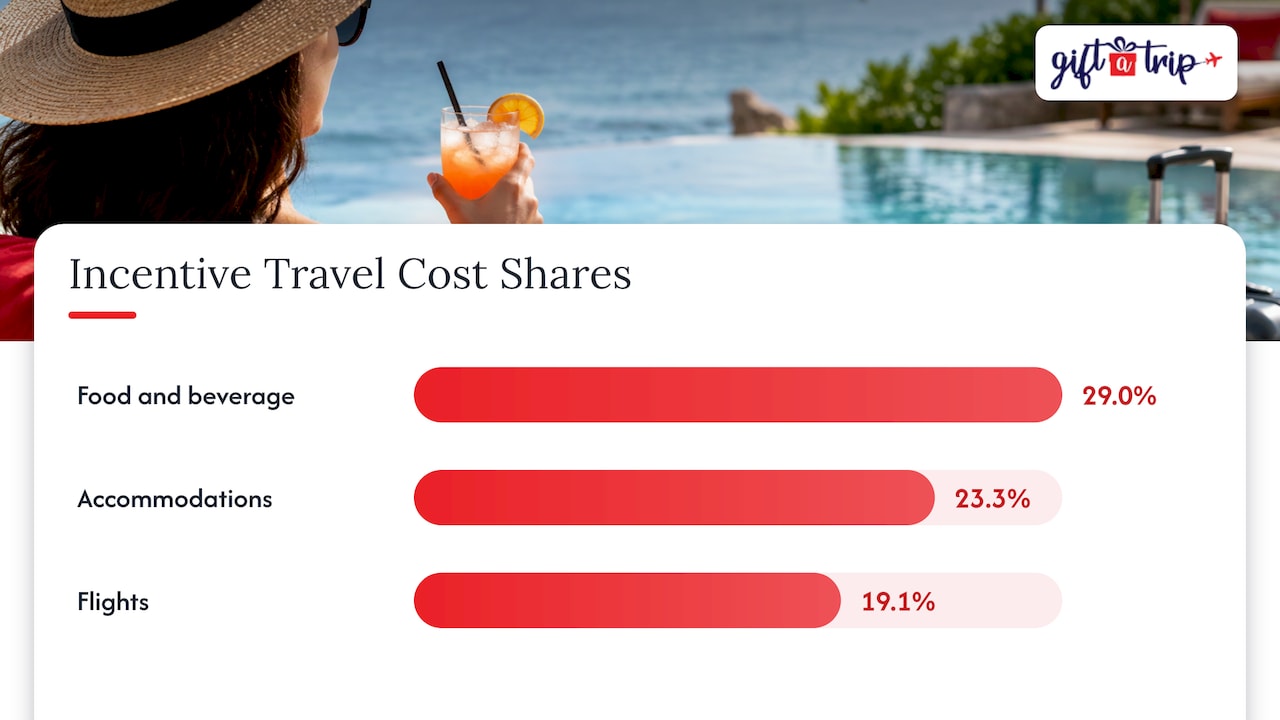
A travel reward has more cost lines than the price of the trip. The IRF and University of Central Florida case study of a $1.2 million incentive-travel program costing $4,000 per person found that food and beverage took 29.0% of the budget, accommodations 23.3% and flights 19.1%, together 71.4%. The remaining spend went to production, web services, marketing, room gifts, ground transportation, hospitality staff, excursions, receptions, gratuities and site inspections.
That is a group program, but the lesson carries over. If you plan a group trip, you pay for many items beyond the room and the flight, and it helps to understand food and beverage costs in corporate travel before you set the figure.
With an individual certificate, most of those lines disappear. For our certificates, taxes and resort fees are covered in the price, there is no minimum order, and blackout dates are kept to a minimum. What remains to budget:
- The certificate value for each award.
- Delivery. Digital delivery is secure and requires no shipping. If you want a physical presentation, our Red Box Delivery is a $69 one-off fee.
- Airfare, if the reward should include it. Our airfare vouchers are available in all denominations, so you can add flights to a stay.
- Administration time for whoever runs the program.
- Communication. A short launch note, a presentation moment and a thank-you message.
The tax line
Budget for the tax treatment of the award as well. A state guidance manual explains that employer awards or prizes are generally taxable wages at fair market value, reported on Form W-2 and subject to federal withholding, unless an exclusion applies. Nominal, infrequent noncash awards may be treated as de minimis. A travel certificate of a meaningful value is rarely nominal, so plan with your payroll team or tax adviser for how it will be reported, and decide whether the company will cover the employee’s withholding. Our guide to secure digital travel certificates, fees and HR taxes walks through what HR teams should prepare.
Why travel earns its share of the budget
Travel is not only expensive, it is popular. The IRF’s 2023 generational study found that when cash and gift cards are removed, travel rewards are the most preferred reward type across age and income groups, and individual travel was preferred over paid time off and flexible work.
The same study adds detail that helps you design the reward:
- Workers aged 51 and older lean toward drivable domestic destinations.
- Workers aged 18 to 30 and higher earners are more likely to prefer group reward travel.
- Employees who have already experienced group incentive travel are significantly more likely to want it again.
A program with a broad workforce needs choice. A certificate that can be used for a resort stay, a cruise or a golf and spa getaway lets each person pick what fits their life. Our Flex Trip Collections are built around that idea, and our category pages cover cruises, resorts and hotels, and golf and spa getaways.
Individual or group
The IRF’s 2018 market study notes that individual travel rewards may come as vouchers or pre-packaged trips with flexible dates, often accommodating families, while group travel has a higher entry threshold but strong memorability. For budgeting, that translates simply:
| Individual certificates | Group trip | |
|---|---|---|
| Cost per winner | Set by you, any level | Typically the highest line in the program |
| Number of winners | As many as the budget allows | Limited by the group size you can fund |
| Planning effort | Low | High (venue, travel, agenda) |
| Scheduling | Winner chooses dates | One date for everyone |
Many teams combine both: individual certificates all year, one group experience for the very top performers. We cover that approach in our guide to group incentives versus individual rewards and in why group travel incentives work for your team in 2026.
Make the money count: rules for fair travel rewards
A budget only works if people see the reward as earned and fair. The IRF award-value study recommends pairing every tangible reward with explicit appreciation tied to the specific behavior or achievement, using rewards to reinforce fairness rather than replace recognition. A Forbes Business Council guide adds that recognition is most effective when it is fulfilling, authentic, personalized, equitable and embedded in company culture.
In practice:
- Publish the criteria and the value before the period starts.
- Write a personal note naming what the person did. Our certificates support personalized messaging for this.
- Keep values consistent for the same level of achievement across departments.
- Hold a small reserve for spontaneous awards, so managers can recognize excellence as it happens.
- Present it properly. A branded box or a custom trip selection site makes the moment feel considered. We offer custom, branded gift box delivery and custom trip selection sites for corporate programs.
Sales teams: tying the budget to results
For sales managers, the budget logic is a cost-per-outcome one. Set the travel line as a fraction of the revenue a target unlocks, not as a share of headcount. If hitting a quota adds a defined amount of margin, a certificate worth a small percentage of that margin keeps the economics clear. Use tiers: one certificate level for hitting target, a higher one for exceeding it. Our guide on travel incentive cost for HR teams lays out how to size each tier, and our comparison of travel certificates and cash bonuses explains why a trip is remembered when a bonus is spent on bills.
Other buyers: events, auctions and retail promotions
The same arithmetic applies if you run a milestone celebration, a charity auction or a customer promotion. Decide the number of prizes and their value, add delivery, and keep a reserve. Certificates suit these uses because the value is set up front and the recipient chooses the destination and dates.
What we have learned about travel budgets
We build our certificates for the person who has to defend a number. Group trips have many moving parts, and each one carries a cost that is easy to miss. An individual certificate takes most of them away: taxes and resort fees are covered, delivery is digital, there is no minimum order, and blackout dates stay minimal.
That lets an HR or sales manager do something simple: choose a value, choose how many people earn it, and be done with the budget conversation. We also see the budget stretch further when companies combine a few certificates of different sizes. A modest one for steady performers, a larger one for the top tier, and flights added through airfare vouchers when the reward should be a complete getaway.
If you take one thing from this guide, set the reward value before you announce the program, not after. The rest follows.
Donovan
Put the budget to work
If your travel line is set, the next step is choosing the format. Our corporate gifting program covers custom trip selection sites, airfare vouchers in all denominations, custom Flex Trip Collections and branded gift box delivery, and there is no minimum order, so you can start with a single award.
For a single gift or a first test of the idea, browse individual travel certificates or the full certificate catalog, including Royal Caribbean certificates and golf and spa resort stay certificates.
FAQ
How much should I budget for travel as part of employee recognition?
Start with your total recognition pool (headcount times an annual amount per person) and assign a fixed share to travel. For context, the 2025 Incentive Travel Index put average group incentive-travel spend at $5,100 per person. Individual certificates let you reward at any value you choose, so your per-award number can be far lower.
Is a $100 gift per employee too much?
Not necessarily. The right figure depends on your pool and on how many people you reward. A common approach is to give small, frequent thank-yous to everyone and reserve larger travel awards for earned achievements, so $100 is a reasonable everyday figure while a trip certificate is set at a higher tier.
Are travel rewards taxable for employees?
Generally yes. Employer awards are usually taxable wages at fair market value, with a narrow exception for nominal, infrequent noncash awards. Check the treatment of your specific program with your payroll team or a tax adviser before you launch.
What are good incentives to give employees besides travel?
The main categories are cash, gift cards, merchandise, paid time off and travel. The IRF’s 2023 research found that travel is the most preferred reward once cash and gift cards are set aside. Pair any reward with a personal note about what the person did.
Sources
- IRF 2026 Trends Report (overview)
- The IRF 2026 Trends Report (PDF)
- IRF Budgeting for Recognition Toolkit, Section 3
- IRF Award Program Value and Evidence Study
- IRF 2023 Generational Expectations of Incentives
- IRF 2018 Voice of the Market study
- IRF and UCF case study on the anatomy of an incentive travel program
- Incentive Federation 2022 research study
- Sales & Marketing: A New Era of Incentive Travel
- Commonwealth of Virginia CAPP Manual, Employer Provided Fringe Benefits
- Forbes Business Council: Best Practices For Shaping Your Employee Recognition Program
- Corporate Travel Terminology Explained