
Risk management for travel giveaways comes down to four things: running the promotion legally, describing the trip so precisely that nobody can dispute it, handling winner paperwork and taxes, and making sure the trip the winner receives is the trip you promised. Most problems come from the last two, because a travel prize involves several vendors and many moving parts. Giving winners a travel certificate with defined terms, rather than assembling flights and hotels yourself, takes much of that complexity off the table, and our travel certificates are built for exactly that.
TL;DR
- Decide first whether you are running a sweepstakes (chance) or a contest (skill). Each has different rules, and a sweepstakes needs a free way to enter.
- Add up the total prize value before launch. New York, Florida and Rhode Island have registration or bonding thresholds that can apply.
- Describe the trip in the official rules: who books, dates, blackout dates, what is covered and what is not.
- Plan the winner paperwork: eligibility affidavit, releases, tax forms and a cash component for taxes on large prizes.
- Document winner selection and post anti-fraud rules, because anything valuable attracts cheaters.
Table of Contents
- Start by choosing the right giveaway format
- The legal layer: federal and state rules
- Describe the trip so nothing can be disputed
- Fulfillment: where trips actually go wrong
- Winner selection, fairness and fraud
- Winner paperwork, taxes and privacy
- A pre-launch risk checklist
- Make the prize easy to deliver
- FAQ
- Sources
Start by choosing the right giveaway format
The National Law Review explains that a sweepstakes picks winners by chance, while a contest picks them by skill. That choice drives everything else.
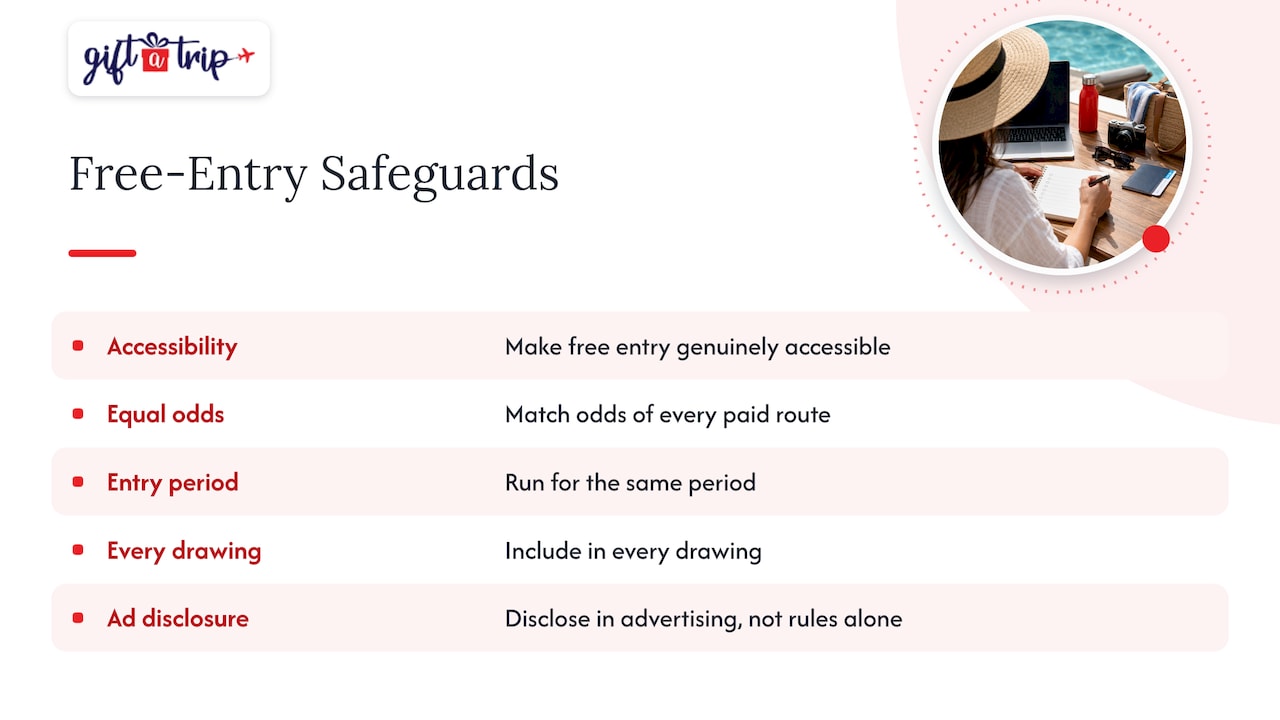
In a sweepstakes, entry cannot require a purchase. Your rules need a free alternative method of entry with the same odds as any paid route, and MC Law says it should be genuinely accessible, run for the same period, be included in every drawing and be disclosed in the advertising itself, not only in the rules.
In a contest, you must name who judges and on what criteria. If you judge with weighted criteria, announce the weights before entry opens, have judges score independently and keep every scoresheet. Public voting should be only one input, not the whole decision, according to a promotion checklist.
For marketers weighing a raffle against a sweepstakes, see our guide on running travel prizes as sweepstakes.
The legal layer: federal and state rules
The FTC polices deceptive prize and odds claims, federal mail law adds disclosures for mailed sweepstakes, and state lottery laws decide whether a promotion is legal at all, as the BrandMovers legal guide summarizes. Primerus adds that you need written official rules listing sponsor contact details, prize description and value, eligibility and odds.
Registration and bonding thresholds
Three states deserve a check before launch:
| State | Trigger | What is required |
|---|---|---|
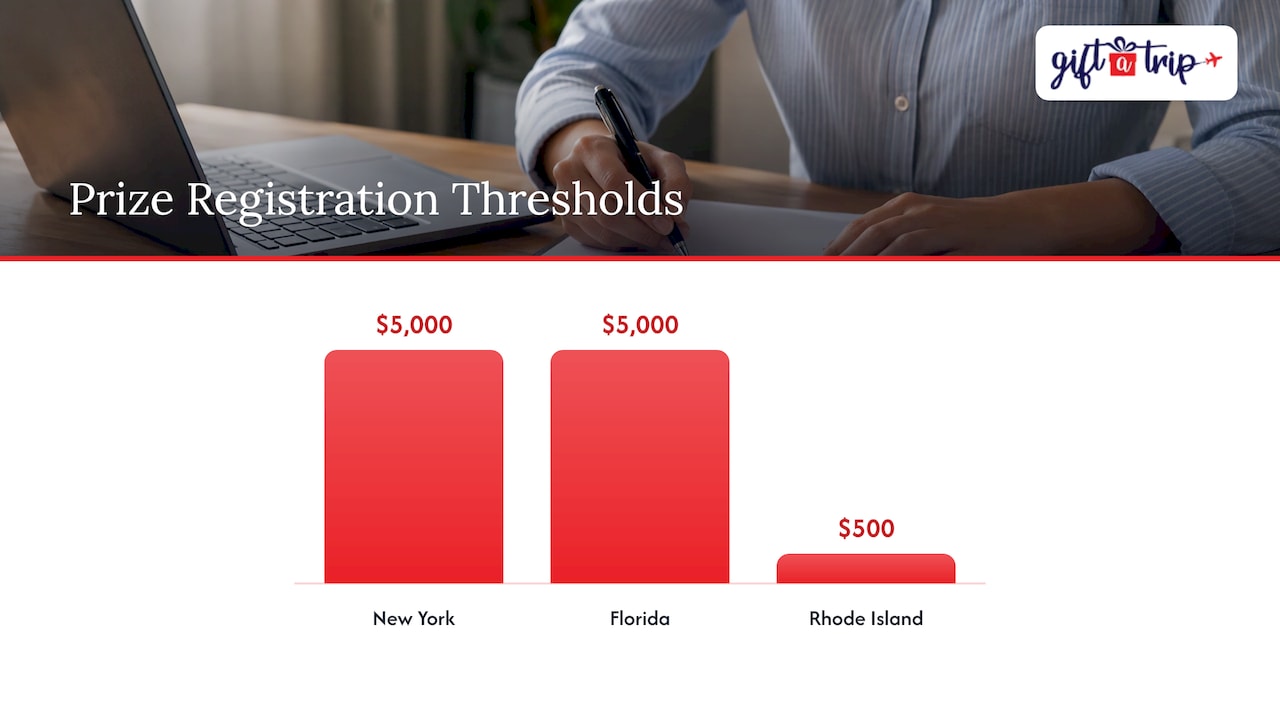
| New York | Total prizes over $5,000 | Registration at least 30 days before start, $100 fee, trust account or bond equal to prize value |
| Florida | Total prizes over $5,000 | Registration at least 7 days before start, $100 fee, trust account or surety bond |
| Rhode Island | Total prizes over $500 (retail sales promotions) | Registration, no bond |
These details come from BrandMovers and Primerus. MC Law notes a missed filing deadline cannot be cured afterward, so the choice is to register or to exclude those residents. Florida violations can bring misdemeanor and civil penalties of up to $1,000 each, per BrandMovers.
Worked example: a holiday promotion with ten $750 travel certificates totals $7,500. That crosses the $5,000 line in New York and Florida, even though no single prize looks large. Do this arithmetic before you write the rules. Our travel prize fulfillment guide and sweepstakes rules compliance guide go deeper on this.
Also limit eligibility to adults 18 or older, since the National Law Review flags enforceability problems with minors. If you run a sales presentation promotion in Texas, Chapter 621 of the Business and Commerce Code allows a clearly disclosed refundable deposit for trip prizes.
Truthful advertising
Advertising must be truthful. For a travel voucher, Sprintlaw notes ads should not imply that it covers all expenses and should disclose blackout dates, expiration and other limits.
Describe the trip so nothing can be disputed
Travel is the hardest prize category, according to MC Law. Its checklist covers who books, blackout dates, travelers and companions, passports and visas, included costs, insurance, transferability, expiration and what happens if the winner cannot travel.
The more specific the better. A Lexology article suggests spelling out details such as economy airfare with one checked bag and double occupancy in a stated hotel class, rather than “airfare and hotel,” and stating that anything undescribed is not included.
Your rules should also cover:
- Who decides dates and itinerary. Legal 500 says to establish who determines and books dates, airline, itinerary and hotel, and that travel stays subject to airline and hotel terms. It warns of significant liability if these details are not disclosed in advance.
- Approximate retail value (ARV). Manatt says to state the number of prizes and ARV of each, not based on your cost, and to disclose date restrictions.
- Incidentals. Typical rules, such as the Margaritaville resort sweepstakes, state that transportation, meals, gratuities and personal charges are the winner’s responsibility and that blackout dates may apply.
- Substitution. A clause allowing a substitute of equal or greater value if a component becomes unavailable, as in the Big Game sweepstakes rules.
Blackout dates are the most common source of winner frustration, so explain them plainly in your materials. Our guide on blackout dates in travel gifts shows how.
For a look at how a logistics-heavy promotion reads from the winner’s side, travel logistics and prize terms gives useful context on what travelers need to know before they pack.
Fulfillment: where trips actually go wrong
Enteractive Solutions lists recurring failures: winners booking their own flights on a stipend while a hotel is booked separately, causing check-in mismatches; vague rules leading to standard rooms instead of promised luxury ones; and several vendors leaving the winner with no single point of contact. The trip must match the official rules on blackout dates, airfare class, number of travelers and covered costs.
The fix is to reduce the number of parties. One certificate from one provider, with defined terms, replaces a chain of separate bookings. Our Flex Trip Collections and airfare vouchers and custom trip selection sites are designed for that single-source approach, and we state that taxes and resort fees are included and blackout dates are minimal.
For in-person events, the conference prize playbook and trade show giveaway guide show how to run tiered prizes.
Winner selection, fairness and fraud
Document selection exactly as your rules describe it. MC Law recommends recording the method, tool, seed or process, date, people present and result, and using an independent administrator for high-value promotions. Nolo adds that random selection by a third party protects you from accusations of impropriety.
Keep the process fair. KickoffLabs notes that Florida’s statute prohibits arbitrarily rejecting entries, rigging and failing to award prizes, so a “we can do anything” clause is no substitute.
Post anti-fraud rules on the contest page, excluding duplicate entries, fake referrals, temporary emails and bots, and reserve the right to disqualify, per KickoffLabs. Apply them consistently to every entrant.
Also warn winners about scams. Marden-Kane reports that scammers use AI to produce realistic fake winner notices and send partial-prize checks asking winners to wire back “tax fees.” Tell winners in your rules that you will never ask them to send money.
Winner paperwork, taxes and privacy
Collect from each winner an affidavit of eligibility, a liability release and, where lawful, a publicity release. Manatt also advises a separate travel release from any guest.
The winner owes tax on the prize. Primerus notes the Internal Revenue Code includes prize value in gross income and that for trips sponsors may consider direct costs of the components. MC Law says to state ARV honestly and consider a cash component alongside a large travel prize so the winner is not left with a tax bill and no funds.
Reporting thresholds changed. One 2026 guide says the Form 1099-MISC threshold rose from $600 to $2,000 for prizes awarded on or after January 1, 2026, counted as an annual total per payer. Confirm with your tax adviser before relying on it. Sponsors typically collect a W-9 first, as in the 12 Days of Giveaways rules. Our travel certificate tax guide explains how taxes are handled on our certificates.
On privacy, post a privacy policy where the promotion is advertised and make data collection conform to it, per ACC program material. Describe the data collected, processors, retention and marketing consent, and never make marketing consent a hidden condition of free entry, according to Rafl.
A pre-launch risk checklist
- Format chosen (sweepstakes or contest) and free entry method written.
- Total prize value added up; New York, Florida and Rhode Island handled or excluded.
- Eligibility set: age 18+, states, employees or not.
- Prize described: ARV, dates, blackout dates, inclusions, exclusions, substitution.
- Single fulfillment source identified.
- Selection method and independent administrator documented.
- Fraud rules and scam warning posted.
- Winner paperwork and tax plan ready.
- Privacy policy linked.
- A sweepstakes attorney has reviewed the rules, which Legal 500’s David Klein recommends before any travel prize promotion.
Our view
We think the safest travel prize is the simplest one to explain. Every extra vendor is another place where the trip can drift from the rules you published. That is why we build around one certificate, with taxes and resort fees included, minimal blackout dates and delivery that is secure and digital. The winner knows what they have, and you know what you promised.
For teams giving prizes to a sales force or an audience, we also offer custom, branded gift box delivery and custom Flex Trip Collections, so the prize looks as good as it reads in the rules.
Donovan
Make the prize easy to deliver
If you want a prize that is simple to describe and simple to fulfill, start with our Flex Trip Collections or browse cruise, resort and golf and spa certificates. There is no minimum order, and corporate teams can use custom trip selection sites and branded gift boxes. Our Red Box Delivery is $69 one-off for a premium presentation.
FAQ
Do I need a free entry method for a travel giveaway?
If winners are chosen by chance and entry could involve a purchase or other consideration, yes. MC Law says the free route must have equal odds, be genuinely accessible and be disclosed in the advertising itself.
When do I need to register or post a bond?
New York and Florida apply when total prizes exceed $5,000, with registration 30 and 7 days before start respectively. Rhode Island applies above $500 in retail sales promotions. Add up all prizes before launch.
Does the winner pay taxes on a travel prize?
Yes, prize value counts as income. Sponsors usually collect a W-9 and report reportable prizes on Form 1099-MISC. Consider adding a cash component so the winner can cover the tax, and consult a tax adviser.
What should the rules say about the trip itself?
Name who books, the dates, blackout dates, travelers, what is included and excluded, the ARV, expiration and what happens if the winner cannot travel or a component becomes unavailable.
Sources
- Legal Considerations for Giveaways, Contests and Sweepstakes, National Law Review
- Running a Legal Sweepstakes or Contest, MC Law
- Promotion Launch Checklist, Rightsy
- The Complete Legal Guide For Running Sweepstakes, BrandMovers
- Sweepstakes and Contests, Primerus
- Texas Business and Commerce Code Chapter 621
- Promotional Giveaway Terms of Service, Sprintlaw
- Boot camp #3: travel prizes, Lexology
- Live Event Sweepstakes Considerations, Legal 500
- Sweepstakes and Contests, Manatt
- Margaritaville Resort sweepstakes rules
- Big Game sweepstakes rules
- Travel and Vacation Nightmares, Enteractive Solutions
- Rules for Running an Online Contest, Nolo
- Giveaway Rules Template, KickoffLabs
- Best Practices for Keeping Giveaways Legal, KickoffLabs
- Sweepstakes Risk Assessment, Marden-Kane
- Winning Multiple Prizes guide
- 12 Days of Giveaways sweepstakes rules
- Online Advertising, Contests and Sweepstakes, ACC
- Official Rules for a Sweepstakes template, Rafl