
Most gift card orders in the United States carry no sales tax at the register, whether you buy one card or five hundred. That is not a special exemption you apply for. A gift card is treated as a cash equivalent, so tax waits until someone spends it. The part that catches businesses is a different tax: when you hand cards to employees or sales reps, the IRS generally treats them as taxable pay. Our travel certificates are built for exactly this situation, with taxes and fees covered in the price we publish, so the order you place is the order you pay for.
TL;DR
- Sales tax is generally not charged when you buy a gift card, including bulk business orders. It is charged when the card is redeemed for taxable goods or services.
- You do not usually need an exemption certificate for a gift card purchase, because there is nothing to exempt at the point of sale.
- Gift cards given to employees are cash-equivalent and are taxable compensation under IRS rules, whatever the amount.
- Promotional and charity uses follow their own rules, so confirm your state’s treatment with your tax adviser before a large program.
- Travel certificates from Gift A Trip are priced with taxes and fees included, which keeps the budget simple.
Table of Contents
- Why gift card purchases are not taxed at checkout
- Bulk and business orders
- When sales tax does apply: redemption
- The tax that does apply: gift cards for employees and sales teams
- Business deductions
- Why travel certificates simplify the math
- Our view
- Order certificates for your team or your gift list
- FAQ
- Sources
Why gift card purchases are not taxed at checkout
A gift card is a prepaid payment instrument, not a product or service. One 2026 sales tax guide explains that taxing it at sale would risk tax pyramiding: tax paid when the card is bought and again when it is spent. So the tax is collected at redemption instead.
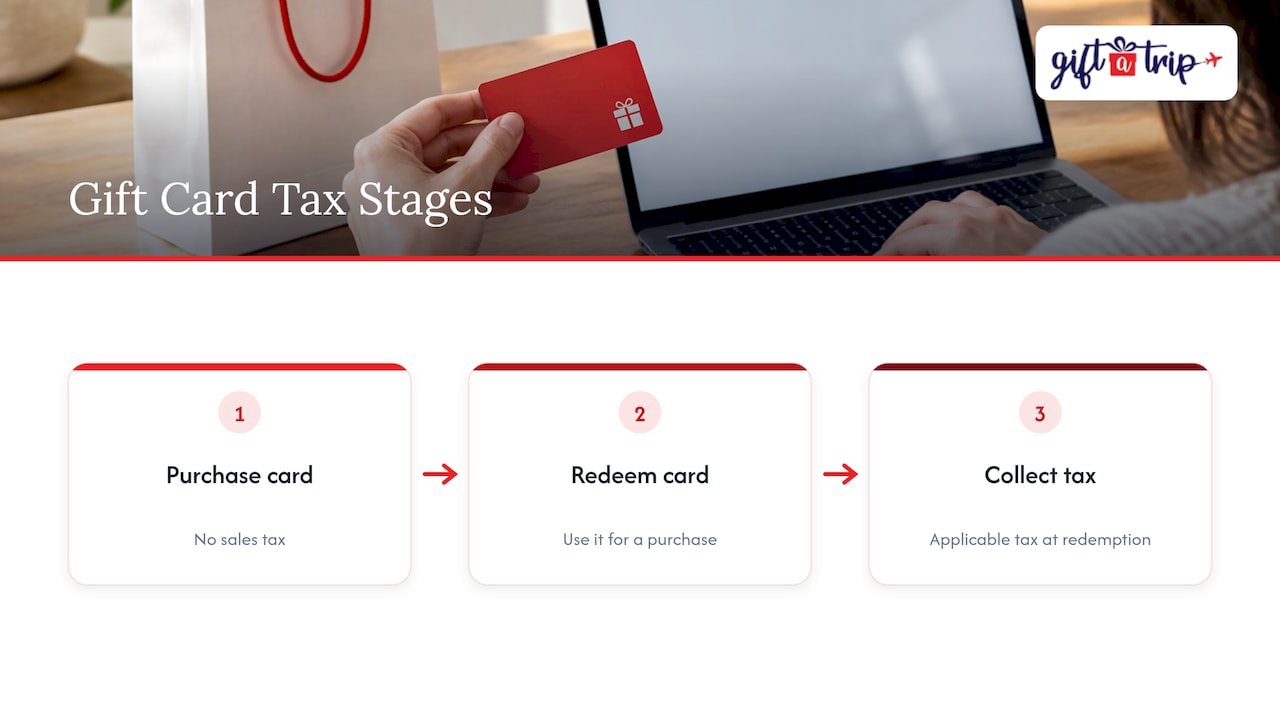
That pattern is nearly universal. TaxShark reports that all 45 sales-tax states plus D.C. treat gift cards as non-taxable on purchase, and that there is no federal sales tax, so each state sets its own rules. The state revenue agencies say the same thing. Washington’s Department of Revenue states that taxes do not apply to gift cards and gift certificates when they are sold. Minnesota says gift card sales are not taxable and are treated like cash.
For a buyer, the practical meaning is simple: the price on the card is the price you pay. You do not need to hunt for an exemption form.
Bulk and business orders
Businesses sometimes assume that a large order needs a tax-exempt certificate on file. For gift cards it generally does not. A trade publication on incentive cards describes bulk business purchases as an exchange of cash or a cash equivalent with no added value or service, so no sales tax is due, and notes that the vast majority of states collect tax when recipients use the cards.
A few points keep a bulk order clean:
- Ask what is taxed on your invoice. A card should show its face value and nothing else. Delivery or customization fees are separate and may be treated differently.
- Keep the order record. You will want it for your books and for the employee-pay question below.
- Separate gifts for customers from pay for employees. The two are treated differently for income tax.
We publish a deeper walkthrough in our guide to buying gift cards in bulk for corporate programs. There is no minimum order with us, so a program can start with a handful of certificates and grow.
When sales tax does apply: redemption
Tax is tied to the item bought, not the payment method. Washington’s restaurant guidance gives a clean example: a $25 gift certificate bought in July triggers no tax, but when it is used in August toward a $30 meal, retail sales tax applies to the full $30, with the certificate counted as a cash payment.
Two details trip people up:
- The card amount does not reduce the taxable price. Minnesota says tax is charged on the full sales price before the card is subtracted. Idaho’s tax commission makes the same point: a $50 card sold for $30 still means tax on $50 of goods when it is redeemed.
- Partial use leaves the rest untouched. A payments guide notes that if someone spends $45 of taxable goods with a $50 card, tax is collected on $45 and the remaining $5 stays untaxed until used.
Some states also tax certain vouchers at sale. Wisconsin’s Publication 201 says a gift certificate’s price is not taxable, but a voucher redeemable for one specific taxable product is taxable when sold.
Promotional cards
A card a seller gives away with a purchase is different from one a customer buys. New Jersey’s ANJ-9 bulletin treats a spend-$50-get-a-$10-card offer like a seller coupon: tax is charged on the price after the card is deducted, provided the seller receives no compensation for the card. If you run promotions, check your own state’s rule before you design the offer.
The tax that does apply: gift cards for employees and sales teams
This is where most HR and sales managers should focus. Sales tax is not the issue. Income tax is.
The IRS states in its de minimis fringe benefit guidance that cash and cash-equivalent items provided by an employer are never excludable from income. Gift certificates redeemable for general merchandise are not de minimis benefits and are taxable. A certificate for a specific item of minimal value, given infrequently, may be excludable.
The federal personnel agency OPM says the IRS treats gift certificates as taxable fringe benefits valued at face value.
A worked example from employment lawyers at Littler: a $20 grocery gift card is not de minimis because it works like cash, while a certificate good only for a turkey likely would be. A $100 card is treated as taxable wages, and an employer may choose to gross up the value so the employee is not out of pocket for the tax.
In practice:
| Situation | Typical tax treatment |
|---|---|
| Buying cards in bulk | No sales tax at purchase |
| Employee receives a general gift card | Taxable compensation at face value |
| Employee receives a certificate for a specific low-value item, rarely | May be excludable |
| Recipient spends the card on taxable goods | Sales tax at redemption |
We cover the payroll side in more detail in our HR playbook on employee gift tax rules and our guide to de minimis fringe benefits. Employers outside the U.S. face different rules: Canada, for example, has its own employee gift tax rules with a separate limit and gift log.
Business deductions
Cards given to customers, employees or charities raise a deduction question as well. For tax years beginning after December 31, 2025, Ohio State’s 2026 tax workbook notes that a new federal law puts a 1% floor and a 10% cap on corporate charitable contribution deductions. If your organization donates certificates, such as for a fundraising auction, bring this to your tax adviser before the budget is set. Charities running auctions should likewise ask their accountant how the donor’s receipt and the winning bidder’s payment are reported.
Why travel certificates simplify the math
Travel gifts add a layer that plain retail cards do not have: the trip itself carries taxes, resort fees and gratuities. Our certificates are priced all-inclusive, with taxes, gratuities and fees covered, and we keep blackout dates minimal. For a program owner that means the certificate value you budget is the value the recipient uses, without a surprise bill at the front desk. Our guides on how taxes are handled in travel certificates and resort fees go through what that covers.
Remember the employee rule still stands: a travel certificate given as a reward is compensation, so your payroll team should record it.
Our view
Every month, people ask us whether they need a tax-exempt form to buy certificates. For gift cards the answer is generally no, because the sales tax question is settled at redemption. The question worth your time is the one HR owns: how the reward is reported.
That is why we built certificates around clarity. The price includes taxes and fees, there is no minimum order, delivery is secure and digital, and you can add a personal message. A manager rewarding one top performer and an HR team rewarding 500 people use the same process.
Experiences also land differently than a retail card. A resort stay or a cruise is something people remember, and the budget you set is the value they receive.
Donovan
Order certificates for your team or your gift list
If you are rewarding a sales team, running an event prize table or planning a milestone gift, start with our corporate gifting page. It covers custom trip selection sites, airfare vouchers in all denominations, custom Flex Trip Collections and branded gift box delivery. Red Box Delivery is a one-off $69 for a boxed presentation, available on our gift delivery page.

For one person, browse cruises, resorts and golf and spa getaways and pick a brand they will love.
FAQ
Is there sales tax when I buy a gift card?
Generally no. A gift card is a prepaid payment instrument, and states collect tax when it is redeemed for taxable goods or services. Delivery or add-on fees are separate, so check your invoice.
Do I need a tax-exempt certificate to buy gift cards in bulk?
Usually not, since there is no sales tax at purchase to exempt. Bulk business purchases are treated as an exchange of cash equivalents. Keep your order records for your books and ask your accountant about your state.
Are gift cards taxable income for the person who receives them?
From an employer, yes. The IRS treats cash-equivalent items as taxable compensation, so general gift cards from an employer are reported as wages. Personal gifts from friends or family are not wages.
Does sales tax apply when the card is used?
Yes, if the purchase is taxable in that state. Tax is based on the price of the goods or services bought, and any unused balance stays untaxed until spent.
Sources
- Numeral: Sales Tax on Discounts, Coupons, and Gift Cards (2026 Guide)
- TaxShark: Do You Pay Sales Tax on Gift Cards?
- Washington Department of Revenue: Gift cards, gift certificates, and layaway purchases
- Minnesota Department of Revenue: Coupons and Other Forms of Payment
- Sales and Marketing: Incentive gift card use
- Washington Department of Revenue: Coupons, gift certificates, and free meals
- Idaho State Tax Commission: Coupons, Vouchers and Gift Cards
- Upward Merchant: Gift Card Sales Tax
- Wisconsin Department of Revenue: Publication 201
- New Jersey Division of Taxation: ANJ-9
- IRS: De minimis fringe benefits
- OPM: Can an agency give a gift certificate as an award?
- Littler via Lexology: Tax implications of office gifts
- Ohio State: 2026 National Income Tax Workbook, Chapter 11
- Canada’s employee gift tax rules