Choose the incentive that matches task interdependence: hybrid models usually win when cooperation matters, while individual rewards win when output is easily measurable and largely independent. The deciding factors are task interdependence, how easily you can measure individual contribution, and team size. Meta-analyses and field trials consistently point to combined approaches as the strongest performers in cooperative settings.
TL;DR:
- In a randomized step count trial, only the combined incentive arm significantly beat control, with 0.35 reaching goals versus 0.18 among controls.
- Use individual commissions for autonomous, countable work, but pair volume targets with a quality measure and publish payout rules before launch.
- For interdependent projects, keep group incentive teams small and stable, then use contribution dashboards and submetrics to limit free riding and expose overlooked work.
- Pilot one team for 60 to 90 days, set a control group and success threshold in advance, and track retention and engagement alongside performance.
Table of Contents
- Defining Individual and Group Incentives
- What the Research Says About Performance Effects
- When Individual Incentives Make Sense
- When Group Incentives Work Better
- Building Hybrid Incentive Structures
- Rolling Out and Measuring an Incentive Program
- Using Travel Experiences Inside Incentive Programs
- What I’d Tell Any HR Leader Building This From Scratch
- How Gift A Trip Supports HR Incentive Programs
- FAQ
- Sources
Defining Individual and Group Incentives
Individual incentives tie pay or recognition to one person’s measurable output. Group incentives tie a reward to the collective result of a team, department, or company.
Individual plans typically include commissions, piece-rate pay, and spot bonuses tied to a single employee’s numbers. Group plans more often take the form of team bonuses, gainsharing (sharing the value of efficiency improvements), or profit-sharing distributed across a unit or company. Each category also has a nonfinancial version worth considering alongside the cash options.
- Commissions and piece-rate pay reward individual output directly, common in sales and production roles.
- Spot bonuses recognize a specific individual achievement shortly after it happens.
- Team bonuses and gainsharing split a reward pool based on a group’s combined performance against a target.
- Profit-sharing distributes a portion of company or department profit across eligible employees.
- Recognition and experiential rewards, including travel certificates or public acknowledgment, work as non-cash options for either individual or group wins.
The nonfinancial category matters more than it gets credit for. A trip, a public shoutout, or an extra day off can reinforce the same behaviors as cash, often at a lower administrative cost and with fewer equity complaints, since the reward doesn’t invite direct dollar-for-dollar comparisons between coworkers.
What the Research Says About Performance Effects
The evidence base is more specific than most incentive debates suggest, and it splits cleanly between individual-only designs and designs that blend individual and collective rewards.
One randomized field trial found that combining individual and team incentives produced the largest behavior change of any arm tested. In a trial measuring daily step counts, the combined incentive arm reached a mean proportion of 0.35 achieving the step goal against 0.18 for the control group, a difference of 0.17, and only the combined arm significantly beat the control during the active intervention period. Participants in the combined group also increased their mean daily steps by over a thousand more than control during the intervention. That result matters because it isolated a true hybrid structure, rather than comparing individual plans against group plans in the abstract.
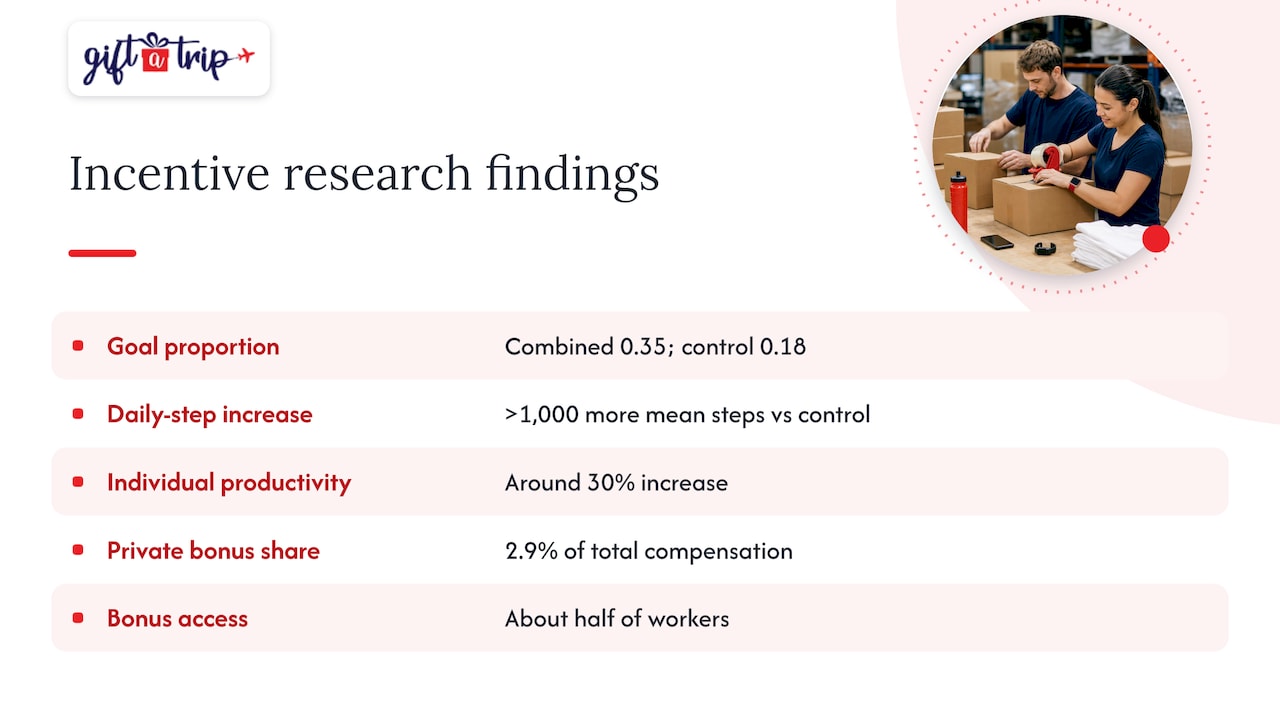
SHRM guidance notes that individual plans such as commissions and piece-rate systems often raise productivity by around 30%, but they tend not to encourage teamwork and struggle in roles where individual output can’t be cleanly isolated. The same guidance warns that stacking a team bonus on top of an existing individual plan without redesigning either one usually backfires: employees keep optimizing for the individual metric and treat the team reward as an afterthought.
On the budget side, Bureau of Labor Statistics data from March 2025 shows nonproduction bonuses accounted for 2.9% of total compensation for private industry workers, and about half of those workers had access to some form of nonproduction bonus. That gives HR teams a realistic benchmark when sizing a new incentive budget rather than guessing at competitive norms.
When Individual Incentives Make Sense
Individual incentives perform best when work is autonomous, repetitive, and easy to measure without ambiguity about who did what. Sales roles, data entry, and production-line work are classic fits because output per person is countable and comparisons feel fair.
- Confirm the work is genuinely independent. If one person’s result depends heavily on a teammate’s input, an individual plan will create friction rather than motivation.
- Set transparent payout rules before launch. Employees should be able to calculate their own expected payout without asking HR.
- Track performance on a consistent cadence. Weekly or monthly reviews catch problems before they compound into a quarter of misaligned incentives.
- Watch for quality trade-offs. Pure volume incentives can push people to cut corners, so pair any output metric with a quality or error-rate check.
- Monitor for burnout and inequity perceptions. A visible gap between top and bottom earners on the same team can sour morale even when the plan is technically fair.
Pro Tip: Pair every individual output metric with one quality metric, so the incentive can’t be gamed by speed alone.
When Group Incentives Work Better
Group incentives fit complex, interdependent work where no single person controls the outcome, and they tend to support innovation and cross-functional projects better than individual plans because they reward the handoffs between people, not just the final step.
- Favor group incentives for interdependent, innovation-heavy, or cross-functional work where success depends on multiple contributors coordinating well.
- Keep teams small and stable since a reward pool split among a large or shifting roster dilutes the perceived link between effort and payout.
- Use peer visibility to limit free-riding, such as shared dashboards that show individual contributions within the team total.
- Add sub-metrics alongside the group target so a quiet contributor’s work is still visible even when the headline number is collective.
- Set a normative code early, meaning the team agrees on what “pulling your weight” looks like before the incentive period starts.
SHRM’s guidance on team incentives points to the same risk every HR professional eventually runs into: without these guardrails, a group bonus can quietly become a reward for the loudest or most visible team member rather than the most effective one. Smaller teams make that distortion easier to catch and correct.
Building Hybrid Incentive Structures
A hybrid plan pays out on both an individual metric and a team or group metric, and the split between the two should reflect how interdependent the work actually is.
- Fixed individual share plus team bonus, often structured as 70% individual and 30% team, suits roles where output is mostly independent but some coordination still matters.
- Conditional top-ups, where a team bonus only unlocks once individual minimums are met, work well when quality control is a concern.
- Tournament plus team share, pairing a competitive individual prize with a smaller guaranteed team payout, fits sales environments that still need some collaboration, such as account handoffs.
- A 60/40 or 50/50 split tends to suit teams with high interdependence, where the collective outcome deserves equal or greater weight than any one person’s contribution.
The randomized field trial on combined incentives found that blending individual and team-based rewards produced a stronger short-term behavior shift than either arm alone, with the combined group significantly outperforming control while individual-only and team-only arms did not reach the same significance during the intervention. That result is a useful anchor when building the business case for a hybrid pilot internally.
Rolling Out and Measuring an Incentive Program
A hybrid or redesigned incentive plan needs a measurement plan before it needs a launch date, and skipping that step is the most common reason programs quietly fail.
- Pick metrics that are hard to game and tie directly to the outcome you actually want, not just an easy-to-count proxy.
- Define a success threshold and a control group before the pilot starts, so results can be judged against something other than gut feeling.
- Scope a pilot to one team or region for a fixed window, typically 60 to 90 days, before rolling out company-wide.
- Communicate the mechanics clearly and repeatedly, since SHRM notes that misalignment between levels of the organization is a leading cause of incentive failure.
- Budget using real benchmarks, keeping in mind that nonproduction bonuses average 2.9% of total compensation for private industry workers nationally.
- Set an evaluation window and track performance, retention, and engagement together, not performance alone, since a plan that boosts output while increasing turnover isn’t actually working.
Pro Tip: Run the pilot with a visible dashboard from day one. Visibility into how the reward links to daily behavior is what sustains engagement past the first few weeks, according to implementation research on cooperating teams and reward strategies.
Using Travel Experiences Inside Incentive Programs
Travel certificates give HR teams a flexible reward format that works across individual, team, and hybrid structures without requiring a separate system for each.
- Individual spot awards fit naturally as a standalone certificate for a specific achievement, without the administrative weight of a cash bonus.
- Top-performer trips reward the kind of sustained individual output that commission and piece-rate plans are built to measure.
- Team retreats work as the collective half of a hybrid plan, giving a group something to work toward together rather than splitting a cash pool unevenly.
- Auction or raffle prizes suit recognition events and charitable programs where a single high-value reward motivates broad participation.
Bulk ordering and custom, branded gift box delivery reduce the coordination work of distributing rewards to a large group at once, and because taxes, gratuities, and resort fees are built into the certificate value, finance teams avoid the budget surprises that often come with cash-equivalent travel prizes.
What I’d Tell Any HR Leader Building This From Scratch
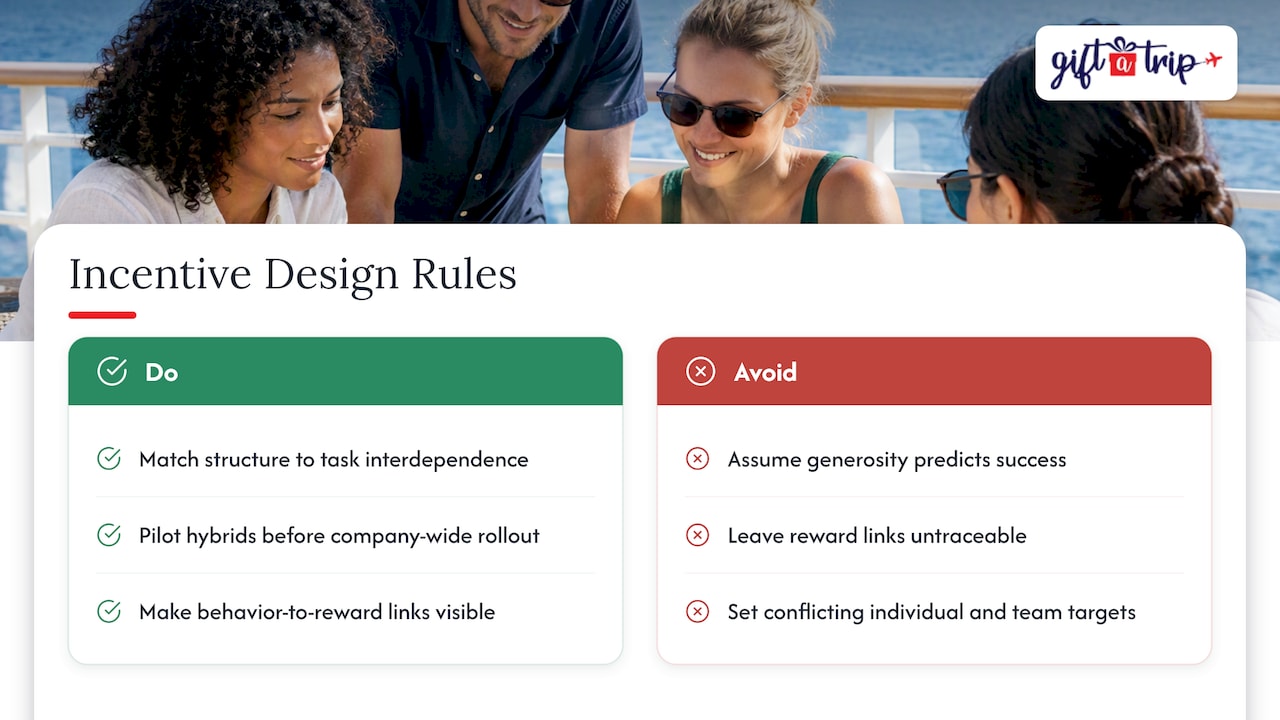
Three rules hold up across most incentive debates. Match the structure to task interdependence first, since that single decision predicts more about success than plan generosity ever will. Pilot hybrids before committing budget to them company-wide, because the mechanics that work in one team’s culture often need adjustment elsewhere. And make the link between behavior and reward visible, not assumed, through dashboards or regular updates, since an incentive nobody can trace back to their own actions might as well not exist.
The quieter failure mode is misalignment across levels: an individual bonus that rewards one thing while the department’s collective target pulls in another direction sends mixed signals that no amount of plan design can fix after the fact.
— Donovan
How Gift A Trip Supports HR Incentive Programs
Our corporate gifting options are designed to work well for individual spot bonuses, team rewards, or hybrid plans combining both. Bulk ordering and branded packaging through our corporate gifting programs mean one order can cover an entire department’s incentive period, with secure digital delivery sent directly to recipients.
- Flex Trip Collections are suitable for individual awards or shared team prizes, allowing recipients to choose their own redemption.
- Custom, branded gift box delivery fits milestone events, retreats, or company-wide recognition efforts.
- A physical presentation option is available for an additional fee when a certificate requires a tangible unboxing moment.
If you’re piloting a hybrid incentive plan this year, start small with a department-level trial and see how Flex Trip Collections fit into your existing payout structure.
FAQ
What are the four different types of incentives?
Incentive frameworks commonly group rewards into financial (cash bonuses, commissions), recognition-based (awards, public acknowledgment), career-related (promotions, development opportunities), and job-related (autonomy, flexible scheduling) categories. Definitions vary by source, so treat this as a common grouping rather than a fixed standard.
What’s the difference between rewards and incentives?
A reward is given after a result, often without the recipient knowing in advance it was coming, while an incentive is announced beforehand to motivate a specific behavior or outcome. In practice, well-designed programs use both: incentives to set direction and rewards to reinforce results as they happen.
What are the three types of incentives?
A widely used grouping splits incentives into individual, group, and organization-wide (such as profit-sharing) categories, based on who shares in the payout. The right category depends on how interdependent the work is and how easily you can measure one person’s contribution.
What does “group incentive” mean?
A group incentive pays out based on the combined performance of a team, department, or company rather than any single person’s output. Common forms include team bonuses, gainsharing, and profit-sharing, and SHRM guidance notes they work best for interdependent work when designed with clear anti-free-riding safeguards.
Can travel certificates work as a group incentive?
Yes, a shared travel experience or team retreat certificate can serve as the collective component of a hybrid plan, giving a team a tangible goal to work toward together. Bulk and custom gift box ordering make distributing the same reward to an entire team straightforward from an administrative standpoint.
Sources
- Combined individual and team-based financial incentives for physical activity: randomized trial (Way to Health)
- What types of nonproduction bonuses are available to workers? (BLS)
- Making Team Incentives Work (SHRM)