
Travel incentives reliably motivate and retain channel partners when the program is built on clear KPIs, simple qualification rules, and enough flexibility to fit different partner types. The Incentive Travel Index 2025 and MPI’s analysis of it back this up. The practical next step: pilot a tiered program using flexible travel certificates or a small curated group trip before committing to a full rollout.
TL;DR:
- Flexible reward formats like certificates and curated group trips improve participation by accommodating diverse partner preferences.
- Simplified qualification rules and clear communication are crucial to prevent program dropouts and ensure partner engagement throughout the cycle.
- Using a short pilot with a control group helps accurately measure sales lift, retention, and program impact before full implementation.
- Certificates with included taxes and fees reduce administrative complexity and minimize friction between qualification and redemption.
- Delivering consistent messaging, progress updates, and personalized incentives sustains motivation and strengthens long-term partner loyalty.
Table of Contents
- Why incentive travel motivates partners more than cash
- Group trips, certificates, and points: which reward format fits
- Design checklist: eligibility, tiers, timeline, and budget
- Delivering the trip: logistics, vendors, and risk
- Keeping partners engaged from launch to post-trip
- Proving the program works: KPIs and measurement
- What actually separates a good program from a forgettable one
- How Gift A Trip supports partner incentive travel programs
- Sources
- FAQ
Why incentive travel motivates partners more than cash
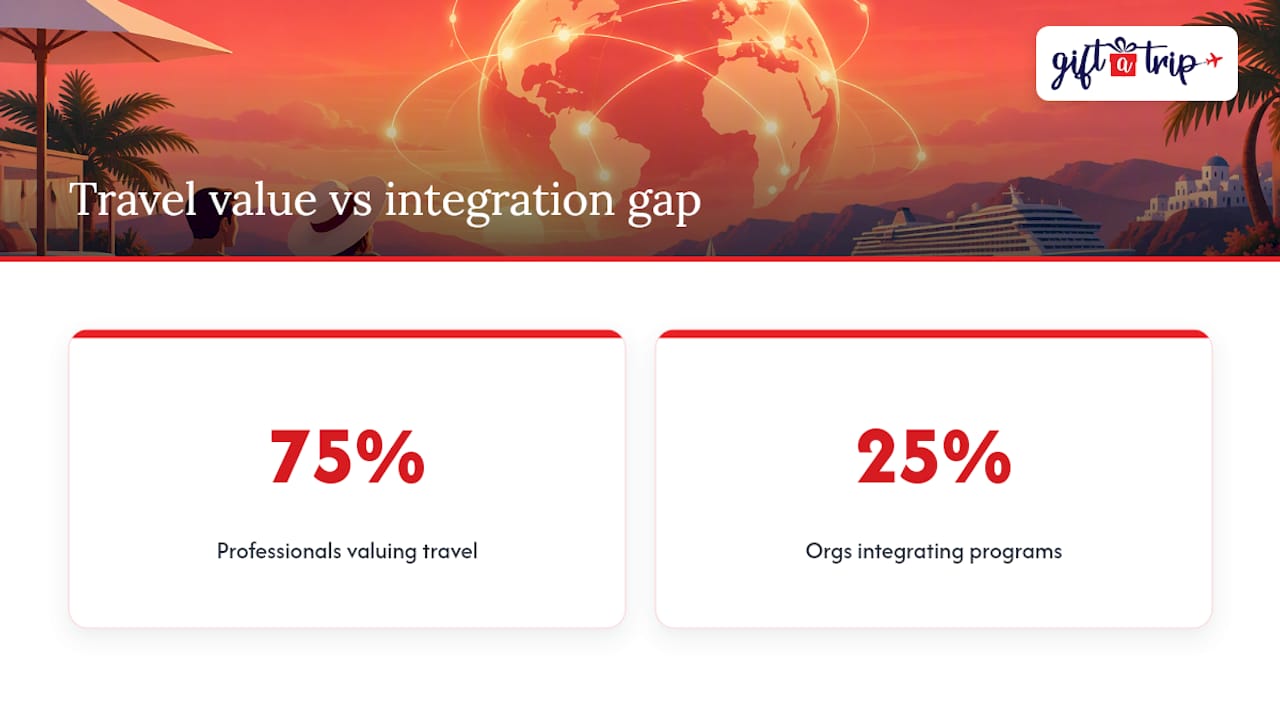
Cash rewards get spent on bills and forgotten. A trip becomes a story a partner tells for years, and that emotional residue is exactly what makes travel rewards outperform commodity incentives for loyalty and retention. The 2025 Incentive Travel Index found that 75% of professionals agree on the value of incentive travel, yet only 25% of organizations fully integrate these programs into formal HR or business strategy, a gap that leaves a lot of upside unclaimed.
Industry commentary tied to the index frames the strongest programs as ones that combine “hard-power” metrics like sales lift and retention with “soft-power” outcomes like culture-building and a sense of belonging. That combination matters because a program judged only on redemption counts misses the loyalty effect that makes partners choose your product line over a competitor’s next quarter.
A few benefits show up consistently across partner-focused programs like higher retention, concentrated sales effort during qualification periods, and partner preference for travel over equivalent-value cash or merchandise.
The Incentive Travel Index 2025 reports that younger qualifiers increasingly demand purpose-aligned experiences, which means destination and format choices now carry more strategic weight than they did a few years ago.
Group trips, certificates, and points: which reward format fits
Not every partner wants the same reward, and forcing one format on a mixed partner base is a common way programs lose participation. The three dominant models each solve a different problem.
Common reward formats include group trips for top qualifiers, flexible travel certificates for those with diverse schedules or locations, points or credit systems for ongoing accrual, and hybrid models combining these approaches to balance exclusivity and broad participation.
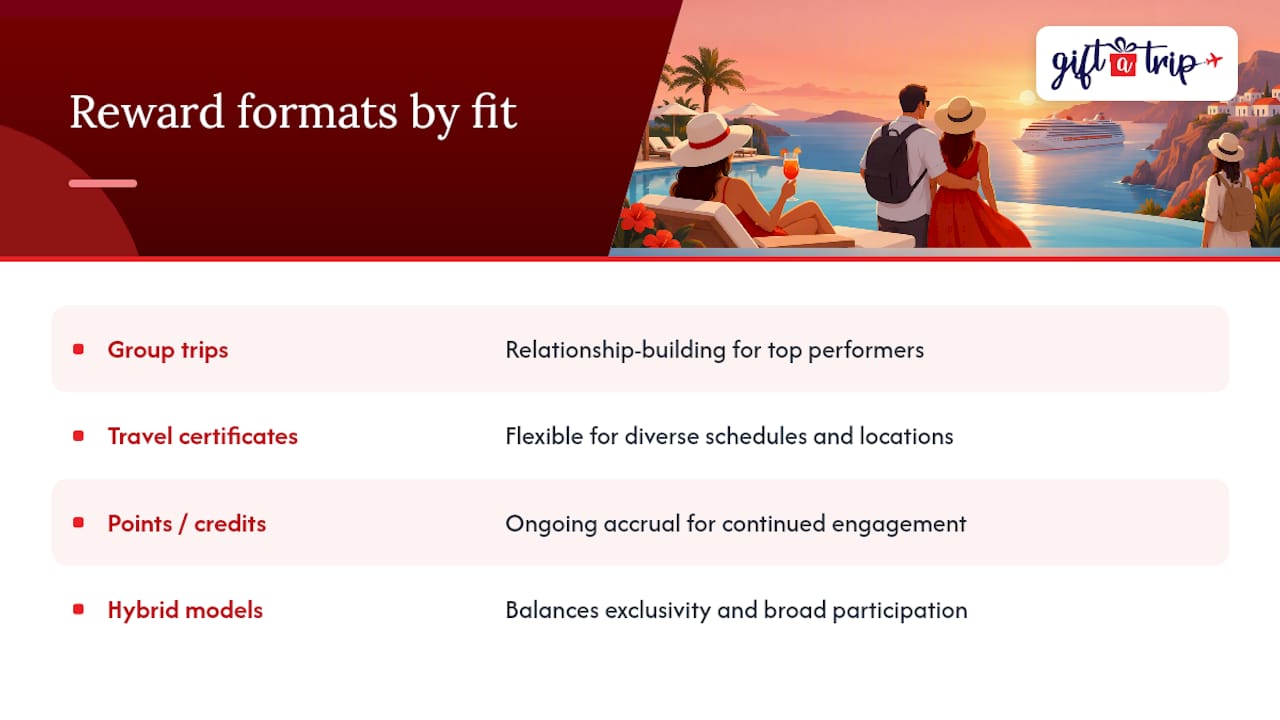
Maritz research on channel seller reward preferences shows partners respond strongly to flexible reward currency, and that added program complexity is a leading cause of partner dropout. That finding argues for certificates over full-group logistics whenever your partner base is large, geographically scattered, or hard to schedule around a single departure date. Curated group trips still win when the goal is relationship-building among a small number of top performers who benefit from being in the same room.
Design checklist: eligibility, tiers, timeline, and budget
A program collapses fastest when the rules are too complicated to explain in one sentence. Before you build anything, lock down five decisions.
- Set one qualification metric per tier. Blending multiple metrics (units sold, margin, new accounts) confuses partners and slows sign-up.
- Limit tiers to three or four. More than that dilutes the aspirational pull of the top prize.
- Publish the qualification window early. Partners need months, not weeks, to plan around a sales push.
- Set a booking cadence. Decide now whether certificates expire, roll over, or require redemption within a fixed period.
- Build the budget around cost-per-partner, not cost-per-trip. Certificates that bundle taxes and resort fees simplify this math and remove surprise costs at redemption.
- Flag tax and compliance questions early. Award travel can carry excise tax and reporting considerations, and the IRS has addressed related questions in private letter rulings, so loop in finance or tax counsel before finalizing structure.
Our guide to structuring channel incentive trips walks through eligibility and destination selection in more detail, and our 2026 budgeting guide breaks down cost line items for HR teams building a first-year budget.
Pro Tip: Draft your qualification rules, then hand them to someone outside the program and ask them to explain the tiers back to you. If they can’t in under a minute, simplify.
Delivering the trip: logistics, vendors, and risk
Once the program design is set, execution is where most incentive trips actually succeed or fail. A handful of operational pieces need owners before the qualification period even starts.
- Vendor roles: a travel management company or destination management company (DMC) typically handles group logistics, while hotels and airlines manage room and seat allotments.
- Booking mechanics: confirm blackout dates, allotment limits, and certificate redemption workflows well ahead of the qualification deadline.
- Risk management: build in travel insurance options and a contingency plan for weather, visa issues, or last-minute cancellations.
- Documentation: collect passport and emergency contact information early so nothing holds up final travel.
- Data and communication: keep a single source of truth for who has qualified, so support teams aren’t fielding conflicting answers.
For programs using certificates instead of a single group departure, redemption logistics are lighter: the certificate itself carries the included fees and blackout terms, which removes most of the vendor coordination a full group trip requires.
Keeping partners engaged from launch to post-trip
A qualification period that goes quiet after launch loses momentum fast. The programs that stay top of mind use a steady cadence of nudges rather than one big announcement.
- Launch messaging: explain the tiers, the timeline, and what qualifies in one clear communication, then repeat it in every channel partners already use.
- Progress dashboards or leaderboards: give partners a running view of where they stand relative to the qualifying threshold.
- Milestone nudges: a message at 25%, 50%, and 75% of the way to qualification keeps effort from stalling midway.
- Personalization and choice: letting partners choose their destination or certificate type, rather than assigning one, measurably improves perceived value.
- Post-trip alumni content: recap photos, testimonials, and an early look at next year’s program turn one trip into an ongoing relationship instead of a one-off reward.
Pro Tip: Send the milestone nudge as a personal note from the partner’s account manager, not a mass email. Partners respond to a name, not a system.
Proving the program works: KPIs and measurement
Finance will ask for numbers, so build the measurement plan before the trip, not after. A few KPIs cover most of what leadership wants to see:
- Sales lift: incremental revenue during and immediately after the qualification window, compared against a control group of non-qualifying partners.
- Partner retention: whether qualifying partners renew or expand their relationship in the following cycle.
- Program NPS: a simple post-trip survey score that tracks whether partners would recommend the program to peers.
- Cost-per-incremental-sale: total program cost divided by the sales lift attributable to the incentive, not total sales.
Industry research from the IRF recommends running a short pilot and checking results at 30, 90, and 180 days rather than waiting for a full annual cycle to judge impact. Pairing a pilot group against a matched control group is the clearest way to isolate what the trip actually caused versus what the market was already doing. Our CFO playbook on proving ROI walks through how to frame these numbers for a finance audience. For agency-level planning support, Elite Travel Group’s guide to incentive travel that motivates covers additional operational detail worth reviewing before a full rollout.
What actually separates a good program from a forgettable one
The programs that work aren’t the ones with the biggest budget or the most exotic destination. They’re the ones a partner can explain to a colleague in one sentence and actually believe they can win. Overengineering is the most common failure mode I see: five qualification metrics, three approval steps, and a redemption window nobody remembers until it’s closed.
Certificates earn their place here because they remove friction at exactly the point where programs usually lose people, the gap between “I qualified” and “I actually got my trip.” A curated group trip still has real value for building culture among a small top tier, but for most of a partner base, flexibility beats spectacle. The model of digital delivery, included taxes and fees, and bulk or custom ordering reflects that same logic: reduce administrative weight so the reward itself does the motivating.
— Donovan
How Gift A Trip supports partner incentive travel programs
Building a partner incentive program shouldn’t mean months of vendor negotiation before a single reward reaches a qualifier. Gift A Trip’s Flex Trip Collections work well for mid and lower tiers where partners want choice over a fixed destination, and the certificates already include taxes and resort fees, so there are no surprise costs at redemption.
For programs run at scale, our corporate gifting solutions cover the details that usually eat up a program manager’s time:
- Custom Trip Selection Sites let each partner browse and pick their own reward within your program’s rules.
- Airfare Vouchers, all denominations, fill the gap when a partner’s ideal reward includes travel to the trip itself.
- Custom, Branded Gift Box Delivery adds a physical presentation moment for top-tier winners, with Red Box Delivery ($69 one-off) as a premium unboxing option.
Visit our corporate gifting page to request a quote or start a pilot order for your next qualification cycle.
Sources
- What the Incentive Travel Index 2025 tells us about the future of incentive travel | MPI
- Incentive Travel Index 2025 released | The IRF
- What are Channel Sellers’ Favorite Reward Types? | Maritz
- IRS PLR (example) on reward points and air transportation excise taxes
FAQ
How much does a travel agent make on a $10,000 trip?
Travel agent commissions vary widely by supplier and booking type, and no single published rate applies across the industry. Program managers using certificates that bundle taxes and fees avoid this variable entirely, since the reward’s cost is fixed at purchase rather than dependent on commission structures.
Can you give me an example of incentive travel?
A common example is a tiered channel partner program where top sellers earn a curated group trip to one destination while other qualifiers receive a flexible travel certificate they can redeem on their own schedule. This hybrid structure is widely used because it rewards top performers with a shared experience while keeping the broader program manageable.
What companies do incentive trips?
Incentive travel programs are common among manufacturers, technology vendors, financial services firms, and any business that sells through a network of distributors, resellers, or agents. The specific companies running these programs aren’t tracked in a single public list, but the Incentive Travel Index surveys professionals across these industries each year.
What is an incentive travel program?
An incentive travel program is a structured reward system that offers trips, travel certificates, or travel credit to partners or employees who hit defined performance goals. The 2025 Incentive Travel Index found that 75% of professionals value these programs, though only 25% currently build them into formal business strategy.