
Valid travel sweepstakes rules must disclose, at minimum: eligibility requirements (age, residency, employee exclusions), complete prize details with approximate retail value (ARV), how to enter including a free alternate method of entry (AMOE), start and end dates with time zone, odds of winning, sponsor identity and contact, winner selection and notification procedures, tax responsibility, and “void where prohibited” language. Under federal and state consumer-protection laws, official rules function as a binding contract between the sponsor and every entrant — missing any of these elements exposes sponsors to regulatory action, civil liability, and potential lottery classification.
Quick pre-launch checklist:
- Draft and post official rules at every point of entry before the promotion goes live
- Include “NO PURCHASE NECESSARY” in conspicuous type and a clearly described AMOE
- Check whether your total prize ARV triggers state registration and bonding (NY/FL above ~$5,000; RI retail above ~$500)
- Disclose the full ARV of every prize and who bears the tax liability
- Set up a process to issue Form 1099-MISC for prizes above $2,000 (for prizes awarded after December 31, 2025) and to collect W-9s from winners
- Get legal counsel to review rules before launch for any multi-state or high-value campaign
Key Takeaways
Compliant travel sweepstakes rules require eligibility, ARV, a free AMOE, dates with time zones, odds, sponsor identity, winner procedures, and tax disclosures — all before the promotion opens.
| Point | Details |
|---|---|
| Official rules are a binding contract | Every required element (eligibility, ARV, AMOE, odds, sponsor ID) must appear before launch. |
| AMOE eliminates lottery risk | The free entry path must offer equal dignity to the paid path — same odds, same visibility. |
| State registration triggers at ~$5,000 | NY and FL require pre-registration and bonding above ~$5,000 ARV; RI retail threshold is ~$500. |
| 1099-MISC threshold is now $2,000 | For prizes awarded after December 31, 2025; winner tax liability is unchanged regardless of threshold. |
| Giftatrip simplifies prize fulfillment | Digital travel certificates include defined ARV, covered taxes and resort fees, and documented redemption terms. |
Table of Contents
- What must official travel sweepstakes rules include?
- A fill-in-the-blank template for official rules
- How do you avoid accidentally running an illegal lottery?
- Which states require registration and bonding before you launch?
- How are travel prizes taxed, and what forms must sponsors file?
- How should you design entry methods for equal treatment?
- How do you select winners and document the process?
- What platform rules apply when you promote on social media?
- Common compliance mistakes and scam red flags to know
- Using travel gift certificates as prizes: compliance notes
- A practical perspective on travel sweepstakes compliance
- Giftatrip makes travel prize fulfillment straightforward
- Sources
- FAQ
What must official travel sweepstakes rules include?
Every element below is either legally required or operationally necessary to defend your promotion against a regulator, a disgruntled entrant, or a state attorney general.
Eligibility
State who can enter: minimum age (typically 18, sometimes 21 for alcohol-adjacent prizes), legal residency (U.S. residents only, or specific states), and exclusions for employees, officers, directors, and their immediate household members. Include “void where prohibited by law” and specify which states or jurisdictions are excluded if you know them in advance.
Entry method and AMOE
Describe every way to enter, step by step. If one entry path involves a purchase or any cost, you must offer a free AMOE with equal dignity. The FTC warns against deceptive practices that make a purchase appear required — so “NO PURCHASE NECESSARY” must appear prominently, not buried in fine print. State the time zone for start and end dates and entry deadlines.
Prize details and ARV
List every prize: the number of prizes, a full description (destination, hotel category, number of nights, included meals, transportation), and the ARV. For travel prizes, specify what is and is not included — airfare, resort fees, taxes, ground transfers, gratuities, and any blackout dates. Sponsors have the right to substitute a prize of equal or greater value; state that right explicitly. See the section below on resort fee treatment for why this detail matters more than most sponsors realize.
Pro Tip: State the ARV as a specific dollar figure, not a range. Regulators and courts treat a vague ARV as a disclosure failure, and it complicates the winner’s tax reporting.
Odds of winning
Either state the exact odds (when the entry pool is fixed) or include language such as: “Odds of winning depend on the total number of eligible entries received.” Never omit odds entirely.
Winner selection and notification
Name the selection method (random draw, third-party drawing service, judging panel), who conducts it, the draw date, and how winners are notified (email, phone, certified mail). Set a claim period — typically 14 to 30 days — and state what happens to unclaimed prizes (alternate winner drawn or prize forfeited).
Sponsor identity and contact
Include the sponsor’s full legal name, mailing address, and a way to obtain a copy of the official rules (URL or written request address). This is not optional; it is a baseline disclosure under consumer-protection law.
Tax and reporting responsibilities
State that all federal, state, and local taxes on prizes are the winner’s sole responsibility. Disclose that the sponsor will issue tax forms as required by law. Under IRC §74, prize fair market value is gross income to the winner — no exceptions for travel prizes.
Operational clauses
Include modification and cancellation rights (force majeure, technical failures), governing law and jurisdiction, a dispute-resolution clause, a release of liability, and a publicity consent clause (winner’s name and likeness may be used for promotional purposes, subject to applicable law). Add a privacy/data-use notice and a link to your full privacy policy — required under CCPA for California residents and best practice everywhere.
A fill-in-the-blank template for official rules
Use these modular snippets as a starting draft. Have counsel adapt them before launch.
Eligibility snippet:
How to enter / AMOE snippet:
Prize / ARV snippet:
Winner selection / odds snippet:
Taxes snippet:
Sponsor / governing law snippet:
Pre-launch checklist before you publish:
- Rules are posted at every point of entry (website, app, in-store display, social post)
- AMOE is described clearly and is at least as prominent as the paid entry path
- State registration and bonding requirements have been checked for NY, FL, and RI
- Social-platform disclaimers are included in every post and influencer brief
- Vendor contracts (hotel, airline, certificate provider) are signed and inventory confirmed
- Legal counsel has reviewed and approved the final rules document
The template above is a starting point, not a finished legal document. Corporate counsel should begin the review process well before launch — ideally four to six weeks out for a national campaign.
How do you avoid accidentally running an illegal lottery?
A promotion becomes an illegal lottery the moment it combines three elements: a prize, chance, and consideration. Sweepstakes eliminate consideration. Contests eliminate chance (winners are judged on skill). Lotteries have all three — and running one without a state license is a criminal offense in most U.S. jurisdictions.
The three-element test:
- Prize: Something of value awarded to a participant
- Chance: Winners are selected randomly, not by skill
- Consideration: Participants must pay money, make a purchase, or expend significant effort to enter
The trap is consideration. A purchase requirement is obvious consideration. Less obvious: a premium text-message entry (the entrant pays the SMS fee), a paid app download required to access the entry form, or an AMOE so burdensome that it effectively excludes free entrants.
How AMOE eliminates the risk:
An Alternate Method of Entry gives entrants a free path into the same drawing. The critical concept is “equal dignity” — the free path must be realistically achievable and offer the same odds as the paid path. If a purchase earns 10 entries and the AMOE earns 1, that disparity may still constitute covert consideration. If a purchase earns 1 entry and the AMOE earns 1, the promotion is clean.
Problematic AMOE patterns to avoid:
- A mail-in address that is difficult to find or buried in footnotes
- A mail-in deadline that closes before the promotion ends
- A free entry path that earns dramatically fewer entries than the paid path
- Requiring a paid app download before the AMOE form is accessible
Pro Tip: Draft the AMOE first, then design the paid entry path around it. If the free path feels like an afterthought, regulators will treat it as one.
Which states require registration and bonding before you launch?
State registration and bonding are the most commonly missed pre-launch obligations in national sweepstakes. Missing them does not just expose you to fines — it can invalidate the entire promotion.
| State | Registration Required | Bond Required | Common Threshold |
|---|---|---|---|
| New York | Yes | Yes | Prize ARV above ~$5,000 |
| Florida | Yes | Yes | Prize ARV above ~$5,000 |
| Rhode Island | Yes (retail) | No | Retail promotions above ~$500 |
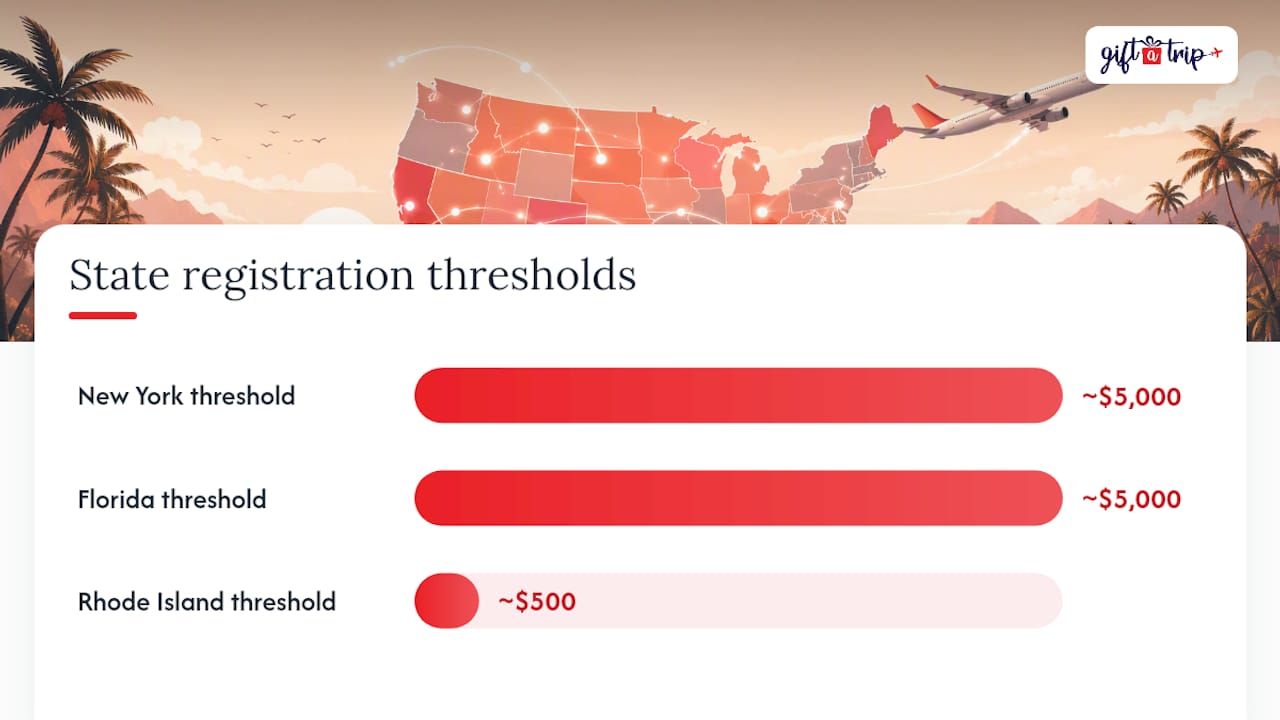
New York and Florida require sponsors to register the promotion with the state and post a bond equal to the total prize value before the sweepstakes opens. Rhode Island’s threshold is lower and applies specifically to retail-based promotions. These thresholds are the most commonly cited benchmarks; always verify current requirements with counsel, as state rules change.
Operational workflow for state compliance:
- Calculate total prize ARV across all prizes before drafting rules
- Run a jurisdictional check: does the ARV exceed any state’s registration threshold?
- Allow at least four weeks for bond procurement and state filing in NY and FL
- Retain copies of all registration filings, bond certificates, and confirmation receipts
- Post winner lists as required (NY requires public posting of winners)
- Implement “void where prohibited” operationally: geo-block or screen entrants from excluded jurisdictions at the point of entry, not just in the rules
State-by-state variation makes a one-size-fits-all approach genuinely risky. Sponsors running national sweepstakes should budget both lead time and legal fees for registration and bonding in these three states whenever the prize pool crosses the relevant threshold.
How are travel prizes taxed, and what forms must sponsors file?
Prize taxation is non-negotiable. Under IRC §74, the fair market value of any prize is gross income to the winner. A trip to Cancun worth $4,500 is $4,500 of taxable income — full stop. Winners cannot avoid this by declining the cash equivalent; the ARV of the prize itself is what gets reported.
Key reporting thresholds:
| Form | Threshold (prizes awarded after Dec 31, 2025) | Who Files |
|---|---|---|
| Form 1099-MISC | $2,000 (raised from $600) | Sponsor files; winner receives copy |
| Form W-2G | $600 or more (gambling winnings) | Payer files; applies to certain game-of-chance promotions |
The 1099-MISC threshold increase to $2,000 reduces paperwork for lower-value promotions, but it does not reduce the winner’s tax liability. A winner who receives a $1,500 travel prize still owes income tax on $1,500 — they just may not receive a 1099. Sponsors must still record the prize ARV and winner identity regardless of whether a form is issued.
Sponsor checklist for tax compliance:
- Collect a completed IRS Form W-9 from every winner before delivering the prize
- Issue Form 1099-MISC for prizes with ARV at or above $2,000 (for prizes awarded after December 31, 2025)
- Retain prize fulfillment records, W-9s, and copies of issued 1099s for at least four years
- Withhold federal income tax (24%) if the winner refuses to provide a W-9 and the prize value exceeds $600
Winner checklist:
- Report the prize ARV on your federal tax return as “other income,” even if you receive no 1099
- Keep documentation of the prize description and ARV in case of an IRS inquiry
- Consult a tax professional if the prize value is large enough to affect your estimated tax payments
IRS Publication 525 covers taxable and nontaxable income and is the primary reference winners should consult for prize reporting guidance.
How should you design entry methods for equal treatment?
Entry method design is where many sponsors create compliance problems without realizing it. The goal is a system where every entry — paid, free, online, or mail-in — has an equal chance of winning and is documented well enough to survive an audit.
Common entry methods and their risk profiles:
- Online form: Low risk; easy to timestamp and export; most common for travel sweepstakes
- Social media comment or tag: Moderate risk; platform rules restrict certain mechanics; entries must be captured and logged manually or via a third-party tool
- Text message: Higher risk; premium SMS is likely consideration; standard SMS to a short code is generally acceptable if entry is free
- Mail-in postcard: Required for a valid AMOE in many campaigns; low volume but legally necessary
Entry limits and bonus entries:
Set a clear daily or total entry limit per person and per household. If you offer bonus entries for sharing, following, or purchasing, the AMOE must offer a path to the same bonus entries — or the bonus structure itself becomes consideration. Document every entry limit decision in the rules and enforce it consistently.
Documentation practices that protect you:
- Export timestamped server logs of all online entries at the close of the promotion
- Maintain a separate log of mail-in AMOE entries with postmark dates
- Apply the same disqualification criteria across all entry channels
- Flag and investigate suspected duplicate or fraudulent entries before the draw, using consistent criteria stated in the rules
For campaigns that include accessibility accommodations for disabled entrants, document those accommodations in the rules and in your operational records — both as a legal protection and as a matter of basic fairness.
How do you select winners and document the process?
The draw itself is the moment of highest legal exposure. A poorly documented selection process is the fastest path to a dispute you cannot win.
Step-by-step winner selection process:
- Close entries at the exact date and time stated in the rules; export and lock the entry pool
- Remove ineligible entries (duplicates, incomplete forms, entries from excluded jurisdictions)
- Conduct the random draw using a documented method — a third-party drawing service, a witnessed random-number generator, or a certified auditor
- Select alternates (typically 3–5) in the same draw in case the primary winner cannot be verified
- Notify the winner via the channel stated in the rules (email, phone, certified mail) within the timeframe stated
- Send a winner affidavit and IRS Form W-9 for completion within the claim period (typically 14–30 days)
- Verify eligibility: confirm age, residency, and that the winner is not an excluded employee or household member
- Deliver the prize and retain all fulfillment documentation
Recordkeeping checklist:
- Timestamped entry logs for all channels (online, mail-in, social)
- AMOE entry records with postmark or submission dates
- Documentation of all notification attempts (email delivery receipts, certified mail tracking)
- Signed winner affidavit of eligibility and release
- Completed W-9 and copy of issued 1099-MISC
- Prize fulfillment receipt or certificate delivery confirmation
- Retain all records for a minimum of three years; four years is safer for tax-related documents
Suggested timeline from draw to delivery:
- Day 0: Draw conducted; alternates selected
- Days 1–3: Winner notified via stated channel
- Days 4–14: Winner returns affidavit and W-9
- Days 15–21: Eligibility verified; prize delivery initiated
- Days 22–45: Prize delivered; 1099-MISC issued if required
What platform rules apply when you promote on social media?
Every major platform has its own promotion policies, and violating them can result in post removal, account suspension, or worse. The rules below reflect common platform requirements; always check current platform policies before launch, as they update frequently.
Platform requirements at a glance:
- Instagram and Facebook (Meta): Require an acknowledgment that the platform is not a sponsor, co-sponsor, or administrator of the promotion. Prohibit mechanics that require sharing on a personal timeline as a condition of entry. Allow “like to enter” and “comment to enter” mechanics on a brand page.
- TikTok: Requires compliance with its Branded Content Policy; prohibit mechanics that require following as the sole condition of entry in some markets. Sponsored content must be disclosed.
- YouTube: Requires compliance with its contest policies; prohibit sub-for-sub or view-for-view mechanics tied to prize eligibility.
Required disclaimer for every social post:
Include this language in the caption of every promotional post, in influencer briefs, and in any paid social creative. Platform rules require this acknowledgment and noncompliance risks account penalties.
Pro Tip: Add a platform compliance checklist to your influencer contract as an exhibit. Require influencers to include the disclaimer verbatim in their posts and to submit screenshots for your records before payment is released.
Privacy disclosures matter here too. If you collect entrant data through a social entry mechanic, your rules must disclose how that data is used, stored, and shared — required under CCPA for California residents and a best practice under any applicable state privacy law.
Common compliance mistakes and scam red flags to know
Sponsor mistakes that create legal exposure:
- Burying the AMOE in footnotes or making it harder to find than the purchase path
- Offering an AMOE with dramatically fewer entries than the paid path (covert consideration)
- Failing to register and bond in NY, FL, or RI before the promotion opens
- Omitting the ARV from prize descriptions or understating it
- Not disclosing that winners bear tax responsibility
- Unclear redemption logistics for travel prizes (no booking window, no blackout date disclosure)
Entrant red flags that signal a scam:
Real sweepstakes never require payment to claim a prize. If you are told you won but must pay “taxes,” “processing fees,” “shipping and handling,” or “insurance” before receiving your prize, it is almost certainly a prize scam. Other red flags: being asked to wire money or buy gift cards to release a prize, being pressured to act immediately, or receiving a notification for a sweepstakes you never entered.
If you encounter a prize scam, report it to the FTC at ReportFraud.ftc.gov. Sponsors who discover a compliance error mid-campaign should pause the promotion, consult counsel, and correct the rules with notice to existing entrants before resuming.
Using travel gift certificates as prizes: compliance notes
Travel gift certificates are among the cleanest prize formats for sweepstakes — they have a defined ARV, digital delivery, and clear redemption terms. But the rules must describe them precisely to avoid post-award disputes.
How to describe a travel certificate in your official rules:
- State the certificate’s ARV as a specific dollar figure
- List what is included: resort nights, taxes, resort fees, and any included amenities
- List what is not included: airfare, ground transportation, gratuities, incidental charges
- State the redemption window (e.g., “Certificate must be redeemed within 18 months of award date”)
- Disclose blackout dates or peak-season restrictions
- State the substitution policy if the specific property or package is unavailable
Sample rule clause for a travel certificate prize:
Supplier coordination checklist:
- Confirm inventory availability for the redemption window before the promotion opens
- Get written confirmation of blackout dates from the certificate provider
- Clarify who handles booking changes, cancellations, and refunds
- Confirm the certificate provider’s process for winner identity verification at redemption
- Document the delivery method (digital delivery via email) and the timeline for sending the certificate after winner verification
Pro Tip: Run a test redemption with the supplier before launch. Confirm the booking process works end-to-end for a winner who has never used a travel certificate before. A smooth redemption experience protects your brand and reduces post-award disputes.
For executing travel rewards with turnkey certificates, the operational steps above apply whether you are running a consumer sweepstakes or a corporate incentive program. Suppliers may have their own booking terms that affect the winner’s experience — disclose that in the rules.
A practical perspective on travel sweepstakes compliance
Most sponsors treat official rules as a legal formality — something to hand off to counsel at the last minute. That instinct gets expensive. The compliance failures that generate FTC inquiries and state enforcement actions are almost always operational, not legal: an AMOE that nobody can find, a prize ARV that was never calculated, a state registration that was skipped because nobody checked the prize total.
Here is the prioritized checklist that actually matters, in order:
- Legal review first. Get counsel involved before you finalize the prize structure, not after. The prize ARV determines whether you need state registration and bonding — that decision has to happen before rules are drafted, not after they are published.
- Verify the AMOE is real. Test it yourself. If you cannot complete the free entry path in under two minutes, it will not survive scrutiny.
- Run the state registration check. If total prize ARV exceeds $5,000, assume NY and FL require registration and bonding until counsel tells you otherwise.
- Check platform rules. Social platforms update their promotion policies without announcement. Check the current policy for every platform you plan to use, the week before launch.
- Test supplier fulfillment. For travel prizes specifically, confirm the certificate or booking process works before you announce the winner. A winner who cannot redeem their prize is a compliance and reputational problem simultaneously.
The tax issue surprises sponsors most often. The 1099-MISC threshold increase to $2,000 for prizes awarded after December 31, 2025 reduces paperwork, but it does not reduce winner tax liability. Collect the W-9 before you deliver the prize, every time, without exception.
Giftatrip makes travel prize fulfillment straightforward
Running a compliant sweepstakes is hard enough without chasing down hotel inventory, negotiating blackout dates, and managing winner redemptions manually. Giftatrip’s digital travel certificates give sponsors a prize with a defined ARV, documented inclusions (taxes and resort fees covered), minimal blackout dates, and secure digital delivery — exactly the specifics your official rules need to be complete.
Whether you are running a consumer sweepstakes, a corporate incentive program, or a charitable auction, Giftatrip’s travel certificate distribution guide walks through the fulfillment process so sponsors know exactly what to disclose in their rules and what to expect after the winner is selected. Certificates are available for resorts, hotels, and cruise lines from major brands, with bulk and custom-branded options for larger campaigns.
Sponsors should still have counsel review their official rules before launch — Giftatrip handles the prize logistics, not the legal compliance. Browse available certificates and get started at Giftatrip.

Sources
- Sweepstakes law: A primer on how to run compliant promotions | Mondaq
- FTC — Lotteries, sweepstakes & contests
- 26 U.S. Code § 74 — Prizes and awards
- Sweepstakes, Contests and Other Types of Giveaways in the Digital Era — Venable LLP (PDF)
This article is general information, not a substitute for advice from a qualified lawyer. Consult a qualified legal professional about your own circumstances before acting on anything here.
FAQ
What are the legal requirements for sweepstakes in the United States?
U.S. sweepstakes must include official rules disclosing eligibility, prize details and ARV, entry method with a free AMOE, start and end dates, odds, sponsor identity, and winner procedures. Sponsors must also comply with state registration and bonding requirements in states like New York and Florida when total prize ARV exceeds ~$5,000.
What are the typical rules of a travel sweepstakes?
Travel sweepstakes rules typically cover who can enter, how to enter for free, the prize description with ARV (including what is and is not covered), blackout dates, odds of winning, how winners are selected and notified, the claim period, and the winner’s tax responsibility. The rules function as a binding contract between the sponsor and entrants.
Can you legally run a giveaway that requires a purchase to enter?
No — a promotion that requires a purchase and awards prizes by chance is an illegal lottery in most U.S. states. Sponsors must offer a free alternate method of entry (AMOE) with equal dignity to the paid path to remove “consideration” and qualify as a legal sweepstakes.
Do sweepstakes winners have to pay taxes on travel prizes?
Yes. Under IRC §74, the fair market value of any prize is taxable income to the winner, regardless of whether a Form 1099-MISC is issued. For prizes awarded after December 31, 2025, sponsors must issue a 1099-MISC when the prize ARV reaches $2,000 or more, but winners must report prize income on their tax returns even below that threshold.
What are the red flags that a travel sweepstakes is a scam?
The clearest red flag is being asked to pay any fee — taxes, processing, shipping, or insurance — to claim a prize. Legitimate sweepstakes never require payment to receive a prize. Other warning signs include pressure to act immediately, requests for wire transfers or gift cards, and notifications for contests you never entered. Report suspected scams to the FTC at ReportFraud.ftc.gov.