
Travel certificates are the strongest corporate holiday travel gift you can buy this season. The Incentive Research Foundation confirms that experiential rewards create vivid, social memories that cash simply cannot match, and Giftatrip delivers them as secure digital certificates with taxes and resort fees included.
Before the next budget meeting, lock in three steps:
- Set your per-recipient budget and confirm whether your company will gross up the tax liability.
- Place your bulk order through a vendor that provides FMV documentation (the IRS requires it).
- Schedule delivery at least two weeks before your holiday event so recipients have time to plan.
Key Takeaways
Travel certificates are the most effective corporate holiday gift when tax handling, vendor terms, and rollout timing are planned together from the start.
| Point | Details |
|---|---|
| Travel beats cash | Experiential awards create vivid, social memories that outlast any cash bonus, per the Incentive Research Foundation. |
| Tax reporting is required | Most travel certificates are taxable wages; obtain FMV documentation and decide on gross-up before ordering. |
| Vendor terms matter most | Insist on taxes/fees included, minimal blackout dates, and written redemption support SLAs before signing. |
| Start procurement 8–10 weeks out | A four-phase rollout (Plan, Buy, Distribute, Follow Up) keeps holiday delivery on schedule. |
| Giftatrip for bulk programs | Giftatrip offers secure digital delivery, included taxes/resort fees, minimal blackout dates, and FMV documentation for corporate orders. |
Table of Contents
- Why travel certificates outperform cash for holiday recognition
- US tax and payroll rules you need to plan for
- Which travel certificate types should you choose?
- How to run the procurement and rollout on schedule
- Questions to ask vendors before you sign anything
- What running these programs actually teaches you
- Giftatrip makes corporate holiday travel gifting straightforward
- Sources
- FAQ
Why travel certificates outperform cash for holiday recognition
Cash feels transactional. A travel certificate feels like a reward worth talking about at dinner.
The Incentive Research Foundation’s research identifies two qualities that make travel awards stick: vividness and social storytelling. Employees retell travel experiences for months, which extends the recognition moment far beyond the day the gift lands in an inbox. A bonus check rarely gets a second mention.
Four behavioral reasons travel certificates consistently outperform cash or generic gift cards:
- Vividness: A beach resort or cruise conjures a specific, desirable image. Cash conjures nothing.
- Social storytelling: Recipients share photos, stories, and plans, turning one award into ongoing brand visibility.
- Aspirational framing: Travel feels like a prize, not a paycheck supplement, which raises perceived value above face value.
- Perceived prestige: A luxury resort certificate signals that the company invested in the employee’s experience, not just their wallet.
Stat to know: The Incentive Research Foundation reports that employees who receive experiential travel awards are significantly more likely to retell the experience over time compared to cash recipients, compounding the program’s motivational impact.
Frame the award in your communications as a badge of achievement, not a cash equivalent. A subject line like “You’ve earned a getaway” lands differently than “Here’s your holiday bonus.” That framing shift costs nothing and meaningfully changes how recipients perceive the gift.
US tax and payroll rules you need to plan for
The short answer: travel certificates given to employees as rewards are almost always taxable compensation. Plan for that before you order.
The IRS is explicit that cash equivalents, including most gift certificates, are not de minimis fringe benefits and must be reported as wages. The Lexology legal analysis reinforces this: gift cards and certificates are generally taxable wages unless they meet narrow, infrequent, low-FMV exceptions that rarely apply to a planned holiday program.
Key rules to apply:
- De minimis threshold: The IRS de minimis exclusion covers only occasional, low-value benefits. A travel certificate with meaningful face value does not qualify.
- Cash-equivalent rule: Certificates redeemable for general merchandise or travel are treated as cash equivalents, making them fully taxable.
- FMV calculation: The taxable amount is the fair market value of the certificate, not its cost to you. Get FMV documentation from your vendor.
- Accountable plans: IRS Publication 5137 covers accountable plans for travel reimbursements. To exclude a reimbursement from wages, you need a business connection, proper documentation, and timely return of any excess. Pure reward certificates do not qualify.
- Gross-up option: Many employers cover the tax on behalf of the employee. Practitioner guidance recommends gross-up for higher-tier awards to preserve the perceived value of the gift.
| Gifting structure | Typical tax treatment | Buyer action |
|---|---|---|
| Direct travel certificate (reward) | Taxable wages; report on W-2 | Obtain FMV documentation; withhold or gross up |
| Gross-up approach | Employer covers employee’s tax | Calculate gross-up amount; add to payroll |
| Travel as business meeting | Potentially excludable if mostly business days | Document business purpose; consult tax advisor |
| Travel reimbursement (accountable plan) | Excludable if plan requirements met | Require receipts, business connection, timely return |
Pro Tip: Loop in payroll and a tax advisor before you finalize the order. Ask your vendor for an FMV letter for each certificate tier. Giftatrip can provide supporting documentation to help your team handle reporting accurately.
Which travel certificate types should you choose?
Match the certificate to your audience: a luxury cruise package for top performers, a flexible digital hotel certificate for a broad recognition program.
Certificate categories to consider:
- Digital single-brand hotel certificates: Redeemable at one brand’s properties; easy to deliver at scale.
- Multi-brand vacation packages: Cover flights, hotel, and activities; higher perceived value for senior employees.
- Cruise certificates: Brands like Virgin Voyages or Crystal Cruises carry strong aspirational appeal for premium tiers. Giftatrip offers Virgin Voyages cruise certificates and Crystal Cruises certificates for exactly this use case.
- Full-vacation packages: All-inclusive resort stays with taxes and fees covered; the clearest “no hidden cost” story to tell recipients.
- Branded hotel certificates: Marriott, Hilton, and similar; familiar names that recipients trust immediately.
Vendor terms that actually affect recipient satisfaction:
- Taxes and resort fees included: If the recipient pays these at checkout, the gift feels smaller than advertised. Giftatrip includes taxes and resort fees in its certificates.
- Blackout dates: Minimal blackout dates are non-negotiable for broad programs. Giftatrip maintains minimal blackout restrictions.
- Expiration and transferability: Certificates with short windows or no transfer rights create frustration. Confirm both before signing.
- Substitution and refund policy: What happens if a property closes or a recipient cannot travel? Get this in writing.
- Redemption support: Is there a support line for recipients? Poor support damages program perception.
- White-labeling: Can you brand the certificate with your company logo and a personalized message?
- Fulfillment SLA: How quickly are bulk orders processed and delivered?
The three terms that most often change recipient satisfaction: taxes/fees included, blackout date limits, and redemption support quality.
How to run the procurement and rollout on schedule
A four-phase approach keeps holiday travel gifting on track: Plan → Buy → Distribute → Follow Up.
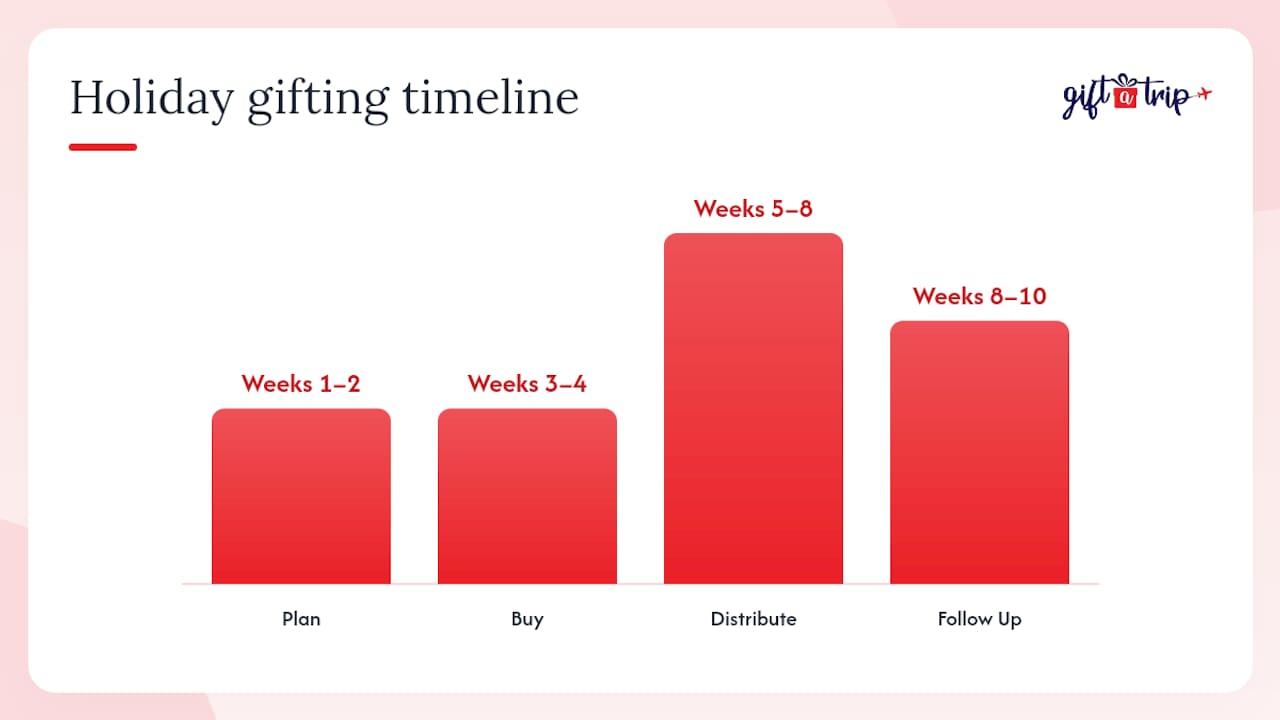
For a December holiday delivery, an 8–10 week timeline works like this:
| Week | Milestone | Owner |
|---|---|---|
| 1–2 | Budget approval; tax/gross-up decision | HR + Finance |
| 3 | Vendor selection; FMV documentation request | Procurement |
| 4 | Bulk order placed; personalization brief submitted | HR + Vendor |
| 5–6 | Certificates produced; branded packaging confirmed | Vendor |
| 7 | Internal review; payroll notified of taxable amounts | HR + Payroll |
| 8 | Certificates delivered to recipients | Communications |
| 8–10 | Redemption support window; feedback collected | HR |
Numbered steps for the procurement lead:
- Confirm per-recipient budget and total headcount.
- Decide on gross-up or employee-pays-tax approach with payroll.
- Request FMV documentation and sample redemption flow from your vendor.
- Submit personalization brief (logo, message, recipient names).
- Confirm delivery format (digital email, physical gift box, or both).
- Notify recipients with a branded announcement that frames the certificate as an achievement.
- Track redemption rate at 30, 60, and 90 days post-delivery.
For travel certificate distribution guidance tailored to HR teams, Giftatrip’s resource covers bulk fulfillment specifics.
Questions to ask vendors before you sign anything
Copy this into your RFP and require written answers.
Due-diligence questions:
- Can you provide FMV documentation for each certificate tier?
- Are taxes and resort fees included in the certificate value?
- What are your blackout date policies, and can you cap them contractually?
- Walk me through a sample redemption flow from the recipient’s perspective.
- How do you handle fraud, proof-of-purchase disputes, and lost certificates?
- What data security and PCI/PII practices govern recipient data?
- Do you offer white-label branding and personalized messaging?
- What is your fulfillment SLA for bulk orders of 100+ certificates?
- What post-redemption reporting do you provide?
Red flags that signal operational risk:
- Vague or unavailable FMV documentation
- No written blackout date limits
- Hard expiration dates with no grace period or notice to recipients
- No bulk-order support or dedicated account manager
- Customer service SLAs measured in days, not hours
- No post-redemption data or reporting
Negotiate for capped blackout dates, substitution flexibility, and a written reporting commitment. Require procurement and legal to review the contract before signing, and always test the redemption path yourself before distributing to employees. Procurement teams should require sample redemption journeys and post-redemption reporting in contracts to protect program reputation and measure ROI reliably.
What running these programs actually teaches you
The tax handling and the emotional payoff pull in opposite directions, and that tension is where most programs stumble. Get the compliance piece wrong and you surprise employees with an unexpected W-2 line item. Get it right and the certificate feels like a pure win.

Two things I’d tell any HR team running this for the first time: pilot with a small group first, maybe 20–30 employees, before scaling to the full organization. You will catch redemption friction, messaging gaps, and payroll questions at a manageable scale. Second, pre-clear the gross-up decision with payroll before the order goes in. Changing course after certificates are delivered creates real administrative pain.
Programs that frame the award as a badge of achievement, communicate the tax handling transparently, and provide strong redemption support consistently outperform those that treat the certificate as a line item. The difference shows up in redemption rates and, over time, in retention data.
Giftatrip makes corporate holiday travel gifting straightforward
Holiday gifting at scale has one real enemy: complexity. Giftatrip removes it. The platform offers secure digital delivery, bulk ordering with customizable gift boxes, personalized messaging, and certificates that include taxes and resort fees, so recipients never hit a surprise charge at checkout. Blackout dates are minimal by design.

For HR teams and event planners managing dozens or hundreds of recipients, Giftatrip’s corporate program covers the full stack: branded packaging, FMV documentation for payroll, and a certificate range that spans hotel stays, resort packages, and cruise lines. Whether you need digital travel certificates for a broad recognition program or premium cruise certificates for top performers, the catalog supports both. Visit Giftatrip’s corporate gifting page to request bulk pricing or start a pilot order for your holiday program.
Sources
- De minimis fringe benefits | Internal Revenue Service
- Anatomy of a successful incentive travel program
- Pubs/IRS extracts on travel reimbursements and de minimis examples (PDF)
- Tax rules for incentive trips, IRS benefit treatment I LCT
- Employer-Provided Gifts: Taxable or Not? – Lexology
This article is general information, not a substitute for advice from a qualified financial advisor. Consult a qualified financial professional about your own circumstances before acting on anything here.
FAQ
Are travel gift certificates taxable to employees?
Yes, in most cases. The IRS treats travel certificates as cash equivalents, making them taxable wages that must be reported on the employee’s W-2. Narrow de minimis exceptions rarely apply to planned holiday programs.
What does “taxes and resort fees included” mean for a travel certificate?
It means the recipient pays nothing extra at check-in. Giftatrip includes taxes and resort fees in its certificates, so the face value is the true value, with no surprise charges.
How early should HR start the procurement process for holiday travel gifts?
Allow 8–10 weeks before your target delivery date. That window covers budget approval, vendor selection, bulk ordering, personalization, payroll notification, and delivery.
Should employers gross up travel certificate awards?
Practitioner guidance recommends gross-up for higher-tier awards to preserve the perceived value. Confirm the approach with payroll before placing the order, and get FMV documentation from your vendor to calculate the gross-up amount accurately.