
Charity raffles are legal for qualifying nonprofits in most U.S. states, but three states ban paid-ticket raffles outright, and every state that allows them requires a permit or registration before you sell a single ticket. The federal layer adds its own requirements: the IRS mandates Form W-2G reporting when a prize (minus the ticket price) is $600 or more and at least 300 times the wager, and 18 U.S. Code §1302 makes mailing raffle tickets or payments through the U.S. Postal Service a federal crime carrying up to two years in prison.
Before you design a ticket or post a single social media announcement, do two things:
- Check your state regulator. Find your state attorney general’s charitable trust division or gaming commission and confirm your organization’s eligibility, permit requirements, and filing deadlines.
- Flag your IRS obligations. Identify whether any prize will trigger W-2G reporting or withholding, and confirm whether your raffle activity could generate unrelated business taxable income (UBTI).
The rest of this guide walks through every layer of compliance, from state permits to prize valuation to day-of drawing procedures, with templates you can adapt.
Key Takeaways
Running a compliant charity raffle in 2026 requires securing a state permit before any ticket sales, following IRS W-2G reporting and withholding rules, and keeping complete records of tickets, receipts, prizes, and volunteer labor.
| Point | Details |
|---|---|
| Check state law first | Alabama, Utah, and Hawaii ban or severely restrict paid-ticket raffles; confirm your state’s rules before planning. |
| Permit before sales | Apply 30–60 days before ticket sales open; no tickets may be sold until the permit number is in hand. |
| IRS W-2G threshold | File Form W-2G when net winnings are $600 or more and at least 300 times the ticket price; withhold 25% on net winnings over $5,000. |
| Document volunteer labor | Substantially all raffle work must be performed by volunteers to qualify for the UBTI exclusion; keep signed role assignments. |
| Travel prize documentation | Collect a written donor letter with FMV, blackout dates, and redemption terms for every donated travel certificate. |
Table of Contents
- Which organizations may legally hold a charity raffle?
- How to read state rules and where raffles are allowed in 2026
- What the state permit process typically looks like
- Federal tax obligations: IRS reporting, withholding, and UBIT risks
- Ticket sales rules, online sales, and advertising requirements
- How to value prizes and handle restricted prize types
- Day-of procedures, drawing methods, and recordkeeping
- Common compliance mistakes and what they cost you
- Your one-page compliance checklist and sample raffle rules
- Donated travel certificates as raffle prizes: what nonprofits need to know
- What most raffle guides get wrong about compliance timing
- Sources
- FAQ
Which organizations may legally hold a charity raffle?
Not every nonprofit automatically qualifies. States set their own eligibility rules, and the variation is real enough to trip up even experienced fundraisers.
The baseline most states use:
- 501©(3) status is the most commonly accepted credential, though many states also allow 501©(4), 501©(6), 501©(7), and similar exempt classes.
- Minimum operating period. According to the Texas Attorney General’s guidance on charitable raffles, states commonly require one to five years of continuous operation before an organization qualifies for a raffle permit. Texas itself requires a qualifying organization to have been in existence for at least three years.
- State registration. Many states require the organization to be registered with the state attorney general’s charity registry or a gaming commission before applying for a raffle permit.
- No for-profit entities. Commercial businesses cannot use the charitable raffle framework, even when donating proceeds to charity.
- No professional fundraisers running the raffle independently. Some states prohibit paid outside promoters from managing the raffle on the organization’s behalf.
Common additional restrictions:
- Members of the organization (and sometimes their immediate families) may be prohibited from winning prizes in some states.
- Some states require that all raffle workers be bona fide members or volunteers of the organization, not paid staff.
- A few states distinguish between “qualified” and “unqualified” exempt organizations and apply different rules to each class.
Pro Tip: If your chapter or affiliate is newly formed, check whether your parent organization’s history satisfies the minimum-years-of-operation requirement. Some state regulators accept a parent organization’s track record on behalf of a chapter, but you must request that determination in writing before applying.
How to read state rules and where raffles are allowed in 2026
States fall into three broad categories, and knowing which bucket yours is in determines everything that follows.
Category 1: Allowed with license or registration (most states). The majority of U.S. states permit charitable raffles for qualifying nonprofits, subject to a permit or registration, ticket disclosure requirements, and post-event reporting. The permit process varies from a simple one-page online form to a multistep application with financial history.
Category 2: Allowed with strict limits. Some states cap the total prize value per raffle, cap individual ticket prices, restrict the number of raffles per year, or require that all proceeds go to specific types of charitable purposes. California is the clearest example: the California Department of Justice requires that at least 90% of gross raffle receipts be used for charitable purposes in California, and organizations must register with the Registry of Charities and Fundraisers before conducting any raffle activity.
Category 3: Prohibited or severely restricted. According to Zeffy’s 2026 state-by-state raffle law roundup, Alabama and Utah prohibit paid-ticket raffles entirely. Hawaii allows only free-entry prize drawings; any raffle requiring a ticket purchase is prohibited. Always confirm current status with the state regulator directly, since legislatures do amend these rules.
State overview (representative examples):
How to find the right regulator page:
- Search “[your state] + charitable raffle + attorney general” or “[your state] + raffle license + gambling commission.”
- Look for the registration form name, the filing deadline relative to your event date, and the fee schedule.
- Confirm whether your state requires a separate permit per event or an annual registration covering multiple raffles.
What the state permit process typically looks like
There is no federal raffle license. Every permit or registration comes from a state agency, and the application workflow follows a recognizable pattern even though the specifics differ by state.
Common application fields you will need to complete:
- Organization legal name, EIN, and mailing address
- Contact person and title
- Raffle dates (start of ticket sales through drawing date)
- Description of each prize and its estimated fair market value
- Estimated gross receipts from ticket sales
- Certificate of tax exemption or IRS determination letter
- Proof of years of operation (often a copy of your earliest IRS filing or state registration)
- Name and contact for any third-party vendor assisting with the raffle
Fees and timelines. Permit fees typically range from $15 to $500 depending on the state and the scale of the raffle. Many states require 30–60 days of processing time, so plan your application well before ticket sales open. Some states issue annual registrations that cover all raffles in a calendar year; others issue single-event permits. If your ticket sales begin in one calendar year and the drawing falls in the next, check whether your permit covers both periods or whether you need a renewal.
Step-by-step permit checklist:
- Confirm your organization meets the state’s eligibility requirements (tax-exempt status, years of operation, state registration).
- Identify the correct state agency and download the current application form.
- Gather supporting documents: IRS determination letter, most recent Form 990, state charity registration certificate.
- Complete the application with all prize descriptions and estimated gross receipts.
- Pay the filing fee and submit by the required deadline (typically 30–60 days before ticket sales begin).
- Receive your permit or registration number and record it — it must appear on every ticket and in advertising.
- Confirm whether your state requires a pre-event report, a post-event report, or both.
- For California, note that aggregate reporting is due by February 1 for the prior reporting period; missing that aggregate report is one of the most common sources of administrative penalties.
Federal tax obligations: IRS reporting, withholding, and UBIT risks
This is where volunteer organizers most often get surprised. Federal tax rules apply on top of state permits, and they are not optional.
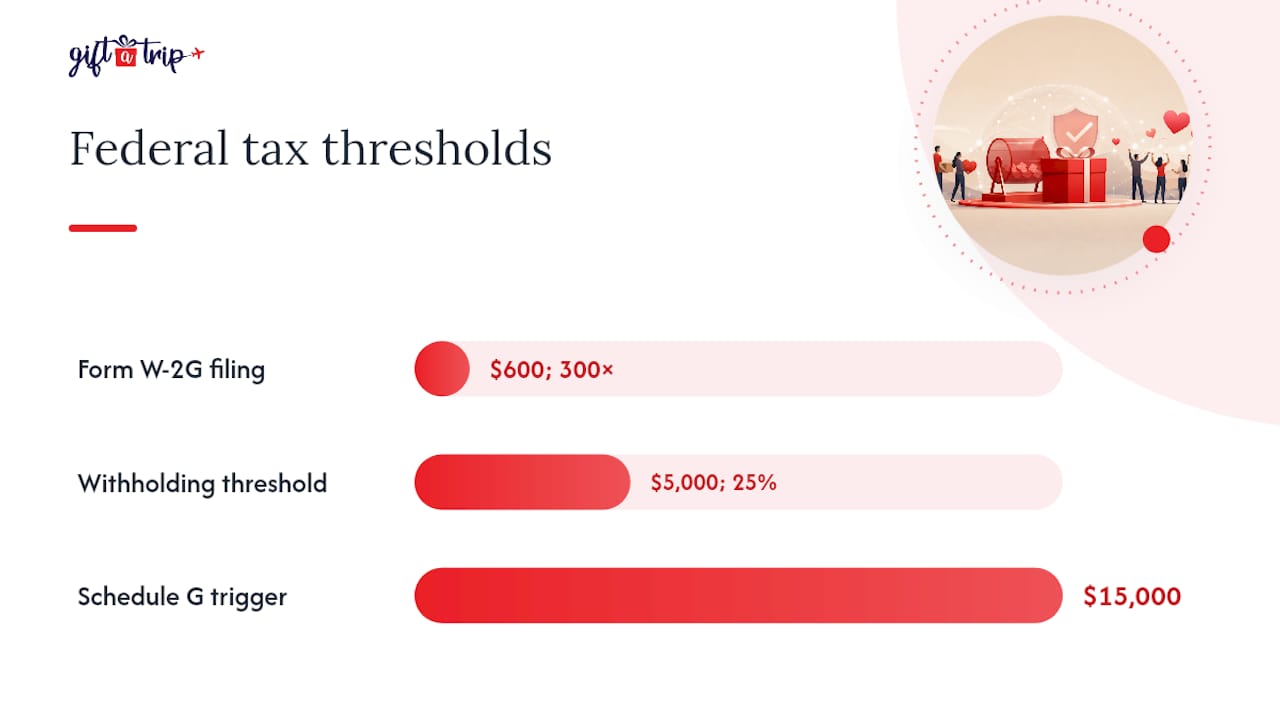
Form W-2G reporting thresholds. Per the IRS instructions for Forms W-2G and 5754, you must file Form W-2G when a winner’s net winnings (prize value minus the ticket price) are $600 or more and at least 300 times the ticket price. Forms W-2G must be filed with the IRS by the last day of February following the calendar year of the raffle, and a copy goes to the winner.
If a winner does not provide a valid taxpayer identification number (TIN), backup withholding applies instead. For noncash prizes, IRS Notice 1340 confirms that fair market value is used for both reporting and withholding calculations. If your organization chooses to pay the withholding on behalf of the winner, you must “gross up” the prize value, which changes the math significantly and can create an unexpected tax liability for the charity if not budgeted in advance.
Gross-up example: If a noncash prize has a fair market value of $6,000 and the ticket cost $1, net winnings are $5,999, which exceeds the $5,000 withholding threshold. If the organization pays the 25% withholding rather than deducting it from a cash prize, the grossed-up amount is larger than $6,000. Budget for this before awarding the prize.
Form 990 / Schedule G. Organizations that file Form 990 must report gaming activity on Schedule G when gross gaming receipts exceed $15,000 in the tax year. Raffle income counts as gaming. If you use a professional fundraiser or a third-party raffle management company, that arrangement must also be disclosed on Schedule G.
UBIT risks. The IRS guidance on exempt organization gaming and UBTI is clear: gaming income can be unrelated business taxable income if the activity is regularly carried on. A single annual raffle is unlikely to trigger UBTI, but a series of monthly raffles could. The volunteer-labor exclusion is your primary mitigation: if substantially all work is performed by unpaid volunteers, the gaming proceeds are generally excluded from UBTI. Document volunteer hours and roles carefully, because regulators will ask.
Key federal tax triggers at a glance:
- Prize minus ticket price is $600 or more AND at least 300× the ticket price → file Form W-2G
- Net winnings exceed $5,000 → withhold 25% (or apply backup withholding if no TIN)
- Gross gaming receipts exceed $15,000 in the tax year → complete Schedule G on Form 990
- Gaming is regularly carried on → assess UBTI exposure; document volunteer labor to claim exclusion
Ticket sales rules, online sales, and advertising requirements
Selling tickets sounds simple. The legal constraints around how, where, and to whom you sell them are not.
The federal mailing prohibition. 18 U.S. Code §1302 prohibits mailing raffle tickets, raffle advertisements, or payments for raffle tickets through the U.S. Postal Service. This is a federal criminal statute, not a civil fine. Because mailing tickets is a federal crime, most nonprofits default to in-person sales or carefully constrained online sales that avoid interstate transactions. Any platform you use for online ticket sales must be verified to comply with your state’s rules on electronic transactions.
Interstate sales. Transporting tickets across state lines for sale is also restricted under federal law. Practically, this means your online ticket sales should be limited to residents of the state where your permit is issued. Geo-restriction tools on your ticketing platform are not a luxury; they are a compliance requirement.
State-level ticket sales rules:
- Some states require all ticket sales to occur in person, prohibiting online sales entirely.
- Others allow online sales but require the buyer to be a state resident.
- Many states cap ticket prices (common caps range from $1 to $100 per ticket, depending on the state and raffle type).
- Selling tickets to minors is prohibited in virtually every state. Post clear signage at sales locations and train volunteers to ask for ID when age is in doubt.
Required disclosures on tickets and advertising. Missing these is a common audit trigger. Every ticket and every advertisement must typically include:
- The organization’s legal name and permit or registration number
- The drawing date, time, and location
- The ticket price
- A description of each prize and its approximate value
- The odds of winning, or a statement of how odds will be determined (e.g., “1 in [number of tickets printed]”)
- A statement that the raffle is licensed by the state (where required)
The California Department of Justice treats missing ticket disclosures as a serious compliance failure that can void the raffle or trigger fines.
How to value prizes and handle restricted prize types
Prize valuation is not optional math. It determines whether you owe withholding, whether you must file W-2G, and what you disclose to winners.
Fair market value (FMV) is the standard. For noncash prizes, FMV is the price a willing buyer would pay a willing seller in an arm’s-length transaction. IRS Notice 1340 confirms that FMV governs both reporting and withholding for noncash prizes. Use the donor’s written statement of FMV as your starting point, but verify it against comparable market prices for high-value items.
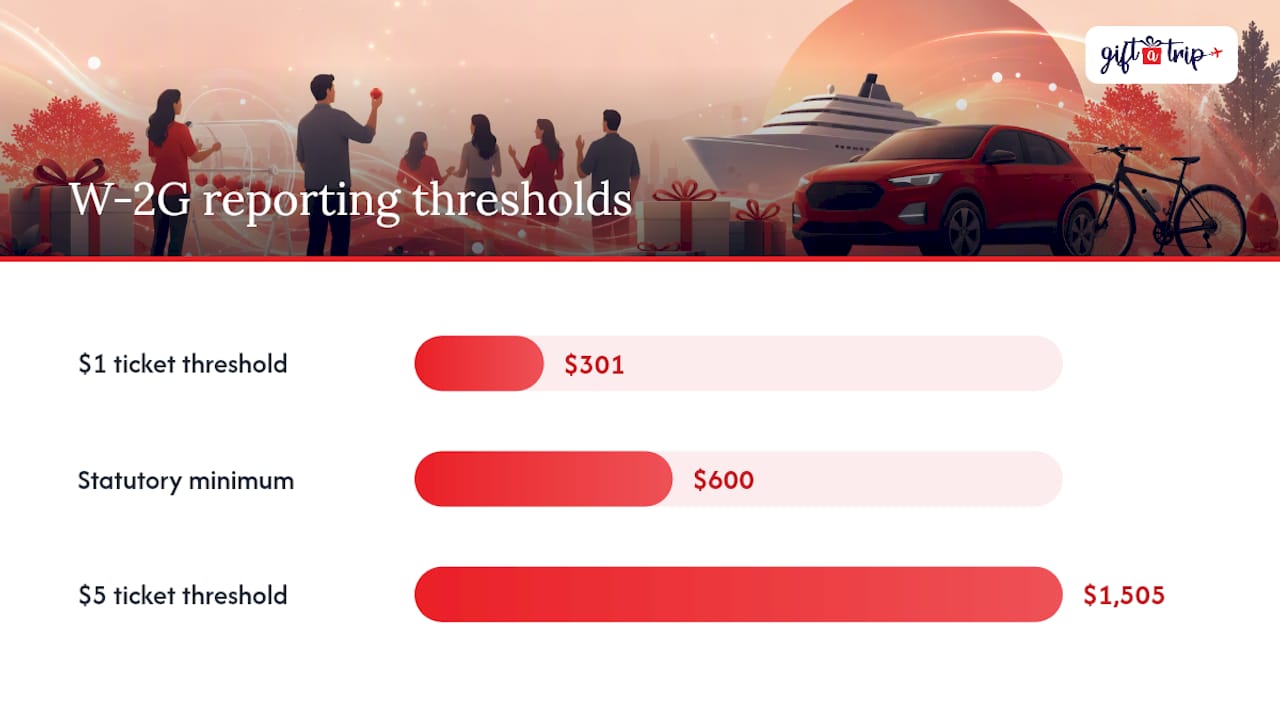
Calculating whether a prize triggers W-2G. The threshold is net winnings of $600 or more AND at least 300 times the ticket price. With a $5 ticket, a prize must be worth at least $1,505 (300 × $5 = $1,500, plus the $5 ticket cost) to trigger reporting. With a $1 ticket, the threshold drops to $301. Ticket price matters more than most organizers realize.
Common prize restrictions by state:
- Real estate prizes are prohibited or heavily restricted in several states.
- Alcohol as a prize is restricted in states with specific liquor control laws.
- Some states cap the value of a single prize (caps vary widely; check your state’s statute).
- Firearms as prizes require compliance with federal firearms transfer rules regardless of state raffle law.
Travel prizes and donated certificates. Travel certificates and vacation packages are among the most popular raffle prizes, and they carry specific documentation requirements. Collect the following from any donor:
- A written donation letter stating the donor’s name, the certificate’s description, and its fair market value
- The certificate’s full terms: blackout dates, expiration date, redemption instructions, and any restrictions on destinations or travel periods
- Proof that the donor owns the certificate and has the right to donate it
For tax reporting, the FMV stated in the donor’s letter is what you use on the W-2G if the prize triggers reporting. Winners who receive travel certificates should receive a copy of the donor’s FMV statement along with their W-2G (if applicable) so they can report the income accurately.
Pro Tip: When a travel certificate has blackout dates or limited availability windows, state that clearly on the raffle ticket and in the winner notice. Ambiguity about redemption terms is the single biggest source of post-raffle disputes and can expose your organization to claims that the prize was misrepresented.
For a deeper look at how travel rewards work as fundraising prizes, including how to present certificates attractively and compliantly, Giftatrip’s fundraising resource covers the practical side in detail.
Day-of procedures, drawing methods, and recordkeeping
A transparent drawing protects your organization legally and builds donor trust. Regulators expect documented procedures, not improvised ones.
Accepted drawing methods and transparency requirements:
- Physical ticket draws (drum draws, bowl draws) are universally accepted and easy to document.
- Random number generators are accepted in many states but may require documentation of the software or method used.
- A public drawing with announced date, time, and location is standard practice and required in most states.
- For high-value prizes, some states require an independent witness or a notary to certify the drawing.
- Never pre-select winners or conduct the drawing before all tickets are sold (unless your rules explicitly state a ticket cap and that cap has been reached).
Required records and retention periods. Most state regulators expect you to retain raffle records for three to five years. Keep:
- Ticket serial number log (range issued, range sold, range unsold/returned)
- Cash handling records: total collected, by date and location
- Stub reconciliation: stubs retained vs. stubs in the drawing drum
- Prize award records: winner name, address, TIN, prize description, FMV, W-2G data
- Vendor invoices for any purchased prizes
- Bank deposit records matching gross receipts
- Volunteer vs. paid staff log (critical for UBTI exclusion documentation)
Sample recordkeeping fields regulators commonly request:
| Field | What to Record |
|---|---|
| Ticket serial range sold | First and last serial number of tickets sold |
| Total tickets printed | Count from printer invoice or internal log |
| Total tickets sold | Count from stub reconciliation |
| Gross receipts | Dollar amount collected, by date |
| Prizes awarded | Description, FMV, and winner ID for each prize |
| Volunteer hours | Names, roles, and hours worked |
| Drawing date and witnesses | Names of witnesses or notary, if required |
Pro Tip: Keep both a digital and a printed copy of every donor’s certificate, the prize receipt, and any W-2G or Form 5754 signed by winners. If a state auditor requests records two years after the event, a printed backup saves you from a corrupted file or a defunct cloud account.
For event-level safety and documentation requirements at your venue, first aid documentation at events is a useful compliance reference covering what venue operators and event organizers typically need on file.
Common compliance mistakes and what they cost you
Most enforcement actions against nonprofits stem from a short list of avoidable errors.
The mistakes regulators see most often:
- Selling tickets before the permit is issued. This is the single most common violation. No sales until the permit number is in hand.
- Mailing tickets or accepting mailed payments. A federal crime under 18 U.S.C. §1302, not just a state infraction.
- Failing to file Forms W-2G. Many volunteer organizers do not know the threshold exists. Missing filings trigger IRS penalties and can flag the organization for broader audit.
- Not collecting withholding on prizes over $5,000. The organization is liable for the uncollected withholding if it fails to withhold.
- Using paid staff without assessing UBTI. Paid labor disqualifies the volunteer-labor exclusion, potentially making raffle income taxable.
- Missing required ticket disclosures. No license number, no drawing date, no odds statement — any of these can void the raffle or trigger fines.
- Failing to file the annual aggregate report. Many states require one aggregate report covering all raffles in the registration year, not a separate filing per event. Missing it is a common source of administrative penalties.
Regulator red flags:
- Large gross receipts with no corresponding permit on file
- Ticket serial number gaps (suggesting unsold tickets were not returned or destroyed)
- Inconsistent prize awards (winner records don’t match prize descriptions)
- Repeat violations within the same registration period
Consequences. Penalties range from administrative fines to suspended raffle privileges to misdemeanor charges in states that treat unlicensed raffles as criminal activity. In some cases, regulators require the organization to return funds to ticket buyers or award corrective relief to winners who were improperly denied prizes.
If you discover a violation after the fact: Stop all ticket sales immediately. Notify your state regulator proactively — self-reporting typically results in lighter penalties than being discovered. Perform a full reconciliation of tickets, receipts, and prizes. Consult your state attorney general’s charity division or a nonprofit attorney before communicating with winners or the public about the issue.
Your one-page compliance checklist and sample raffle rules
Use this section as a working template. Adapt every item to your state’s specific requirements.
Pre-event compliance checklist:
- Confirm organization meets state eligibility (tax-exempt status, years of operation, state charity registration)
- Identify state regulator and download current permit application
- Submit permit application at least 30–60 days before ticket sales begin
- Record permit/registration number for use on all tickets and advertising
- Verify insurance or bonding requirements with your state regulator and venue
- Design tickets with all required disclosures (organization name, permit number, drawing date, ticket price, prize description, odds statement)
- Assign volunteer roles in writing; confirm no paid staff will perform raffle duties (to preserve UBTI exclusion)
- Validate all prizes: collect donor letters, FMV statements, and certificate terms
- Establish cash handling procedures and designate a reconciliation officer
- Confirm drawing date, time, location, and witness requirements with your state
Sample raffle rules (adapt to your state):
- Eligibility to win: Open to all purchasers of a valid ticket who are 18 years of age or older and residents of [State]. Employees, officers, and board members of [Organization Name] are [eligible/ineligible per state law].
- Ticket purchase limits: No individual may purchase more than [X] tickets. Tickets are $[price] each.
- Drawing method: All sold ticket stubs will be placed in a drum and drawn at random at [Location] on [Date] at [Time]. The drawing is open to the public.
- Prize delivery: Winners will be notified by [method] within [X] days of the drawing. Prizes must be claimed within [X] days or the prize is forfeited.
- Unclaimed prizes: Unclaimed prizes will be [re-drawn / retained by the organization / donated to charity] per [State] law.
- Governing law: This raffle is conducted pursuant to [State Statute Citation] and is licensed under permit number [XXXXXX].
Post-event report fields:
Insurance and bonding. Some states require a surety bond for raffles above a certain gross receipts threshold. Even where not required, special-event liability insurance is worth purchasing if your raffle involves a public venue, cash handling, or prizes valued above $10,000. Check with your venue: many require proof of event liability coverage as a condition of use.
Donated travel certificates as raffle prizes: what nonprofits need to know
Travel certificates and vacation packages consistently rank among the highest-performing raffle prizes because they generate excitement that cash-equivalent prizes rarely match. Handling them correctly requires a few extra documentation steps.
Documentation to collect from every travel-certificate donor:
- A written donation letter on the donor’s letterhead stating: donor’s legal name, certificate description (brand, destination type, duration), fair market value, and the date of donation
- The certificate’s complete terms of redemption: blackout dates, expiration date, booking procedures, and any geographic or seasonal restrictions
- Confirmation that the donor owns the certificate and has the right to transfer it as a donation
- The certificate’s face value or retail price (for FMV verification)
How digital travel certificates are treated for tax reporting. A digital travel certificate is a noncash prize. Its FMV, as stated in the donor’s letter and verified against comparable retail pricing, is the figure you use for W-2G reporting and withholding calculations. IRS Notice 1340 governs noncash prize treatment: FMV is used for both the reporting threshold and the withholding calculation. If the certificate’s FMV minus the ticket price is $600 or more and at least 300 times the ticket price, a W-2G is required.
Clear donor declarations reduce audit risk significantly. A donor who states FMV in writing gives you a defensible basis for your W-2G calculation. A donor who provides no documentation leaves you estimating, which invites scrutiny.
Sample donor declaration fields to request and retain:
- Donor legal name and contact information
- Certificate brand and description (e.g., “Four-night resort stay at [Brand], valid at participating properties”)
- Fair market value: $[amount]
- Blackout dates: [list or “none”]
- Expiration date: [date]
- Redemption instructions: [URL or phone number]
- Donor signature and date
Pro Tip: Include the redemption URL, expiration date, and blackout dates directly on the winner’s prize notification letter and on the raffle ticket stub. Winners who lose their documentation will call you. Winners who have everything in writing rarely do.
Giftatrip’s travel certificate distribution guide covers the logistics of awarding digital certificates at events, including how to handle delivery, redemption instructions, and documentation for bulk prize distributions. For nonprofits looking for travel certificates to use as raffle prizes, the digital travel certificates guide explains how certificates work, what’s included, and how to present them to winners.

Giftatrip offers travel gift certificates redeemable for resort stays, hotel packages, and cruise lines from major brands, with taxes and resort fees included and minimal blackout dates. For nonprofits awarding travel prizes, digital delivery means the certificate reaches the winner instantly, with no shipping delays or lost mail risk.
What most raffle guides get wrong about compliance timing
The compliance advice that circulates among volunteer fundraisers tends to focus on what to do, not when to do it. That gap is where most violations happen.
Permit timelines are the clearest example. A 30-to-60-day processing window means that if your gala is in October, your permit application needs to be submitted in August, not September. Most organizations that sell tickets before their permit arrives do so not out of negligence but because they started the application process two weeks before the event and assumed approval would be fast. It rarely is.
The second underestimated issue is the W-2G threshold calculation. Organizers often check whether a prize is “big enough” to trigger reporting, but they check against the wrong number. The threshold is not just $600; it is $600 and 300 times the ticket price. A $1 ticket means any prize worth more than $300 potentially triggers reporting. Price your tickets at $5 and that threshold jumps to $1,500. Ticket pricing is a tax planning decision, not just a revenue decision.
Written volunteer role assignments are also underused. The UBTI volunteer-labor exclusion requires that substantially all work be performed by volunteers. “Substantially all” is not defined by a bright-line percentage in IRS guidance, which means documentation is your only defense. A one-page volunteer assignment sheet signed before the event is worth far more than a verbal agreement you cannot reconstruct two years later when an auditor asks.
The organizations that run clean raffles year after year are not the ones with the most sophisticated legal teams. They are the ones that start the permit process early, price tickets with the IRS thresholds in mind, and keep a paper trail that would satisfy a skeptical auditor on a bad day.
Sources
These are the primary federal and state sources for charity raffle compliance. Verify that you are reading the current version for your state and tax year before relying on any specific figure or form.
Federal sources:
- Instructions for Forms W-2G and 5754
- Nonprofit Raffles | State of California – Department of Justice
- Charitable Raffles and Casino/Poker Nights (Texas Attorney General)
- 18 U.S. Code §1302 – Mailing lottery tickets or related matter
State regulator pages:
Practical starting-point guides (confirm with your state regulator for final authority):
Last reviewed: 2026. Raffle laws change frequently. Verify all permit requirements, fees, and reporting deadlines with your state regulator and current IRS instructions before conducting any raffle activity.
This article is general information, not a substitute for advice from a qualified lawyer. Consult a qualified legal professional about your own circumstances before acting on anything here.
FAQ
Are charity raffles legal in the United States?
Yes, for qualifying nonprofits in most states, but Alabama and Utah ban paid-ticket raffles entirely, and Hawaii allows only free-entry drawings. Every state that permits raffles requires a permit or registration before ticket sales begin.
What is the legal difference between a raffle and a drawing?
A raffle requires participants to pay for a chance to win, making it a form of lottery subject to state gambling laws. A drawing (or sweepstakes) offers free entry, which removes the “consideration” element and generally exempts it from raffle licensing requirements.
What are the most common charity raffle mistakes to avoid?
Selling tickets before the permit is issued, mailing tickets through the U.S. Postal Service, failing to file Form W-2G for qualifying prizes, and not collecting required withholding on prizes over $5,000 are the most frequent violations that trigger fines or enforcement action.
What states don’t allow raffles?
Alabama and Utah prohibit paid-ticket raffles. Hawaii prohibits any raffle requiring a ticket purchase and allows only free-entry prize drawings. Check Zeffy’s state-by-state guide as a starting point, then confirm with your state regulator.
When does a nonprofit have to issue a Form W-2G to a raffle winner?
A Form W-2G is required when the winner’s net winnings (prize value minus ticket price) are $600 or more and at least 300 times the ticket price, per IRS instructions. The form must be filed with the IRS by the last day of February following the year of the raffle.