
TL;DR:
- Covering taxes and mandatory fees inside travel rewards maintains their emotional value and boosts redemption rates. Bundled pricing reduces payment friction, increases perceived fairness, and encourages loyalty among recipients. Including all costs upfront benefits both reward recipients and program senders by enhancing experience and program ROI.
Covering taxes and mandatory fees inside travel rewards is the single most effective way to protect the emotional value of the gift. When a recipient opens a travel certificate and later discovers they owe $150 in resort fees or port taxes at checkout, the reward stops feeling like a gift and starts feeling like a partial payment. That friction kills loyalty, reduces redemption rates, and generates support calls nobody budgeted for.
The research is clear: incentive travel is the top non-cash motivator across generations, with 93% of incentive travel recipients wanting to qualify again after receiving a travel reward. Bundled pricing that covers mandatory fees reduces the “pain of payment” and raises booking intent compared with itemized, drip-style pricing.
Who should absorb these costs:
- Individual gift-givers sending a personal certificate for a birthday or anniversary
- HR managers and incentive program administrators running employee reward programs
- Event planners and nonprofit auction coordinators offering travel prizes
The simplest next step: buy a certificate that already bundles taxes and fees, so neither you nor the recipient has to think about it again.
Table of Contents
- Why covering taxes and fees in rewards changes booking behavior
- Why senders benefit when they absorb taxes and fees
- How to price and budget certificates that include taxes and fees
- U.S. legal and tax considerations when covering fees in rewards
- How to present bundled fees on certificates and in messaging
- Common objections about covering fees in rewards
- Key Takeaways
- The case for full-cost certificates
- Giftatrip makes fee-inclusive travel certificates easy
- FAQ
Why covering taxes and fees in rewards changes booking behavior
Hidden fees don’t just annoy people. Drip pricing actively reduces satisfaction and pushes recipients toward worse decisions, a pattern regulators have scrutinized and that the DOT has addressed by requiring advertised airfares to include government-imposed taxes and fees upfront.
When a travel certificate reveals mandatory charges only at redemption, the reward transforms into a partial purchase. The recipient now has a decision to make: pay the difference or skip the trip. Either outcome damages the program. Bundled pricing enhances perceived fairness and booking intention versus itemized pricing, according to 2026 research on resort fee transparency and mental budgeting.
Stat to know: 89% of incentive travel recipients said the reward increased their likelihood to stay in their role, and 93% wanted to qualify again. That loyalty collapses when the reward comes with a surprise bill at checkout.
Pro Tip: If your budget is tight, choose a certificate with a capped fee allowance rather than a partially covered option. A clear cap (“up to $75 in mandatory fees included”) sets expectations without leaving the recipient guessing.
Concrete recipient benefits when fees are bundled:
- Friction-free redemption: no out-of-pocket surprise at booking
- Predictable cost: recipients know exactly what the trip will cost them
- Higher perceived value: the gift feels complete, not conditional
- Better program sentiment: recipients associate the reward with generosity, not fine print
Why senders benefit when they absorb taxes and fees
Absorbing taxes and fees increases the perceived value of the certificate without requiring a proportionally larger face-value increase. A $500 certificate that covers $60 in resort fees feels worth more than a $560 certificate that itemizes the fees separately, because the recipient never experiences the payment friction.
Sender benefits are measurable:
- Fewer redemption support contacts (recipients aren’t calling to dispute surprise charges)
- Higher redemption rates, which directly improve program ROI metrics
- Lower complaint volume from recipients who feel misled
- Cleaner accounting: one fixed cost per certificate, no variable reconciliation
Consider a mid-size company that switched its annual sales incentive from partially covered certificates to fully bundled ones. Redemption rates climbed, and the HR team reported a sharp drop in post-redemption complaints, because recipients no longer hit unexpected charges during booking. The program cost slightly more per certificate and significantly less in administrative time.
Operational note: Before launch, align with finance and procurement on the per-certificate reserve for fees. Document the policy in writing so legal, HR, and your certificate vendor are working from the same number.
For corporate gifting programs, the operational case is straightforward: one fixed cost per award, predictable budget, and a recipient experience that reflects well on the company.
How to price and budget certificates that include taxes and fees
Three practical approaches cover most program structures:
| Approach | How it works | Best for |
|---|---|---|
| Raise face value | Add average tax/fee estimate to certificate price | One-off personal gifts, simple programs |
| Fixed per-certificate reserve | Absorb a set dollar amount on top of face value | Mid-size corporate programs |
| Capped allowance | Cover fees up to a stated cap; recipient pays overages | Large programs with variable destinations |

Sample calculation: If average resort fees and per-person taxes are considered, a conservative reserve of about $100 per certificate covers most domestic redemptions. For cruise certificates, hidden port and ferry fees can add $50–$150 per person, so a higher cap or a fully bundled product is worth the extra cost.
The trade-off is simple: raising face value is easiest to communicate but least precise. A capped allowance gives budget predictability for large programs but requires clear recipient communication about what happens at the cap.
Implementation checklist for finance and procurement:
- Confirm average fee ranges for the certificate destinations in your program
- Set a per-certificate reserve or cap with a 10–15% buffer for variability
- Document the fee policy in the program rules before distribution
- Align with your certificate vendor on how fees are disclosed at redemption
U.S. legal and tax considerations when covering fees in rewards
Covering travel taxes and fees generally preserves gift value, but it can create tax-reporting obligations depending on who receives the award. The rules differ significantly between employees and non-employees, and getting this wrong creates payroll tax exposure.
Key U.S. issues to watch:
- Gift tax basics: Individual gifts to non-employees generally fall under the annual gift tax exclusion ($18,000 per recipient in 2024, per IRS guidance). Consult a tax professional for your specific situation.
- Employee awards vs. taxable compensation: Travel rewards given to employees are typically taxable compensation unless they qualify under narrow IRS de minimis or employee achievement award rules. The fair market value of the award, including covered fees, is generally reportable on the employee’s W-2.
- Non-employee recipients: Prizes and awards to non-employees (contest winners, customers) over $600 in fair market value require a Form 1099-NEC.
- State-level variation: Some states impose additional reporting or withholding requirements on prizes and awards.
Pro Tip: Structure corporate programs with a written, non-discriminatory policy and document the business purpose of each award. This supports de minimis treatment where applicable and simplifies any IRS inquiry. Always run the program design by corporate tax counsel before launch.
Compliance reminder: The tax implications of rewards depend on recipient classification, award structure, and program design. This article is general information, not tax or legal advice. Confirm the current rules with a qualified tax professional for your specific program.
Practical actions for HR and finance:
- Classify all recipients before distributing awards (employee vs. non-employee)
- Budget for payroll tax gross-up if employee awards are taxable
- Collect W-9 information from non-employee recipients when required
- Document program rules and business purpose in writing
How to present bundled fees on certificates and in messaging
The communication goal is simple: make the reward feel like a complete gift, not a deposit toward a trip. Every touchpoint, from the certificate itself to the redemption confirmation email, should reinforce that message.
Template text for certificates:
- “Taxes and mandatory resort fees are included. No additional charges at booking.”
- “This certificate covers your stay, taxes, and required fees up to $[cap]. Any optional upgrades are at your discretion.”
- “Port taxes and government fees are included for the listed itinerary.”
Dos and don’ts:
- Do state fee inclusion prominently on the certificate face, not in footnotes
- Do specify any cap amount clearly (“up to $100 in mandatory fees”)
- Don’t bury fee rules in fine print that recipients won’t read until they’re at checkout
- Don’t use vague language like “most fees included” without defining which ones
Checklist for each touchpoint:
- Certificate face: fee inclusion statement, cap if applicable, expiration date
- Delivery email: one-sentence fee summary, redemption instructions, support contact
- Redemption landing page: itemized breakdown of what’s covered, clear process for overages
- Cancellation/refund policy: state whether covered fees are refundable
For variable charges like per-person port taxes or destination-specific levies, transparent guest experience design recommends stating the fee range with a concrete example (“port taxes often range within a moderate amount per person for Caribbean itineraries, as an example”) rather than leaving recipients to discover the number at booking.
Common objections about covering fees in rewards
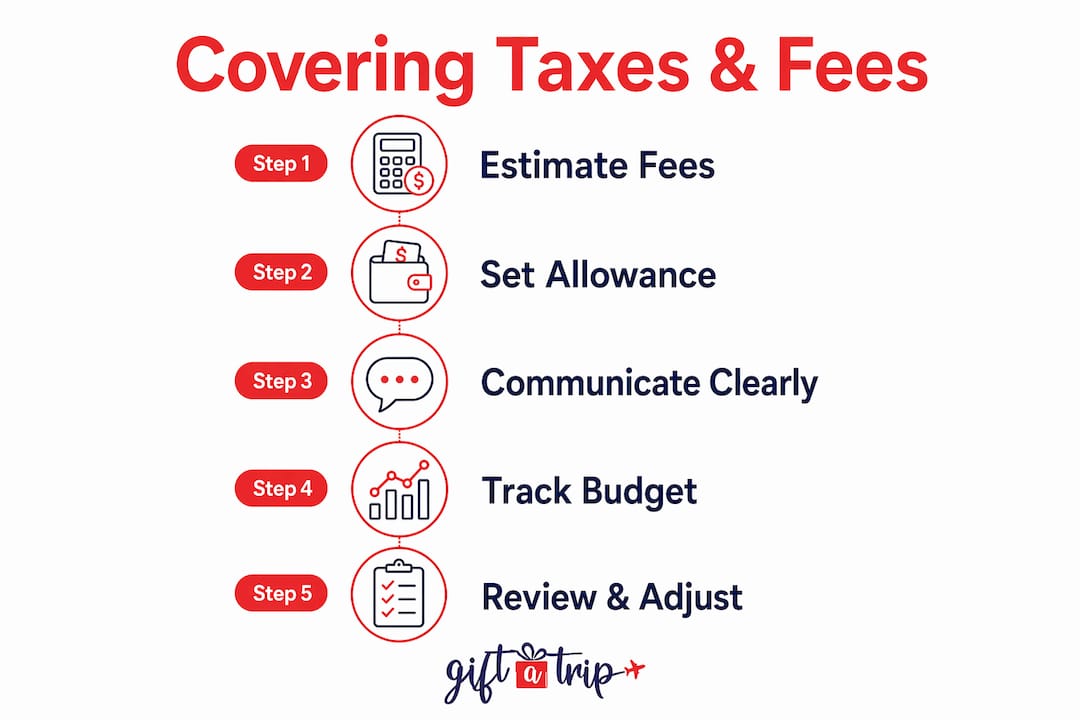
“Isn’t this too expensive?”
The per-certificate cost increase is usually $100 for domestic redemptions, and $50–$150 per person for cruise certificates due to port and ferry fees. The cost of a single redemption complaint, a refund dispute, or a disengaged employee who skips the program is higher. Bundled certificates also tend to have higher redemption rates, which improves program ROI.
“Will this create payroll tax issues?”
Possibly, if recipients are employees. Budget for a payroll tax gross-up and document the program’s business purpose. The tax implications of rewards are manageable with proper classification and counsel.
“What about variable resort fees or taxes by destination?”
Use a capped allowance with a clear disclosure. State the cap on the certificate and explain what happens if the destination’s fees exceed it. Most recipients accept a reasonable cap when it’s communicated upfront.
“What if the recipient cancels or upgrades?”
Include a clear cancellation and upgrade policy in the program rules. Specify whether covered fees are refundable and who absorbs upgrade costs.
Mitigation steps for HR and finance:
- Set a conservative fee cap with a buffer for high-fee destinations
- Require recipient acknowledgment of the fee policy at redemption
- Build a small reserve fund for edge cases (unusual destination fees, group bookings)
- Review fee ranges annually as travel costs shift
Key Takeaways
Covering taxes and mandatory fees in travel rewards protects recipient experience, raises redemption rates, and delivers measurably better program ROI for senders.
| Point | Details |
|---|---|
| Bundle fees upfront | Including taxes and fees eliminates surprise costs and preserves the full emotional value of the reward. |
| Research backs it | 89% of incentive travel recipients said the reward increased their likelihood to stay in their role, and 93% wanted to qualify again; bundled pricing raises booking intent versus itemized fees. |
| Use a capped allowance | A fixed per-certificate reserve or cap gives budget predictability without sacrificing recipient experience. |
| Know the U.S. tax rules | Employee travel awards are generally taxable compensation; consult a tax professional before program launch. |
| Giftatrip bundles it for you | Giftatrip certificates include taxes and mandatory fees, so recipients book without surprise charges. |
Bottom line: The most effective travel reward programs cover all mandatory costs upfront. Recipients who never see a surprise fee are the ones who stay loyal, redeem their certificates, and talk about the program positively.
The case for full-cost certificates
Most incentive program managers focus on the face value of the award and treat fees as a secondary detail. That’s the wrong order of operations. A recipient’s first experience with the reward isn’t the moment they receive it. It’s the moment they try to book it. If that moment produces a surprise charge, the entire emotional investment in the reward evaporates.
The research on bundled vacation pricing confirms what experienced program managers already know: how price elements are presented changes purchase intent and satisfaction. Transparency isn’t just an ethical choice. It’s a performance lever. Programs that cover fees fully tend to see higher redemption, fewer complaints, and stronger repeat participation.
The objection I hear most often is cost. But the math rarely supports it. A $100 fee reserve per certificate is a rounding error against the cost of a disengaged employee or a failed loyalty program. The real risk isn’t spending the extra money. It’s not spending it and watching the program underperform.
Giftatrip makes fee-inclusive travel certificates easy
Giftatrip certificates come with taxes and mandatory fees already covered, so the recipient books without hitting a surprise charge. That single feature removes the most common point of friction in travel reward programs and is the reason HR teams, event planners, and individual gift-givers return to Giftatrip for bulk and custom orders.

Certificates are available for resorts, hotels, cruise lines, and vacation packages from major brands, with options for custom messaging, bulk ordering, and branded gift boxes for corporate programs. The travel certificate distribution guide walks HR and event teams through the full process, from program design to recipient delivery. For individual buyers, the digital travel certificates guide explains exactly what’s included and how redemption works. Ready to build a program or send a single gift? Visit Giftatrip to request a custom quote or purchase a certificate directly.
FAQ
Why should travel rewards include taxes and fees?
Including taxes and fees removes surprise out-of-pocket costs at redemption, preserving the full perceived value of the reward. Research shows bundled pricing raises booking intent and reduces the “pain of payment” compared with itemized fee disclosure.
Are travel awards taxable compensation for employees?
Generally yes. The fair market value of a travel award, including covered fees, is typically reportable as taxable compensation on the employee’s W-2. Consult a qualified tax professional to confirm the rules for your specific program structure.
How do you handle variable fees like resort or port charges?
Set a capped allowance per certificate (for example, up to $100 in mandatory fees) and state the cap clearly on the certificate and in the redemption email. For cruise certificates, budget for port taxes separately, as they vary by itinerary.
What happens if a recipient cancels a bundled certificate?
State the cancellation policy explicitly in the program rules and on the certificate. Specify whether covered fees are refundable and under what conditions, so recipients have no ambiguity before they book.
Does Giftatrip include taxes and fees in its certificates?
Yes. Giftatrip structures certificates to include taxes and mandatory fees, so recipients can book without unexpected charges. Corporate buyers can also request custom caps and bulk pricing for larger programs.