
Jump to Section:
TL;DR:
- Cruise certificates are prepaid vouchers that cover only the base fare for the first two guests in a stateroom, excluding taxes and fees. They are issued by cruise lines, casinos, and nonprofits for various purposes and have strict expiration dates. Recipients must budget for additional costs and verify availability before booking or gifting to avoid surprises.
Cruise certificates are prepaid travel vouchers that cover the base cruise fare for a double-occupancy stateroom, allowing the holder to book a future sailing within a specified validity period. They are issued by cruise lines, casino loyalty programs, third-party travel platforms, and nonprofit organizations. Unlike a standard cruise booking, a certificate does not include taxes, port fees, gratuities, or cabin upgrades. Understanding exactly what they cover, and what they do not, is the difference between a great deal and an unexpected bill.
What are cruise certificates and how do they work?
A cruise certificate is defined as a single-use voucher that prepays the base fare for one stateroom, typically for two guests traveling together. Base fare coverage applies only to the first and second guests in a double-occupancy cabin. Third or fourth guests in the same cabin are not covered and must pay their own fares separately.

Certificates carry fixed expiration dates. Most are valid for sailings within a 12–24 month window from the issue date. The holder must book and complete the cruise before that deadline. Extensions are rare and usually require a fee, if they are offered at all.
One important distinction: consumer cruise certificates have nothing to do with maritime crew certifications like STCW (Standards of Training, Certification and Watchkeeping). STCW certificates are mandatory labor credentials for onboard crew members. Consumer cruise certificates are purely travel vouchers for paying passengers.
What types of cruise certificates exist?
Cruise certificates fall into four main categories, each with different rules, sources, and restrictions.
| Certificate Type | Source | Best For |
|---|---|---|
| Promotional certificates | Cruise lines | New customers, seasonal deals |
| Casino loyalty certificates | Onboard casino programs | Frequent casino players |
| Gift certificates | Third-party platforms, cruise lines | Personal and corporate gifting |
| Nonprofit/charity certificates | Cruise line CSR programs | Fundraising auctions and raffles |
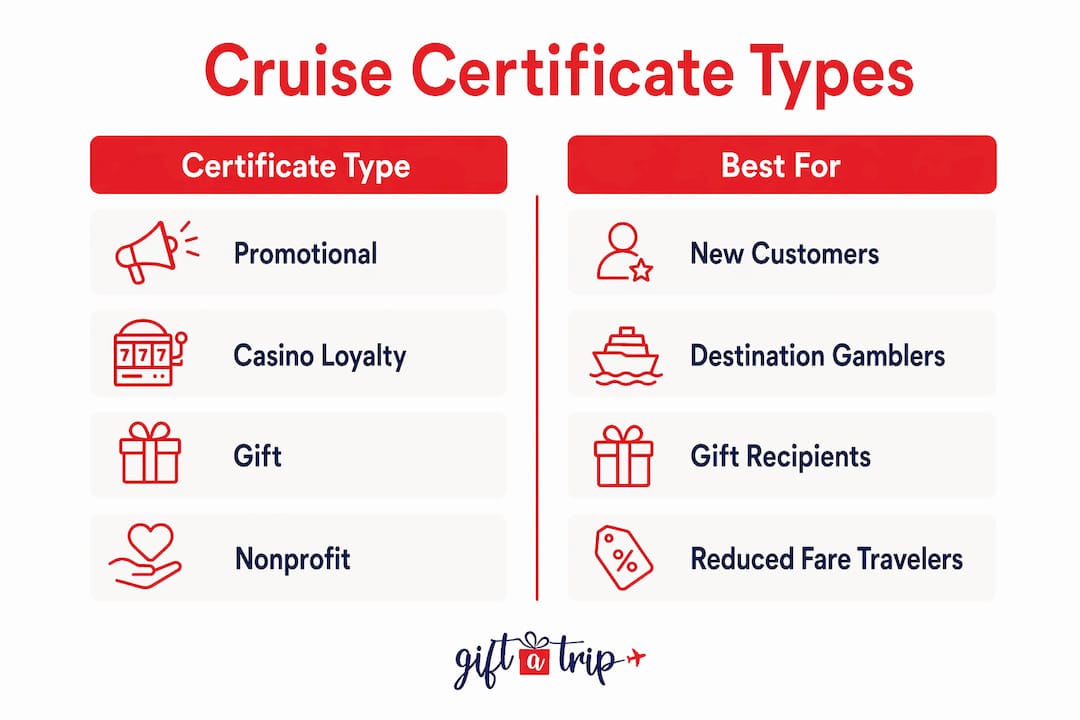
Promotional certificates are issued directly by cruise lines during sales campaigns. They typically lock in a discounted or complimentary base fare for a specific ship or itinerary category.
Casino loyalty certificates are the most structured type. Royal Caribbean’s Casino Royale program, for example, issues Instant Cruise Certificates when players hit specific point thresholds during a single voyage. Point thresholds range from 600 for entry-level certificates up to 3,000 for premium sailings. Booking early with these certificates can unlock bonus free play ranging from $100 to $5,000. That bonus is a real incentive to act fast after earning the certificate.
Gift certificates are purchased by individuals or businesses and given to someone else for travel. Platforms like Giftatrip sell cruise gift certificates from brands including Virgin Voyages, Crystal Cruises, and Windstar Cruises. These are popular for birthdays, anniversaries, employee rewards, and corporate incentive programs.
Nonprofit certificates are a lesser-known category. Holland America and other lines provide reduced-fare certificates to nonprofits for use in charity auctions and raffles. These certificates help organizations raise money while offering donors a compelling travel prize.
Pro Tip: If you receive a casino certificate, check whether it is an “Instant” certificate earned during one voyage or an “Annual” certificate tied to your total yearly play. Annual certificates often have higher value but stricter sailing restrictions.
How do you get a cruise certificate?
Acquisition methods vary depending on your goal, whether that is earning one through loyalty, buying one as a gift, or obtaining one for a fundraiser.
-
Earn through casino play. Royal Caribbean’s Casino Royale program awards certificates based on points earned at the slots or table games. Slot machines earn points at $5 per point, while video poker earns at $10 per point. Knowing the difference helps you plan your play without overspending to hit a threshold.
-
Purchase directly from a cruise line. Most major lines sell gift certificates through their websites. These are redeemable against future bookings and are a straightforward way to prepay a cruise for someone else.
-
Buy from an authorized third-party platform. Giftatrip offers digital travel certificates from multiple cruise lines in one place. Digital delivery makes them practical for last-minute gifting and corporate bulk orders.
-
Receive as a business incentive. Companies use cruise certificates as employee recognition tools, sales contest prizes, and client appreciation gifts. A corporate travel reward like a Royal Caribbean certificate carries a perceived value far above its cost to the business.
-
Acquire through nonprofit programs. Organizations can apply directly to cruise lines like Holland America for reduced-fare certificates to use in fundraising events. These certificates are not available to the general public through retail channels.
Pro Tip: When earning casino certificates, focus on a single game type per voyage rather than splitting play across multiple games. Concentrated play on slots reaches point thresholds faster because the per-point cost is lower than table games.
What are the benefits and limitations of cruise certificates?
Cruise certificates offer real value, but only when you understand exactly what they cover.
Benefits:
- They lock in the base cruise fare at no cost to the recipient, which protects against price increases on popular itineraries.
- They give the holder flexibility to choose a sailing date within the validity window, making them useful for people who cannot commit to a specific date at the time of gifting.
- For businesses, they carry high perceived value relative to their wholesale cost, making them efficient incentive tools.
- Nonprofit organizations can use them to generate auction bids well above face value.
Limitations:
- Certificates cover base fare only, excluding taxes, port fees, gratuities, and upgrades. These additional costs can add hundreds of dollars per person to the total trip cost.
- Coverage applies only to the first two guests in a stateroom. A family of four will pay full fare for the third and fourth guests.
- Expiration dates are fixed and generally not extendable. A certificate that expires unused has zero residual value.
- Certificates are typically non-refundable and non-combinable with other promotional offers.
“The cruise may be free, but the trip is not.” Industry experts consistently flag that travelers are often surprised by out-of-pocket fees even when holding a valid cruise certificate. Budget for taxes, port charges, and daily gratuities before you book.
The gap between “free cruise” and “total trip cost” is where most certificate holders get caught off guard. A realistic budget review before booking prevents that surprise.
How do you redeem and gift cruise certificates?
Redeeming a certificate follows a clear process, but the details matter.
-
Locate your certificate number and terms. Every certificate has a unique code, an expiration date, and a list of eligible sailings or cabin categories. Read the terms before calling.
-
Contact the cruise line’s booking center directly. Redemption requires contacting the cruise line’s reservation team. Online self-service booking is not always available for certificate holders.
-
Check availability for your preferred dates. Certificates are subject to sailing availability and blackout dates. Peak holiday sailings are often restricted or require an upgrade fee to access.
-
Decide on a cabin upgrade. The certificate covers a base category stateroom. Upgrading to a balcony or suite is possible but costs extra. Compare the upgrade fee against the retail price of booking that cabin outright before committing.
-
Transfer or gift the certificate if needed. Most certificates are transferable, meaning you can give them to someone else. To use a certificate as a corporate gifting tool, simply transfer it to the recipient with the booking instructions included.
| Redemption Step | Key Action | Watch Out For |
|---|---|---|
| Review terms | Read expiry, cabin class, and restrictions | Blackout dates on peak sailings |
| Call booking center | Use certificate number to reserve | Limited availability on popular routes |
| Upgrade decision | Compare upgrade cost vs. retail price | Upgrade fees can exceed certificate value |
| Transfer to recipient | Provide certificate number and instructions | Some certificates require name changes |
For corporate users, platforms like Giftatrip simplify bulk gifting by delivering certificates digitally with personalized messaging. That removes the logistics burden from HR teams managing large reward programs.
Key takeaways
Cruise certificates cover the base fare only. Every other trip cost, from taxes to gratuities, comes out of the traveler’s pocket regardless of certificate type.
| Point | Details |
|---|---|
| Core definition | A cruise certificate prepays base fare for two guests in one stateroom. |
| Hidden costs | Taxes, port fees, and gratuities are always the holder’s responsibility. |
| Four certificate types | Promotional, casino loyalty, gift, and nonprofit certificates each have distinct rules. |
| Expiration is strict | Fixed expiry dates are rarely extended; unused certificates have no cash value. |
| Gifting and corporate use | Certificates transfer easily and work well as employee incentives or personal gifts. |
The “free cruise” trap nobody warns you about
I have seen more people get burned by cruise certificates than almost any other travel product. Not because the certificates are bad. Because the marketing around them is misleading.
When a casino hands you a certificate after a good night at the slots, the word “free” is front and center. What the fine print says is that the base fare is covered. What it does not say loudly enough is that you will still owe taxes, port fees, and daily gratuities before you even step on the ship. On a seven-night Caribbean sailing, that can easily run $300–$600 per couple. That is real money, and it catches people off guard every time.
The second trap is the upgrade calculation. A certificate covers an interior cabin. You want a balcony. The upgrade fee sounds reasonable until you realize you could have booked the balcony outright for a similar price during a sale. Always run that comparison before you pay the upgrade.
My honest advice: treat the certificate as a discount, not a free trip. Build a full trip budget before you book. Check the expiration date the day you receive the certificate, not the week before it expires. And if you are buying certificates as gifts through a platform like Giftatrip, choose one that clearly explains what is and is not included so the recipient is not surprised.
The best cruise certificate experience I have seen is when the giver does the homework upfront, sets the recipient’s expectations correctly, and picks a certificate with minimal blackout dates. That combination turns a voucher into a genuinely memorable gift.
— Donovan
Giftatrip makes cruise certificate gifting simple
Giftatrip offers a curated selection of cruise certificates from top lines including Virgin Voyages, Crystal Cruises, and Windstar Cruises, all available as digital gifts with secure delivery and personalized messaging.

Whether you are shopping for a birthday, anniversary, or corporate reward program, Giftatrip handles the details so you do not have to. Browse Virgin Voyages cruise certificates for a modern, adults-only sailing experience, or explore Crystal Cruises luxury options for premium gifting. Corporate clients can order in bulk with custom gift boxes and branded messaging. Giftatrip covers taxes and resort fees on select certificates, removing the biggest complaint about travel vouchers. Visit Giftatrip’s full catalog to find the right certificate for any occasion.
FAQ
What does a cruise certificate actually cover?
A cruise certificate covers the base cruise fare for a double-occupancy stateroom for the first two guests. It does not cover taxes, port fees, gratuities, or cabin upgrades.
Can i give a cruise certificate as a gift?
Yes. Most cruise certificates are transferable and can be gifted to another person. Platforms like Giftatrip sell digital cruise certificates specifically designed for gifting, with personalized messaging options.
Do cruise certificates expire?
Cruise certificates carry fixed expiration dates that are generally not extendable. The holder must book and complete the sailing before the stated deadline or the certificate loses all value.
How do casino cruise certificates work?
Casino programs like Royal Caribbean’s Casino Royale award certificates when players reach specific point thresholds during a voyage. Points are earned at different rates depending on the game, with slots earning at $5 per point and video poker at $10 per point.
Can businesses use cruise certificates for employee rewards?
Yes. Cruise certificates work well as employee incentives, sales contest prizes, and client gifts. Corporate buyers can purchase them in bulk through platforms like Giftatrip, which offers digital delivery and customizable packaging for large reward programs.