
Jump to Section:
TL;DR:
- Travel certificates are taxed as wages if they function as cash equivalents or incentive awards, and as reimbursements if issued through an IRS-compliant accountable plan. Proper program classification and strict documentation are essential to avoid payroll liabilities and disallowed deductions. Structuring travel incentive and gift programs carefully ensures compliance, optimizes tax benefits, and prevents costly audit mistakes.
How taxes are handled in travel certificates depends on one core distinction: whether the certificate functions as a cash-equivalent taxable wage or as a non-taxable reimbursement under an IRS-compliant accountable plan. Get this wrong and both employers and employees face unexpected payroll liabilities, disallowed deductions, and W-2 corrections. The IRS does not treat all travel certificates equally, and the structure of your program determines everything. This guide covers the full picture for individuals and businesses, from IRS classification rules to deduction strategies and proper reporting in 2026.
How taxes are handled in travel certificates: the IRS classification rules
The IRS classifies travel certificates based on what they functionally represent, not what you call them. A certificate that operates like a gift card or cash equivalent is taxable compensation included in employee wages and reported on Form W-2. A certificate issued as reimbursement for documented business travel under an accountable plan is excluded from gross income entirely.
Three categories define the tax treatment of travel certificates:
- Cash-equivalent incentive awards. Certificates redeemable for any travel product, with no restriction to a specific business purpose, are treated as wages. The IRS views these the same way it views gift cards. Their fair market value is subject to federal income tax, Social Security, and Medicare withholding.
- Qualifying achievement awards. Tangible personal property awards for length of service or safety achievement may qualify for exclusion under IRC Section 74©, but cash, gift cards, and travel certificates that function like cash do not qualify. This exclusion is narrow and rarely applies to travel certificates.
- Accountable plan reimbursements. Travel reimbursements issued under an IRS-compliant accountable plan are not wages. They are excluded from gross income and never appear on Form W-2, provided three conditions are met: a clear business connection, proper substantiation, and return of any excess amounts.
The practical implication is significant. A company that hands employees travel certificates as performance rewards owes payroll taxes on the full value. A company that reimburses documented business travel through an accountable plan owes nothing in payroll taxes on those same amounts.
Pro Tip: Before issuing travel certificates to employees, determine whether the program is structured as an incentive award or a reimbursement. That single decision controls your entire payroll tax exposure.
How do accountable plans affect employer payroll obligations?
An accountable plan is the mechanism that converts a travel reimbursement from taxable wages into a tax-free payment. The IRS sets three firm requirements, and failing any one of them converts the entire reimbursement into taxable wages subject to payroll taxes and income tax withholding.
The three requirements are:
- Business connection. The expense must be directly related to the employer’s business. Personal travel, even partially, does not satisfy this condition without proper allocation.
- Substantiation. Employees must document the amount, time, place, and business purpose of every expense. Receipts are generally required for lodging and for any single expense exceeding $75. This documentation must be submitted within a reasonable period, typically 60 days of incurring the expense.
- Return of excess. Any advance or reimbursement that exceeds the substantiated expense must be returned to the employer. The IRS requires this within 120 days of the expense being paid or incurred.
When a plan fails these requirements, it becomes a non-accountable plan. Under a non-accountable plan, reimbursements become taxable wages reported on Form W-2, and the employer owes the employer’s share of FICA taxes on every dollar reimbursed. For a company running a large travel incentive program, this can represent a substantial and entirely avoidable cost.
Common audit risks include missing receipts for lodging, vague business purpose descriptions, and employees who never return excess advances. The IRS scrutinizes these patterns closely, particularly in S corporations and closely held businesses where travel benefits flow to owner-employees.

Pro Tip: Build substantiation deadlines into your expense policy as a hard cutoff, not a suggestion. A single lapse in documentation can disqualify the entire reimbursement from accountable plan treatment.
What travel expenses linked to certificates are tax-deductible?
IRS Publication 463 defines deductible business travel expenses as ordinary and necessary costs incurred while traveling away from the taxpayer’s tax home for business. The deductible categories include transportation, lodging, meals at 50%, and incidental expenses such as tips and fees. Understanding how travel certificates interact with these deductions is where many businesses make costly errors.
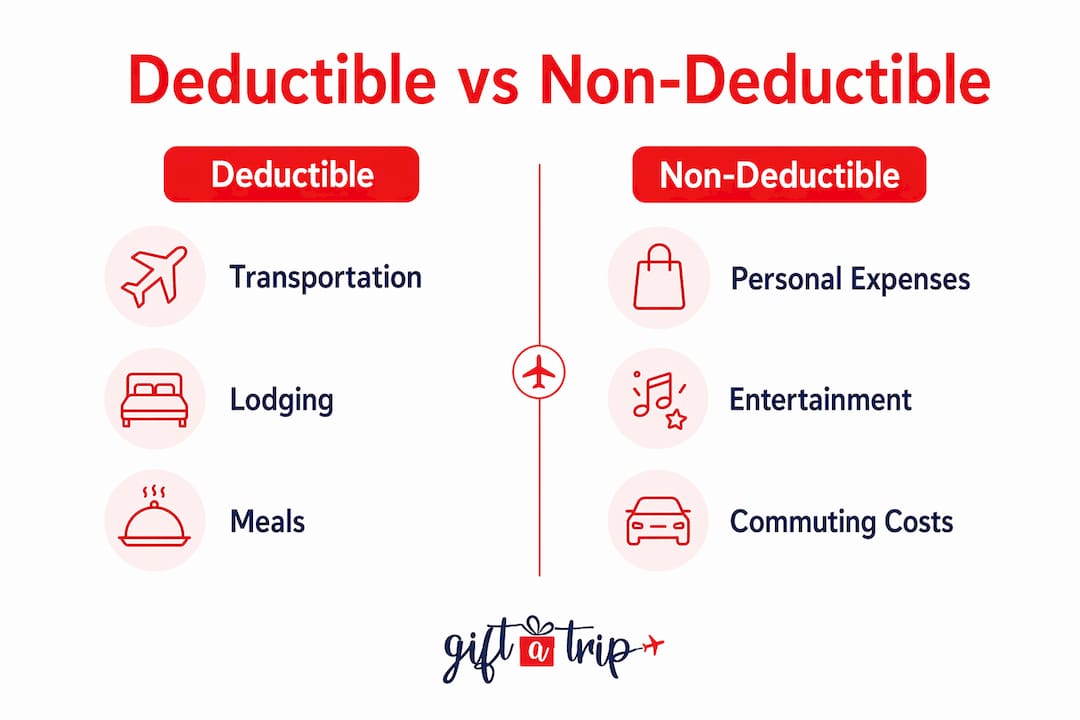
| Expense Category | Deductibility | Key Rule |
|---|---|---|
| Transportation (airfare, train, car) | 100% if primarily business | Business days must exceed personal days for mixed trips |
| Lodging | 100% for business nights | Must be away from tax home overnight |
| Meals | 50% of actual cost | Business purpose required; no deduction for lavish meals |
| Incidentals (tips, fees) | 100% | Must be documented with receipts |
| Personal travel days | 0% | Costs allocated to personal days are not deductible |
When a travel certificate offsets the cost of a business trip, the deductible amount must reflect the actual net cost incurred. If a certificate covers a $400 hotel stay that would otherwise be a deductible business expense, the deduction is reduced by the certificate’s value. You cannot deduct an expense you did not actually pay.
For mixed personal and business trips, the IRS requires expense allocation. Transportation costs are fully deductible only when business days represent the primary purpose of the trip. Lodging and meals are deductible only for the days with a documented business purpose. Corporations face heightened IRS scrutiny on mixed-use travel, and disallowed deductions are among the most common findings in small business audits.
Recordkeeping is not optional. The IRS requires contemporaneous records, meaning documentation created at the time of the expense, not reconstructed later. A travel log, receipts, and a written business purpose for each trip form the minimum standard.
How to report travel certificate taxes correctly
Proper reporting of travel certificate tax implications starts with correctly identifying the nature of the payment. The reporting path differs significantly depending on whether the certificate is an incentive award or a reimbursement.
Follow this reporting framework:
- Taxable incentive awards. Include the fair market value of the travel certificate in the employee’s gross wages for the pay period in which it is awarded. Report the amount in Box 1 of Form W-2. Withhold federal income tax, Social Security, and Medicare taxes on the full value.
- Accountable plan reimbursements. Do not include reimbursements on Form W-2 at all. Keep all substantiation records on file for at least three years in case of an IRS audit. No payroll tax withholding applies.
- Non-accountable plan reimbursements. Report the full reimbursement amount as wages in Box 1 of Form W-2. These amounts are subject to all payroll taxes. Employees may attempt to deduct unreimbursed business expenses on Schedule A, but the Tax Cuts and Jobs Act suspended this deduction for most employees through 2025.
- Excess advances not returned. If an employee fails to return excess travel advances within 120 days, the excess becomes taxable income and must be added to wages on Form W-2 for that tax year.
- Self-employed individuals. Report deductible business travel expenses on Schedule C. Travel certificates received as business income are reported as gross receipts. Certificates received as personal gifts are generally not taxable income unless they represent compensation for services.
Maintaining a dedicated travel expense file for each employee or trip is the most reliable way to support your reporting positions. Digital tools like Expensify, Concur, or Ramp can automate substantiation collection and flag missing documentation before it becomes a compliance problem.
Personal use versus corporate programs: how tax treatment differs
Travel certificate tax regulations apply differently depending on whether the certificate is used personally or within a structured corporate program. The distinction matters because the tax consequences can be substantial in either direction.
| Scenario | Tax Treatment | Key Consideration |
|---|---|---|
| Personal gift certificate (individual) | Generally taxable income if received as compensation; non-taxable if a personal gift from a non-employer | Gift tax exclusion applies up to $18,000 per year per donor in 2026 |
| Corporate incentive award (employee) | Taxable wages at fair market value; reported on W-2 | Narrow exclusions exist for qualifying achievement awards only |
| Business travel reimbursement (accountable plan) | Non-taxable; excluded from gross income | All three accountable plan conditions must be met |
| Business travel reimbursement (non-accountable plan) | Fully taxable wages; reported on W-2 | Employer owes payroll taxes on full amount |
Personal travel certificates received as gifts from family or friends are not taxable income to the recipient. The gift tax rules apply to the donor, not the recipient, and the annual exclusion covers most personal gifts. However, when a certificate is received from an employer or as compensation for services, it is taxable regardless of how it is labeled.
Corporate incentive travel programs, including those used to reward sales teams or recognize top performers, are treated as taxable compensation unless a specific exclusion applies. Program design matters enormously here. A well-structured corporate travel rewards program that pairs certificates with accountable plan documentation can achieve a very different tax outcome than a program that simply hands out certificates as prizes.
Key takeaways
Travel certificates are taxable wages when structured as cash-equivalent incentive awards, and non-taxable reimbursements only when issued under a fully compliant IRS accountable plan.
| Point | Details |
|---|---|
| Classification drives tax treatment | The IRS taxes travel certificates as wages when they function like gift cards or cash equivalents. |
| Accountable plans eliminate payroll tax | Reimbursements under accountable plans are excluded from gross income when all three IRS conditions are met. |
| Deductions must reflect net cost | Travel certificates that offset business expenses reduce the deductible amount dollar for dollar. |
| Reporting depends on plan type | Taxable awards go on Form W-2; accountable plan reimbursements are never reported as wages. |
| Documentation is non-negotiable | Receipts, business purpose records, and timely substantiation are required to defend any tax position. |
Why most travel certificate tax mistakes are entirely preventable
After years of watching businesses navigate travel incentive programs, the pattern I see most often is not ignorance of the rules. It is the assumption that labeling something a “reimbursement” makes it one. The IRS does not care what you call a payment. It cares what the payment actually is and whether you can prove it.
The accountable plan rules are not complicated. Three conditions, clearly documented. Yet the most common audit finding I encounter involves companies that have a written accountable plan policy but never actually enforce it. Employees submit vague expense reports months after the fact, excess advances sit unreturned, and receipts for lodging are missing entirely. The plan exists on paper and nowhere else.
The second mistake is failing to net travel certificates against deductions. A business that redeems a certificate for a hotel stay and then deducts the full rack rate is claiming a deduction for an expense it did not pay. That is not a gray area. It is a clear overstatement of deductions.
My honest recommendation is to treat travel certificate tax compliance as a program design problem, not an accounting problem. Before you launch any employee travel incentive or gifting program for employees, decide upfront whether it will be structured as a taxable award or an accountable plan reimbursement. Build the documentation requirements into the program itself. Do not leave it to employees to figure out after the fact.
The businesses that handle this well are not doing anything exotic. They have clear policies, consistent enforcement, and records that can survive an audit. That is the entire playbook.
— Donovan
Travel certificates designed with gifting and compliance in mind
Giftatrip offers flexible travel certificates redeemable at resorts, hotels, cruise lines, and vacation packages from major brands, making them a practical choice for both personal gifting and corporate reward programs.

For businesses, Giftatrip’s certificates are designed to support clear program structures, whether you are rewarding a sales team, recognizing employee milestones, or building a loyalty program. The platform covers taxes and resort fees within the certificate value, which simplifies the cost accounting for corporate buyers. Bulk ordering, customizable gift boxes, and personalized messaging make it straightforward to deploy certificates at scale. If you are building a travel incentive program for 2026, Giftatrip provides the flexibility to match your program design to your tax strategy.
FAQ
Do travel certificates count as taxable income?
Travel certificates are taxable income when received as compensation or incentive awards from an employer, because the IRS treats them as cash-equivalent wages subject to payroll taxes and W-2 reporting. They are not taxable income when received as personal gifts from non-employers, provided the gift tax rules are satisfied.
What is an accountable plan and why does it matter for travel certificates?
An accountable plan is an IRS-compliant reimbursement arrangement that excludes travel payments from an employee’s gross income when three conditions are met: a business connection, proper substantiation, and return of excess amounts. Without accountable plan status, reimbursements become taxable wages subject to full payroll tax obligations.
Can businesses deduct travel certificates as a business expense?
Businesses can deduct the cost of travel certificates as a compensation expense when the certificates are included in employee wages and properly reported on Form W-2. Certificates issued under an accountable plan as reimbursements are deductible as business travel expenses, provided the underlying travel meets IRS Publication 463 requirements.
How do I report a travel certificate on my taxes?
If you received a travel certificate from your employer as an award or incentive, the value should appear in Box 1 of your Form W-2 and is reported as ordinary income on your federal tax return. If you received it as a personal gift, no reporting is required on your return.
Does redeeming a travel certificate reduce my travel deduction?
Yes. When a travel certificate offsets the cost of a deductible business trip, the deductible amount is reduced by the certificate’s value, because you can only deduct expenses you actually paid out of pocket.