
Jump to Section:
TL;DR:
- Research shows travel certificates outperform cash bonuses by creating lasting emotional loyalty and strong engagement. Proper program design, including claim windows and non-transferability, is key to maximizing redemption and brand association. Travel rewards foster repeat motivation and are underutilized tools for both corporate recognition and individual gifting.
Most managers assume cash bonuses are the gold standard for keeping employees and customers engaged. The research disagrees. Understanding how travel certificates support loyalty reveals a smarter, more durable approach to recognition. A 2026 SITE and Maritz study found that 89% of employees who earned incentive travel reported stronger loyalty and a higher likelihood of staying with their organization. That number should stop any manager in their tracks. Travel rewards, when designed well, do not just thank people. They create a cycle of engagement that cash simply cannot replicate.
Table of Contents
- Key takeaways
- How travel certificates support loyalty programs
- The research case for travel rewards and loyalty
- Designing programs that maximize loyalty impact
- Why travel certificates outperform other loyalty rewards
- Applying travel certificates in corporate and individual strategies
- My take on travel certificates as an underutilized loyalty tool
- Reward smarter with Giftatrip travel certificates
- FAQ
Key takeaways
| Point | Details |
|---|---|
| Travel beats cash for loyalty | Research shows travel certificates outperform cash bonuses in motivating employees across all generations. |
| Program design determines success | Short claim windows paired with generous travel scheduling flexibility maximize redemption and engagement. |
| Restrictions protect ROI | Non-transferability and one-time use rules prevent misuse and keep loyalty value intact for the brand. |
| Emotional value drives repeat behavior | Travel experiences create memories that make recipients want to earn the reward again. |
| Corporate and consumer use cases differ | Corporate programs need structured rules; individual gifting benefits from flexibility and personalization. |
How travel certificates support loyalty programs
Travel certificates, known in the industry as incentive travel vouchers or travel reward certificates, are prepaid documents that entitle the holder to a specific travel experience. They are distinct from generic gift cards in one critical way: they are locked to a travel product. You cannot withdraw the value as cash, transfer it to a different category, or apply it to a grocery bill.
That restriction is a feature, not a limitation. Programs like Alaska Airlines’ Bonus Travel Certificates demonstrate exactly how structure supports loyalty intent. These certificates are valid for one year, non-exchangeable for cash, and structured so any ticket price difference above the certificate value gets paid by credit card. The balance stays intact until fully used. This keeps the reward experience tied to the brand and the booking behavior the program wants to encourage.
Other programs add even tighter behavioral rules:
- Frontier’s companion certificate is a one-time use benefit that requires the companion’s frequent flyer number at initial booking, preventing any post-purchase transfers.
- Tallink’s Club One program requires recipients to claim rewards within two months of earning them, keeping participation active and intentional.
- Most programs attach non-transferability clauses to prevent secondary markets from undermining the brand relationship.
Pro Tip: When building your own program, define your claim window and your travel window separately. A tight claim deadline creates urgency. A generous travel window gives people enough runway to actually book. Collapsing both into one short period is the fastest way to trigger redemption failure.
The research case for travel rewards and loyalty
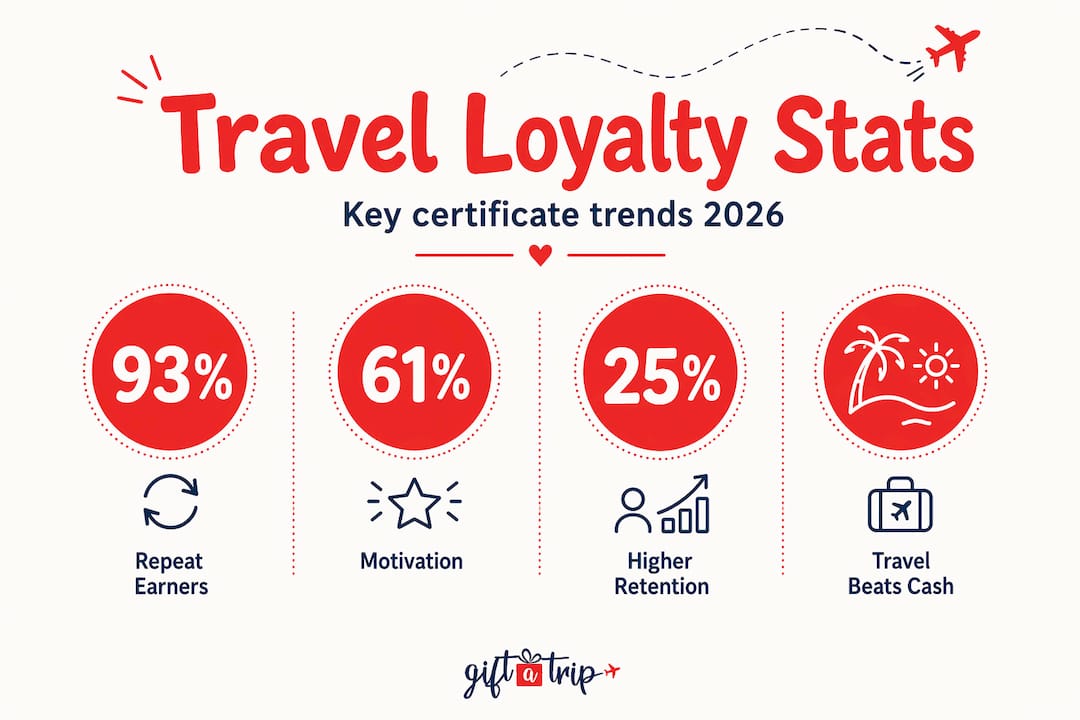
Here is the number that should anchor every conversation about loyalty program design. According to 2026 SITE and Maritz research, individual travel rated “extremely motivating” by 61% of employees surveyed, compared to group travel at 50%. Both figures exceeded cash and gift cards by a significant margin.
61% of employees rate individual incentive travel as “extremely motivating,” outperforming cash bonuses and gift cards as a retention tool. (SITE and Maritz, 2026)
That gap exists because of how the human brain processes different types of rewards. Cash gets absorbed into a paycheck. It pays a bill, covers a car repair, and disappears without any lasting association to the person who gave it. A travel experience does the opposite. It creates a memory with a distinct emotional origin: “My company sent me to a resort in Cancun.” That association sticks.
The same research found that 93% of employees who had earned incentive travel were eager to qualify again. That is not satisfaction. That is a loyalty loop. Recognition generates experience, experience generates motivation, and motivation drives the behavior the program was designed to reward in the first place. For corporate managers, this is not just an HR win. It is a performance strategy with measurable returns.
The implications extend beyond employees. Customer loyalty programs that use travel rewards and loyalty mechanics see similar re-engagement patterns. When a customer earns a trip rather than a discount code, they associate the brand with an experience they want to repeat.

Designing programs that maximize loyalty impact
Good intentions and a travel certificate PDF are not enough. The structure of your program determines whether recipients actually redeem their rewards or let them expire in an inbox. Program design is where most managers leave value on the table.
Tallink’s Club One model is worth studying closely. Recipients must claim their rewards within two months of earning them. But once claimed, they have up to six months to complete the actual travel. That split serves a specific purpose: the short claim window forces immediate engagement with the program, while the longer travel window prevents people from abandoning their reward because life got complicated. The result is higher redemption and stronger brand association.
Here is how key program structures compare across three real-world examples:
| Program | Claim window | Travel window | Transferable | Cash-out option |
|---|---|---|---|---|
| Alaska Airlines BTC | N/A (immediate use) | 1 year from issue | No | No |
| Frontier companion | N/A (one-time use at booking) | 1 year from issue | No | No |
| Tallink Club One | 2 months from earning | Up to 6 months | No | No |
The pattern is consistent. All three programs use non-transferability and no cash-out policies as structural defaults. This is not accidental. Restrictions like one-time use and booking conditions prevent misuse and keep the reward tethered to the brand relationship it was designed to build.
One design element that gets overlooked is the payment difference mechanism. Alaska’s certificates allow recipients to pay any price gap above the certificate value by credit card, with the certificate balance retained until fully used. This flexibility eliminates a common redemption barrier without undermining the travel-only intent of the reward.
Pro Tip: Send recipients a clear, step-by-step redemption guide the same day the certificate is issued. Programs that assume recipients will figure out the rules on their own see significantly higher expiry rates. One concise email with deadlines, booking steps, and a contact for questions can double your redemption rate.
Why travel certificates outperform other loyalty rewards
Cash bonuses have one obvious advantage: everyone wants money. But that universality is exactly what makes cash a poor loyalty tool. It disappears into the background of someone’s financial life without creating any connection to the program that provided it.
Travel certificates avoid this through structure and experience. The benefits over cash and gift cards are worth spelling out directly:
- No cash-out risk. No exchange for cash or check means the reward stays tied to the intended behavior and brand relationship.
- Higher perceived value. A certificate for a cruise or resort stay feels worth more than the equivalent dollar amount in cash, even when the face values are identical.
- Memorable impact. Travel creates experiences people talk about. A cash bonus does not generate a story worth sharing.
- Repeat motivation. The desire to earn another trip is a documented driver of sustained performance, as the SITE and Maritz 93% re-qualification finding demonstrates.
- Brand alignment. When the certificate is tied to a travel experience, the recipient associates the memory with the rewarding organization.
The one real challenge is expiration. When recipients do not plan ahead or miss a claim window, the reward is lost. You can explore how to compare certificates versus bonuses in more detail, but the mitigation is straightforward: clear communication and a redemption process that requires minimal effort. The certificate should feel like a gift, not a test.
Applying travel certificates in corporate and individual strategies
The mechanics of travel certificates work whether you are a corporate manager building a recognition program or an individual looking to reward someone meaningful. The application just looks different.
For corporate managers, here is a practical sequence for integrating travel certificates effectively:
- Define the earning behavior. Sales quota attainment, customer satisfaction scores, tenure milestones. The behavior should be specific and measurable before you select a certificate product.
- Choose certificates that match your audience. A team of remote workers spread across time zones will respond better to individual resort or hotel certificates than group travel packages.
- Set a redemption timeline with two windows. Claim deadline within 30 to 60 days of earning. Travel window of four to six months. This mirrors the Tallink model that demonstrably improves engagement.
- Communicate the full redemption process upfront. Do not wait for questions. Send the certificate with a one-page guide covering what it covers, how to book, and who to contact.
- Track redemption rates and ask for feedback. Redemption rate is your primary ROI signal. High redemption means the reward is valued. Low redemption means the process is broken or the reward does not resonate.
For individual consumers, travel gift certificates work particularly well for milestone gifting: anniversaries, retirements, graduations, or any occasion where you want the gift to create a lasting memory rather than blend into a pile of presents. Choosing a certificate tied to a specific experience, like a resort stay or a cruise, signals that you thought about what the person actually wants.
In both contexts, measuring the lift matters. For corporate programs, track whether certificate earners show higher retention, performance, or re-engagement six months after redemption. That data makes the program defensible at the budget level.
My take on travel certificates as an underutilized loyalty tool
I have watched companies spend enormous amounts on recognition programs that deliver almost nothing in sustained engagement. Nine times out of ten, the failure is not budget. It is format. They hand out cash or generic gift cards and wonder why the same people leave anyway.
What I have seen work, consistently, is the travel certificate. Not because travel is glamorous but because it forces the recipient to have an experience. And that experience becomes a story. Stories create loyalty in a way that a line item on a pay stub never will. The most powerful thing I have seen a loyalty program do is make someone want to earn the reward again. That is exactly what the 2026 SITE and Maritz data confirms, and it tracks with what I have observed firsthand.
The detail most managers miss is program design. The certificate itself is not magic. The structure around it, the claim window, the redemption clarity, the connection to a specific brand experience, is what converts a nice gesture into a loyalty driver. Get the design right and you are not just rewarding past behavior. You are engineering future behavior.
The trend I see accelerating in 2026 is the move toward individual travel certificates over group incentive trips. Schedules are fragmented. Employees want flexibility. A certificate for a resort stay that someone can redeem on their own timeline feels more personal than a group retreat where attendance is mandatory.
— Donovan
Reward smarter with Giftatrip travel certificates
If you are ready to put these strategies into practice, Giftatrip makes it straightforward. The platform offers a wide catalog of digital travel certificates covering resort stays, hotel collections, and cruise lines, including options like Virgin Voyages cruise certificates and luxury Crystal Cruises experiences, all formatted for corporate gifting and individual use. Certificates are delivered digitally with options for personalized messaging, bulk ordering, and custom gift packaging.
For corporate managers, the platform supports structured recognition programs at scale, with certificate products that align with the design principles covered in this article. Taxes and resort fees are included, and blackout dates are minimal. Explore the full range of options at Giftatrip’s corporate rewards guide and find the certificate product that fits your program goals.
FAQ
What are travel certificates in loyalty programs?
Travel certificates are prepaid vouchers redeemable for specific travel experiences like hotel stays, cruises, or flights. Unlike cash bonuses, they keep the reward tied to a brand experience, which is what makes them effective loyalty tools.
Do travel certificates actually boost loyalty more than cash?
Yes. According to 2026 SITE and Maritz research, individual travel is rated “extremely motivating” by 61% of employees, a figure that exceeds both cash and gift cards. Additionally, 93% of travel reward earners expressed desire to qualify again, demonstrating strong repeat engagement.
How should you structure a travel certificate program?
Use two separate windows: a short claim deadline of 30 to 60 days to create urgency, and a longer travel window of four to six months to give recipients practical scheduling flexibility. This structure, modeled by programs like Tallink Club One, maximizes redemption rates.
Why are non-transferable travel certificates better for loyalty?
Non-transferability keeps the reward connected to the recipient and the rewarding organization. It prevents a secondary market from forming and ensures the travel experience, along with the positive memory it creates, is associated with your brand.
Can individual consumers use travel certificates the same way corporations do?
Yes, though the application differs. Individuals typically use travel certificates for milestone gifts like anniversaries or retirements, while corporations use them in structured recognition programs tied to measurable performance. Both benefit from the emotional impact that travel experiences deliver over transactional rewards.