Jump to Section:
TL;DR:
- Travel gifts offer a high perceived value by emphasizing experiences that foster emotional connections and long-term loyalty. Proper planning, legal compliance, and strategic sourcing are essential for successful fundraising events involving travel packages. These experiential rewards surpass traditional recognition methods in creating advocates and sustaining impactful donor relationships.
Choosing a gift that genuinely moves people is hard. Choosing one that moves a fundraising needle is even harder. That is why this travel gift fundraising guide exists: to walk you through every stage of using travel experiences as fundraising tools, from picking the right format and sourcing packages to staying on the right side of IRS disclosure rules. Whether you are a nonprofit planning a gala auction, an HR team building an employee rewards program, or an individual organizing a milestone celebration, travel gifts solve a problem that gift cards and product baskets simply cannot.
Table of Contents
- Understanding travel gifts in fundraising and corporate giving
- Preparing for your travel gift fundraiser: planning and legal considerations
- Executing your travel gift fundraising event: sourcing, marketing, and running auctions or raffles
- Ensuring impact and compliance after your fundraiser
- Why travel gifts are the future of fundraising and corporate rewards
- Explore flexible travel gift certificates for your next fundraising campaign
- Frequently asked questions
Key Takeaways
| Point | Details |
|---|---|
| Travel gifts boost fundraising | Curated travel experiences and packages increase donor engagement and raise more funds than traditional gifts. |
| IRS compliance matters | Nonprofits must disclose fair market value for travel benefits over $75 to ensure proper donor tax deductions. |
| Consignment reduces risk | Using consignment travel packages avoids upfront costs and financial risk for fundraising events. |
| Post-trip engagement retains donors | Structured reflection and personalized keepsakes after travel gifts enhance long-term donor loyalty. |
| Travel gifts build advocacy | Travel programs create passionate supporters who promote your cause beyond immediate donations. |
Understanding travel gifts in fundraising and corporate giving
Travel gifts are not just a fancier version of a gift card. They represent a category of giving built around experience rather than ownership. In practice, they show up as hotel stay certificates, cruise vouchers, curated vacation packages, or resort credits. They work across a wide range of contexts because their emotional weight scales up regardless of the recipient.
Here is what the category actually includes:
- Hotel and resort certificates: Redeemable stays at branded properties, often covering taxes and fees
- Cruise vouchers: Credits toward cabin fares on major cruise lines, typically flexible in departure dates
- Curated vacation packages: Bundled flights, accommodation, and activities tied to a specific destination
- Experience add-ons: Spa credits, adventure tours, or dining packages layered onto a base travel certificate
- Digital travel gift cards: E-delivered certificates for instant distribution, ideal for corporate bulk programs
What makes these gifts uniquely powerful in fundraising is their perceived value. Travel gifts like certificates and packages are favored for employee rewards and fundraising incentives due to their high perceived value and emotional impact. A beach resort certificate does not feel like a $300 item. It feels like a vacation. That gap between actual cost and perceived value is exactly what auction fundraisers and raffle organizers want to exploit.
For corporate clients, travel gifts serve a different but equally important purpose: recognition. A weekend getaway for a top-performing sales rep communicates something that a cash bonus cannot. It says the organization sees you as a whole person, not a revenue line item.
Preparing for your travel gift fundraiser: planning and legal considerations
With the basics of travel gifts understood, let us explore how to properly prepare for your fundraising event, focusing on legal and planning essentials.
The single biggest mistake organizations make when planning a travel gift fundraiser is treating compliance as an afterthought. IRS rules around donated goods with tangible benefits are specific and carry real penalties. If your event involves travel gifts valued at or above $75, the rules kick in immediately.
Know your disclosure obligations
When a donor pays for a travel auction item or benefit, they are making what the IRS calls a “quid pro quo contribution.” That means part of their payment is a donation and part is payment for something received. Nonprofits must provide written disclosure of the fair market value for travel auction benefits over $75 to comply with IRS quid pro quo regulations. Fail to disclose, and your organization faces a $10 penalty per contribution, uncapped.
Understand raffle tax rules before you sell tickets
Raffles are a popular fundraising format, but many organizers assume participants can deduct their ticket purchases. They cannot. Raffle tickets for travel prizes are not tax-deductible since they are payment for a chance to win. This needs to be communicated clearly in your marketing materials to avoid donor confusion and potential disputes.
Choose the right format for your travel gift’s value
| Travel Gift Value | Best Fundraising Format | Why It Works |
|---|---|---|
| Under $50 | Raffle | Low cost per entry, high volume of participants |
| $75 to $500 | Silent auction | Competitive bidding drives price above face value |
| $500 and above | Live auction or premium package | Spectacle and urgency maximize bids |
Budgeting with a consignment mindset
If you are sourcing travel packages yourself and paying upfront, you carry all the financial risk. A smarter approach is to use a vacation raffle fundraiser guide framework combined with consignment-style procurement, where you only pay for the package if it sells above the minimum bid. This removes the inventory risk entirely.

Pro Tip: When setting your minimum bid on a travel certificate, anchor it at roughly 60% of the package’s retail value. This creates an immediate perceived deal for bidders while still covering your costs and generating margin for the cause.
Executing your travel gift fundraising event: sourcing, marketing, and running auctions or raffles
Now that you have planned, here is how to execute your travel gift fundraising event effectively for optimal results.
Step 1: Source your travel packages with zero upfront risk
Consignment travel packages allow nonprofits to offer high-value items with zero upfront cost, paying only when the item sells above a minimum bid. This model is not just smart budgeting. It also lets smaller organizations offer aspirational prizes like a seven-night Caribbean cruise that they could never afford to purchase outright.
Step 2: Build revenue layers with gift basket pairings
One of the most underused travel fundraising strategies is combining travel certificates with thematic gift baskets in a tricky tray or basket raffle format. Events pairing tricky tray items with silent auctions generate 30% to 40% more revenue than standalone events, especially with well-priced travel gift baskets. A “Paris escape” basket with a European hotel certificate, a French cookbook, a bottle of wine, and a luggage tag set generates excitement that a single certificate never could.
Step 3: Build your marketing around emotion, not specs
Nobody bids on “three-night hotel certificate, standard room, blackout dates apply.” They bid on “Your family on the beach at sunset.” Your marketing copy, social posts, and emcee script should all paint the experience, not describe the product.
Here is a quick comparison of promotion formats and their strengths:
| Marketing Channel | Best Use Case | Travel Gift Advantage |
|---|---|---|
| Email to existing donors | Pre-event awareness and early bidding | High-intent audience, familiar with your cause |
| Social media video | Visual storytelling of destination | Shareable, reaches new audiences organically |
| Event slideshow | Live auction hype-building | Immersive visuals drive competitive bidding |
| Corporate partner outreach | Sponsorship and bulk gift sourcing | Positions travel gifts as mutual value exchange |
Step 4: Train your event staff on travel gift details
Bidders ask questions. Know the redemption window, blackout date policies, included amenities, and any transfer restrictions before your event goes live. Staff uncertainty kills momentum in the middle of an auction.
Pro Tip: If you are running a how to gift employee travel program alongside your fundraising event, use the same travel certificates for both. Bulk ordering from one provider typically unlocks better pricing and consistent redemption terms.
Ensuring impact and compliance after your fundraiser
After your event, focus on impact measurement and compliance to build lasting relationships and avoid pitfalls.
Most organizations declare victory when the gavel falls and revenue is counted. The ones that build lasting fundraising programs do something different: they treat the post-event period as the beginning of donor cultivation, not the end.
Your post-event compliance checklist:
- Send written disclosure letters to all auction participants who made quid pro quo contributions over $75
- Document the fair market value of every travel item and retain records for three years
- Send thank-you communications separately from disclosure letters so appreciation does not feel administrative
- Collect signed acknowledgment forms if your state requires them for raffle or auction compliance
Nonprofits risk IRS penalties if they fail to provide proper disclosures for quid pro quo donations related to travel gifts over $75. This is not a technicality. It is a fiduciary obligation to your board, donors, and mission.
Turn travel winners into long-term advocates
The travel gift winner who takes that Caribbean cruise is sitting on something invaluable to your organization: a story. Post-trip facilitated reflection sessions and personalized memory packages increase donor retention and advocacy after travel gift fundraising experiences. Ask them to share photos. Feature them in your newsletter. Invite them to speak at your next event.
This is not just feel-good engagement. It creates social proof that your organization delivers on its promises, which directly influences future bidders and donors.
Measure what actually matters
Beyond revenue per event, track these indicators: new donor acquisition rate from travel auctions, repeat participation rates from prior travel gift winners, and downstream donations from winners who became advocates. These numbers reveal the true ROI of your travel fundraising strategies.
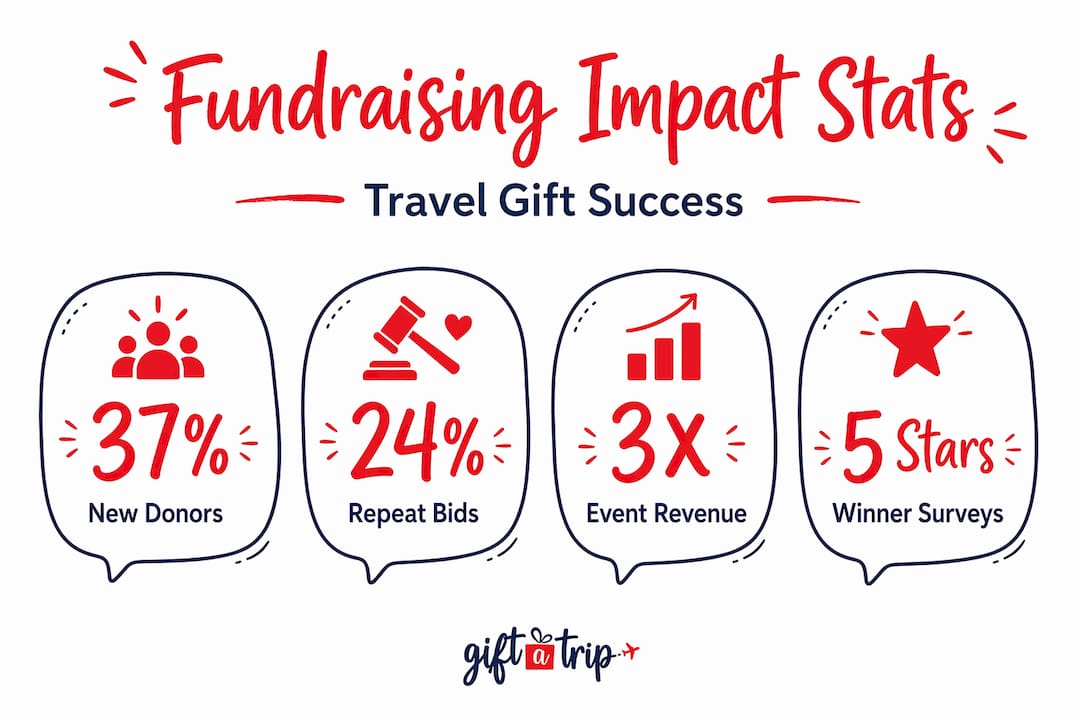
Pro Tip: Create a simple post-event survey for travel gift winners that asks one key question: “Would you recommend bidding at our events to a friend?” A score of 8 or above is a reliable indicator of future donor loyalty, and the open-ended responses will sharpen your next event.
Why travel gifts are the future of fundraising and corporate rewards
Here is an opinion most fundraising consultants will not say out loud: most donor recognition programs are boring. A plaque on a wall. A mention in an annual report. A branded tote bag. These gestures do not create advocates. They create polite thank-yous.
Travel gifts operate differently. They do not just acknowledge a donor’s generosity. They become part of that donor’s life story. The couple who bid on a Tuscany getaway at your gala does not remember the auction. They remember the trip. And when they come back, they come back changed, with photographs, memories, and an emotional connection to your cause that no branded merchandise can manufacture.
Travel programs deliver outsized fundraising ROI by developing a network of passionate ambassadors and sustained donor engagement over years. That is not marketing language. It is a behavioral reality rooted in how human memory works. Experiences outperform objects in long-term recall and emotional association because they are encoded differently in the brain.
For corporate clients running rewards programs, the same logic applies. Cash bonuses are forgotten by the next pay cycle. A trip to Costa Rica is something an employee talks about for years, and talks about in the context of the company that gave it to them. That word-of-mouth is employer branding that no recruiting budget can buy.
The organizations that have figured this out are not treating travel gifts as a line item on an events budget. They are treating them as relationship infrastructure. Every travel gift issued is a calculated investment in a donor or employee who will give more, advocate louder, and stay longer than someone who received a fruit basket.
If your fundraising or rewards program has not made this shift yet, you are not just missing revenue. You are missing the entire architecture of long-term loyalty.
Explore flexible travel gift certificates for your next fundraising campaign
Putting these strategies into practice requires a reliable source for travel certificates that actually deliver on their promises. Unclear redemption terms, hidden fees, and narrow availability windows can turn a marquee auction item into a donor complaint.
Gift A Trip offers travel certificates explained with taxes and resort fees covered, minimal blackout dates, and secure digital delivery for both individual and bulk orders. Whether you need a single honeymoon package or a hundred employee reward certificates, the platform handles customization, personalized messaging, and distribution so your team does not have to. Learn how to send digital travel gifts instantly, or explore the full vacation raffle success guide to run your next event with confidence.
Frequently asked questions
Are travel raffle tickets tax deductible?
No, raffle ticket purchases for travel prizes are not tax-deductible because they are considered payment for a chance to win, not a charitable donation.
What IRS disclosures are required for travel auction donations?
Nonprofits must provide written disclosure of the fair market value of travel benefits for contributions over $75 so donors can deduct only the amount their payment exceeds that value. Quid pro quo donations over $75 require a good-faith fair market value statement in writing.
How can nonprofits reduce risk when offering travel packages for fundraising?
Use consignment travel packages, which carry no upfront cost. Consignment models let nonprofits pay the provider only when an item sells above the minimum bid, eliminating financial exposure entirely.
What makes travel gifts effective for donor loyalty?
Travel experiences create lasting emotional connections tied directly to your cause. Immersive travel experiences foster emotional bonds that increase donor retention far beyond what standard fundraising incentives or material gifts can achieve.