Jump to Section:
TL;DR:
- Personalized, well-timed gifting significantly boosts sales engagement and pipeline velocity.
- Gifting programs are more effective than cash incentives for employee motivation and retention.
- Structured, culturally aware, and measurable gifting strategies deliver higher ROI and lasting relationships.
Most sales leaders assume the fastest path to higher performance runs through commission structures and cash bonuses. That assumption is costing them results. Strategic gifting to prospects alone can boost meeting acceptance rates up to 70%, a number that reframes the entire conversation around sales incentives. For HR professionals and sales managers who want to build programs that actually move the needle, the evidence points clearly toward personalized, well-timed gifting as a force multiplier. This article breaks down the psychology, the data, and the frameworks you need to put it all to work.
Table of Contents
- Understanding the psychology behind gifting in sales
- Strategic gifting for prospects: Evidence and applications
- Employee motivation: Gifting versus cash incentives
- Frameworks and best practices for sales gifting programs
- What most sales leaders miss about gifting
- Modern gifting solutions for sales performance
- Frequently asked questions
Key Takeaways
| Point | Details |
|---|---|
| Personalized gifting drives results | Thoughtful, customized gifts produce higher meeting rates and motivation than generic or cash alternatives. |
| Strategic timing maximizes impact | Deploy gifts around trigger events for prospects and milestones for employees to achieve the best performance boosts. |
| Frameworks enhance ROI measurably | Segmenting, budgeting, and tracking gifting strategies deliver measurable improvements in sales performance and team morale. |
| Compliance and cultural fit matter | Successful gifting programs account for regional differences and stay within legal and company guidelines. |
| Modern solutions simplify gifting | Travel certificates and digital gifting platforms make implementation efficient and flexible for managers. |
Understanding the psychology behind gifting in sales
Before you spend a dollar on gifts, you need to understand why they work. Gifting is not just a nice gesture. It activates deeply wired psychological responses that directly influence purchasing behavior, loyalty, and engagement.
The most important force at play is reciprocity. When someone receives a gift, they feel an almost automatic pull to give something back. In a sales context, that “something back” often looks like a scheduled meeting, a returned call, or a signed contract. But the gift has to feel personal. Generic swag with your logo slapped on it does not trigger reciprocity. It triggers the recycling bin.
Research backs this up sharply. Unconditional gifts drive immediate customer spending increases of up to 31.66% by triggering gratitude and a sense of obligation. That is not a marginal effect. That is the kind of behavioral shift that changes quarterly results.
Here is what actually separates effective gifting from wasted budget:
- Personalization matters more than price. A thoughtful, low-cost gift outperforms a generic high-value one almost every time.
- Timing is everything. A gift sent at a key milestone feels meaningful. The same gift sent at a random moment feels like noise.
- Effort signals sincerity. Handwritten notes, curated selections, and thoughtful packaging all amplify perceived value.
- Cultural fit is non-negotiable. A gift appropriate in one region may be offensive or irrelevant in another.
“The best gifts aren’t expensive. They’re accurate.” When your gift reflects that you actually know the recipient, it creates a connection that no cash bonus can replicate.
One number worth burning into your memory: 73% of generic branded merchandise is discarded by recipients. If you are handing out logo pens and tote bags, you are paying for trash. For impactful recognition tips that move people, the shift from generic to personal is where everything starts.
The psychology of gifting is not complicated, but it is precise. Gratitude, obligation, and reciprocity work together when the gift is right. They collapse entirely when it is wrong.
Strategic gifting for prospects: Evidence and applications
Now that we understand why gifting works, let’s look at the concrete numbers and how you can apply them at each stage of your sales process.
The data on prospect gifting is striking. Meeting rates increase significantly across every sales role when strategic gifting is deployed: SDRs see a 22% lift, Account Executives see 45%, and Enterprise reps see a full 70% increase. The ROI range across these tiers runs from 2.1x to 5.2x. These are not theoretical projections. They are outcomes from teams that built deliberate gifting systems.
Here is a quick comparison of gifting impact by sales role:
| Sales role | Meeting rate increase | ROI range |
|---|---|---|
| SDR | 22% | 2.1x |
| Account Executive | 45% | 3.4x |
| Enterprise Rep | 70% | 5.2x |
The gap between SDR and Enterprise results is not accidental. Enterprise gifting works better because the stakes are higher, the decision cycle is longer, and a well-placed gift at the right moment genuinely accelerates movement. Personalization and timing explain almost all of the performance difference.

For practical application, 67% of gifting budgets are currently wasted on non-strategic, generic gifting. That means most teams are already spending on gifts. They are just doing it badly.
To fix that, follow this implementation sequence:
- Segment your prospect list by deal size, industry, and sales stage.
- Identify trigger events such as a funding round, a new leadership hire, or a product launch that signals readiness.
- Match the gift to the recipient profile. A travel certificate for an executive who values experiences. A curated book for someone who engages with thought leadership.
- Integrate with your CRM. Track gift send dates, follow-up timing, and meeting outcomes to measure what works.
- Measure cost-per-meeting and deal velocity to calculate actual ROI for each segment.
For teams focused on driving revenue with incentives, building this kind of system is the difference between random acts of gifting and a repeatable pipeline accelerator. If you want more strategies for engagement that scale, tiered gifting programs built around sales milestones are the most reliable starting point.
Employee motivation: Gifting versus cash incentives
Alongside prospect engagement, the role of gifting in employee motivation reveals striking differences from cash rewards. The common assumption is that employees always prefer cash. The research says otherwise.
Non-monetary gifts produce 25% higher worker productivity compared to equivalent cash bonuses. The reason is partly psychological and partly practical. Cash gets absorbed into everyday expenses and loses its emotional resonance within days. A travel experience or a meaningful gift card creates a memory that reinforces positive associations with the workplace long after the reward is given.
Here is how different incentive types stack up for sustained motivation:
| Incentive type | Emotional impact | Productivity lift | Memory duration |
|---|---|---|---|
| Cash bonus | Low to moderate | Baseline | Short (days) |
| Gift card | Moderate | +15% | Medium (weeks) |
| Travel experience | High | +25% | Long (months or years) |
| Personalized gift | High | +20% | Long (months) |
Top-performing companies have already figured this out. 94% of high-performance programs use gift cards, and non-cash incentive payouts for sales roles are consistently higher than those in other departments. These organizations are not abandoning cash entirely. They are layering non-monetary rewards on top to create a richer, more motivating experience.
For budgeting purposes, investing 3 to 7% of payroll in incentive programs is the range where results become measurable without straining operating budgets. Below that threshold, the program feels token. Above it, you are in premium territory that only makes sense for your highest-impact roles.
Pro Tip: Pair your hotel gift certificates or individual travel incentives with a handwritten recognition note from a direct manager. The combination of personal acknowledgment and an experiential reward creates a motivational effect that neither element achieves alone.
Key principles for effective employee gifting:
- Presentation effort signals respect. How you give a gift matters almost as much as the gift itself.
- Frequency matters. Quarterly recognition outperforms annual awards in sustaining motivation.
- Tie gifts to specific achievements. Vague rewards feel like participation trophies. Specific rewards feel like earned recognition.
Frameworks and best practices for sales gifting programs
To maximize both prospect and employee impact, you need proven frameworks and clear operational guidelines. A gifting program without structure is just random spending.
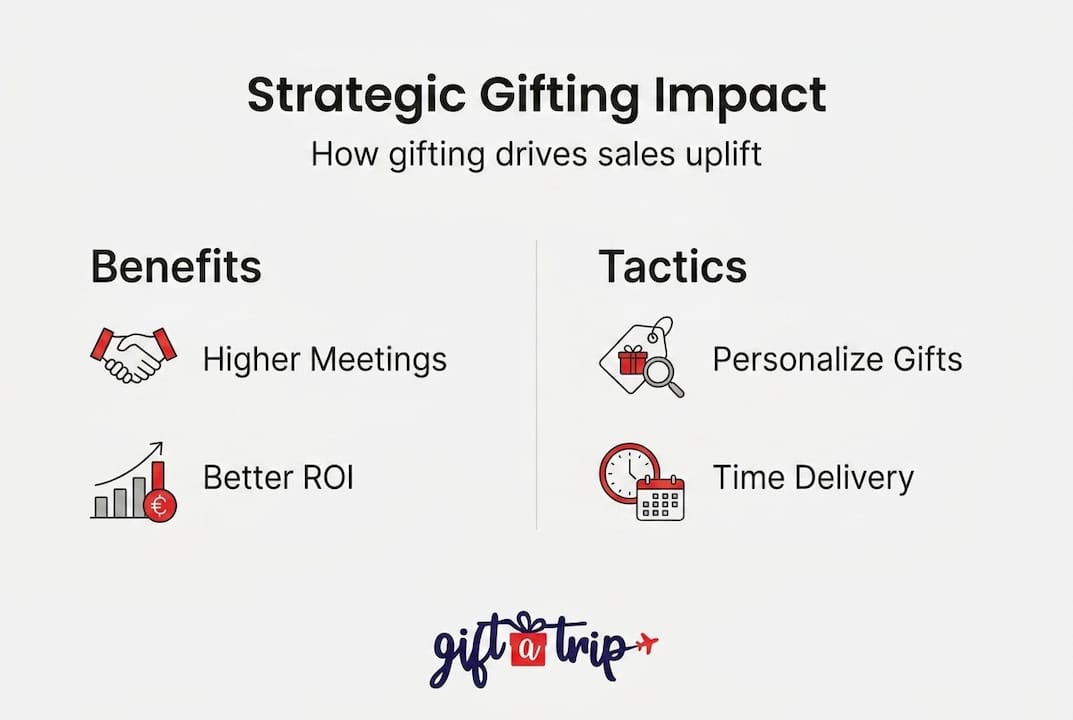
Start with segmentation. Not every prospect or employee deserves the same gift. Your highest-value opportunities and top performers should receive tiered rewards that reflect their importance. Budgeting 3 to 7% of payroll for incentives is a reliable benchmark, and CRM integration is the tool that turns gifting from a guessing game into a measurable system.
Key metrics to track from day one:
- Cost-per-meeting for prospect gifting programs
- Deal velocity to measure whether gifts actually accelerate pipeline movement
- Employee retention rates in cohorts that receive regular recognition versus those that do not
- Engagement scores before and after program implementation
Pro Tip: Run a 90-day pilot with one sales team before rolling out a company-wide gifting program. Measure cost-per-meeting and deal velocity against a control group. The data will tell you exactly where to invest and where to pull back.
For cultural and compliance considerations, regional adaptation is essential. What resonates in one market can fall flat or cause offense in another. Beyond cultural fit, compliance is non-negotiable. FCPA regulations and internal gift policies set hard limits, particularly in regulated industries or international markets. Build your gifting policy with legal review from the start.
For teams building toward corporate travel rewards programs, the framework is the same: segment, personalize, time it well, and measure everything. If you are planning ahead for corporate recognition with travel as a core strategy in 2026, integrating these metrics from the beginning will save you from guessing later.
What most sales leaders miss about gifting
Here is the uncomfortable truth: most gifting programs plateau not because the budget is wrong, but because the thinking is wrong. Sales leaders who assume cash is king are not bad managers. They are just working from an outdated model.
The evidence is clear that prospect gifting accelerates pipeline and employee incentives via gifts enhance productivity at measurable rates. But knowing the data is not enough. The programs that underperform share three common traits: they send generic rewards, they time them poorly, and they skip compliance until it becomes a problem.
The leaders who get real results treat gifting as a precision tool, not a broadcast. They align gifts with real-time milestones, they personalize based on actual knowledge of the recipient, and they build in compliance review before launch, not after. For premium business recognition that creates lasting impressions, the effort you put into choosing the right gift is the effort your recipient will remember.
Generic swag does not build relationships. Thoughtful, timely, personalized recognition does.
Modern gifting solutions for sales performance
With these insights, you can confidently move from theory to action. The research points clearly toward personalized, experience-based gifts as the highest-ROI choice for both prospect engagement and employee motivation.
Gift A Trip makes it straightforward for corporate sales teams and HR professionals to put these strategies into practice. From top corporate travel gift ideas that inspire and retain top performers, to a simple process for sending digital travel gifts that recipients genuinely love, the platform covers every step. If you are ready to build a program that delivers measurable results, explore our full range of corporate reward solutions designed for teams that take performance seriously.
Frequently asked questions
What types of gifts are most effective for sales performance?
Thoughtful, non-monetary gifts such as travel certificates, gift cards, and personalized items outperform cash incentives for both employee motivation and prospect engagement. Non-monetary gifts produce 25% higher worker productivity than equivalent cash bonuses.
How can companies track the ROI of their gifting programs?
Track cost-per-meeting, deal velocity, and employee retention using CRM integration tied to gifting activity. Segmenting by sales stage and role gives you the attribution clarity you need to optimize spend over time.
Are low-value gifts effective in boosting sales results?
Yes, timing and thoughtfulness matter far more than price. Low-value gifts can nearly match high-value gifts in effectiveness when they arrive at the right moment and feel personally chosen.
What compliance issues must companies consider with gifting?
Companies must comply with FCPA regulations and internal gift policies, particularly in regulated industries or cross-border sales. Cultural and regional adaptation is equally essential to avoid misalignment or offense.
When should gifts be given for maximum sales impact?
Gifts work best when they coincide with trigger events such as a funding round, a new hire, or a deal milestone. Timing gifts to milestones maximizes meeting rates and compresses the sales cycle meaningfully.